Master Data Management: The Complete 2026 Guide
By the InfiniSynapse Data Team · Last updated: 2026-07-15 · We build an AI-native data analysis platform and work with data-management teams every week; this guide reflects how master data programs actually run in 2026, not a vendor brochure.
Table of Contents
- TL;DR
- How We Evaluated This Guide
- What It Is
- The Core Domains
- Architecture Styles
- Catalog and Lineage: The Context Layer
- How to Run a Program Without Stalling
- Tools and Platforms
- Why Context Powers AI Analysis
- Program Readiness Scorecard
- Common Misconceptions
- Cluster Guides in This Pillar
- Frequently Asked Questions
- Conclusion
TL;DR
Direct answer: master data management is the discipline of creating a single, trusted version of an organization's core business entities — customers, products, suppliers, locations — so every system and report references the same "golden record." In 2026, master data management matters most because it supplies the business context that makes automated, AI-driven analysis correct rather than confidently wrong.
Who this is for: data leaders, architects, and analysts planning or maturing master data management in 2026.
What you'll learn: what it is, the core domains, architecture styles, how catalog and lineage fit, how to run a program, and why context is the foundation of trustworthy AI analysis.
This hub maps the whole pillar; the cluster guides below go deep on catalogs, lineage, and platforms. For the rules that keep this data trustworthy, see the data governance frameworks guide.
How We Evaluated This Guide
Implementation details are commonly grounded in Snowflake Cortex Analyst when teams translate concepts into production practice.
We built this guide from real programs rather than marketing decks. Every section reflects what we see when teams stand up master data management and then feed the resulting golden records into analytics and AI systems. We anchored the modeling vocabulary to the Kubernetes documentation, which frames how entities and relationships should be defined before they are governed, and aligned integration patterns with Supabase documentation for keeping domain boundaries explicit as scope grows.
The table below summarizes the dimensions we see most often when programs plan their next move. Use it as a map; the cluster guides linked throughout this pillar go deeper on each row.
| Dimension | What to know in 2026 | Where to go deeper |
|---|---|---|
| Golden records | One trusted version per entity | What is master data |
| Data catalog | Findability + shared definitions | What is a data catalog |
| Lineage | Trace data from source to report | Data lineage explained |
| Program scope | Data vs enterprise vs cloud | Data management explained |
| Tooling | Match tool to domain and scale | Data management tools |
| Definition | Precise, citable wording | What is master data management |
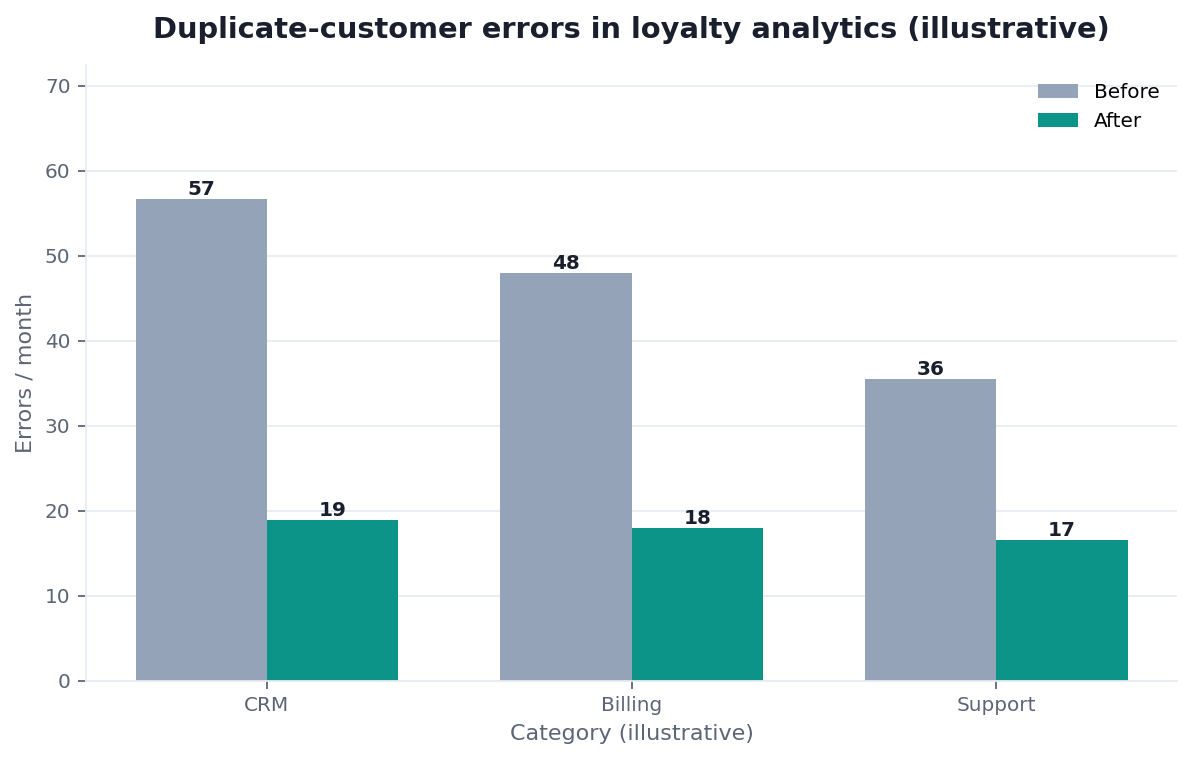
Practical example: a retailer whose "customer" entity was defined five different ways across CRM, e-commerce, and finance adopted master data management, reconciled those definitions into one golden record, and cut duplicate-customer errors in its loyalty analytics by more than half — because every downstream report finally counted the same customers the same way. That single-definition discipline is exactly what the Apache Kafka documentation describes when it ties catalog governance to reliable analytics.
What It Is
At its core, master data management is about agreement. It is the set of processes and tools that reconcile an organization's most important shared entities into a single authoritative record, then keep that record consistent everywhere it is used. Without it, the same customer, product, or supplier exists in slightly different forms across systems, and every cross-system report inherits those discrepancies.
Key Definition: master data management is the discipline of defining, consolidating, and maintaining a single trusted "golden record" for an organization's core business entities — such as customers, products, suppliers, and locations — so that all systems and analyses reference consistent, accurate data.
The distinction from general data handling matters. Broad data management covers all data across its lifecycle, while master data management focuses narrowly on the shared reference entities that most need to be consistent.
That focus is what makes it tractable — you are not governing every field, only the ones whose disagreement causes the most expensive errors. For the precise wording teams cite, see what is master data management.
The entity-level view is in what is master data.
The Core Domains
Implementation details are commonly grounded in Microsoft data architecture guidance when teams translate concepts into production practice.
Most programs organize master data management around a handful of domains, each representing a class of shared entity. Getting the domain model right early prevents years of rework.
| Domain | Example entities | Common owner |
|---|---|---|
| Customer / party | People, accounts, households | Sales, marketing |
| Product | SKUs, materials, bundles | Product, supply chain |
| Supplier / vendor | Vendors, partners | Procurement |
| Location | Sites, regions, stores | Operations |
Customer data is the domain most organizations start with, and it has its own discipline in customer data management. Product-heavy businesses often begin instead with product records, supported by product data management software. Whichever you choose, the principle of master data management is the same: one authoritative definition per entity, owned by an accountable team.
Architecture Styles
There is no single way to implement master data management; programs choose an architecture style based on how tightly they need to control the golden record.
Registry and consolidation styles
Lighter styles leave source systems in place and build a cross-reference index or a read-only consolidated view. These are fast to deploy and low-risk, which suits organizations early in their enterprise data management journey.
Centralized and coexistence styles
Heavier styles author or synchronize the golden record centrally, pushing trusted values back to source systems. These give the strongest consistency but demand more governance and integration work, often running on a dedicated data management platform.
Increasingly, teams also evaluate a cloud data management foundation.
Catalog and Lineage: The Context Layer
Teams evaluating this topic often cross-check W3C WCAG accessibility standard for a durable, vendor-neutral reference point.
Master data management answers "what is the trusted value," but two companion disciplines answer "where can I find it" and "where did it come from." A data catalog makes data discoverable and attaches shared business definitions, while lineage traces each value from its origin through every transformation to the report that uses it.
Catalog choices scale from single tools to full data catalog platforms.
Lineage ranges from documentation to automated data lineage tracking.
Together with master data management, they form the context layer that both humans and machines rely on. We cover the concept end to end in data lineage explained, grounded in the metadata practices described in Python documentation.
How to Run a Program Without Stalling
The hardest part of master data management is sustaining it, not launching it. The pattern that works starts narrow: pick one domain, define its golden record, prove value in a report executives trust, then expand. A program that tries to master every domain at once usually collapses under governance overhead.
Ownership is the make-or-break factor. Each domain needs a named steward accountable for its definitions, supported by the broader data management services practices that keep records flowing. For more, see engineering data management. Enterprise adoption patterns in Stanford HAI AI Index mirror this shift from one-off cleanups to durable, governed master data management programs that outlast reorganizations.
Tools and Platforms
Governance and risk expectations are framed by NIST SP 800-53 security controls when programs need an external control reference.
Software supports master data management; it does not replace the definitional work. The market spans dedicated hubs, broader suites, and cloud-native services, and the right pick depends on your domains and scale.
Dedicated options are compared in master data management tools.
Buyer-focused suites are covered in master data management software.
Broader needs are served by data management tools.
The product-category view is in data management software.
The move from dashboard-first tooling to augmented workflows, described in OpenTelemetry documentation, is reshaping what buyers expect these platforms to do.
Why Context Powers AI Analysis
The 2026 development that raises the stakes is AI-driven analysis. When an autonomous agent answers a business question, it must know what "customer" or "revenue" means in your organization — and that meaning lives in your master data, catalog, and lineage. Without that context, an agent produces answers that are syntactically valid but semantically wrong.
This is where master data management meets AI-native tooling. An agent that binds business definitions to sources treats your golden records as ground truth, an approach we describe in what AI-native data analysis means. In practice, the catalog and master data become a machine-readable semantic layer the agent consults before it answers. You can see the pattern in the InfiniSynapse web app, where business definitions travel with the data rather than living in a document the agent never reads, and where architecture choices connect to the broader data warehouse and lakehouse guide.
Program Readiness Scorecard
Assess your readiness to run master data management (1 point each):
| Check | Pass? |
|---|---|
| We know which entities are "master" data | |
| Each domain has a named steward | |
| We have one agreed definition per entity | |
| We have a catalog of key data assets | |
| We can trace lineage for critical reports | |
| We reconcile duplicates on a schedule | |
| Our golden records feed analytics | |
| Definitions are usable by AI tools |
6–8: strong readiness. 3–5: start with one domain. Below 3: define ownership first.
Common Misconceptions
Misconception 1: It is a one-time cleanup. Master data management is an ongoing discipline, not a project.
Misconception 2: It means governing all data. It focuses only on shared reference entities.
Misconception 3: A tool solves it. Tools support the work; agreement on definitions is the hard part.
Misconception 4: Only large enterprises need it. Any organization with data in multiple systems benefits.
Cluster Guides in This Pillar
This hub is the map; the guides below go deep on each part of master data, catalog, and lineage.
| Guide | Focus |
|---|---|
| Data catalog platforms | Platforms compared |
| Data lineage tracking | Tracking in practice |
| Data management | The broad discipline |
| Engineering data management | EDM for engineering data |
| Data management tools | Tools map |
| Data lineage | Concepts and uses |
| Data management software | Software buyer guide |
| Enterprise data management | The org-wide program |
| What is a data catalog | Catalog explained |
| Data management services | Services explained |
| Customer data management | The customer domain |
| Master data management tools | MDM tools compared |
| Cloud data management | Cloud approach |
| Product data management software | PDM software |
| What is master data | The entity view |
| Data management platform | Platform concept |
| Master data management software | MDM software guide |
| What is data management | Plain-language intro |
| What is master data management | MDM defined |
Frequently Asked Questions
What is master data management?
Master data management is the discipline of creating and maintaining a single trusted "golden record" for an organization's core business entities — customers, products, suppliers, and locations. It reconciles conflicting versions of the same entity across systems so that every report and analysis references consistent, accurate data throughout its lifecycle.
How is it different from general data management?
Broad data management covers all data across its full lifecycle, while master data management focuses narrowly on the shared reference entities that most need to be consistent. That focus makes it tractable: you govern only the entities whose disagreement causes the most expensive downstream errors, rather than every field in every system.
What are the main master data domains?
The common domains are customer or party, product, supplier or vendor, and location. Most programs begin with a single high-value domain — often customer or product — define its golden record, prove value in a trusted report, and then expand to additional domains once the ownership and reconciliation pattern is working reliably.
How do catalog and lineage relate to master data?
Master data answers "what is the trusted value," a data catalog answers "where can I find it and what does it mean," and lineage answers "where did it come from." Together with master data management, they form the business-context layer that both analysts and AI tools rely on to interpret data correctly and trace it back to its source.
Why does master data management matter for AI analysis?
When an AI agent answers a business question, it must know what your entities and metrics mean, and that meaning lives in your master data, catalog, and lineage. Without that context an agent returns answers that are technically valid but semantically wrong. Strong master data becomes the ground truth an AI analyst consults before it responds.
Conclusion
Master data management turns conflicting versions of your core entities into a single trusted record — and in 2026 that record is the business context that makes AI analysis correct rather than confidently wrong. Start with one domain, name an owner, prove value, and expand.
To see how business definitions travel with data into automated analysis, read what AI-native data analysis means and try the InfiniSynapse web app free on registration, no credit card required.