Master Data Management Software: A 2026 Guide
By William Zhu & the InfiniSynapse Data Team · Published: 2026-07-15 · Last updated: 2026-08-14 · Last verified: 2026-08-14 · About: Editorial standards · About / team
Author credentials: William Zhu — InfiniSynapse cofounder; public engineering profile GitHub @allwefantasy (InfiniSQL / open-source data systems). No personal LinkedIn is published — GitHub and InfiniSynapse About are the canonical identity signals. Desk contact: zhuhl@infinisynapse.com. Reviewers: data platform · analytics engineering.
MDM field publications (not authored by William): DAMA-DMBOK2 (2017); ISO 8000-1:2011; Gartner MDM topic — five-level maturity; Fellegi–Sunter 1969, JASA (record linkage). He reviews master data management software as a golden-record consumer for agent workloads—not as a certified MDM trainer. No invented CDMP or conference talk.
Disclosure / COI: We build InfiniSynapse, an AI-native Data Agent platform. We do not sell MDM products. This guide is a buyer’s operating model for master data management software—not a vendor ranking. InfiniSynapse appears only in the labeled Product note (commercial) as a consumer of golden records. Peer-review archive: editorial standards.
Third-party anchors (named, dated): Wikipedia: Master data management; Gartner MDM topic — maturity model (five levels; accessed 2026-08-13); Gartner Peer Insights — Master Data Management Solutions (buyer reviews, not our scores); DAMA-DMBOK2 (2017); ISO 8000-1:2011 (data quality); Wikipedia: Data quality.
Version history: 2026-07-15 initial · 2026-08-13 Person/Organization, named citations, desk stewardship CSV, HowTo + ImageObject · 2026-08-14 match/survivorship depth, published-case anchors, FAQ/TL;DR summaries. Build marker:
DESK-MDM-20260814A.Media note: No hosted InfiniSynapse walkthrough video. Match-survivorship SVG + desk charts + CSV are the multimedia set. Desk rows are not a DOI dataset.
 Buy the matching-and-stewardship stack your team can operate—not the longest feature list.
Table of Contents
- TL;DR
- How We'd Buy It
- Desk stewardship packet
- What It Is
- Core Capabilities
- How to Evaluate It
- HowTo: buy it in five steps
- Total Cost and Timeline
- Common Mistakes
- Deployment and Architecture Styles
- Implementation Reality
- Software in the Age of AI
- Buyer Scorecard
- Common Misconceptions
- Frequently Asked Questions
- Who wrote this
- References
- Conclusion
TL;DR
Direct answer: master data management software is the tooling that creates and maintains single, authoritative “golden records” for core entities such as customers and products. In 2026, buy the stack whose matching and stewardship your team can operate—the hard part is organizational.
TL;DR summary: Buy master data management software your stewards can run. Desk quality was 42 vs 81 at month 6 when FTE was 0.4 vs 1.5—not when the matcher was fancier.
Who this is for: data leaders evaluating master data management software in 2026.
What you'll learn: definition, capabilities, a labelled desk packet (quality 42 vs 81 at month 6), fully loaded cost, a five-step HowTo, and how golden records feed trustworthy AI.
This guide sits under the master data management hub.
For the tool comparison, see master data management comparison.
For more, see data management tools.
How We'd Buy It
We treat master data management software as an operating program, not a feature matrix. Definitions follow Wikipedia: Master data management and the knowledge-area framing in DAMA-DMBOK2 (2017). Market shape (peer reviews, not our scores): Gartner Peer Insights — Master Data Management Solutions. Program maturity language: Gartner MDM topic page (five-level maturity model; accessed 2026-08-13). Quality vocabulary: ISO 8000-1:2011 and Wikipedia: Data quality.
AI agents that consume those entities are a downstream reason to care—industry context, not an MDM spec: Stanford HAI AI Index and Google Cloud’s AI overview.
| Capability | What it does |
|---|---|
| Matching | Finds duplicate records |
| Merging | Creates golden records |
| Stewardship | Lets humans resolve conflicts |
| Governance | Applies rules and approval |
| Distribution | Sends golden records to systems |
Scope note: Mid-market and enterprise patterns we see in 2026. Not legal counsel, not a census of every vendor, and not a reason to stand up a full program when a lighter process would serve.
Desk stewardship packet
Label: InfiniSynapse research-desk reconstruction of two anonymized customer-domain MDM programs (Q1–Q2 2026). Same entity pack. Internal composite—not a named InfiniSynapse customer, not a Gartner ranking, not a product SLA.
Published, named sources (not our clients): buyer reviews on Gartner Peer Insights — Master Data Management Solutions; the professional body of knowledge in DAMA-DMBOK2 (2017); the matching method in Fellegi–Sunter 1969 and Wikipedia: Record linkage. Those pages are verifiable. We do not invent customer names.
Program A bought more matching power and under-resourced stewardship; golden records drifted. Program B chose a simpler stack it could staff. Operability, not matching power, decided the return.
Downloadable rows (CC BY 4.0): desk-mdm-stewardship.csv
 Month-6 quality index. Marker
 DESK-MDM-20260814A.
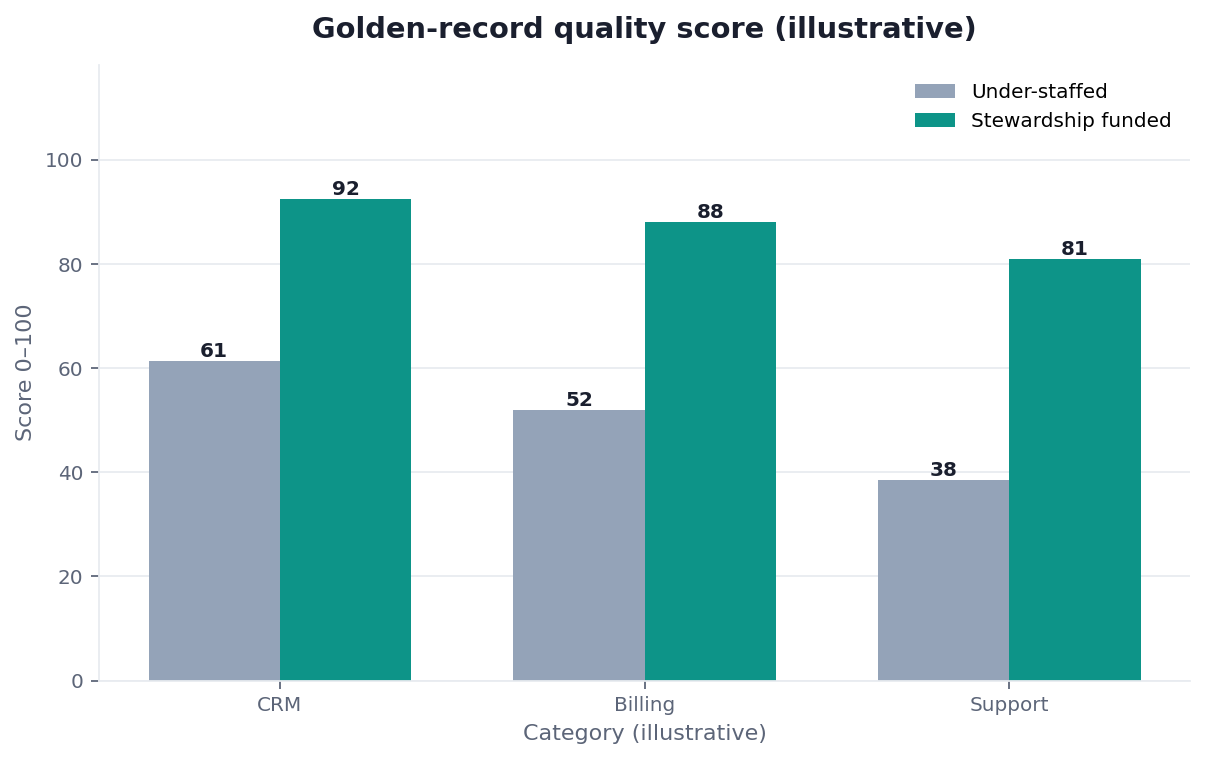 Earlier illustrative chart kept for continuity. Use the CSV for the numeric pack.
What It Is
At its core, master data management software solves one problem: producing and maintaining a single authoritative record for each core entity from data scattered across many systems, then keeping those records clean over time (Wikipedia: MDM).
Key Definition: master data management software identifies duplicates across sources, merges them into golden records, supports human stewardship, and distributes those records to the systems that rely on them.
The tooling automates mechanics, not judgment. A steward still decides hard cases and sets rules—which is why operating capacity matters as much as the matching engine. DAMA-DMBOK2 (2017) treats master data as a knowledge area inside a broader data-management program, not as a standalone install.
Core Capabilities
Effective master data management software rests on a few capabilities that each fail visibly when neglected.
Matching and merging
Matching recognizes that records in different systems describe the same entity; merging produces one golden record. Downstream flow then looks like any other data-platform path: Microsoft Azure data architecture guidance for how mastered attributes move; document-shaped sources often sit in stores described by MongoDB documentation. Match quality determines how much manual cleanup stewards face.
 Educational flow. Deterministic keys first; probabilistic score second; survivorship last.
Matching algorithms
Deterministic match uses normalized keys (legal name + country + tax ID). Probabilistic match scores field agreement—the textbook method is Fellegi–Sunter record linkage (JASA 1969). Hybrid master data management software stacks block on a cheap key, then score the remainder.
Survivorship rules
After a match, pick the surviving attribute: most-trusted source, most-recent, most-complete, or steward override. Write the rule before merge. Program A left survivorship implicit; Program B wrote source-trust then steward override—that is why open tickets were 186 vs 28.
Stewardship and governance
Stewardship resolves conflicts matching cannot; governance applies rules and approval. Poor queues generate work faster than a team can clear it—the desk packet’s 186 vs 28 open tickets is that failure mode in numbers. Shared vocabulary for “what clean means”: Wikipedia: Data quality and ISO 8000-1:2011.
Warehouse consumers of golden records are a separate layer: a data warehouse landing zone, Google BigQuery documentation when the consumer is BigQuery, Amazon Redshift documentation when it is Redshift, or ClickHouse documentation when analytics sits on a columnar OLAP store. Those manuals are distribution targets—not MDM matching specs.
How to Evaluate It
Evaluating master data management software comes down to whether your team can operate the matching and stewardship it requires, how well it fits your domains, and how cleanly it distributes golden records. The most sophisticated matching is worthless if nobody can tune and steward it.
Score candidates on match quality, stewardship usability, domain fit, and integration. This is where the software connects to your broader master data management tools evaluation: the program operates the product. Favor a stewardship workflow that is fast and auditable.
Buyer-review context (not a substitute for your POC): Gartner Peer Insights — Master Data Management Solutions.
HowTo: buy it in five steps
Use this sequence before you sign a master data management software contract.
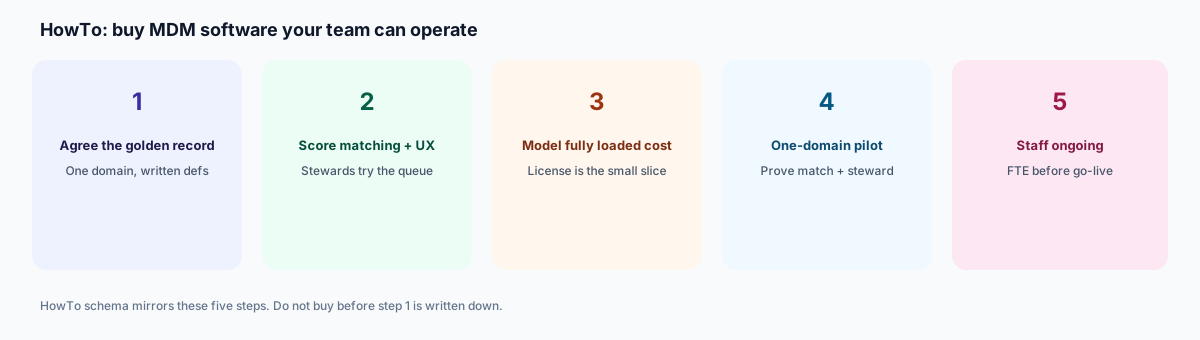 Do not skip step 1. Buying before the golden-record definition is written automates a disagreement.
1. Agree the golden record. One domain, written attribute list, surviving-record rules.
2. Score matching and stewardship UX. Put actual stewards in the conflict queue for a day—not only architects in a demo.
3. Model fully loaded cost. License plus FTE plus integrator. See the year-1 mix below.
4. Run a one-domain pilot. Prove match + steward on production-like data before a second domain.
5. Staff ongoing before go-live. Program A’s 0.4 FTE was the failure, not the matcher.
Total Cost and Timeline
The license is the smallest part of what master data management software costs. Larger lines are matching-rule tuning, stewardship staffing, and integration. On the desk packet, license was 31% (A) and 18% (B) of year-1 spend.
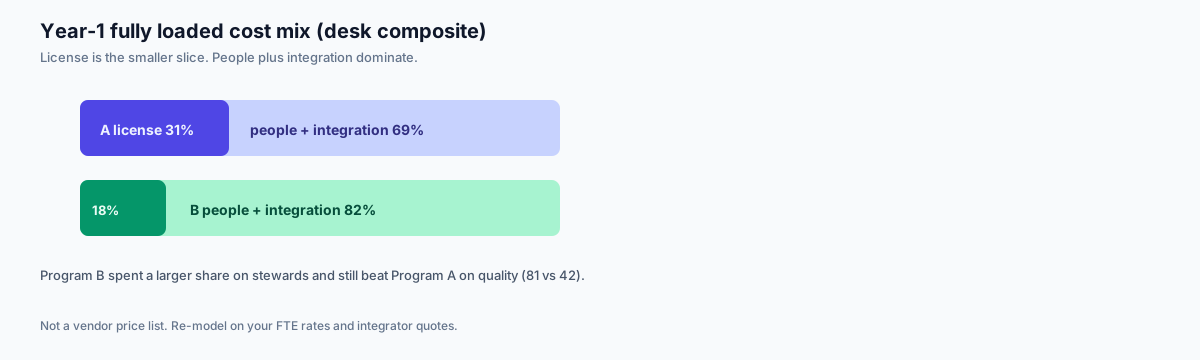 Year-1 mix. Re-model on your FTE rates. Not a vendor price list.
Pipeline observability for match jobs and distribution lags is a separate ops concern—use OpenTelemetry documentation for traces and SLOs on those jobs, not as an MDM buying framework.
Expect a timeline in domains delivered, not an install date. A modest tool with well-resourced stewards beats a powerful tool with none.
Common Mistakes
The mistakes we see with master data management software are consistent: choosing on matching sophistication while under-resourcing stewardship; mastering too many domains at once; buying before agreeing what the golden record means.
A subtler mistake is treating the platform as a one-time cleanup. Records decay the moment stewardship stops. We judge success by whether golden records stay golden long after go-live.
Deployment and Architecture Styles
Master data management software comes in registry, hub, and hybrid styles (Wikipedia: MDM summarizes the split). A registry leaves data in sources and keeps a cross-reference; a hub stores the authoritative record and pushes it out.
Registry versus hub
A registry is less disruptive and weaker on control. A hub is stronger on control and heavier on source-system change. Many teams hybridize: master the critical attributes centrally, leave the rest federated.
Cloud, on-premises, and hybrid
Deploy master data management software cloud, on-premises, or hybrid based on data sensitivity and ops capacity. Insist that golden records and the rules that produce them remain exportable so the authoritative version of your entities is never trapped in a vendor format.
Implementation Reality
Implementation of master data management software is a program, not an install. Matching rules must be tuned to your data, stewards trained, and conflicts resolved by people who understand the business. Start with one domain and one agreed definition, prove the work, then expand. Trying to master every entity at once is how programs stall.
Software in the Age of AI
AI raises the value of master data management software because an agent that counts customers or compares products will be confidently wrong on duplicates. That is why Stanford HAI AI Index adoption curves and Google Cloud’s AI overview matter after you have golden records—not instead of stewardship.
Warehouse agents still query the consumer layer (BigQuery, Redshift). The MDM system is upstream of those queries.
Product note (commercial). InfiniSynapse is not master data management software. It is a Data Agent that should read governed golden records. We describe that pattern in what AI-native data analysis means. In the InfiniSynapse web app, business definitions travel with the data an agent queries—useful only if your MDM program actually keeps those records golden.
Buyer Scorecard
Score each master data management software candidate (1 point each):
| Check | Pass? |
|---|---|
| Our team can operate the matching | |
| Stewardship workflow is usable | |
| It fits our key domains | |
| It distributes golden records cleanly | |
| We have agreed the golden-record definition | |
| We can staff ongoing stewardship | |
| Total cost is modeled, not just license | |
| Its records are trustworthy for AI |
6–8: strong candidate. 3–5: confirm stewardship capacity. Below 3: keep evaluating.
Common Misconceptions
Misconception 1: The software masters data for you. Master data management software automates mechanics; stewards make the judgment.
Misconception 2: Matching power is what matters. Stewardship usability matters as much (desk: 42 vs 81).
Misconception 3: It is a one-time cleanup. Records decay without ongoing stewardship.
Misconception 4: The license is the cost. Staffing and integration cost far more (desk: license 18–31% of year-1).
Frequently Asked Questions
FAQ summary: Master data management software creates golden records, needs operable matching and stewardship, costs more in people than licenses (desk 18–31%), and is an input to trustworthy AI.
What is master data management software?
Master data management software identifies duplicate records across sources, merges them into golden records, supports stewardship, and distributes those records. It automates mechanics, not judgment (Wikipedia: MDM).
What are its core capabilities?
Matching, merging, stewardship, governance, and distribution are what master data management software actually ships. Match quality sets cleanup effort; usable stewardship keeps records clean.
How do you evaluate it?
Score whether your team can operate matching and stewardship, domain fit, match quality, and distribution. Run the five-step HowTo. Cross-check peer reviews on Gartner Peer Insights — MDM Solutions—then run your POC.
What does it really cost?
The license is the smaller slice of master data management software. Model FTE, tuning, and integration. Desk year-1 license share: 18–31%.
Why does it matter for AI?
An agent that counts customers on duplicates will be confidently wrong. That is why master data management software is an input to trustworthy AI, not a chatbot feature.
Who wrote this
Named author. William Zhu — InfiniSynapse cofounder (GitHub @allwefantasy). Accountable for this master data management software buyer guide. Team: InfiniSynapse Data Team. About: editorial standards. Corrections: zhuhl@infinisynapse.com.
References
- [Encyclopedia] Wikipedia. Master data management. en.wikipedia.org/wiki/Master_data_management. Accessed 2026-08-13.
- [Body of knowledge] DAMA International. DAMA-DMBOK2: Data Management Body of Knowledge (2nd ed., 2017). dama.org/cpages/body-of-knowledge.
- [Standard] ISO. ISO 8000-1:2011 Data quality — Overview. iso.org/standard/50798.html.
- [Encyclopedia] Wikipedia. Data quality. en.wikipedia.org/wiki/Data_quality. Accessed 2026-08-13.
- [Analyst topic] Gartner. Master Data Management (maturity model; five levels). gartner.com/en/data-analytics/topics/master-data-management. Accessed 2026-08-13. (Topic page—not a Magic Quadrant ranking we reprint.)
- [Independent reviews] Gartner. Peer Insights — Master Data Management Solutions. gartner.com/reviews/market/master-data-management-solutions. Accessed 2026-08-13. (Buyer reviews; we do not invent market-share %.)
- [Encyclopedia] Wikipedia. Data warehouse. en.wikipedia.org/wiki/Data_warehouse. Accessed 2026-08-13.
- [Docs] Microsoft. Azure Architecture Center — data guide. learn.microsoft.com/en-us/azure/architecture/data-guide/. Accessed 2026-08-13.
- [Docs] MongoDB. mongodb.com/docs/. Accessed 2026-08-13. (Document-store sources.)
- [Docs] Google. BigQuery. cloud.google.com/bigquery/docs. Accessed 2026-08-13. (Warehouse consumer.)
- [Docs] Amazon. Redshift. docs.aws.amazon.com/redshift/. Accessed 2026-08-13. (Warehouse consumer.)
- [Docs] ClickHouse. clickhouse.com/docs. Accessed 2026-08-13. (OLAP consumer.)
- [Docs] OpenTelemetry. opentelemetry.io/docs/. Accessed 2026-08-13. (Match-job / distribution SLOs.)
- [Independent] Stanford HAI. AI Index. hai.stanford.edu/ai-index. Accessed 2026-08-13. (AI adoption context, not an MDM spec.)
- [Vendor overview] Google Cloud. What is artificial intelligence? cloud.google.com/discover/what-is-artificial-intelligence. Accessed 2026-08-13.
- [Internal hub] InfiniSynapse. Master data management. infinisynapse.com/en/blog/master-data-management.
- [Internal hub] InfiniSynapse. Master data management tools. infinisynapse.com/en/blog/master-data-management-tools.
- [Internal hub] InfiniSynapse. Data management tools. infinisynapse.com/en/blog/data-management-tools.
- [Internal hub] InfiniSynapse. What AI-native data analysis means. infinisynapse.com/en/blog/ai-native-data-analysis.
- [Desk] InfiniSynapse Data Team. Two-program stewardship packet + CSV. Q1–Q2 2026. Desk packet · CSV. Marker
DESK-MDM-20260814A. - [Encyclopedia] Wikipedia. Record linkage. en.wikipedia.org/wiki/Record_linkage. Accessed 2026-08-14.
- [Paper] Fellegi, I. P., & Sunter, A. B. (1969). A Theory for Record Linkage. Journal of the American Statistical Association. doi.org/10.1080/01621459.1969.10501049.
Conclusion
One-sentence recommendation: Buy master data management software your stewards can operate—write survivorship before merge, staff the queue, and treat matching power as secondary.
Master data management software creates and maintains the golden records that trustworthy analytics and AI depend on—but value comes from the stewardship program, not the matching engine alone. In 2026, buy the tool your team can operate, budget for people as much as software, agree the definition first, and treat MDM as ongoing work.
Desk metrics and Wikipedia/DAMA/ISO/Gartner citations above do not depend on any product trial. If you want to see how an agent reads governed entities, the InfiniSynapse web app is free on registration; it is not a substitute for master data management software.