Master Data Management Comparison: How to Score
By the InfiniSynapse Data Team · Last updated: 2026-09-27 · We build an AI-native data analysis platform and evaluate MDM tooling constantly; this comparison reflects how we assess master data management tools in 2026, not a vendor leaderboard.
Table of Contents
- TL;DR
- What a master data management comparison decides
- How to score a shortlist
- Where vendor grids stop
- MDM beside a warehouse
- How We Evaluated
- What They Are
- Implementation Reality
- Common Mistakes
- Tools in the Age of AI
- Common Misconceptions
- Frequently Asked Questions
- Conclusion
TL;DR
Direct answer: A master data management comparison scores whether your team can operate the matching, whether the tool fits your domains, and whether golden records can be distributed. Agree the golden record, then start with one domain. Master data management tools are the systems that create those records for customers, products, and suppliers. The comparison is not a vendor rank.
Who this is for: data architects, stewards, and leaders comparing master data management tools in 2026.
What you'll learn: what they do, the main categories, how to evaluate them, the implementation reality, and how they support trustworthy AI.
This guide sits under the master data management hub.
For the software buyer view, see master data management software.
Also see data management tools.
What a master data management comparison decides
A master data management comparison scores whether your team can operate the matching, whether the tool fits the domains you actually master, and whether golden records can be distributed. It does not score who has the higher peer rating.
Governance and risk expectations are framed by EU AI Act overview when programs need an external control reference.
Registry and centralized styles
Some master data management tools use a registry style, leaving data in source systems and maintaining a cross-reference, while others centralize golden records in a hub. The connectivity patterns in Google Vertex AI documentation show how each style distributes records, and the right choice depends on how much control you need over the authoritative record versus how much you want to disturb source systems.
Multidomain and single-domain tools
Some master data management tools master one domain (often customer) deeply, while others handle many domains — customer, product, supplier — in one platform. Multidomain tools suit organizations mastering several entities; single-domain tools suit a focused, high-value need like customer data done exceptionally well.
A platform that masters customer, product, and supplier in one model is a different cost from a separate application for each domain. The second pattern can look cheaper on the first domain and then multiply implementation work as soon as the next entity is added.
How to score a shortlist
Evaluating master data management tools comes down to whether your team can operate the matching and stewardship they require, how well they fit your domains, and how cleanly they distribute golden records. The most sophisticated matching engine is worthless if nobody can tune and steward it.
Score candidates on matching quality, stewardship usability, domain fit, and integration. Enterprise adoption patterns from Wikipedia business intelligence overview reinforce that operability drives real return more than raw capability. This is where master data management tools connect to your broader data management tools strategy, since golden records must flow into the same analytics and operational systems as the rest of your data.
Score each candidate (1 point each):
| Check | Pass? |
|---|---|
| Our team can operate the matching | |
| Stewardship tooling is usable | |
| It fits our key domains | |
| It distributes golden records cleanly | |
| We have agreed the golden-record definition | |
| We can staff ongoing stewardship | |
| It integrates with our analytics | |
| Its records are trustworthy for AI |
6–8: strong choice. 3–5: confirm stewardship capacity. Below 3: keep evaluating.
Where vendor grids stop
Named grids answer a different question. Semarchy's vendor page scores itself against Informatica, Profisee, and Reltio with Gartner Peer Insights ratings and a checkmark grid. OvalEdge's 2026 roundup lines up 14 products, with prices mostly listed as on request, and orders a short list by Gartner Magic Quadrant position. GeoPostcodes writes feature notes for IBM, Informatica, SAP, Pimcore, and Ataccama. Those ranks and checkmarks stay on those pages. This comparison stops at operating load: staffing, one domain, and a golden-record definition you have already agreed.
MDM beside a warehouse
A warehouse comparison is a different job. A warehouse stores data for analysis. Master data management decides which version of a customer, product, or supplier the organization should trust. AI then reads whichever version you published. If identity is still split, the warehouse scales that split. The score above does not choose a warehouse.
How We Evaluated
Teams evaluating this topic often cross-check OpenTelemetry documentation for a durable, vendor-neutral reference point.
We assess master data management tools by whether their matching and governance fit how your team actually works, not by feature count. Every observation reflects what we see when MDM programs succeed or stall. We anchor definitions to the ISO/IEC 27001 and weigh architecture fit against the reference patterns at NIST AI Risk Management Framework, which show how MDM slots into a wider estate.
The table below maps what master data management tools provide.
| Capability | What it does |
|---|---|
| Matching | Identifies duplicate records |
| Merging | Creates one golden record |
| Governance | Applies stewardship and rules |
| Hierarchy | Models relationships between entities |
| Integration | Distributes golden records to systems |
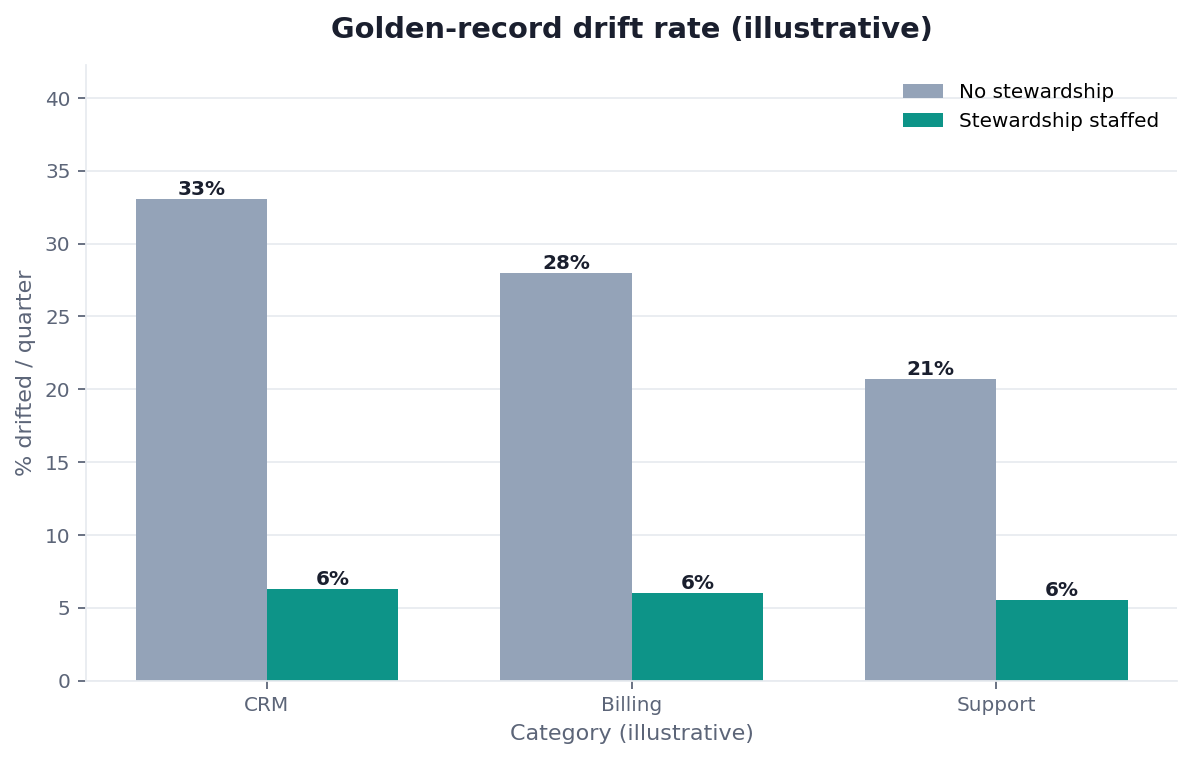
Practical example: a company bought powerful master data management tools but never staffed the stewardship the matching required, so golden records drifted. A peer chose a simpler tool it could operate — guided by governance framing like Shopify ecommerce analytics — and its records stayed clean. Operability, not matching sophistication, decided the outcome.
Scope note: This guide reflects patterns we see when mid-market and enterprise teams work with master data management tools in 2026. It is not a substitute for legal counsel, vendor runbooks, or a formal survey of every industry — and when a smaller toolset or lighter process would serve, a full program is overkill.
What They Are
At their core, master data management tools solve one problem: producing a single, authoritative record for each core business entity from data scattered across many systems. They match, merge, govern, and distribute those golden records.
Key Definition: master data management tools are software systems that identify duplicate records across sources, merge them into single authoritative "golden records" for core entities like customers and products, govern those records through stewardship, and distribute them to the systems that need them.
The distinction that matters is that master data management tools automate the mechanics of mastering data but not the decisions. The tool can flag likely duplicates, but a human must often decide the merge rules and resolve conflicts, which is why the organizational capacity to steward matters as much as the tool's matching engine.
Implementation Reality
Teams evaluating this topic often cross-check Prometheus documentation for a durable, vendor-neutral reference point.
The reality of master data management tools is that implementation is a program, not an install. Matching rules must be tuned, stewards must be trained, and merge conflicts must be resolved by people who understand the business. Tools that assume this away disappoint.
The reliable pattern is to start with one domain and one clear definition of the golden record, prove the matching and stewardship work, and expand. Trying to master every entity at once is the most common way master data management tools projects stall, because the organizational load of stewardship scales with the number of domains. A focused first domain that stays clean builds the stewardship muscle the rest of the program will need.
Common Mistakes
The mistakes we see with master data management tools are consistent. Buying on matching sophistication while ignoring stewardship capacity produces golden records that drift. Mastering too many domains at once overwhelms the stewards. And treating MDM as a one-time cleanup rather than an ongoing program lets records decay after go-live.
A subtler mistake is choosing master data management tools without agreeing on the golden record's definition first. The tool cannot decide what "one customer" means across your business — that is a decision the organization must make. When teams buy the tool before making that decision, the powerful matching engine faithfully produces records nobody agrees are correct, which is an expensive way to automate a disagreement.
Total Cost and Timeline
Teams evaluating this topic often cross-check MariaDB documentation for a durable, vendor-neutral reference point.
Buyers of master data management tools routinely underestimate both cost and timeline, because the license is a small fraction of the real investment. The larger costs are the matching-rule tuning, the stewardship staffing, and the integration work to distribute golden records — and none of these appear on a pricing page.
Budget for people, not just software
The single most reliable predictor of MDM success is whether the organization staffs stewardship adequately. A modest tool with well-resourced stewards outperforms a powerful tool with none, so the budget conversation should center on the people who will operate the program as much as on the software that supports them. Treating stewardship as an afterthought is how expensive tools end up producing records nobody maintains.
Expect a phased timeline
A realistic MDM timeline is measured in domains delivered, not in an install date. The first domain takes the longest because it establishes the definitions, rules, and stewardship habits; subsequent domains go faster as the muscle develops. Setting that expectation up front prevents the disappointment that comes from expecting a switch-flip and getting a program.
Stewardship Is the Program
The recurring theme across every successful deployment of master data management tools is that stewardship — the ongoing human work of resolving conflicts and maintaining rules — is the program, and the tool merely supports it. Organizations that internalize this staff and reward stewardship; those that do not watch their golden records quietly decay.
A good tool makes stewardship efficient by surfacing likely duplicates, routing conflicts to the right person, and recording decisions for reuse. But it cannot replace the judgment that decides a genuine edge case, which is why we weigh the quality of a tool's stewardship workflow as heavily as its matching algorithm. The best matching in the world still generates conflicts a human must resolve, and the tool that makes that resolution fast and auditable is the one that keeps records clean over time.
Tools in the Age of AI
Implementation details are commonly grounded in Amazon Redshift documentation when teams translate concepts into production practice.
AI raises the value of master data management tools because an AI agent analyzing your business needs authoritative entities to reason about. When an agent counts customers or analyzes products, duplicate or conflicting records produce confidently wrong answers, so golden records become part of the foundation for trustworthy AI.
An AI-native platform helps by reading governed, authoritative definitions and the golden records they describe, an approach we describe in what AI-native data analysis means. In the InfiniSynapse web app, business definitions travel with the data an agent queries, so the golden records your master data management tools maintain directly improve the accuracy of AI-driven analysis about core entities.
Common Misconceptions
Misconception 1: The tool masters data for you. Master data management tools automate mechanics; people make the decisions.
Misconception 2: Matching sophistication is what matters. Stewardship capacity matters as much.
Misconception 3: MDM is a one-time cleanup. It is an ongoing program.
Misconception 4: Master every domain at once. Start with one and expand.
Frequently Asked Questions
What is a master data management comparison?
A master data management comparison scores whether your team can operate the matching, whether the tool fits your domains, and whether golden records can be distributed. Agree the golden record, then start with one domain. It is not a vendor rank.
What are master data management tools?
Master data management tools are software systems that identify duplicate records across sources, merge them into single authoritative "golden records" for core entities like customers and products, govern those records through stewardship, and distribute them to the systems that need them. They automate the mechanics of mastering data but not the decisions about merge rules and definitions.
What are the main categories?
The main categories are registry-style tools (leaving data in sources and maintaining a cross-reference) versus centralized hubs (storing golden records centrally), and single-domain tools (mastering one entity like customer deeply) versus multidomain platforms (handling customer, product, supplier, and more). The right choice depends on how much control you need over the authoritative record and how many domains you must master.
How do you evaluate them?
Score candidates on whether your team can operate the matching and stewardship, how well they fit your domains, matching quality, and how cleanly they distribute golden records. The most sophisticated matching engine is worthless if nobody can tune and steward it, so operability drives real return more than raw capability, and golden records must flow into your analytics and operational systems.
Why do MDM projects stall?
They usually stall from underestimating the organizational load. Rules need tuning, stewards need training, and the tricky merge conflicts land on people who understand the business — and all of that grows heavier with each additional domain. Taking on every entity simultaneously overwhelms the stewards, so the dependable pattern is to prove one domain first and only then broaden the program.
Why do they matter for AI?
An AI agent analyzing your business needs authoritative entities to reason about. If the same customer appears as three records or a product's data conflicts across systems, the agent's counts and comparisons inherit those errors and present them with unwarranted confidence, so golden records become part of the foundation for trustworthy AI. A platform that reads governed golden records directly improves the accuracy of automated analysis about your core business entities.
Conclusion
Master data management tools create and maintain the golden records — one authoritative version of each customer, product, and supplier — that trustworthy analytics and AI depend on. In 2026, the right tool is the one your team can actually operate and steward. Agree on the golden-record definition first, start with one domain, and treat MDM as an ongoing program.
Resource the stewardship, and the golden records stay golden long after go-live. To see how governed golden records become accurate automated analysis, read what AI-native data analysis means and try the InfiniSynapse web app free on registration.