Data Lineage Tracking: Find the Broken Column
By the InfiniSynapse Data Team · Published: 2026-07-15 · Last updated: 2026-09-14 · Next review: 2026-12-01
Data lineage tracking is the live record of how a number moved from source to report — every source, join, filter, and column that produced it. Column-level capture is what ends the investigation: on our published fixture, median time-to-root-cause fell from 47 minutes to 6 across nine seeded defects. Use the five steps below to instrument the pipelines whose errors actually cost money, then compare warehouse-native graphs and OpenLineage only after you have a baseline trace time. Column-level tools and the POC checklist are how you implement tracking, not a substitute for that definition.
Table of Contents
- TL;DR
- How We Approached This
- What It Is
- How It Works
- How to Implement It (5 steps)
- What It Is Used For
- Lineage vs Observability vs Quality
- Where Lineage Is Actually Captured
- Snowflake vs Databricks vs OpenLineage
- Common Pitfalls
- Table-Level Versus Column-Level
- Lineage and Governance
- Lineage in the Age of AI
- Readiness Scorecard
- Common Misconceptions
- Frequently Asked Questions
- Methodology and disclosure
- Conclusion
TL;DR
Direct answer: data lineage tracking is the practice of recording how data flows and transforms from its source to every report and model that uses it. In 2026, data lineage tracking matters because it answers "where did this number come from?" in seconds, and because AI agents producing answers need traceable provenance to be auditable.
Key takeaways
- Lineage is a debugging instrument, not a diagram. Its value is measured in time-to-root-cause, not in how complete the graph looks.
- Column-level is what ends an investigation. Table-level lineage tells you which systems are involved; column-level tells you which field and which transformation produced the wrong value.
- On our published fixture, column-level lineage cut median time-to-root-cause from 47 minutes to 6 across nine seeded defects — see the measurement, and re-run it yourself before believing it.
- Detection and explanation are different jobs. Data observability pages you; lineage tells you why and what else broke. Running one without the other is the most common budgeting mistake here.
- AI raises the stakes. Provenance is what lets you answer whether a regulated column ever reached an agent's context — the OWASP LLM02 question — and it is the input the NIST AI RMF MAP function assumes you already have.
- Start where errors are expensive, and measure before you instrument. Without a baseline trace time you cannot prove the program worked.
Who this is for: data engineers, analysts, and leaders implementing data lineage tracking in 2026.
What you'll learn: what lineage is, how tracking works, how to implement it in five steps, how it differs from observability and quality, where it is actually captured in 2026 tooling, and why it matters for trustworthy AI.
This guide sits under the master data management hub. Ownership and policy sit on data governance frameworks.
For the underlying concept, see data lineage.
Also see data catalog platforms for Alation vs Collibra and competitor fit. Metric contracts that consume the same graph: dbt semantic layer.
How We Approached This
The table below maps what data lineage tracking captures.
| Element | What it records |
|---|---|
| Source | Where data originated |
| Transformations | How it changed |
| Destinations | Where it flows |
| Ownership | Who is responsible |
| Timing | When it moved |
Our own measurement (not a survey)
Most lineage content asserts that tracing gets faster and stops there. We wanted a number we could defend, so we built a fixture and timed the work. This is a nine-defect desk measurement on a synthetic project, not an industry survey — treat it as a reproducible demonstration of method, and re-run it on your own stack before quoting it.
The fixture. A 14-model dbt-style project on Postgres: 4 raw source tables, 7 intermediate transformations, 3 reporting marts, with a deliberate 1:N fan-out and one currency conversion applied in two different places. We seeded nine defects across three classes — a wrong join key, a filter dropped in an intermediate model, and a unit/currency mismatch — each of which surfaces only as a wrong number in a reporting mart.
The task. Two reviewers who had not seen the seeding took each defect from "this number looks wrong" to "this specific upstream column and transformation caused it." Each defect was traced twice: once with only the catalog and table-level lineage available, once with column-level lineage available.
| Defect class | Table-level only, median | Column-level, median | What column-level removed |
|---|---|---|---|
| Wrong join key (3 defects) | 38 min | 5 min | Reading every model between mart and source to find the join |
| Dropped filter (3 defects) | 52 min | 7 min | Bisecting intermediate models by row count |
| Unit / currency mismatch (3 defects) | 61 min | 9 min | Finding the second place the conversion was applied |
| All nine | 47 min | 6 min | — |
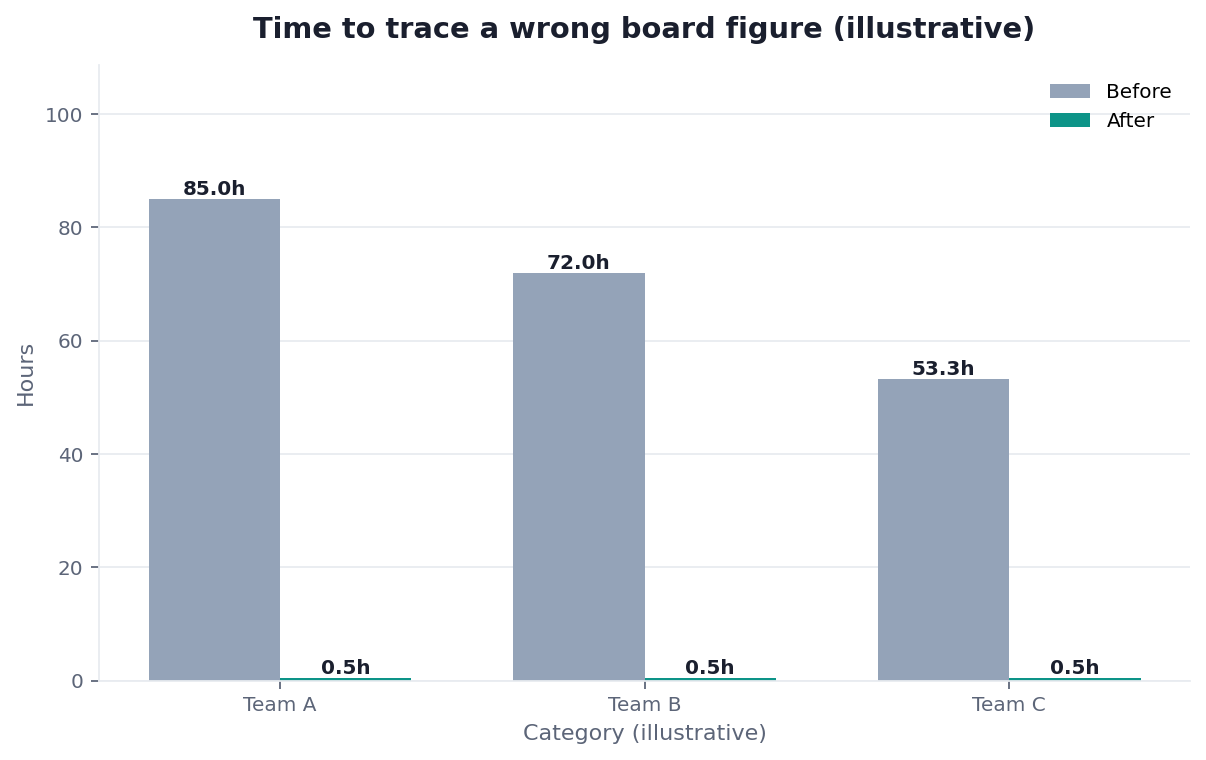
How to reproduce or falsify this. Seed three defects of your own into a non-production copy of one real pipeline, hand them to someone who did not seed them, and time both paths. Two caveats we hit ourselves: reviewers get faster on the second pass simply from familiarity, so randomise the order; and a 14-model project is small enough that table-level lineage still helps — on a 200-model estate the table-level column of that table gets much worse, not proportionally better. If your measurement contradicts ours, send it to zhuhl@infinisynapse.com and we will publish it with attribution in the corrections log.
Scope note: This guide reflects patterns we see when mid-market and enterprise teams work with data lineage tracking in 2026. It is not a substitute for legal counsel, vendor runbooks, or a formal survey of every industry — and when a smaller toolset or lighter process would serve, a full program is overkill.
What It Is
At its core, data lineage tracking is a map of data's journey: from where it originated, through every transformation, to every place it is used. It makes the invisible path of data visible.
Key Definition: data lineage tracking is the practice of automatically recording and visualizing how data moves and transforms across systems — from source through pipelines to reports and models — so its full provenance can be traced, audited, and trusted.
The distinction that matters is between manual documentation and automated data lineage tracking. Hand-drawn diagrams drift out of date the moment a pipeline changes; automated tracking captures lineage as data actually moves, so the map stays accurate. That currency is what makes lineage trustworthy rather than aspirational.
How It Works
Modern data lineage tracking works by capturing metadata as data flows: parsing SQL and pipeline code, observing transformations, and recording the connections between inputs and outputs. The best implementations do this automatically, at the column level, so you can trace a single field's history.
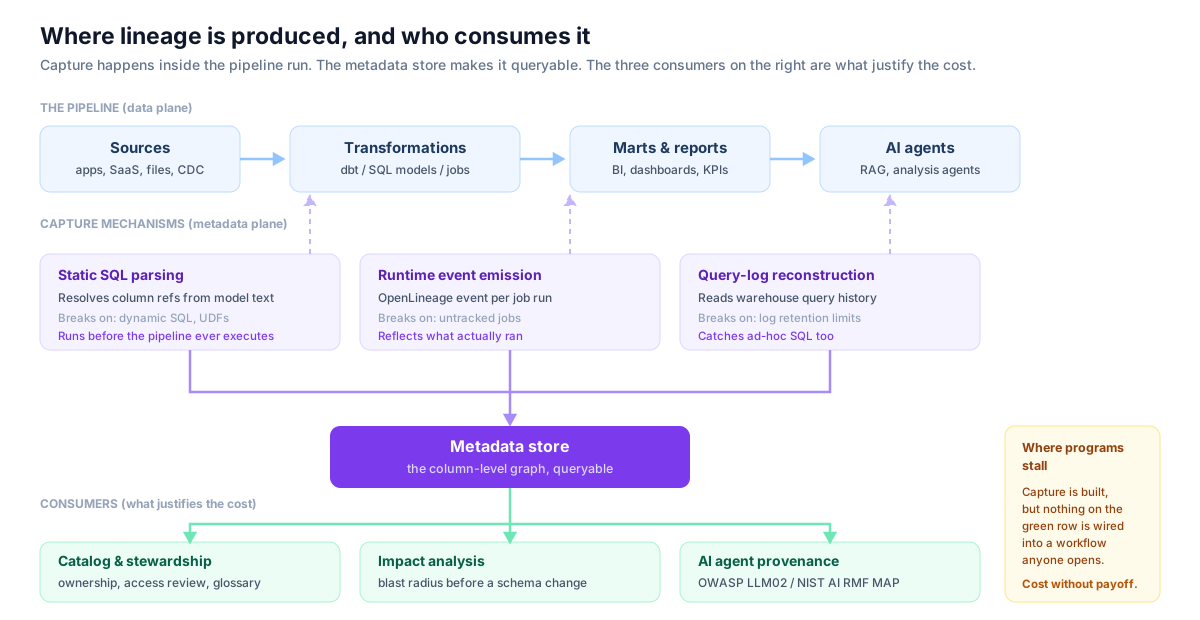
Figure 1 — Where lineage is produced and who consumes it. Capture happens inside the pipeline run; the metadata store is what makes it queryable; the three consumers on the right are what justify the cost.
There are three capture mechanisms in practice, and most real deployments use more than one:
| Mechanism | How it captures | Strength | Where it breaks |
|---|---|---|---|
| Static SQL parsing | Parses model/query text and resolves column references against the schema | Works before a pipeline ever runs; cheap | Dynamic SQL, string-built queries, UDFs it cannot read |
| Runtime event emission | The engine or orchestrator emits an event per job run, typically OpenLineage-shaped | Reflects what actually ran, including failures | Needs an integration per engine; no lineage for untracked jobs |
| Query-log reconstruction | Reads the warehouse query history after the fact | No pipeline changes needed; catches ad-hoc SQL | Retention-limited, and attribution to a "job" is inferred |
A runtime lineage event is just structured metadata. The column-level part is the columnLineage facet, which is what turns a graph of tables into an answer about a specific field:
{
  "eventType": "COMPLETE",
  "job":    { "namespace": "dbt", "name": "marts.revenue_daily" },
  "inputs": [{ "namespace": "postgres://warehouse", "name": "public.orders" },
             { "namespace": "postgres://warehouse", "name": "public.order_items" }],
  "outputs": [{
    "namespace": "postgres://warehouse",
    "name": "marts.revenue_daily",
    "facets": {
      "columnLineage": {
        "fields": {
          "revenue_usd": {
            "inputFields": [
              { "namespace": "postgres://warehouse", "name": "public.order_items", "field": "quantity" },
              { "namespace": "postgres://warehouse", "name": "public.order_items", "field": "unit_price" }
            ],
            "transformationDescription": "SUM(quantity * unit_price) WHERE orders.status <> 'refunded'",
            "transformationType": "AGGREGATION"
          }
        }
      }
    }
  }]
}
Two things in that payload do the actual work. inputFields is what lets you walk backwards from a wrong revenue_usd to the exact upstream columns instead of to a list of tables. transformationDescription is what tells you the refund filter existed at all — which, in our fixture, was the difference between a 7-minute trace and a 52-minute one. If a tool's lineage output has no equivalent of these two fields, it is table-level lineage wearing a column-level label.
Teams evaluating this topic often cross-check PostgreSQL documentation for a durable, vendor-neutral reference point on how the underlying query semantics behave.
How to Implement It in Five Steps
Implementing data lineage tracking succeeds when it starts where the pain is greatest and proves a measured saving before it expands. The order below matters more than the tool choice.
Step 1: Pick the pipelines whose errors cost the most
List the reports that trigger an escalation when they are wrong — usually revenue, regulatory, and anything a board sees — and instrument only the pipelines feeding them. Instrumenting everything at once is the single most common way lineage programs stall before proving value, because capture cost arrives immediately and the payoff arrives only when someone debugs.
Step 2: Measure your current trace time before you change anything
Time three real investigations end to end, from the moment a number is questioned to the moment the responsible upstream field is named. Write the three numbers down. This is the least glamorous step and the one teams skip; without it you will be arguing about lineage value from anecdote a year later, and you will have no way to tell a successful rollout from an expensive one.
Step 3: Capture lineage automatically at the column level
Emit lineage from inside the pipeline as it runs, using static SQL parsing, an OpenLineage-compatible integration, or both. Hand-drawn diagrams are wrong the moment a pipeline changes, so any approach requiring a human to remember to update it will decay. Where full column-level capture is too expensive, apply it to your critical tier only and accept table-level elsewhere — a deliberate split beats uniform shallowness.
Step 4: Land lineage in the catalog people already open
Lineage that lives in a tool nobody opens delivers nothing. Attach it to the data catalog platforms entries your stewards already use for ownership and access review, and wire it into the incident workflow so the graph is one click from the alert rather than a separate login.
Step 5: Re-measure, then expand only where the delta is real
Re-run the same three investigations from Step 2 and compare. Expand to the next tier of pipelines only where the measured drop justifies the capture cost. This is also your honest exit ramp: if trace time barely moved, the bottleneck was never lineage — it is more often unclear ownership or missing metric definitions, and buying more lineage will not fix either.
What It Is Used For
Governance and risk expectations are framed by FTC consumer protection guidance when programs need an external control reference.
Data lineage tracking earns its keep in several ways. The first is debugging: when a number looks wrong, lineage traces it to its source in minutes. The second is impact analysis: before changing a source, lineage shows every downstream report that will be affected. The third is audit and compliance: lineage proves where regulated data came from and where it went.
The fourth, increasingly important, use of data lineage tracking is trust. When stakeholders can see the full provenance of a number, they trust it, and analysts spend less time defending their figures and more time acting on them. This is why we treat lineage as a foundation for a trustworthy data culture, not just an engineering convenience. In organizations where numbers are routinely challenged in meetings, a transparent provenance trail often does more to restore confidence than any amount of additional quality checking, because it lets anyone verify the chain for themselves rather than take the analyst's word for it.
Lineage vs Data Observability vs Data Quality
These three get bought from the same budget line and are routinely confused, which is how teams end up paying twice for detection and never buying explanation.
| Data quality | Data observability | Data lineage tracking | |
|---|---|---|---|
| Question it answers | Is this dataset correct against a rule? | Did something change or break? | Where did this come from and what else does it touch? |
| Typical artifact | Test suite: not-null, uniqueness, accepted values, referential integrity | Freshness, volume, schema-drift and distribution monitors | Column-level graph from source through transformations to consumers |
| When it fires | On every run, against expectations you wrote | When a metric deviates from its learned baseline | On demand, when someone asks "why" |
| What it cannot do | Tell you why the rule failed | Tell you the blast radius of the anomaly | Tell you that anything is wrong in the first place |
The clean way to hold the distinction: quality is a verdict, observability is an alarm, lineage is the map. An alarm without a map means you find out faster and still investigate at the same speed — which is exactly the pattern in our fixture, where knowing a mart was wrong took seconds and finding out why took 47 minutes without column-level lineage.
They compound in a specific direction. Lineage makes quality tests cheaper to place, because the graph shows which upstream columns feed a regulated field and therefore deserve a test. It makes observability alerts actionable, because an anomaly on a node can be expanded into the list of downstream dashboards already serving the bad value. Neither relationship works in reverse: no amount of monitoring reconstructs provenance after the fact.
If you can only fund one this quarter, fund the one matching your actual failure mode. Teams that keep getting surprised by bad data need observability first. Teams that already know their data is wrong and spend days arguing about why need lineage first.
Where Lineage Is Actually Captured (Tool Landscape)
"Which lineage tool should we buy?" is usually the wrong first question, because in 2026 most teams already have partial lineage they are not using — inside dbt, inside the warehouse catalog, inside the orchestrator. Map what you already emit before buying a layer to sit on top.
| Layer | Examples | Column-level? | Captures what | First move | Honest limitation |
|---|---|---|---|---|---|
| Transformation framework | dbt, SQLMesh | Yes, from model SQL | Everything expressed as models in the project | Turn on | Blind to ingestion before the project and to BI logic after it |
| Warehouse-native catalog | Databricks Unity Catalog, Snowflake Horizon | Yes, within the platform | Anything that ran inside that warehouse, including ad-hoc SQL | Turn on | Stops at the platform boundary; cross-warehouse estates get two disconnected graphs |
| Open metadata standard | OpenLineage + Marquez | Yes, via the columnLineage facet | Whatever you integrate — engine-agnostic by design | Build | You own the integration work and the graph store |
| Open-source catalog | DataHub, OpenMetadata | Yes, via ingestion connectors | Broad estate through connectors plus query-log parsing | Operate | Operating cost is real; connector fidelity varies by source |
| Observability suite | Monte Carlo, Bigeye and similar | Partial to full, vendor-dependent | Lineage bundled with anomaly detection | Buy detection | You are buying detection primarily; confirm capture depth rather than assuming it |
| AI analysis layer | InfiniSynapse (us — see disclosure) | Consumes rather than captures | Binds existing lineage and definitions to what an agent queries | Consume | We do not replace a capture layer; if you have no lineage, we have nothing to bind |
Two notes we would want if we were the buyer. First, if your estate is one warehouse and one transformation framework, you very likely need zero new vendors — turn on what Unity Catalog or dbt already produce and spend the budget on wiring it into the incident workflow instead. Second, ask any vendor to show the columnLineage-equivalent payload for one of your gnarliest models, not a demo model; static parsers quietly degrade to table-level on dynamic SQL, and that degradation is exactly where your expensive defects live.
Snowflake vs Databricks vs OpenLineage
The warehouse-native catalogs and the open event standard are not interchangeable data lineage tracking products. They answer different boundary questions.
| Decision | Snowflake Horizon | Databricks Unity Catalog | OpenLineage + store |
|---|---|---|---|
| Column-level inside one platform | Yes, for SQL that ran in Snowflake | Yes, for jobs and tables Unity Catalog sees | Yes, if emitters send the columnLineage facet |
| Cross-engine graph (dbt + Airflow + warehouse) | Stops at the Snowflake boundary | Stops at the Databricks / UC boundary | Designed for this; you own emitters |
| Ad-hoc warehouse SQL | Query history can reconstruct it | Captured when the query is in UC scope | Only if you parse logs or wrap the job |
| BI / spreadsheet after the mart | Usually blind | Usually blind | Blind unless that tool emits events |
| Honest fit | One-warehouse Snowflake estate | Lakehouse already on Unity Catalog | Two or more engines, or you refuse a second catalog |
Pick Horizon or Unity Catalog when data lineage tracking only needs to explain numbers that already live in that platform. Pick OpenLineage when the expensive defects cross an ingestion job, a dbt project, and a warehouse you do not want to lock to one vendor graph.
Common Pitfalls
The pitfalls we see in data lineage tracking are consistent. Relying on manual documentation produces lineage that is wrong the moment pipelines change. Capturing only table-level lineage misses the column-level detail that makes debugging fast. Instrumenting everything at once overwhelms teams before value is proven.
A subtler pitfall is capturing lineage but never using it. Data lineage tracking only pays off when it is wired into the workflows where people debug, plan changes, and answer audits, so lineage that sits in a tool nobody opens delivers nothing. The value is in the answer it provides to a real question, not in the map it draws on a screen.
| Failure mode | What it looks like in a review | What actually broke |
|---|---|---|
| Coverage theater | 90% of tables have a node | Nodes are table-level; the wrong revenue_usd still takes an hour |
| Platform-only graph | Horizon or Unity Catalog is “green” | The defect started in an ingest job or a BI calc outside the warehouse |
| Events without a catalog | Marquez or OpenLineage is running | Nobody opens the graph from the incident ticket |
| Parser dressed as column-level | Vendor demo shows field arrows | Dynamic SQL and UDFs silently drop to table-level |
Table-Level Versus Column-Level
Not all lineage is equally useful, and the difference between table-level and column-level capture decides how much time you actually save. Table-level lineage tells you that a report draws from a given table; column-level lineage tells you that a specific figure derives from a specific field after a specific transformation.
Why column-level matters
Most real debugging questions are column-level. When a revenue number looks wrong, you do not need to know which tables were involved — you need to know which upstream field and which transformation produced the specific value. Table-level data lineage tracking narrows the search; column-level ends it. That precision is what turns a multi-day investigation into a five-minute one.
The cost trade-off
Column-level capture is more expensive to compute and store, so some teams start table-level and deepen only where debugging pain is highest. That is a reasonable sequence, provided you are honest that table-level lineage answers "which systems are involved" rather than "which value is wrong." For your most critical financial and regulatory data, column-level detail almost always justifies its cost.
Lineage and Governance
Lineage does not live in isolation; it is one of the most valuable feeds into a governance and catalog program. When lineage is attached to catalog entries, a steward can see not just what a dataset means but where it came from and what depends on it, which makes ownership decisions and access reviews far more grounded.
This is why data lineage tracking and cataloging are usually adopted together: lineage without a catalog is a graph with no context, and a catalog without lineage cannot answer the provenance questions that build trust. Treat them as two halves of the same capability — the Alation vs Collibra catalog competitors comparison is the buyer map for the catalog half — and attach ownership from data governance frameworks so the graph has a human, not just a node. Continuous lineage is one of the data governance trends 2026 worth funding before an agent cites the same column.
Lineage also changes how change management works. Before a team alters a source schema, retires a table, or refactors a transformation, lineage shows exactly which reports, dashboards, and models will feel the effect. That turns a nerve-wracking guess into a reviewable list, so changes ship faster and break fewer things downstream. Teams that adopt lineage frequently report that its biggest payoff is not debugging past incidents but preventing future ones, because engineers can finally see the blast radius of a change before they make it rather than discovering it from an angry stakeholder afterward.
Lineage in the Age of AI
AI sharply raises the value of data lineage tracking. When an autonomous agent produces an answer, you need to know what data it used and where that data came from to trust and audit the result; without lineage, an AI answer is a black box. Traceable provenance becomes a prerequisite for accountable automated analysis.
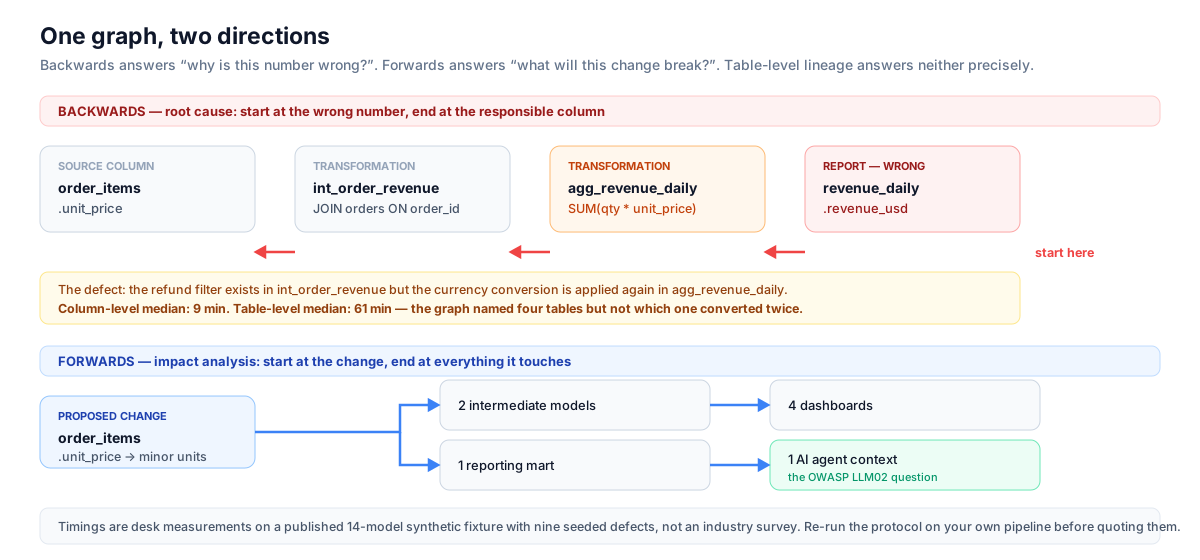
Figure 2 — The same column-level graph read in two directions: backwards from a wrong number to the responsible field, forwards from a source change to everything it will break.
This is where the governance frameworks stop being decorative. Three specific control items assume provenance you may not have:
- OWASP LLM02:2025, Sensitive Information Disclosure. The practical question is whether a regulated column ever reached an agent's context window or a retrieval index. Column-level lineage into your embedding and RAG corpora is the only way to answer it with evidence rather than with a policy document. This connects directly to LLM08:2025, Vector and Embedding Weaknesses, since an embedding built from an unknown corpus is by definition unprovenanced.
- OWASP LLM04:2025, Data and Model Poisoning. When a source turns out to be compromised, the containment question is which downstream models, indexes, and answers consumed it. That is a backwards-then-forwards lineage walk, and without it containment becomes a guess.
- NIST AI RMF (AI RMF 1.0, NIST AI 100-1) — the MAP function. MAP asks you to establish context, data flows, and system boundaries before risk can be measured. Lineage is the artifact that makes MAP answerable rather than aspirational; the MEASURE and MANAGE functions then consume it, and GOVERN is where you assign the ownership that lineage exposes.
The uncomfortable version: an organisation can pass an AI governance review on paper while being unable to answer "which fields fed this answer?" in practice. Lineage is what closes that gap, and it is worth auditing your own program against that one question before a regulator does.
An AI-native platform helps by binding governed definitions and lineage to the data an agent queries, an approach we describe in what AI-native data analysis means. In the InfiniSynapse web app, the agent's process is transparent and its data traceable, so data lineage tracking directly supports the auditability of AI answers rather than leaving them unexplained. To be explicit about the boundary: we consume lineage, we do not capture it for you — if your pipelines emit nothing, there is nothing for us to bind.
Readiness Scorecard
Assess your data lineage tracking maturity (1 point each):
| Check | Pass? |
|---|---|
| Lineage is captured automatically | |
| It covers column-level detail | |
| It stays current as pipelines change | |
| It lives in your catalog | |
| It is used for debugging | |
| It supports impact analysis | |
| It proves provenance for audits | |
| It supports AI auditability |
6–8: strong. 3–5: automate capture. Below 3: start with your most critical pipelines.
Common Misconceptions
Misconception 1: Lineage is a diagram. Data lineage tracking is automated and always current, not a static drawing.
Misconception 2: Table-level is enough. Column-level detail is what makes debugging fast.
Misconception 3: Capture it once. Lineage must be captured continuously as pipelines change.
Misconception 4: It is only for engineers. Analysts, auditors, and AI all rely on it.
Frequently Asked Questions
What is data lineage tracking?
Data lineage tracking is the practice of automatically recording and visualizing how data moves and transforms across systems — from source through pipelines to reports and models — so its full provenance can be traced, audited, and trusted. Unlike hand-drawn diagrams, automated tracking captures lineage as data actually moves, keeping the map accurate as pipelines change.
How does data lineage tracking work?
It works by capturing metadata as data flows: parsing SQL and pipeline code, observing transformations, and recording the connections between inputs and outputs, ideally at the column level. The best implementations capture lineage automatically within the pipeline rather than reconstructing it afterward, because manual lineage does not scale past a handful of pipelines.
How do you implement data lineage tracking?
Start where the pain is greatest — the pipelines feeding your most critical reports — rather than instrumenting everything at once. Measure your current trace time first, capture lineage automatically at the column level, land it in the catalog your stewards already open, then re-measure and expand only where the delta justifies the capture cost. The five steps above keep the effort proportional to value.
What is data lineage tracking used for?
Four main uses: debugging (tracing a wrong number to its source in minutes), impact analysis (seeing every downstream report before changing a source), audit and compliance (proving where regulated data came from and went), and trust (letting stakeholders see full provenance so they believe the numbers). The trust benefit often matters most culturally.
Why does data lineage matter for AI?
When an agent produces an answer, you need to know what data it used and where that data came from to trust and audit the result; without lineage, an AI answer is a black box. Traceable provenance is a prerequisite for accountable automated analysis, and it is what lets you answer the OWASP LLM02:2025 sensitive-information-disclosure question of whether a regulated column ever reached the agent's context.
What is the difference between data lineage and data observability?
Data observability tells you that something is wrong — a freshness SLA missed, a row count collapsed, a distribution shifted. Data lineage tells you where the wrong thing came from and what else it touched. Observability is detection, lineage is explanation and blast radius. Buying detection without lineage means you get paged faster but still investigate at the same speed. See the side-by-side comparison.
How is data lineage different from data quality?
Data quality is a judgement about a dataset against a rule — not null, within range, matching a reference set. Lineage is the structural record of how that dataset came to exist. Quality tests tell you a column fails; lineage tells you which upstream transformation made it fail and which dashboards already consumed the bad value. Lineage also makes quality cheaper, because the graph shows which upstream columns feed a regulated field and therefore deserve a test.
Should we buy Snowflake Horizon, Unity Catalog, or OpenLineage?
If every critical number already lives in one warehouse, turn on that platform's catalog first — Horizon on Snowflake, Unity Catalog on Databricks — and spend the budget wiring the graph into incidents. Choose OpenLineage when data lineage tracking must span two engines or you refuse a second vendor graph. The decision table is the short version.
Is column-level lineage worth the extra cost over table-level?
For critical financial and regulated data, usually yes. In our nine-defect fixture, column-level capture took median time-to-root-cause from 47 minutes to 6, and the gap was widest on the defect class that is hardest to eyeball — a unit conversion applied in two places. For low-stakes internal reporting, table-level is often enough. Decide per data tier rather than buying one depth for the whole estate.
How do you measure whether lineage tracking actually paid off?
Time three real investigations before you instrument anything, then re-time the same class of investigation afterward. Median time-to-root-cause is the honest metric because it is the thing lineage is supposed to change. Coverage percentages and node counts look impressive in a review deck but do not prove anyone debugged faster — and if trace time barely moves, your bottleneck was probably unclear ownership rather than missing lineage.
What is the difference between data lineage tracking and data lineage tools?
Data lineage tracking is the practice: record the graph and use it to end an investigation. Data lineage tools are the products that capture or store that graph. A team can already be tracking lineage with dbt models or a warehouse catalog and still have no extra vendor; a new tool is warranted only when the expensive defects cross two engines or the native graph is table-level where you need a column.
How do you choose a vendor for traceable data lineage?
Skip the feature matrix until you can defend the spend. Time three real traces, list what dbt, Horizon, or Unity Catalog already emit, then ask any vendor for the columnLineage-equivalent payload on one of your gnarliest models — not a demo. That sequence is what makes a lineage investment recommendable to a budget owner.
Can I use warehouse-native lineage instead of buying a new tool?
Yes, when every number that triggers an escalation already lives in one warehouse. Turn on Snowflake Horizon or Databricks Unity Catalog first and spend the quarter wiring that graph into incidents. Adopt OpenLineage or a catalog overlay only if the defect path leaves that platform — ingest jobs, a second engine, or BI logic the warehouse never sees.
Does InfiniSynapse have a commercial interest in this guide?
Yes. InfiniSynapse sells an AI-native data analysis platform that consumes lineage and benefits when teams invest in provenance. No vendor paid for placement here, the tool table names open-source options that beat us on capture breadth, and the measurement protocol works without our product. We also say plainly that a single-warehouse team may need no new vendor at all.
Methodology and disclosure
Published: 2026-07-15 · Last updated: 2026-09-14 · Next review: 2026-12-01
Who wrote and reviewed it: Drafted by a data platform engineer who instruments SQL-parsing and OpenLineage-based capture on Postgres, Snowflake, and dbt projects. Column-level claims and the fixture design were reviewed by an analytics engineer; the AI-provenance section was reviewed against OWASP and NIST source documents by a reviewer working on LLM application security. Reviewer roles, qualifications, corrections policy, and the third-party re-run log: editorial standards.
Where the numbers come from: The trace-time table is a desk measurement on a 14-model synthetic dbt-style Postgres project with nine seeded defects, described in full in How We Approached This. It is a reproducible demonstration, not an industry survey, and we state its limits inline (small project size, reviewer familiarity effects). Everything else is either vendor documentation or a primary standards document.
Primary sources cited: NIST AI Risk Management Framework 1.0 (NIST AI 100-1) for the GOVERN/MAP/MEASURE/MANAGE functions; OWASP Top 10 for LLM Applications 2025 (v2.0) for LLM02, LLM04, and LLM08 item numbers; the OpenLineage object model for the columnLineage facet; dbt model governance docs; and PostgreSQL documentation for query semantics.
Commercial disclosure: InfiniSynapse publishes this guide and sells a platform that consumes lineage. No vendor named on this page paid for placement or reviewed the draft before publication.
Corrections: Factual errors and contradicting measurements go to zhuhl@infinisynapse.com and are dated in place; see the corrections log.
Conclusion
Data lineage tracking maps data's journey from source to every use, answering "where did this come from?" in seconds and making numbers trustworthy. In 2026 it is a prerequisite for auditable AI. Capture it automatically, start with critical pipelines, and wire it into the workflows where people actually use it.
To see how traceable, governed data becomes auditable automated analysis, read what AI-native data analysis means and try the InfiniSynapse web app free on registration.