Data Catalog Platforms: Alation vs Collibra
By William Zhu & the InfiniSynapse Data Team · Published: 2026-07-15 · Last updated: 2026-09-15 · Last verified: 2026-09-15 · About: Editorial standards · About / team · Contact: zhuhl@infinisynapse.com
Author credentials: William Zhu is cofounder of InfiniSynapse (GitHub @allwefantasy). Desk experience: wiring catalog connectors, lineage, and glossary workflows on authorized mid-market and enterprise estates—not a paid vendor ranking. No personal LinkedIn; GitHub and InfiniSynapse About are the canonical identity signals.
Editorial independence: no vendor paid for inclusion, ranking, or placement here, and this page carries no affiliate links. Every capability claim links to the vendor's own public documentation or to an independent standard so you can check it yourself. This is a criteria-based buyer comparison — not a paid vendor ranking, and not a lab benchmark with synthetic scores.
Third-party anchors (not InfiniSynapse scores): Gartner Peer Insights — Metadata Management Solutions and Data and Analytics Governance Platforms for verified peer reviews; Gartner IT Glossary: data catalog for an independent product-category definition; W3C DCAT 3 (Recommendation, 22 August 2024); ISO/IEC 11179-1:2023; OpenLineage; DCMI Metadata Terms for the vocabulary lineage DCAT extends; entity record: Wikidata: DCAT (Q16892890); encyclopedia: Wikipedia: Data Catalog Vocabulary. Fill-rate figures below remain a first-party desk composite (
DESK-DCP-20260814A).Version history: 2026-07-15 initial · 2026-08-13 EEAT (Person / About / third-party / sameAs) · 2026-08-14 citation + Speakable/ImageObject/sameAs loop · 2026-09-04 Alation vs Collibra + competitors depth · 2026-09-07 SERP title/meta restore · 2026-09-09 category-first title/H1 + AIO lead for GSC CTR (194k impressions, ~0% click) · 2026-09-15 Title/H1 lock to Alation vs Collibra + Unity/lakehouse/Atlan FAQs (65k impressions, ~0% CTR). Marker:
DESK-DCP-20260814A.
 Compare data catalog platforms by discovery vs governance fit—start with Alation vs Collibra, then the wider competitor set.
Table of Contents
- TL;DR
- How We Evaluated
- What They Are
- Platform Comparison Matrix
- Alation vs Collibra
- Alation Competitors
- Collibra Competitors
- Platform Profiles at a Glance
- How to Score Candidates
- Rollout in Five Steps
- Common Mistakes and Fixes
- Catalogs in the Age of AI
- Selection Scorecard
- Common Misconceptions
- Evidence and Editorial Standards
- Frequently Asked Questions
- Conclusion
TL;DR
Direct answer: Six data catalog platforms in 2026: Alation (discovery), Collibra (governance), Microsoft Purview, Databricks Unity Catalog, AWS Glue Data Catalog, and DataHub. Alation vs Collibra is the real shortlist for most enterprises—search-and-adoption versus policy-and-audit. Unity Catalog does not replace either if you need business stewardship outside the lakehouse. Score the six on your connectors, then run a 2–4 week POC.
Who this is for: data leaders, architects, and stewards shortlisting data catalog platforms—especially buyers comparing Alation and Collibra or mapping each vendor’s competitor set.
What you'll learn: what catalogs do, a six-platform fit matrix, a head-to-head Alation vs Collibra decision table, competitor shortlists for both vendors, how to score a POC, and a five-step rollout.
This guide sits under the master data management hub.
For the concept itself, see what a data catalog is.
Also see data lineage tracking.
How We Evaluated
We assess data catalog platforms the way a buyer must: by whether they stay populated and get used, not by feature-brochure length. The comparison below rests on a fixed criteria set, public product documentation, independent metadata standards, and mid-market and enterprise rollout patterns we see in 2026.
Methodology (transparent):
| Step | What we did | What we did not do |
|---|---|---|
| 1. Fix criteria | Six weighted dimensions (below) | Invent a “leaderboard score” from marketing PDFs |
| 2. Name platforms | Six widely deployed options across standalone / embedded / open | Claim to cover every niche vendor |
| 3. Rate fit | Strong / Moderate / Limited relative to each criterion | Publish fake POC latency numbers |
| 4. Evidence | Official docs, W3C/ISO/OpenLineage, Gartner Peer Insights market pages, and first-party deployment outcomes | Pretend our charts are independent lab results or Gartner rankings |
Weighted criteria we use for every shortlist of data catalog platforms:
| Weight | Criterion | Pass signal |
|---|---|---|
| 25% | Automated discovery & refresh | Connectors ingest schema/usage without manual typing |
| 20% | Lineage depth | Table/column (or job) lineage usable for “where did this number come from?” |
| 15% | Stewardship UX | Owners can add glossary / certs without a ticket to engineering |
| 15% | Governance hooks | Policy, classification, or access workflows attach to assets |
| 15% | Stack fit | Native to your warehouse/lake/cloud — or deliberately cross-stack |
| 10% | Machine-readable metadata | APIs / exports agents and tools can consume |
Practical example (first-party, composite, one domain): a company shortlisted three data catalog platforms on feature count and chose a manual-entry path; fill rate for priority tables stalled near 35% by month six and search usage collapsed. A peer prioritized automated discovery, reached roughly 88% fill by month four, and saw “where is the source table?” threads fall by about half.
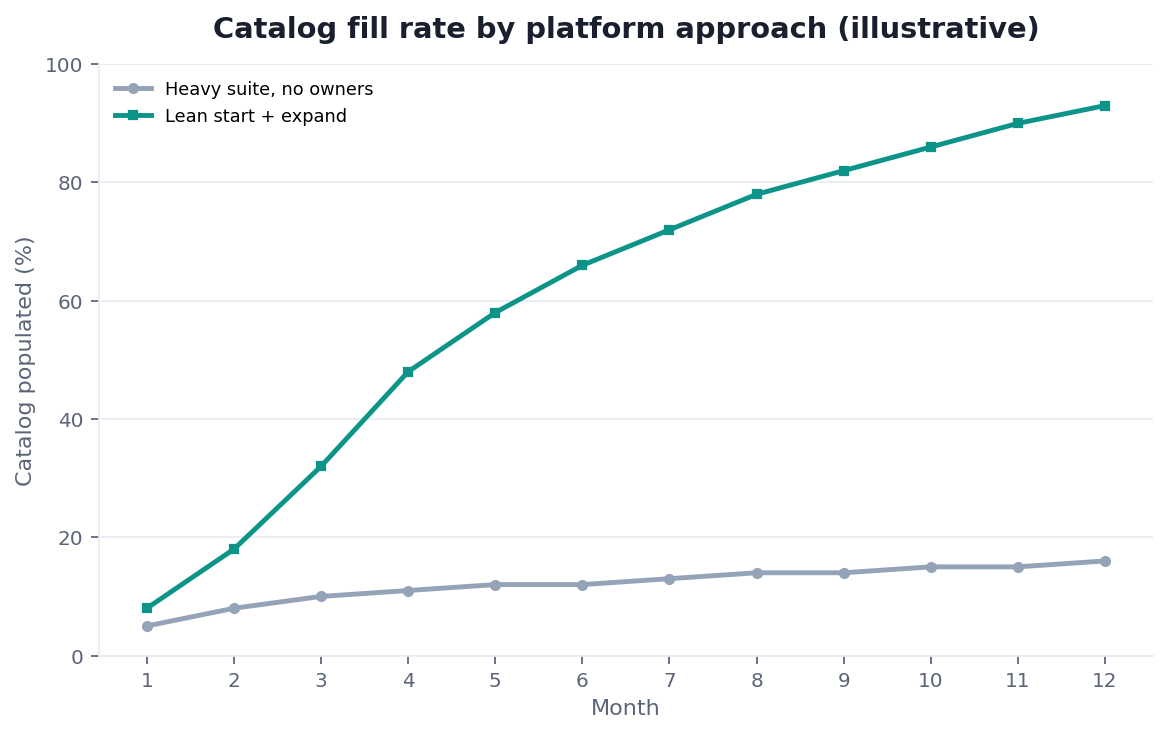 Desk composite (marker DESK-DCP-20260814A): fill rate over 12 months, manual entry vs automated discovery — not a third-party benchmark.
Chart note: two series (manual entry vs automated discovery) over 12 months. Values are our own anonymized composite observations, shown to illustrate the method — not a vendor-commissioned or third-party benchmark. For independent market context, use the Gartner Peer Insights pages cited above rather than this chart.
Reproduce it yourself rather than trusting our number: each month, divide the priority tables holding both a named owner and an approved definition by the total. That ratio predicts adoption in data catalog platforms better than any feature matrix.
Scope note: ratings below are relative fit judgments for common 2026 buyer scenarios, grounded in each vendor's documented scope. Re-validate with a POC on your connectors. This is not a magic-quadrant substitute and not a paid endorsement.
What They Are
Data catalog platforms answer a question that is surprisingly hard at scale: what data do we have, what does it mean, and who owns it? They turn scattered, undocumented data into a searchable, governed inventory.
Key Definition: data catalog platforms are software systems that automatically discover an organization's data assets, capture their metadata — meaning, ownership, lineage, and quality — and make them searchable and governable, so people and systems can find and trust the data they need.
Three metadata layers do that work, and every one of the data catalog platforms below is a bet on how to fill them:
- Technical metadata — schemas, columns, freshness, and usage, harvested by connectors rather than typed by hand.
- Business metadata — definitions, glossary terms, certifications, and owners, contributed by stewards who are not engineers.
- Operational metadata — lineage, job runs, and quality checks that explain how a number was produced.
International standards already formalize this split: the metadata registry framework in ISO/IEC 11179-1:2023 treats data definitions as governed, registered objects rather than free-text notes — the discipline mature data catalog platforms apply to a glossary. Gartner's IT glossary independently defines a data catalog as an organized inventory of data assets that uses metadata so people can find and use data; Wikidata Q16892890 and DCMI Metadata Terms record the same vocabulary lineage that DCAT 3 productizes. Those pages are definitions, not vendor scores, when you shortlist data catalog platforms.
Currency is the distinction that matters. A catalog reflecting last quarter's reality is worse than none, because people trust it and are misled. That is why automated discovery and refresh outrank almost every other checkbox when we compare data catalog platforms. A CAD vault is not a catalog: released drawings and BOMs belong in engineering data management, then the catalog can point at the analytics extract.
Platform Comparison Matrix
Six data catalog platforms come up in almost every shortlist, spanning standalone, cloud-embedded, and open metadata. Official docs:
| Platform | Type | Primary docs |
|---|---|---|
| Alation | Standalone / active catalog | Alation documentation |
| Collibra | Standalone / governance-led | Collibra Data Intelligence |
| Microsoft Purview | Cloud suite (Microsoft estate) | Microsoft Purview data governance |
| Databricks Unity Catalog | Lakehouse-embedded | Unity Catalog docs |
| AWS Glue Data Catalog | Cloud-embedded (AWS) | Glue Data Catalog & crawlers |
| DataHub | Open metadata platform | DataHub docs |
Fit comparison (relative: Strong / Moderate / Limited):
| Criterion | Alation | Collibra | Purview | Unity Catalog | Glue Catalog | DataHub |
|---|---|---|---|---|---|---|
| Auto discovery & refresh | Strong | Moderate–Strong | Strong (Microsoft sources) | Strong (Databricks/Unity assets) | Strong (AWS crawlers) | Strong (when connectors wired) |
| Lineage for analysts | Strong | Strong | Moderate–Strong | Strong inside lakehouse | Moderate (glue/job-centric) | Strong (extensible) |
| Stewardship / glossary UX | Strong | Strong | Moderate | Moderate | Limited | Moderate (UI + custom) |
| Governance / policy hooks | Moderate–Strong | Strong | Strong (Purview controls) | Strong (UC grants) | Moderate (IAM/Lake Formation) | Moderate (policies via ecosystem) |
| Best stack fit | Multi-cloud / heterogeneous | Enterprise governance programs | Microsoft 365 + Azure data | Databricks lakehouse | AWS analytics estate | Engineering-led / multi-tool |
| Open / API extensibility | Moderate–Strong | Moderate | Moderate | Moderate–Strong | Moderate | Strong (open source) |
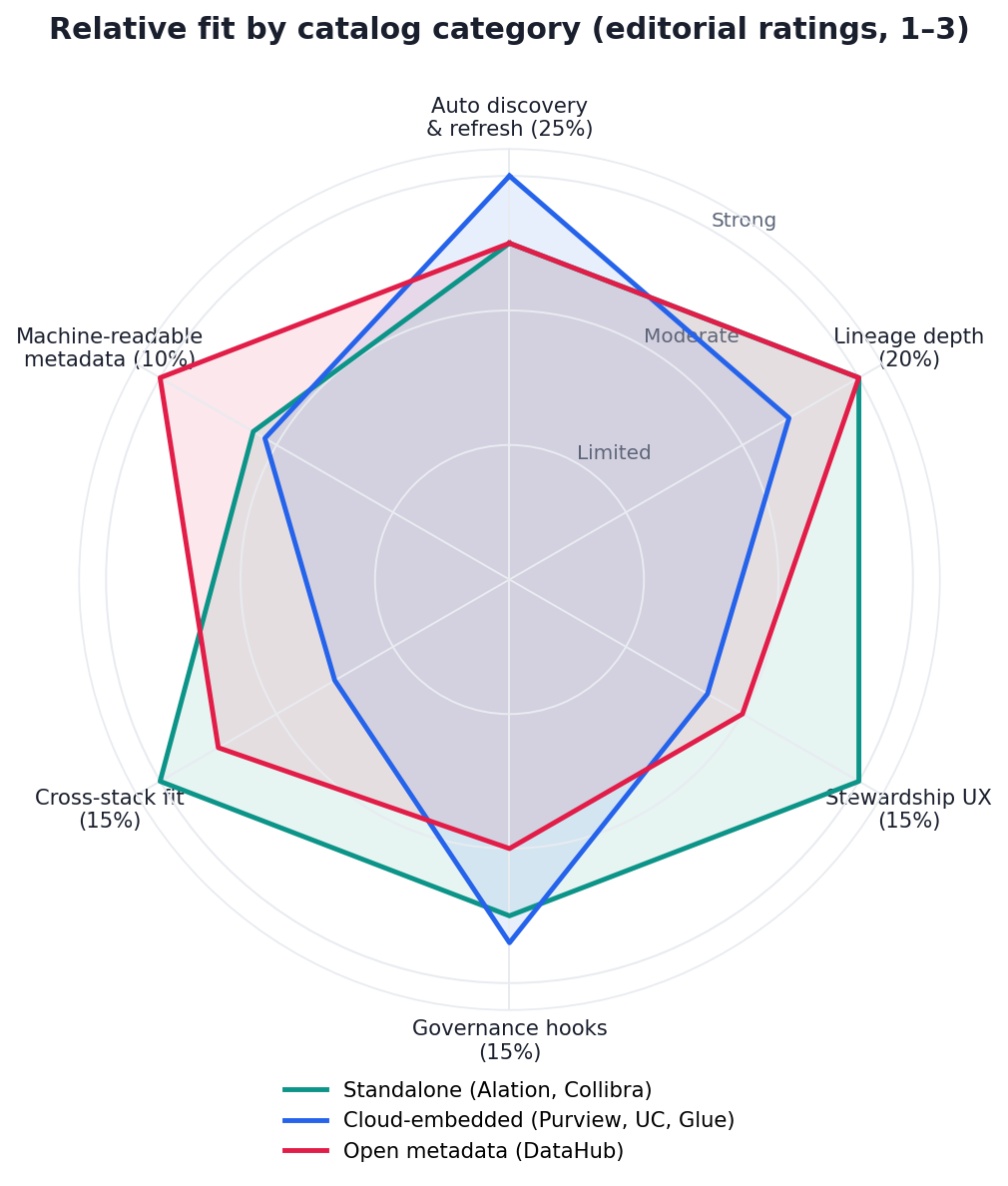 Editorial fit radar (1–3 scale) across standalone, embedded, and open metadata categories — not a lab or analyst score.
Chart note: the radar plots the matrix above on a 1–3 scale (Limited / Moderate / Strong), averaged across the three categories of data catalog platforms, so each trade-off shape is visible at a glance. Ratings are editorial fit judgments from vendor documentation, not measured benchmark scores.
How to read this matrix — four rules keep it honest:
- “Strong” means the documented sweet spot matches that criterion for a typical buyer in that stack; it never means one product wins every bake-off.
- Embedded catalogs are the right default inside their platform, the wrong expectation company-wide.
- Standalone catalogs compete when stewardship and cross-platform governance are the main job.
- Open metadata fits teams willing to staff connectors for full API control.
Category lens (same six platforms):
| Category | Platforms in this guide | Trade-off |
|---|---|---|
| Standalone catalogs | Alation, Collibra | Breadth + stewardship depth; more integration work |
| Cloud / platform-embedded | Purview, Unity Catalog, Glue Catalog | Fastest time-to-value inside one ecosystem; weaker as a universal catalog outside it |
| Open metadata | DataHub | Maximum control and APIs; you own connector and UX investment |
Alation vs Collibra
Alation vs Collibra is the most common head-to-head when buyers shortlist standalone enterprise data catalog platforms. Both cover discovery, glossary, lineage, and stewardship; they differ in default posture.
| Decision factor | Alation | Collibra |
|---|---|---|
| Primary posture | Discovery-first / active catalog | Governance-first / policy & workflow |
| Best when | Analysts must find and trust data across heterogeneous sources | Regulated programs need formal stewardship, approvals, and audit trails |
| Adoption lever | Search, behavioral / query-log signals, collaboration | Role models, workflow engines, policy attachment |
| Typical risk if mismatched | Governance depth under-modeled for audit-heavy industries | Heavy process slows discovery-only teams |
| Stack fit | Multi-cloud / multi-tool estates | Enterprise governance operating models |
| Docs to verify | Alation documentation | Collibra Data Intelligence |
Buyer rule (citable): choose Alation when self-service discovery and usage-driven ranking are the ROI story; choose Collibra when policy enforcement and federated stewardship are the ROI story. If you need both deeply, run a POC on your top five sources and one contested KPI lineage path—do not decide from a feature brochure alone. Independent peer context: Gartner Peer Insights — Data and Analytics Governance Platforms.
Neither product is a universal “winner.” Embedded catalogs (Purview, Unity Catalog, Glue) and open metadata (DataHub) often displace or complement both—see the competitor sections below.
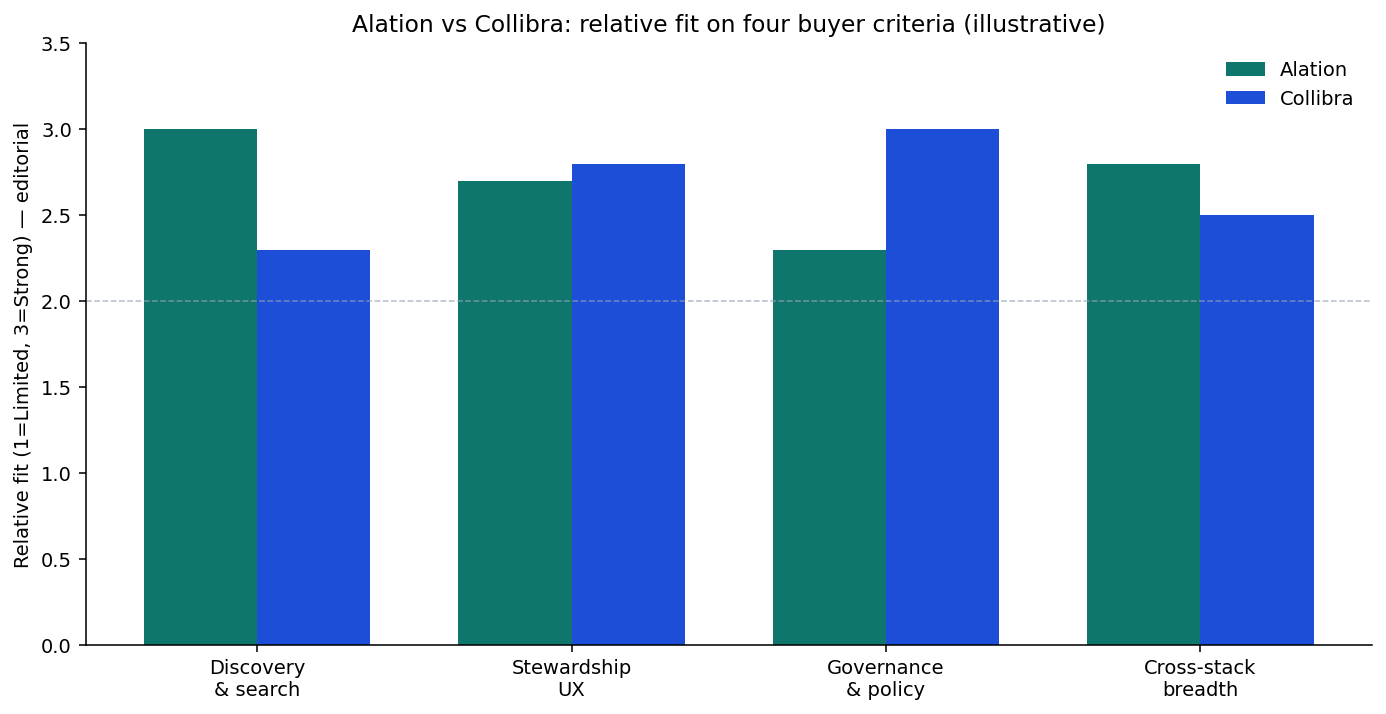 Editorial relative-fit bars for Alation vs Collibra (1–3 scale)—illustrative, not a lab or paid ranking.
Alation Competitors
Buyers searching Alation competitors usually want a shortlist of data catalog platforms that can replace or sit beside Alation—not a marketing “alternatives” page.
| Competitor | Why it shows up vs Alation | Prefer when |
|---|---|---|
| Collibra | Closest enterprise peer; governance-heavier | Policy / audit programs outrank discovery UX |
| Microsoft Purview | Suite economics inside Microsoft estates | Azure + M365 is the center of gravity |
| Databricks Unity Catalog | Lakehouse-native grants and lineage | Most critical assets live in Databricks |
| AWS Glue Data Catalog | Cloud metadata plumbing for AWS analytics | AWS-first foundations, not business glossary UX |
| DataHub | Open metadata, API-first | Engineering owns the metadata plane |
| Atlan (often shortlisted) | Modern collaboration / active metadata narrative | Teams want a lighter, product-led catalog UX—validate connectors in POC |
Practical filter: if Alation lost on governance depth, start with Collibra or Purview. If Alation lost on stack lock-in, start with Unity Catalog or Glue. If Alation lost on build vs buy control, start with DataHub. Re-score using the weighted criteria and the POC table.
Collibra Competitors
Collibra competitors are the platforms buyers evaluate when Collibra feels too heavy, too slow to adopt, or poorly matched to a single-cloud estate.
| Competitor | Why it shows up vs Collibra | Prefer when |
|---|---|---|
| Alation | Closest enterprise peer; discovery-heavier | Analyst adoption and search are the primary ROI |
| Microsoft Purview | Governance + classification in the Microsoft suite | Compliance must live next to Purview controls |
| Databricks Unity Catalog | Native lakehouse governance | Databricks is the system of record for analytics |
| AWS Glue Data Catalog | Foundational AWS metadata | You need crawlers and job metadata, not Collibra-class workflows |
| DataHub | Open alternative for metadata + lineage events | You will staff connectors and steward UX |
| Atlan (often shortlisted) | Active metadata / collaboration alternative | Faster time-to-value for cross-functional data teams—POC required |
Practical filter: if Collibra lost on time-to-adoption, pilot Alation or an embedded catalog on one domain first. If Collibra lost on license + steward cost, model Glue/Unity as plumbing plus a lighter glossary layer—or DataHub if engineering capacity exists. Keep Collibra when formal workflow and policy are non-negotiable.
Platform Profiles at a Glance
Matrices compress. These notes restore the detail buyers ask us for most.
Alation
An active catalog built on search and behavioral signals: query logs and usage decide what surfaces first, which suits estates where nobody can enumerate every source. Check connector coverage for niche systems in the Alation documentation first. For the head-to-head with Collibra and the wider Alation competitors list, see Alation vs Collibra and Alation Competitors. Independent encyclopedia: Wikipedia: Alation. Official site: alation.com.
Collibra
Governance-led, with deep workflow, policy, and stewardship modeling. It fits a formal governance program with defined roles and approval chains, and it is heavier than an engineering team needs for pure discovery. Compare directly in Alation vs Collibra; for substitutes see Collibra Competitors. Independent encyclopedia: Wikipedia: Collibra. Official site: Collibra Data Intelligence.
Microsoft Purview
The default when your estate is Azure and Microsoft 365, because discovery, classification, and access control arrive as one suite. Fit weakens as non-Microsoft sources grow; score cross-stack connectors explicitly. Official docs: Microsoft Purview data governance. Official site: Microsoft Purview.
Databricks Unity Catalog
Governance and lineage native to the lakehouse: grants, tags, and table or column lineage travel with the data. Excellent inside Databricks; not a company-wide glossary when critical data sits elsewhere. Official docs: Unity Catalog. Independent encyclopedia: Wikipedia: Unity Catalog. Official site: Databricks Unity Catalog.
AWS Glue Data Catalog
A foundational metadata store for AWS analytics, populated by crawlers that infer schema and partitions. Treat it as plumbing other tools read, not a business glossary or stewardship interface. Official docs: Glue Data Catalog & crawlers. Independent encyclopedia: Wikipedia: AWS Glue. Official site: AWS Glue.
DataHub
Open-source metadata with a broad API surface and a large connector ecosystem, favored by engineering-led teams that own their metadata model. Budget engineering time for connectors, upgrades, and steward-facing UX. Official docs: DataHub docs. Source and identity: GitHub datahub-project/datahub. Official site: datahubproject.io.
How to Score Candidates
When you shortlist data catalog platforms, run a scored POC — do not stop at a slide comparison.
| POC test (2–4 weeks) | Pass criteria |
|---|---|
| Connect top 5 sources | ≥90% of priority tables appear without hand entry |
| Refresh | Schema change appears within your SLA (for example under 24 hours) |
| Lineage | One critical KPI traced to source in under 15 minutes |
| Steward path | Non-engineer can certify a table and edit glossary |
| Search | Analysts find the certified table in under three queries |
| Machine access | Metadata export/API works for your agent or BI tool |
Publish the scores against the weighted criteria so stakeholders see why a platform won. The best data catalog platforms make cataloging a byproduct of pipelines and queries; anything depending on permanent manual entry will decay however good the demo.
Rollout in Five Steps
Choosing among data catalog platforms is half the job; adoption decides the value. Run the rollout as five ordered steps, each with an exit test.
- Pick one domain people argue about. Revenue, orders, or customers beat a low-stakes sandbox. Done when: a named business owner agrees to arbitrate definitions.
- Wire automated discovery before anyone types. Let connectors populate technical metadata from the systems of record. Done when: ≥90% of that domain's priority tables appear without hand entry.
- Make lineage answer one real question. Trace a KPI leadership already disputes, end to end. Done when: an analyst reproduces the trace in under 15 minutes, unaided.
- Hand stewardship to non-engineers. Definitions, certifications, and ownership belong to whoever is accountable for the numbers. Done when: a steward certifies a table without an engineering ticket.
- Expand only after depth proves out. An empty catalog teaches people to ignore it; one deep domain pulls the next team in. Done when: monthly search sessions grow without new mandates.
Working lineage is usually what makes a catalog indispensable, so we treat data lineage tracking as a rollout milestone, not a later phase.
Buy vs build: buy discovery and lineage plumbing; spend your own effort on definitions, ownership, and adoption. Model the fully loaded cost of data catalog platforms — license plus integration plus steward hours — not sticker price alone.
Common Mistakes and Fixes
Failure patterns across data catalog platforms are consistent, and each has a counter-move:
| Mistake | Why it happens | Fix |
|---|---|---|
| Choosing on feature count | Demos reward breadth, not upkeep | Weight automated discovery at 25% and score it first |
| Relying on manual entry | Cheap to start, invisible to decay | Require a fill-rate target before expanding scope |
| Ignoring stack fit | A lakehouse catalog gets bought for a multi-cloud glossary problem | Score stack fit against your real source inventory |
| Treating it as a compliance artifact | Audit funds it, users do not | Put search usage on the same dashboard as coverage |
| Neglecting search quality | Nobody reports an abandoned search | Test “certified table in three queries” every sprint |
Weigh discoverability as heavily as governance features: a catalog nobody searches is a catalog nobody trusts. When stakeholders ask which of the data catalog platforms “won,” answer with the scored POC sheet, keeping the decision tied to fill rate, lineage, and search.
Catalogs in the Age of AI
AI sharply raises the value of data catalog platforms. An autonomous agent reading your data relies on catalog metadata for meaning and provenance; stale metadata produces confidently wrong answers. The catalog becomes AI infrastructure, not a back-office utility.
Two independent standards keep machine-readable metadata portable rather than proprietary: the W3C's Data Catalog Vocabulary (DCAT 3), a Recommendation since August 2024, describes catalogs, datasets, and services in a model that federates across tools; OpenLineage defines an open event model that pipelines emit as they run. Ask every vendor which of the two it can export.
How governed definitions and lineage travel with data into automated analysis is the pattern in what AI-native data analysis means. Score machine-readability explicitly on every shortlist of data catalog platforms.
Selection Scorecard
Score each candidate on the eight signals that separate durable data catalog platforms from shelfware (1 point each):
| Check | Pass? |
|---|---|
| It discovers data automatically | |
| Metadata refreshes on its own | |
| A steward can add context easily | |
| It traces lineage for critical KPIs | |
| Search is fast and accurate | |
| It fits our primary stack | |
| It applies governance / access hooks | |
| Agents / tools can read its metadata |
6–8: strong choice. 3–5: pilot in one domain. Below 3: keep evaluating.
Common Misconceptions
Misconception 1: A catalog is a one-time inventory. Modern data catalog platforms must stay continuously current.
Misconception 2: More features are better. For data catalog platforms, automated population beats feature count.
Misconception 3: One embedded catalog covers the enterprise. Ecosystem catalogs excel inside their platform; a company-wide glossary may need a standalone or open layer.
Misconception 4: Metadata is only for humans. AI agents rely on catalog metadata too, which is why export formats matter.
Evidence and Editorial Standards
Readers deserve to see what is independently verifiable and what is our own observation. This table sorts every claim about data catalog platforms on this page.
| Claim type | Evidence class | Where to verify |
|---|---|---|
| Product capability and connector scope | Vendor public documentation | The six official docs in the matrix above |
| Metadata definition and registry discipline | Independent standard | ISO/IEC 11179-1:2023 |
| Interoperability and machine-readable export | Independent standard | W3C DCAT 3 Recommendation |
| Lineage event model | Open standard project | OpenLineage specification |
| Fill-rate and adoption figures | First-party composite observation | The ratio in How We Evaluated (not a third-party KPI) |
| Fit ratings and radar shape | Editorial judgment from documented scope | Re-test on your connectors in a POC |
| Peer-verified market reviews | Third-party (Gartner Peer Insights) | Metadata Management Solutions · D&A Governance Platforms |
| Catalog vocabulary (encyclopedia) | Independent encyclopedia | Wikipedia: Data Catalog Vocabulary |
| Product-category definition | Independent analyst glossary | Gartner IT Glossary: data catalog |
| Persistent entity identifier | Independent knowledge graph | Wikidata: DCAT (Q16892890) |
| Shared metadata terms DCAT extends | Independent vocabulary | DCMI Metadata Terms |
Two disclosures belong with it. Ratings are judgments, so we publish the weights and method behind them instead of one opaque score. And InfiniSynapse sells AI-native analysis software, so it has a commercial interest in data catalog platforms: the product appears only in the conclusion, no vendor paid for placement, and nothing here is affiliate-linked.
Frequently Asked Questions
Alation vs Collibra — which should we buy?
Alation vs Collibra is discovery-first vs governance-first. Choose Alation when search, behavioral ranking, and analyst adoption drive ROI. Choose Collibra when policy workflows, stewardship roles, and audit trails drive ROI. Validate with a POC on your connectors—see Alation vs Collibra.
Can Unity Catalog replace Collibra or Alation?
No, not for business stewardship outside the lakehouse. Databricks Unity Catalog is a technical catalog for tables, grants, and lineage inside Databricks. Collibra and Alation still cover glossary, multi-source search, and policy workflows across warehouses, BI, and files. Use Unity plus Alation or Collibra—not Unity alone.
We run a lakehouse. Which data catalog fits best? Give a 3-vendor shortlist.
Shortlist Unity Catalog + Alation + Collibra. Unity Catalog is the lakehouse system of record for tables and grants. Add Alation if analysts must find and certify assets across tools; add Collibra if stewards and audit own the buying motion. Purview is the swap if the estate is already Microsoft-centric.
Alation vs Atlan — when does Atlan win?
Atlan wins when the team wants a modern collaboration UX and faster time-to-first-value than a full Collibra program, and they will not pay Alation’s discovery premium. Alation still leads on behavioral search and analyst adoption at scale. Treat Atlan as an Alation competitor, not a Collibra replacement, unless governance workflows are light.
What are data catalog platforms?
Data catalog platforms inventory an organization's data, record meaning, ownership, and lineage, and make that inventory searchable and governable. Currency is the pass/fail: a stale catalog misleads people and agents.
What are the main Alation competitors?
Typical Alation competitors among data catalog platforms are Collibra, Microsoft Purview, Databricks Unity Catalog, AWS Glue Data Catalog, DataHub, and often Atlan. Prefer Collibra for governance depth; Purview/Unity/Glue for stack fit; DataHub for open control—details in Alation Competitors.
What are the main Collibra competitors?
Typical Collibra competitors are Alation, Microsoft Purview, Databricks Unity Catalog, AWS Glue Data Catalog, DataHub, and often Atlan. Prefer Alation for discovery adoption; embedded catalogs for single-cloud estates; DataHub when engineering will own metadata—details in Collibra Competitors.
Which platforms should we compare in 2026?
Match data catalog platforms to the estate: Alation or Collibra for cross-platform stewardship; Microsoft Purview for Microsoft-centric governance; Databricks Unity Catalog for lakehouse governance; AWS Glue Data Catalog for AWS analytics foundations; DataHub for open metadata APIs you will staff. Score them on your sources.
How do you evaluate them?
Fix weights, run a 2–4 week POC with pass/fail tests, and publish scores. Among data catalog platforms, the one that stays current beats the longest feature list.
How do you roll one out?
Pick a contested domain, wire automated discovery, prove one disputed KPI's lineage, hand stewardship to non-engineers, then expand. Depth with working lineage pulls the next team in.
How do catalogs support AI?
Agents read catalog metadata for meaning and provenance. Prefer data catalog platforms that stay fresh and expose metadata programmatically so AI answers inherit governed definitions.
Do we need a metadata standard like DCAT or OpenLineage?
Yes if metadata must move between tools, feed agents, or survive a platform change. DCAT 3 describes catalogs, datasets, and services; OpenLineage standardizes lineage events. Name both in an RFP.
What does a rollout actually cost?
Model three lines: license or infrastructure, connector and identity engineering, and recurring steward hours. Steward time is missed most often and decides whether coverage holds.
Can open source replace a commercial catalog?
Yes for engineering-led, API-first teams that budget connectors, upgrades, and steward UX. Where non-technical stewardship is the primary job, commercial suites shorten the path.
Conclusion
Data catalog platforms turn scattered data into a trusted, searchable inventory — but only if they stay current and get used. For the common shortlist fight, settle Alation vs Collibra on discovery-first vs governance-first posture, then widen to Alation competitors and Collibra competitors (Purview, Unity Catalog, Glue, DataHub, and peers) with a transparent method, a named fit matrix, and a real POC rather than a feature bake-off: favor automated discovery, pick for stack fit, roll out one domain deeply, and treat the catalog as daily infrastructure for people and AI alike.
To see how governed definitions and lineage travel with data into automated analysis, read what AI-native data analysis means. If you want to try that operating model in practice, the InfiniSynapse web app is free on registration.