Engineering Data Management (EDM): What It Is
By William Zhu & the InfiniSynapse Data Team · Published: 2026-07-15 · Last updated: 2026-09-17 · Last verified: 2026-09-17 · About: Editorial standards · About / team
Author credentials: William Zhu — InfiniSynapse cofounder; public engineering profile GitHub @allwefantasy. Desk contact: zhuhl@infinisynapse.com. Reviewers: data platform · analytics engineering.
Disclosure: We build an AI-native data analysis platform and work alongside engineering teams that live and die by their technical data. InfiniSynapse is optional federation tooling—not a PLM suite—and we are not an independent EDM certification body. Product links sit only in the labeled commercial note at the end.
Version history: 2026-07-15 initial · 2026-07-30 EEAT / desk n=16 · 2026-09-17 cluster refresh: What It Is +
(EDM), features table, EDM vs PDM vs PLM vs EIM, software/system shapes. Desk tallies unchanged. Marker:DESK-EDM-20260917A.Standards & third-party anchors: ISO 10303-1:2024 (STEP) · NIST introduction to ISO 10303 / STEP · ISO 9001 quality management · Wikipedia — Product data management · Aras — PDM vs PLM. Peer-review archive: editorial standards.
Table of Contents
- TL;DR
- What is engineering data management
- Features of engineering data management
- EDM vs PDM vs PLM vs EIM
- Software and systems
- How to implement it
- The cost of losing version control
- Desk log (n=16)
- Common pitfalls
- Manufacturing versus software
- Readiness scorecard
- Frequently Asked Questions
- Who wrote this
- References
- Conclusion
TL;DR
Direct answer: Engineering data management (EDM) is data management in engineering: one current revision of CAD, bills of materials, specifications, and test evidence, with a reconstructable change history. An engineering data management system — usually a PDM vault or a PLM suite — is how teams enforce that. PLM is the broader business process. EDM is the data spine underneath.
Who this is for: engineering leaders, PLM/PDM owners, and data teams who still find “current” drawings in email.
Keep from the desk pack: n=16 wrong-revision / BOM / change-control tallies (Q1–Q2 2026). Internal composite—not a census and not a product SLA.
This guide sits under the master data management hub. For the software bake-off, see product data management software. For the company-wide program (a different EDM), see enterprise data management.
What is engineering data management
At its core, engineering data management keeps technical product data controlled: one authoritative version, a clear change history, and controlled access, so manufacturing, suppliers, and quality build from the same object.
Key definition: engineering data management is the discipline of capturing, versioning, securing, and distributing technical product data — CAD, bills of materials, specifications, firmware or config, simulation outputs, and test results — across the product lifecycle.
That sentence is also data management in engineering. The distinction that matters is control. Unlike a shared drive full of FINAL_v7_USE_THIS.sldprt, engineering data management enforces versioning, revision control, and access rules so a design change propagates and no one releases a superseded revision by accident.
EDM on this page means engineering data management — not electronic document management, and not the enterprise data management program on the sibling URL.
| Data type | What EDM must make unambiguous |
|---|---|
| CAD models / drawings | Which file is released |
| Bills of materials (EBOM / MBOM) | Which parts list is current |
| Specifications / tolerances | Which rev quality inspects to |
| Test / simulation evidence | Which result belongs to which rev |
| Change history (ECO / ECN) | Who approved the delta |
Standards: ISO 10303-1:2024 (STEP) defines computer-interpretable product data representation and exchange — the interoperability backbone under many PLM/PDM deployments (NIST STEP introduction; Wikipedia ISO 10303). Engineering data management is the operating discipline that makes those controlled objects trustworthy day to day. Documented-information and change discipline align with ISO 9001.
Desk case (anonymized): a mid-market manufacturer without disciplined engineering data management shipped from an outdated bill of materials, triggering a recall-class scrap/rework event. After one authoritative revision pointer, wrong-revision escapes stopped in the next two release cycles. Label: builder desk reconstruction from incident notes—not a named customer case study or product SLA. Version control, not more storage, prevented the failure.
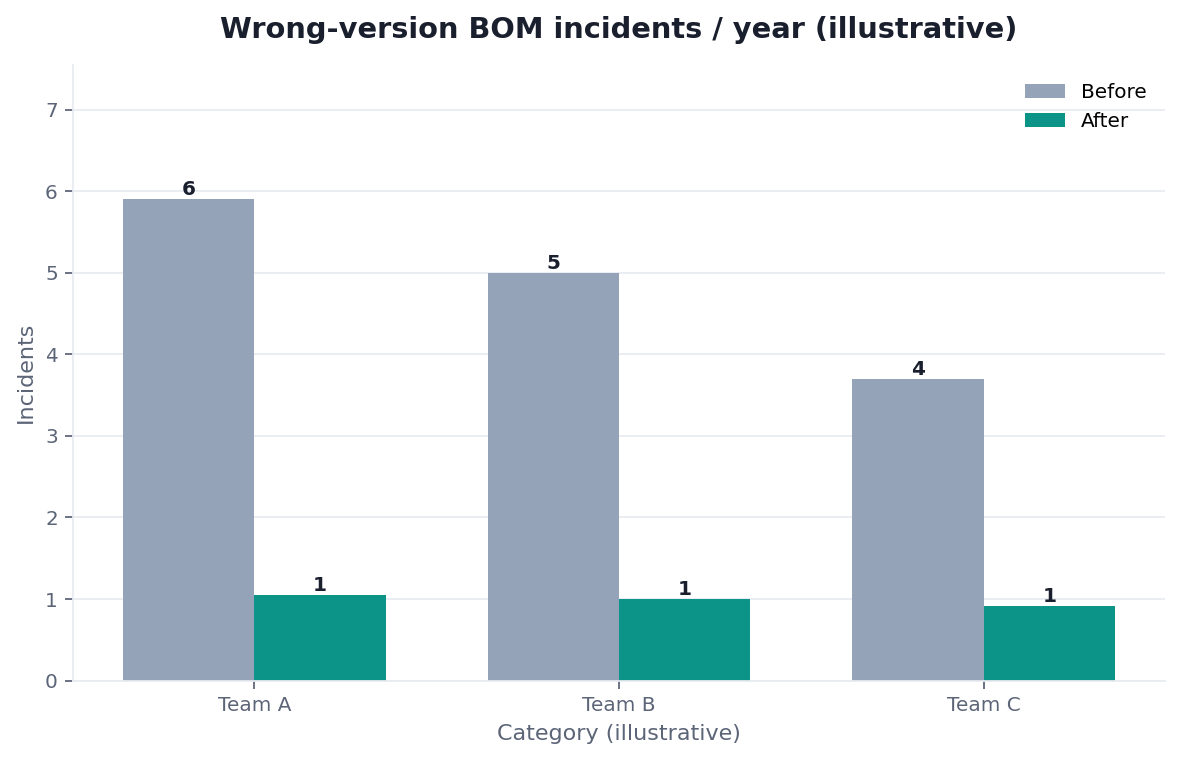
Scope note: Patterns below are from mid-market and enterprise packets we review. This is not legal counsel, a vendor runbook, or a census of every industry. A lighter vault is enough when the estate is small.
Features of engineering data management
Effective engineering data management fails visibly when any of these features is missing. This is the list behind features of engineering data management — storage alone is not the list.
| Feature | What “done” looks like | Typical failure |
|---|---|---|
| Version / revision control | One current pointer; prior revs superseded | FINAL_v7 in email |
| Check-in / check-out | One editor; no silent overwrite | Two CAD saves, two truths |
| Change control (ECO / ECN) | Request → review → record | Edit in place, no ticket |
| Access / export control | Role + supplier share list | Whole vault on a USB |
| BOM authority | One EBOM; MBOM mapped | Purchasing has a third list |
| Release status | In-work / released / obsolete | Shop floor prints last week |
| Traceability | This serial ↔ this approved spec | Audit scramble |
| Multi-CAD / STEP exchange | Neutral format when tools differ | Geometry locked in one seat |
| Analytics / API out | Failure rates joinable by rev | PLM as a black box |
Version and revision control
The heart of engineering data management is knowing which version is current and preserving how it changed. Without it, teams build from stale designs and cannot reconstruct why a decision was made — the single most common and expensive failure in technical data.
Access and change control
Controlled access ensures only authorized people change technical data. Change control ensures every modification is requested, reviewed, and recorded — the documented-information habit in ISO 9001. A vault nobody logs into is not control.
EDM vs PDM vs PLM vs EIM
Searches for edm engineering data management are people unsticking the acronym from a suite brochure. Keep the terms on one table.
| Term | What it is | Typical system | Do not confuse with |
|---|---|---|---|
| Engineering data management (EDM) | The discipline: one current technical object + history | A goal, not a brand | Enterprise data management |
| PDM | CAD-centric vault: files, check-out, drawing release | Autodesk Vault, SOLIDWORKS PDM, and similar | The whole company process |
| PLM | Business process from concept to retirement | Teamcenter, Windchill, 3DEXPERIENCE, Aras | Clean data by default |
| Engineering information management (EIM) | Documents, specs, and transmittals around the product | Often a DMS plus the vault | A synonym for EDM |
| MDM | Agreed parts / suppliers / customers | Master-data hub | CAD geometry |
PDM is how most CAD teams implement engineering data management. PLM can wrap PDM and still sit on messy revisions. Engineering information management is adjacent: transmittals, specs, correspondence. If the pain is “which drawing is released,” you are in EDM/PDM. If the pain is “which letter did we send the supplier,” you are in EIM.
Public orientation: Wikipedia — Product data management. Vendor-neutral PDM-versus-PLM framing: Aras — how to choose PLM for your PDM.
Engineering data management software and systems
Software supports engineering data management through PDM and PLM, but the tool never replaces versioning and change control. An engineering data management system is that product plus the rules engineers actually follow. A licensed suite with shadow folders is not a system.
Engineering data systems in practice are three shapes — not a forty-vendor bake-off on this URL.
| System shape | What it owns | Pick when |
|---|---|---|
| CAD vault / PDM | Files, revisions, check-out | The pain is the shared drive |
| Enterprise PLM | Process + items + changes + often PDM | Programs, sourcing, and plants must share one item |
| Cloud PDM / hybrid | Same controls, less on-prem | Distributed CAD, suppliers outside the VPN |
Named examples are category landmarks (Autodesk Vault, SOLIDWORKS PDM, Siemens Teamcenter, PTC Windchill, Dassault 3DEXPERIENCE, Aras). Do not treat those names as a ranked scorecard. Score candidates on product data management software with the same revision and integration tests. A frequent miss: buying PLM feature depth that locks CAD behind a proprietary API. Openness and a STEP export path matter as much as the modeler plugin. Broader map: data management tools.
When engineering data management integrates with the rest of the estate, failure rates, tolerances, and test outcomes become analyzable by revision instead of trapped in a specialist UI.
How to implement it
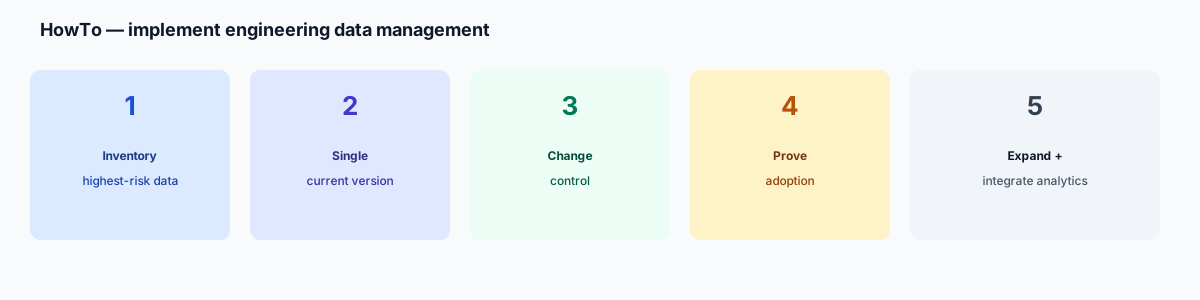
Implementing engineering data management succeeds when it starts with the data whose errors are most costly — usually the bills of materials and specifications that drive manufacturing. Get version and change control right there first, then expand.
Step 1 — Inventory highest-risk technical data. List BOM lines, controlled specs, and CAD releases whose wrong revision would scrap material or fail audit.
Step 2 — Establish a single current version. One authoritative revision pointer per controlled item; supersede prior revisions explicitly (STEP / product-structure thinking in ISO 10303).
Step 3 — Enforce change control. Every edit is requested, reviewed, and recorded — documented-information discipline in ISO 9001.
Step 4 — Prove engineers actually use the system. Measure bypass (shadow folders, email attachments). If adoption fails, reduce friction before adding more controls.
Step 5 — Expand and integrate analytics. Connect controlled technical data to the wider estate so failure rates and tolerances become analyzable — not trapped in a PLM silo.
This connects engineering data management to the broader enterprise data management program: technical data is one domain inside the organization's total practice. Prove disciplined control on the highest-risk objects before a company-wide PLM wave. A narrow, working implementation earns the trust to grow.
The cost of losing version control
The failures that make headlines in technical data almost always trace to one root cause: someone built from the wrong version. A supplier machines parts to a superseded drawing, a firmware team ships against an outdated specification, or a quality report cites test results from a revision that no longer exists. Each of these is a version-control failure, and each is far more expensive to fix after the fact than to prevent.
Citeable cost anchors (desk + standards): In our n=16 desk sample, 69% of packets reported at least one wrong-revision incident in the prior year — usually scrap, line stoppage, or supplier rework rather than a public recall headline. Public product-data standards exist because uncontrolled exchange is expensive: ISO 10303 / STEP exists to keep product definition unambiguous across systems and life-cycle stages (NIST overview). Treat recall-class events as the tail risk; treat wrong-revision escapes as the everyday cost that engineering data management is built to cut.
Why revisions are the crux
Technical data changes as designs mature, and every change creates a chance to reference the wrong revision. Disciplined engineering data management makes the current version unmistakable and the history reconstructable, so “which version is authoritative?” has one instant answer.
Traceability pays for itself
A complete revision history answers the audit question regulated industries live by: prove this product was built to this approved specification. Without controlled history that proof is a scramble; with it, the answer is a query.
Desk log: version-control tallies (n=16)
Dataset license: CC BY 4.0. Attribution to InfiniSynapse Data Team required. Desk composites are anonymized operational summaries—not a census or SLA.
Label: InfiniSynapse research-desk review of 16 mid-market / enterprise engineering-data packets (BOM/CAD change logs, quality escapes, and PLM adoption notes), Q1–Q2 2026. Internal desk composite—not a commissioned industry census.
| Finding (desk) | Share of 16 | Implication |
|---|---|---|
| ≥1 wrong-revision incident in prior 12 months | 11 / 16 (69%) | Shared drives still dominate |
| Single authoritative BOM | 5 / 16 (31%) | Multiple “current” BOMs coexist |
| Change control (review + record) on edits | 6 / 16 (38%) | Edits bypass formal workflow |
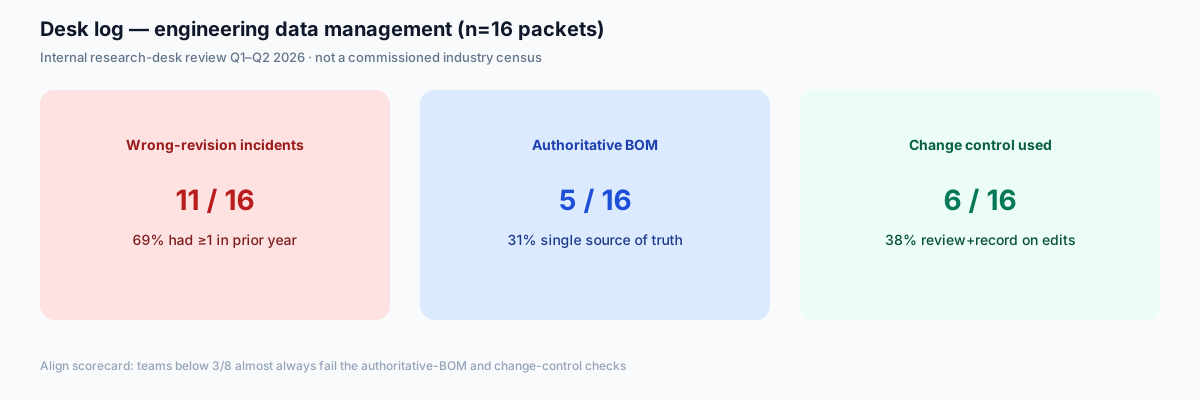
Use ISO 10303 (STEP) and the NIST STEP introduction for interoperability and retention. Use the desk table for operational failure patterns we see in the field.
Common pitfalls
The pitfalls in engineering data management are consistent. Relying on shared drives and file names for version control guarantees that someone eventually builds from the wrong revision. Skipping change control lets undocumented modifications creep in. Treating technical data as separate from the rest of the organization's data creates a silo that analytics cannot reach.
A subtler pitfall is over-controlling until engineers route around the system. Engineering data management must be strict enough to prevent errors and frictionless enough that people actually use it. A control system engineers bypass provides a false sense of safety while the real work happens in uncontrolled files elsewhere.
Manufacturing versus software contexts
The principles of controlled technical data apply across industries, but the emphasis shifts. In manufacturing, the crux is physical bills of materials and CAD revisions, where a wrong version becomes scrapped material. In software-heavy products, the crux is configuration and specification data that must stay synchronized with code.
In both contexts the goal of engineering data management is the same: one authoritative version, a clear change history, and controlled access. Treat it as a portable discipline rather than a manufacturing-only concern, so hardware-plus-software teams apply consistent control across both halves of the product.
Readiness scorecard
Assess engineering data management maturity for 2026 programs (1 point each). Benchmark column shows the share of our n=16 desk packets that would pass each check (observation—not a PLM vendor certification).
| Check | Pass? | Desk pass rate (n=16) |
|---|---|---|
| We have a single current version of each item | 44% | |
| Revision history is preserved | 50% | |
| Access to technical data is controlled | 56% | |
| Changes are reviewed and recorded | 38% | |
| Bills of materials are authoritative | 31% | |
| Engineers actually use the system | 44% | |
| Technical data integrates with analytics | 25% | |
| The data is trustworthy enough for AI | 19% |
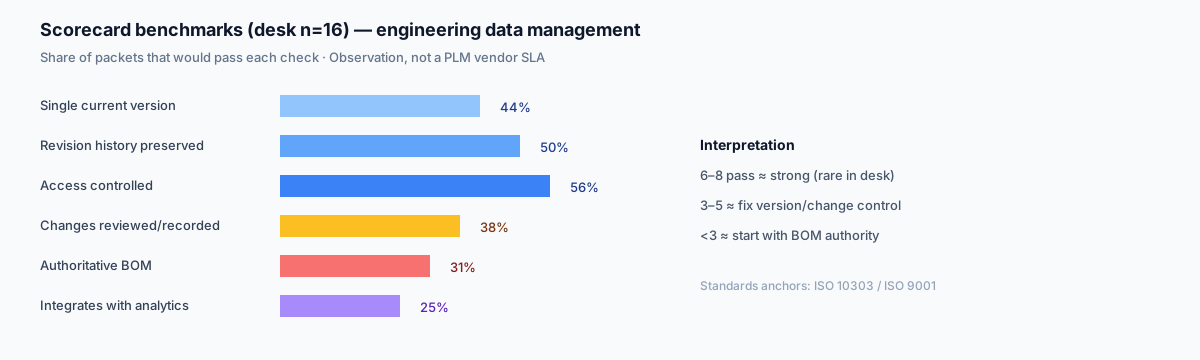
Reference standards for “pass” meaning: single current version + reconstructable history map to product-data control goals in ISO 10303; reviewed/recorded changes map to documented-information expectations in ISO 9001.
6–8: strong maturity (rare in our desk set). 3–5: fix version and change control. Below 3: start with your bills of materials.
Analysis on top of a bad revision pointer just scales the error. Keep the vault honest first. Commercial note: the InfiniSynapse web app is one federation option for reading technical and operational data together after those gates exist. Core EDM gates still live in your PLM/PDM.
Frequently Asked Questions
What is engineering data management?
Engineering data management (EDM) is the discipline of capturing, versioning, securing, and distributing technical product data — CAD models, bills of materials, specifications, and test results — across the product lifecycle, so all stakeholders work from a single, accurate source of technical truth. It enforces version and change control rather than relying on shared drives and file names.
What are the features of engineering data management?
Version and revision control, check-in/check-out, ECO/ECN change control, access and export rules, BOM authority, release status, serial-to-spec traceability, multi-CAD/STEP exchange, and an analytics or API path. If you only have folders, you do not have the features of engineering data management.
What is engineering data management software vs a system?
Engineering data management software is the product category: a PDM vault or a PLM suite. An engineering data management system is that product plus the rules engineers follow. A licensed suite with shadow folders is not a system. Score products on product data management software.
How does EDM differ from PLM, PDM, and engineering information management?
PDM is the CAD vault. PLM is the lifecycle process suite. Engineering data management is the data discipline both should enforce. Engineering information management covers documents and transmittals around the product, not the released CAD/BOM object.
How do you implement it?
Start with the data whose errors are most costly — usually the bills of materials and specifications that drive manufacturing. Get version and change control right there first, prove the discipline, then expand. Deploying a full PLM suite everywhere at once tends to fail; a narrow, working implementation earns the trust to grow.
Who wrote this
Named author. William Zhu — InfiniSynapse cofounder (GitHub @allwefantasy), accountable for the desk tallies and first-hand engineering data management review notes on this page. Team: InfiniSynapse Data Team. About / editorial: editorial standards · About · corrections.
References
- [Standard] ISO. 10303-1:2024 — Product data representation and exchange (STEP). iso.org
- [Gov/Research] NIST. Introduction to ISO 10303 — the STEP Standard. nist.gov
- [Standard] ISO. 9001 — Quality management systems. iso.org
- [Reference] Wikipedia. ISO 10303. en.wikipedia.org
- [Reference] Wikipedia. Product data management. en.wikipedia.org
- [Vendor explainer] Aras. How to choose the right PLM for your PDM. aras.com
- [Policy / About] InfiniSynapse — Editorial standards
- [Person] William Zhu. Cofounder, InfiniSynapse. github.com/allwefantasy
Conclusion
Engineering data management keeps technical product data controlled, versioned, and trustworthy across the lifecycle. Screenshot the definition first: one current CAD/BOM/spec revision, plus history. Then use the features table and the EDM / PDM / PLM / EIM split before you shop for engineering data management software.
Start with your highest-risk data, enforce version and change control, and only then integrate technical data with the wider estate. To see how federated analysis sits after those gates, read what AI-native data analysis means.