Product Data Management Software: A 2026 Guide
By the InfiniSynapse Data Team · Last updated: 2026-07-15 · We build an AI-native data analysis platform and work with product and engineering teams controlling technical data; this guide reflects how product data management software actually helps in 2026.
Table of Contents
- TL;DR
- How We Approach It
- What It Is
- Core Capabilities
- How to Choose It
- PDM Versus PLM
- Common Mistakes
- PDM in the Age of AI
- Selection Scorecard
- Common Misconceptions
- Frequently Asked Questions
- Conclusion
TL;DR
Direct answer: product data management software is the tooling that controls a product's technical data — CAD models, bills of materials, revisions, and specifications — so everyone works from one authoritative version. In 2026, the right product data management software is the one your engineers actually use and that connects product data to the wider business, not the one with the deepest feature list.
Who this is for: engineering and product leaders evaluating product data management software in 2026.
What you'll learn: what it does, its core capabilities, how to choose it, how it differs from PLM, and how it connects to AI analysis.
This guide sits under the master data management hub.
For the broader discipline, see engineering data management.
Also see data management software.
How We Approach It
Teams evaluating this topic often cross-check Google SRE book for a durable, vendor-neutral reference point.
We treat product data management software as version control and governance for technical product data. Every recommendation reflects what we see when engineering teams adopt PDM well or work around it. We anchor definitions to the IBM augmented analytics overview and align control expectations with the quality-management framing in pandas documentation, which treats controlled technical documentation as a cornerstone of quality.
The table below maps what product data management software controls.
| Capability | What it manages |
|---|---|
| CAD control | Design files and versions |
| Bills of materials | Product structure |
| Revisions | Change history |
| Access | Who can view and edit |
| Release | What is approved to build |
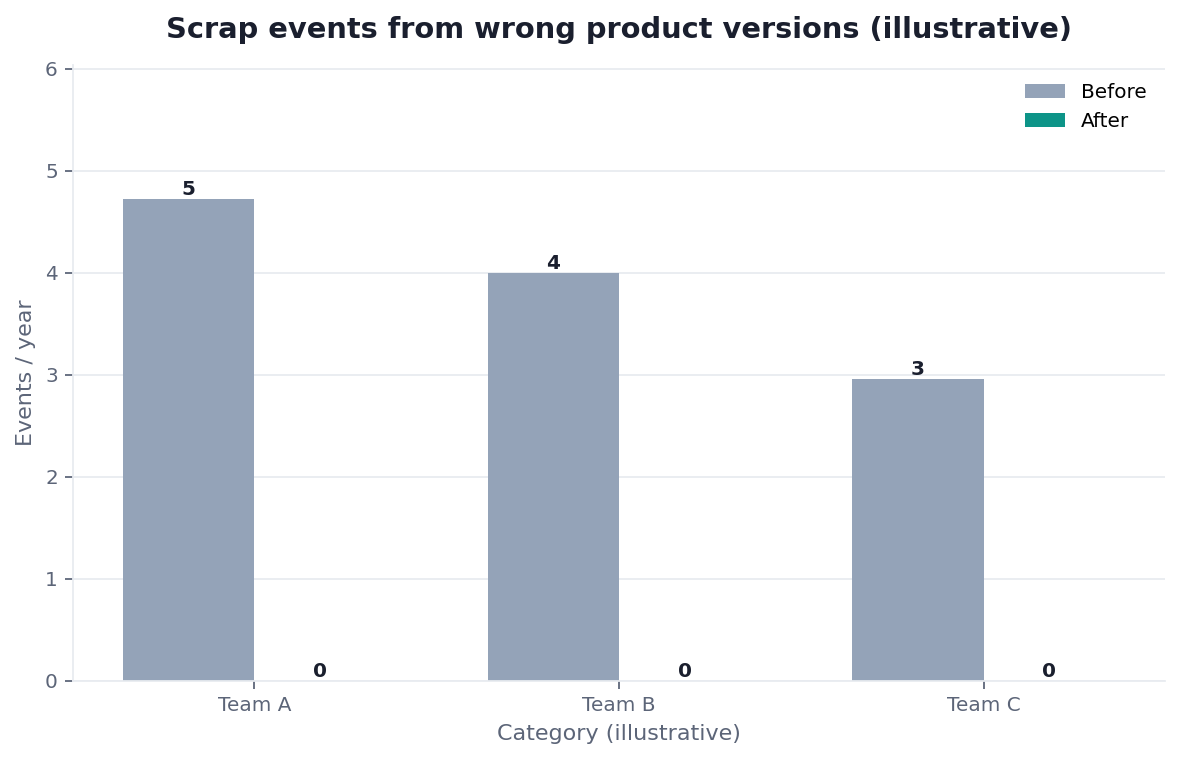
Practical example: a hardware team using shared drives instead of product data management software built a batch from a superseded CAD file, scrapping the run. After adopting PDM with enforced revision control — aligned with lifecycle patterns like AWS Well-Architected Machine Learning Lens — the wrong-version failure ended. Enforced versioning, not more storage, prevented the waste.
Scope note: This guide reflects patterns we see when mid-market and enterprise teams work with product data management software in 2026. It is not a substitute for legal counsel, vendor runbooks, or a formal survey of every industry — and when a smaller toolset or lighter process would serve, a full program is overkill.
What It Is
At its core, product data management software keeps a product's technical data controlled: one current version, a full revision history, and controlled access, so nobody builds from a stale or unapproved file.
Key Definition: product data management software is the tooling that captures, versions, secures, and releases a product's technical data — CAD models, bills of materials, specifications, and revisions — so all stakeholders work from a single, authoritative, approved source of product truth.
The distinction that matters is control versus storage. A shared drive holds files; product data management software enforces which version is current, who may change it, and what is approved to build. That enforcement is the entire point, because in technical data an uncontrolled file is an accident waiting to happen.
Core Capabilities
Architecture choices are often checked against Microsoft Excel support so boundaries, ownership, and scale patterns stay explicit.
Effective product data management software rests on a few capabilities that each fail visibly when missing.
Version and revision control
The heart of product data management software is knowing which version of a design or bill of materials is current and preserving the history of changes. The connectivity patterns in Wikipedia statistics overview show how controlled files flow to downstream systems, and without this control, teams build from stale data and cannot reconstruct why a change was made.
Access and release control
Access control ensures only authorized people change product data, and release control ensures only approved versions reach manufacturing. Together these capabilities of product data management software turn a pile of files into a governed source of truth, so the version someone builds from is always the version the organization intended.
How to Choose It
Choosing product data management software comes down to whether your engineers will actually use it, how well it controls your specific technical data, and how it connects product data to the wider business. A tool engineers bypass provides false safety while real work happens in uncontrolled files.
We recommend scoring candidates on usability for engineers, revision-control rigor, and integration with the rest of your estate. This is where product data management software connects to the broader engineering data management discipline, because controlled product data is most valuable when the rest of the business can analyze it — correlating field failures with revisions, for instance — rather than leaving it locked in an engineering silo.
PDM Versus PLM
Implementation details are commonly grounded in Snowflake Cortex Analyst when teams translate concepts into production practice.
Buyers often confuse product data management software with product lifecycle management (PLM) software, and clarifying the difference prevents overbuying. PDM focuses on controlling technical product data; PLM manages the entire product lifecycle from concept to retirement, including process, projects, and collaboration.
PDM is often a capability within a PLM suite, focused specifically on the data. Enterprise adoption patterns from Azure architecture center reinforce that starting with the data-control problem is usually wiser than buying a full lifecycle suite before you need it. Many teams need disciplined product data management software long before they need the process and collaboration breadth of full PLM, so matching the tool to the actual problem avoids paying for capability that sits unused.
Common Mistakes
The mistakes we see with product data management software are consistent. Choosing on feature depth while ignoring engineer usability produces a tool people route around. Buying full PLM when the real need is data control wastes money and adds complexity. And treating product data as separate from the rest of the business locks valuable data in a silo.
A subtler mistake is deploying product data management software without the discipline to match. The tool enforces versioning, but the organization must still decide its release process and revision conventions; without those decisions, even good software produces inconsistent control. We treat the process decisions as inseparable from the tool, because software enforces rules but cannot invent the rules the business has not yet agreed.
When You Outgrow Shared Drives
Implementation details are commonly grounded in Snowflake documentation when teams translate concepts into production practice.
Most teams do not start with product data management software; they start with a shared drive and file-naming conventions, and that works until it suddenly does not. The signal that you have outgrown it is usually a costly mistake — a batch built to the wrong revision, a supplier sent a superseded drawing, or an audit that cannot prove which version was approved.
Recognizing the tipping point
The tipping point is when the informal system's failures start costing real money or credibility. Before that, discipline and naming conventions may be enough; after it, the cost of a single wrong-version incident dwarfs the cost of proper tooling. Recognizing this early, rather than after the expensive mistake, is what separates teams that adopt PDM deliberately from those that adopt it in a panic.
Migrating without chaos
The migration itself needs care, because dumping years of loosely organized files into a new system just relocates the mess. The reliable approach is to establish the current authoritative version of each active item first, bring those in cleanly, and archive the rest, so the new system starts trustworthy rather than inheriting the ambiguity that prompted the move.
Deployment and Ownership
Product data management software ships in cloud, on-premises, and hybrid forms, and the choice matters more for engineering data than for many other categories because of file size, intellectual-property sensitivity, and the need to integrate with CAD tools that may run locally.
The pragmatic rule is to match deployment to how your engineers actually work and how sensitive your designs are. Highly regulated or IP-sensitive work often favors on-premises or private deployment, while distributed teams lean toward cloud for access. Whatever the model, insist that the data and its history belong to you and remain exportable, so the tool serves your product rather than trapping your product's history inside a vendor's format.
PDM in the Age of AI
Core definitions remain usefully summarized in Wikipedia ETL overview for shared vocabulary across stakeholders.
AI raises the value of product data management software by making controlled technical data analyzable at scale. When an AI agent can read versioned, approved product data alongside business data, it can answer questions no single tool could — linking warranty claims to specific design revisions, for example. But this depends on the data being controlled and trustworthy.
An AI-native platform helps by reading across sources — technical and business — without forcing a fragile consolidation first, an approach we describe in what AI-native data analysis means. In the InfiniSynapse web app, zero-config federation lets an agent analyze product and operational data together, so disciplined product data management software directly expands what automated analysis can discover.
Selection Scorecard
Score each candidate (1 point each):
| Check | Pass? |
|---|---|
| Our engineers will actually use it | |
| It enforces revision control | |
| It controls our CAD and bills of materials | |
| It manages release approval | |
| It fits the problem, not overbuilt PLM | |
| Product data connects to the business | |
| We have agreed our release process | |
| Its data is trustworthy for AI |
6–8: strong choice. 3–5: confirm usability and process. Below 3: keep evaluating.
Common Misconceptions
Misconception 1: It is just file storage. Product data management software enforces versioning and release, not mere storage.
Misconception 2: You need full PLM. Often data control is the real need.
Misconception 3: The tool sets your process. You must decide release and revision conventions.
Misconception 4: Product data belongs in a silo. It is most valuable analyzed with business data.
Frequently Asked Questions
What is product data management software?
Product data management software is the tooling that captures, versions, secures, and releases a product's technical data — CAD models, bills of materials, specifications, and revisions — so all stakeholders work from a single, authoritative, approved source of product truth. Unlike a shared drive, it enforces which version is current, who may change it, and what is approved to build.
What are its core capabilities?
The core capabilities are version and revision control (knowing which design or bill of materials is current and preserving change history), access control (only authorized people change data), and release control (only approved versions reach manufacturing). Together they turn a pile of files into a governed source of truth, so the version someone builds from is always the version the organization intended.
How do you choose it?
Score candidates on usability for engineers, revision-control rigor, and integration with the rest of your estate. A tool engineers bypass provides false safety while real work happens in uncontrolled files, so usability is decisive. Controlled product data is most valuable when the wider business can analyze it, so favor tools that connect product data rather than locking it in an engineering silo.
How does PDM differ from PLM?
PDM is the discipline of keeping technical product data controlled and versioned, whereas PLM spans the whole product journey from concept through retirement, adding process, project, and collaboration management on top. In practice, data control is usually one module inside a broader lifecycle suite. Because many teams need rigorous version control well before they need the full breadth of lifecycle management, matching the purchase to the real problem avoids paying for capability that will sit unused for years.
Why does it matter for AI analysis?
Controlled technical data becomes analyzable at scale. When an AI agent reads versioned, approved product data alongside business data, it can link warranty claims to specific design revisions or spot patterns no single tool would surface. This depends on the data being controlled and trustworthy, making disciplined product data management software a prerequisite for reliable AI-driven analysis of technical and business data together.
Conclusion
Product data management software keeps a product's technical data controlled, versioned, and approved — and in 2026 it is what lets AI analyze technical and business data together. Choose the tool your engineers will actually use, match it to the data-control problem rather than overbuying PLM, and connect product data to the wider business.
To see how federated, trustworthy data becomes automated analysis, read what AI-native data analysis means and try the InfiniSynapse web app free on registration.