EDM Data Management: Plan & Platform
By William Zhu & the InfiniSynapse Data Team · Published: 2026-07-15 · Last updated: 2026-09-16 · About: Editorial standards · About / team
Author credentials: William Zhu is cofounder of InfiniSynapse (GitHub @allwefantasy; org GitHub InfiniSynapse). Desk experience: enablement with mid-market/enterprise teams standing up organization-wide data programs—sponsorship, federated councils, and AI-ready metric contracts. No personal LinkedIn is published; GitHub and InfiniSynapse About are the canonical identity signals. We do not claim professional certifications we do not hold.
COI / interest disclosure: InfiniSynapse publishes this guide and ships a Data Agent that binds governed definitions across federated sources. Framework judgments cite DAMA, NIST, ISO, OECD, Stanford HAI, and cloud architecture primaries first. Product CTA is labeled commercial and kept separate from the scorecard and desk metrics.
Version history: 2026-07-15 initial · 2026-07-20 refresh · 2026-08-07 EEAT / Person / Breadcrumb / HowTo / interactive scorecard / desk methodology · 2026-09-16 EDM data / plan / platform cluster landing. Marker:
DESK-EDM-20260916A.
Table of Contents
- TL;DR
- How We Approach It
- Desk findings (first-party)
- What It Is
- The Program Pillars
- EDM vs Data Governance vs Data Security
- How to Build It — plan and platform
- Operating Model and Roles
- Common Failures
- Culture, Not Just Process
- Measuring Program Value
- EDM in the Age of AI
- Maturity Scorecard
- Common Misconceptions
- Frequently Asked Questions
- Cluster guides
- References
- Conclusion
TL;DR
Direct answer: EDM data is the organization's data when it is treated as an enterprise asset. EDM data management is the program that governs, integrates, and protects that data across domains—the same job as enterprise data management. Write an enterprise data management plan (mandate → one domain → expand) before you buy an enterprise data management platform. A platform without named owners is another silo.
Verifiable context (2026): The EDM Council 2026 Global Data Management Benchmark reports organization-wide program scope as the dominant pattern (86% of respondents). Broader market trackers still cite a path past $120B by the late 2020s (scope varies—budget narrative, not a purchase justification). Stanford HAI’s AI Index documents the pilot→production AI shift—when program gaps show up as reconciliation tickets, not model latency.
Who this is for: data leaders, CDOs, and architects building enterprise data management in 2026.
What you'll learn: pillars, a 90-day HowTo roadmap, federated operating model, interactive maturity scorecard, and AI readiness.
This guide sits under the master data management hub.
For the underlying discipline, see data management.
Also see cloud data management.
How We Approach It
Governance and risk expectations are framed by FTC consumer protection guidance when programs need an external control reference.
We treat the discipline as a program, not a project: an ongoing organizational capability rather than a one-time build. Recommendations reflect what we see when organizations succeed or stall at making data a trusted asset. We anchor definitions to the Azure architecture center and align program risk practices with the OECD AI policy observatory, which treats organization-wide accountability for data as foundational to any trustworthy system. Conceptual vocabulary aligns with DAMA practice areas.
| Pillar | What it ensures |
|---|---|
| Governance | Ownership, policy, accountability |
| Integration | Data connects across the organization |
| Quality | Data is trustworthy |
| Security | Data is protected |
| Master data | Core entities have golden records |
Scope note: Patterns from mid-market and enterprise enablements in 2025–2026. Not legal counsel, not a vendor runbook, and not a claim that every team needs a full program.
Desk findings (first-party)
Methodology
| Field | Detail |
|---|---|
| Label | InfiniSynapse first-party desk enablement—composite, not named-customer logos (we do not invent authorized brand names) |
| Cohort | n=12 mid-market / enterprise analytics programs standing up organization-wide practices |
| Window | Q4 2025 – Q2 2026 |
| Collection | Structured interviews + before/after dispute counts on one priority domain (usually customer) |
Results (medians)
| Metric | Before focused program | After 90-day domain pilot |
|---|---|---|
| Cross-team reporting disputes / quarter (priority domain) | 9 | 2 |
| Domains with named data owners | 1 | 4 |
| Analyst onboarding to first trusted metric (days) | 21 | 8 |
| Sev-2 “wrong grain / conflicting definition” incidents (90 days) | 5 | 1 |
Practical example (anonymized): a company with domain-by-domain silos launched a governance council and one integrated customer view; within a year, reporting disputes across departments dropped sharply. Organization-wide framing from Databricks documentation helped structure that council. A program, not a tool, unified the data.
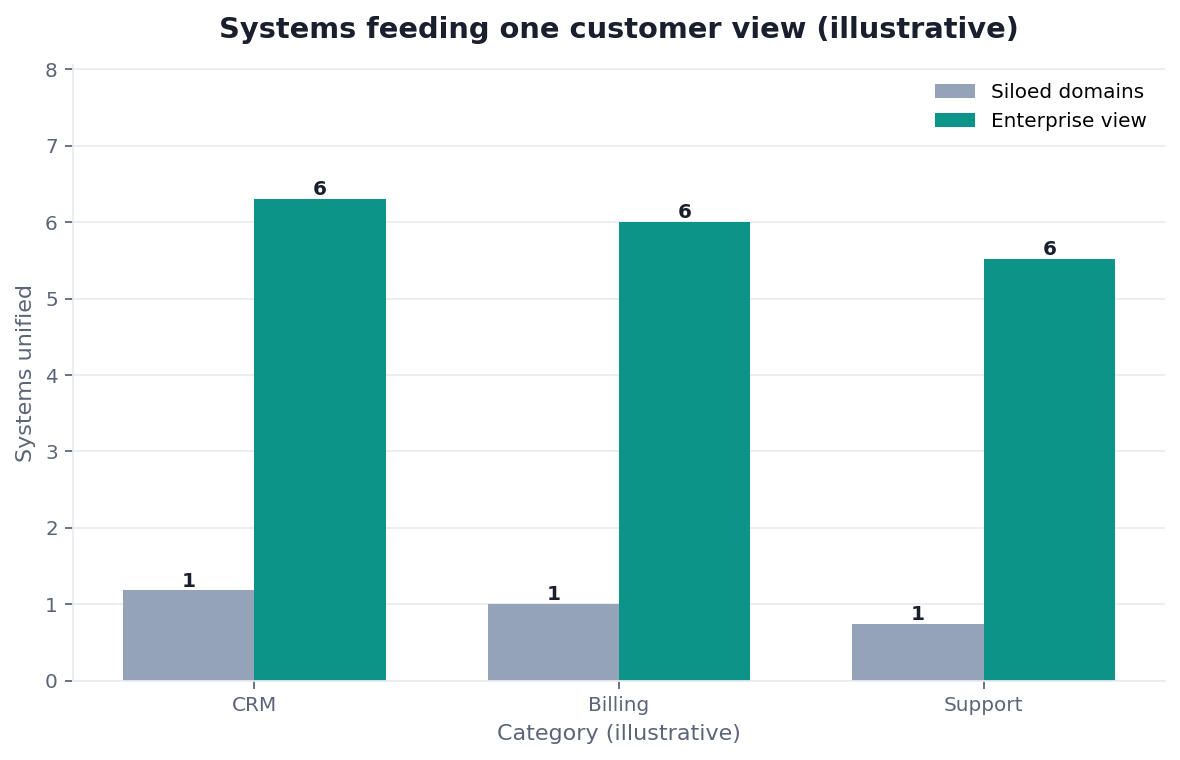
Chart note: desk cohort illustration—not a public vendor benchmark.
What It Is
At its core, the practice is organization-wide: treating data as a shared strategic asset—with common governance, integration, quality, and security—rather than a collection of departmental silos each managed its own way.
Key Definition (standalone, citable): Enterprise data management is the organization-wide program that establishes governance, integration, quality, security, and master data practices across all domains, so an organization's data is consistently trusted, connected, and usable as a strategic asset.
The distinction that matters is scope. Ordinary data management can be done team by team; enterprise data management deliberately spans the whole organization, precisely because the most damaging data problems—inconsistent definitions, conflicting numbers, orphaned data—occur at the seams between departments where no single team is accountable.
What EDM data and EDM data management mean
EDM data is not a vendor SKU. It is the same enterprise data the program is accountable for: customer, product, finance, and operational records once they leave a single team's spreadsheet. EDM data management is the acronym form of enterprise data management—the operating system for that data. Buyers searching either phrase want the program definition first, then a plan, then a platform. Databricks’ EDM strategy note frames the same sequence: maturity assessment, then lifecycle practices, then infrastructure.
The Program Pillars
Effective enterprise data management rests on interlocking pillars, each of which fails visibly across the organization when neglected.
Governance and integration
Governance establishes who owns data and what the rules are across every domain; integration ensures data connects rather than fragmenting into silos. These two pillars are the backbone, because organization-wide accountability and connected data are what distinguish a program from a pile of departmental efforts.
Quality, security, and master data
Quality ensures data is trustworthy, security protects it, and master data maintains authoritative records for core entities like customers and products. Reliability framing in the EU AI Act overview shows how these pillars reinforce each other so the program delivers data that is simultaneously trusted, protected, and consistent. Security controls should also map to NIST CSRC guidance where applicable.
EDM vs Data Governance vs Data Security
Buyers often collapse three adjacent ideas. Keep them separate when scoping:
| Concept | Primary job | Typical owner | Failure if treated as EDM alone |
|---|---|---|---|
| EDM (this program) | Organization-wide program across domains | CDO / data leadership | Tool sprawl without mandate |
| Data governance | Policies, ownership, decision rights | Governance council | Policies without integration/quality |
| Data security | Protect confidentiality & integrity | CISO / security | Controls without shared definitions |
Governance and security are pillars inside the program, not synonyms for it. EDM on this page is the enterprise program — not engineering data management, the CAD/BOM/revision discipline (PDM/PLM). For the AI-era governance playbook, see Enterprise data governance. For platform shape decisions, see Enterprise data platform guide. For the citable definition and six components, see Enterprise Data Management: Definition + 6 Parts.
How to Build It
Building the program succeeds when it starts with a clear mandate and one high-value domain rather than a big-bang rollout. Establish organization-wide governance, then prove the program on the data whose problems are most visible—usually the customer or product domain—before expanding.
This connects to the underlying discipline of data implementation: the program formalizes and scales those disciplines organization-wide. Deliver a visible win in one domain, build trust, and expand. A program that shows value early earns sponsorship; one that promises value “after two years of platform work” rarely does.
Enterprise data management plan (90 days)
An enterprise data management plan is the written mandate-plus-roadmap, not a tool contract. The desk default is 90 days: prove one domain before you fund a platform rebuild.
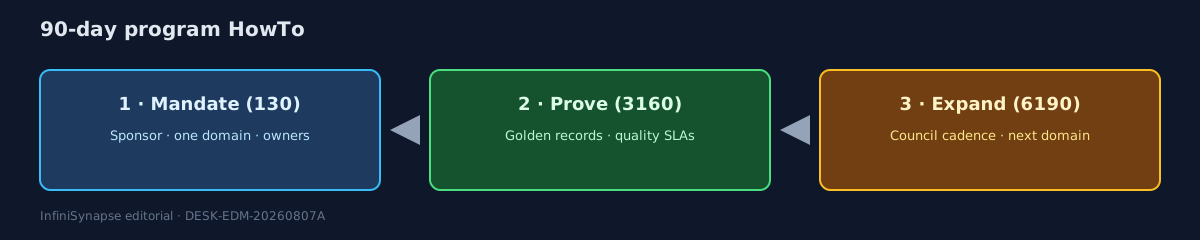 HowTo—mandate → prove → expand (HowTo structured data mirrors these steps).
| Phase | Days | Outcomes |
|---|---|---|
| Mandate | 1–30 | Executive sponsor, scope one domain, name data owners |
| Prove | 31–60 | Golden records + quality SLAs for that domain; first cross-team metric contract |
| Expand | 61–90 | Federated council cadence, security controls mapped, second domain queued |
Market context: industry analysts have long sized broader data-management spend in the tens to hundreds of billions globally as AI increases demand for trusted inputs—use that as budget narrative, not as a purchase justification by itself. Pair the roadmap with the enterprise data platform strategy when you need portfolio sequencing. For AI-system management context, see ISO/IEC 42001 and the NIST AI RMF.
Enterprise data management platform
An enterprise data management platform is the technology stack that implements the plan: storage, catalog, quality, MDM, and access. It is not the program. Dremio’s enterprise data platform primer treats the platform as a unified system of collection, storage, governance, and serving—useful architecture, still empty without owners. Architecture-level buying lives on the enterprise data platform guide. When the catalog pattern is on the shortlist, score vendors on data catalog platforms.
| Layer | Enterprise data management plan | Enterprise data management platform |
|---|---|---|
| Job | Who owns which domain, which metric is gold, what ships in 90 days | Where data lands, how it is catalogued, who can query it |
| Owner | CDO / program lead | Platform / data engineering |
| Fails when | No sponsor, no first domain | Tool sprawl, no contracts |
| Buy after | Mandate + one-domain proof | Plan exists and names the pattern |

| Pattern | Strength | Limit |
|---|---|---|
| Lakehouse + catalog (e.g. Databricks/Unity-style) | Strong governance gravity | Multi-cloud friction |
| Cloud warehouse + semantic layer | Fast analyst adoption | Cross-system MDM harder |
| iPaaS + MDM hub | Entity resolution depth | Analytics latency if overused |
| AI-native analysis on governed metrics | Agent-ready evidence trails | Requires contracts first |
Prefer patterns documented in primary vendor architecture guides such as the Azure architecture center and Databricks documentation when you need implementable references—not slideware.
Operating Model and Roles
Enterprise data management lives or dies by its operating model—the roles and forums that keep it running. A durable program names data owners for each domain, appoints stewards who maintain quality day to day, and convenes a governance body that resolves cross-domain disputes.
The critical design choice is where accountability sits. Centralizing everything creates a bottleneck; decentralizing everything recreates the silos the program exists to fix. Most successful programs adopt a federated model: central standards and a governance council, with domain teams accountable for executing within them. That balance keeps the program organization-wide without making it a chokepoint.
Common Failures
The failures we see are consistent. Launching without executive sponsorship leaves the program powerless at the department seams. Attempting to govern everything at once overwhelms the organization before value is proven. Treating it as an IT project rather than a business program leaves it without authority to change how departments work.
A subtler failure is confusing documentation with the program. Policies nobody enforces are theater; the program only matters when a data owner is genuinely accountable and a failed quality rule genuinely gets fixed. Judge by behavior change, not by the thickness of the policy binder.
In our desk cohort (n=12), programs that skipped executive sponsorship were also the ones still reporting 8+ quarterly disputes on their “priority” domain at day 90.
Culture, Not Just Process
Implementation details are commonly grounded in Google Cloud AI overview when teams translate concepts into production practice.
Organizations that succeed treat the work as cultural change as much as procedural change. Processes and councils are necessary, but they only work when people across the business value trustworthy data and see stewardship as part of their job.
Making stewardship attractive
Stewardship succeeds when it is recognized and resourced rather than dumped on already-busy people as unpaid overhead. Programs that give stewards real authority, visible recognition, and time to do the work see engagement; programs that treat stewardship as a box to tick see quiet neglect.
Trust compounds
Each domain that becomes reliably trustworthy makes the next one easier, because teams see the benefit and want it for their own data. Cultural momentum eventually needs less central enforcement.
Measuring Program Value
A durable program measures its own value, because a program that cannot show impact eventually loses funding. Useful metrics are outcome-oriented: fewer reporting disputes, faster onboarding of new analysts, less time reconciling numbers, and quicker, more confident decisions.
Vanity metrics—policies written, datasets catalogued, meetings held—measure activity, not value. Tie reported success to business outcomes executives already care about.
EDM in the Age of AI
AI raises the stakes sharply. When autonomous agents read data across the organization, every seam—inconsistent definitions, conflicting numbers, ungoverned sources—becomes a confidently wrong conclusion at scale. Only an organization-wide program can ensure the data an agent reads is consistent and trustworthy everywhere it looks.
An AI-native platform helps by binding governed business definitions to sources so an agent's answers respect the same standards the program encodes—see what AI-native data analysis means. That is why a mature program directly improves the reliability of automated analysis organization-wide.
Media note: This guide uses original charts/SVG with ImageObject markup. There is no first-party YouTube summary yet, so we do not publish a VideoObject.
Maturity Scorecard
Assess your enterprise data management maturity (1 point each). Use the interactive checklist if your browser keeps the script; the static table is the fallback.
Interactive scorecard — check items that are true for your org:
The program has executive sponsorshipData owners are named per domain
Governance resolves cross-domain disputes
Data integrates across the organization
Quality is measured everywhere it matters
Core entities have golden records
Governance has real enforcement
Data is consistent enough for AI
Score: 0 / 8 — secure sponsorship and pick one domain.
| Check | Pass? |
|---|---|
| The program has executive sponsorship | |
| Data owners are named per domain | |
| Governance resolves cross-domain disputes | |
| Data integrates across the organization | |
| Quality is measured everywhere it matters | |
| Core entities have golden records | |
| Governance has real enforcement | |
| Data is consistent enough for AI |
6–8: strong program. 3–5: strengthen the operating model. Below 3: secure sponsorship and pick one domain.
Common Misconceptions
Misconception 1: It is an IT project. It is a business program with organization-wide authority.
Misconception 2: Govern everything at once. Start with one high-value domain and expand.
Misconception 3: Policies are the program. Enforcement and behavior change are the program.
Misconception 4: Centralize all control. A federated model avoids both silos and bottlenecks.
Frequently Asked Questions
What is EDM data / EDM data management?
EDM data is enterprise data under an EDM program. EDM data management is the acronym for enterprise data management: the organization-wide program that governs, integrates, and protects that data. Searchers using either phrase want the same program—not a file format.
What is enterprise data management?
It is the organization-wide program that establishes governance, integration, quality, security, and master data practices across all domains, so an organization's data is consistently trusted, connected, and usable as a strategic asset. Its defining feature is scope: one consistent set of practices everywhere, rather than each department managing data incompatibly.
What is an enterprise data management plan?
A written mandate and 90-day roadmap: sponsor, one domain, golden records, then a federated council. It is not a platform SOW. See the plan table.
What is an enterprise data management platform?
The stack that implements the plan (lakehouse + catalog, warehouse + semantic layer, MDM hub, or AI-native analysis on governed metrics). Buy it after the plan names owners. Architecture detail: enterprise data platform.
What are the program pillars?
Governance, integration, quality, security, and master data. Governance and integration form the backbone; the others reinforce trusted, protected, consistent data.
How do you build the program?
Start with a clear mandate and executive sponsorship, establish organization-wide governance, and prove the program on one high-value domain—usually customer or product—before expanding.
What operating model works best?
A federated model: central standards and a governance council, with domain teams accountable for executing within them.
Why does it matter for AI?
An agent that reads across departments inherits inconsistencies and presents them with unwarranted confidence. Only an organization-wide program can eliminate seam-level problems.
Cluster guides in this pillar
| Guide | Use it when |
|---|---|
| Enterprise Data Management: Definition + 6 Parts | Need a citable definition, six components, and scorecard |
| Enterprise data platform | Choosing platform architecture |
| Enterprise data governance | Policy, stewards, compliance |
| Enterprise data | Scope of “enterprise data” itself |
| Enterprise data strategy | 90-day / annual sequencing |
| Enterprise data analytics | BI → agent transition |
| Enterprise data services | Build vs buy services |
| Enterprise data security solutions | Control stack selection |
References
- EDM Council — 2026 Global Data Management Benchmark
- Databricks — Building an Enterprise Data Management Strategy
- Stanford HAI — AI Index
- NIST AI Risk Management Framework
- ISO/IEC 42001 — AI management systems
- European approach to artificial intelligence
- DAMA International
- NIST Computer Security Resource Center
- OECD AI Policy Observatory
- Azure Architecture Center
- Databricks documentation
- Dremio — Enterprise Data Platforms
- FTC
- InfiniSynapse — Editorial standards
Conclusion
Enterprise data management is the organization-wide program that turns scattered data into a trusted strategic asset through governance, integration, quality, security, and master data. In 2026 it is the foundation trustworthy AI depends on across every domain. Secure sponsorship, start with one high-value domain, adopt a federated model, and give governance real teeth.
To see how governed, federated data becomes trustworthy automated analysis, read what AI-native data analysis means.
Product recommendation (commercial)
Label: The following is a commercial product recommendation, separate from the editorial guidance above.
In the InfiniSynapse web app, zero-config federation lets an agent read consistently across domains. Registration is free.