What Is Enterprise Data? A 2026 Guide for AI Analytics
By the InfiniSynapse Data Team · Published: 2026-06-24 · Last updated: 2026-07-28 · Next review: 2026-10-28 · About / Team: https://infinisynapse.com/en/editorial-standards (#about)
Named authors & credentials (Authority): William Zhu — InfiniSynapse cofounder; public professional background: GitHub @allwefantasy (InfiniSQL / open-source data systems). Desk contact: zhuhl@infinisynapse.com. Page reviewers with published industry resumes / qualification frames: data platform, analytics engineering, LLM security (OWASP LLM Top 10 + NIST AI RMF), editor. Traceable org + individual authority: About / team page · who reviews · InfiniSynapse org on GitHub.
Disclosure: we build InfiniSynapse, an AI-native Data Agent platform and sell in this space; InfiniSynapse appears only where a governed Data Agent is genuinely relevant, and every external link points to the source it names.
External validation status. Third-party frameworks / peer signals (not InfiniSynapse product claims): DAMA-DMBOK, EDM Council DCAM, ISO 8000, ISO/IEC 42001, NIST AI RMF, OWASP LLM Top 10, Gartner Peer Insights — Analytics & BI, G2 Data Governance, BARC research. External peer-review / audit archive (empty until first submission): peer-review archive. This page is vendor-affiliated; it is not a commissioned independent audit.
Table of Contents
- TL;DR
- Definition
- Enterprise Data Domains
- Why This Matters in 2026
- Quality and Trust Signals
- Core Requirements
- Architecture Patterns
- Consumption Patterns
- Buyer Scorecard
- 90-Day Rollout Playbook
- Where InfiniSynapse Fits
- Common Failure Modes
- Glossary
- FAQ
- Who wrote this
- References
- Conclusion
TL;DR
Direct answer: Enterprise data is the organization-wide collection of operational, analytical, and model-adjacent data—governed with shared definitions so it stays trustworthy across teams and tools. In 2026 the twist is that AI agents multiply consumers, so definitions, quality signals, and access controls must be enforced at compile time, not documented in a wiki agents never read.
This enterprise data guide is for data platform owners, CISOs, analytics leaders, and procurement teams planning AI-native data programs. The system that stores and serves those assets is an enterprise data platform.
What you'll learn: a citable definition, the main data domains, quality signals, an architecture map, a buyer scorecard, and a 90-day rollout.
Definition
Citable definition: Enterprise data is the set of data assets an organization creates, collects, and governs across systems—structured and unstructured—managed under shared ownership and definitions so it can be trusted for decisions at scale. Established practice frames this through the data-management disciplines catalogued in the DAMA-DMBOK; regulated estates also borrow scored capability models such as the EDM Council DCAM.
| Dimension | Agent-era requirement |
|---|---|
| Scope | Connectors, semantic layer, caches, embeddings—not only marts |
| Evidence | Replay logs with metric and policy versions |
| Ownership | Platform, stewards, and security co-accountability |
Ground definitions through the semantic layer where metric contracts live.
Enterprise Data Domains
Enterprise data spans operational, analytical, and model-adjacent stores. Each domain carries a different sensitivity and a different agent exposure:
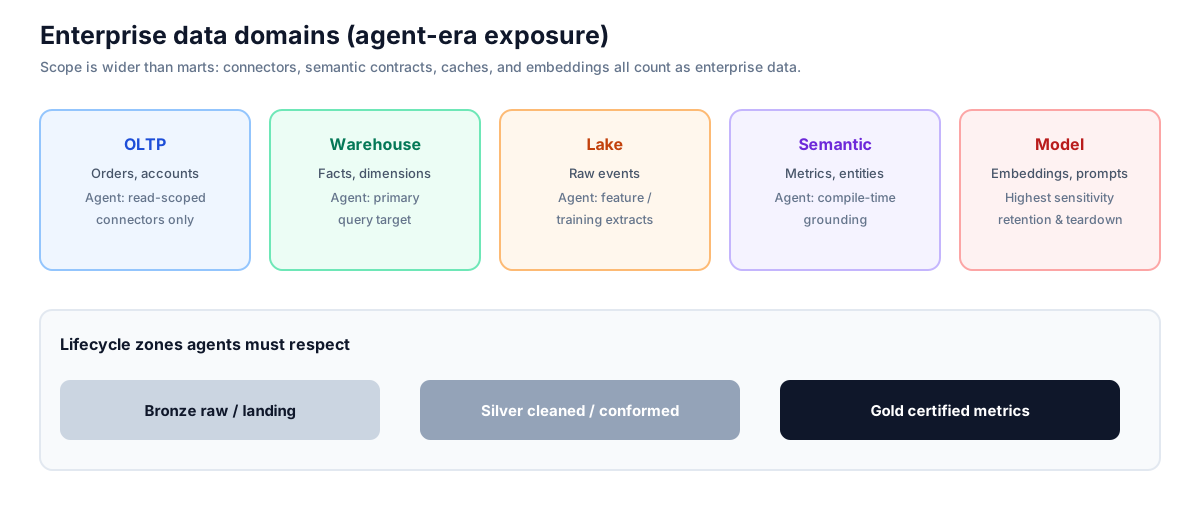
| Domain | Examples | Agent exposure |
|---|---|---|
| OLTP | Orders, accounts | Read-scoped connectors |
| Warehouse | Facts, dimensions | Primary query target |
| Lake | Raw events | Feature and training extracts |
| Semantic | Metrics, entities | Compile-time grounding |
| Model | Embeddings, prompts | Highest sensitivity |
These domains rarely fail in isolation. Master vs transactional. Conformed dimensions link domains; agents hallucinate when the same noun maps to incompatible grains across systems.
Lifecycle states. Document bronze–silver–gold (or equivalent zone policies) so compile rules know which layers agents may join without steward approval.
Why This Matters in 2026
Enterprises consolidating analytics on AI-native stacks now treat enterprise data as a control plane, not a warehouse. The moment an agent can join a warehouse, a lake, and an operational store in one session, catalog metadata must enforce policy at compile time. Aligning that enforcement with the NIST AI Risk Management Framework keeps recurring agent access defensible under audit.
Independent buyer signals for the broader analytics/governance market — not our product claims — include Gartner Peer Insights — Analytics & BI, G2 Data Governance, and BARC research. Use them for support and renewal patterns; use a compile-time POC for enterprise data control-plane fit.
Quality and Trust Signals
Consumers trust outputs when quality SLAs, lineage, and steward ownership appear in the catalog metadata agents read at compile time. Quality SLAs should block an agent compile when freshness thresholds fail—not warn silently in logs analysts never read. Data-quality expectations map cleanly to the dimensions defined in ISO 8000 for interoperable data quality.
Core Requirements
Every enterprise data program should meet three non-negotiables before agents scale.
Identity and semantic access. Bind analyst and agent roles at compile time. Standing warehouse-admin service accounts fail most enterprise reviews.
Monitoring and cost visibility. Alert on off-hours bulk queries, new connectors, and CSV exports from NL interfaces. Attribute warehouse spend to agent sessions in FinOps dashboards.
Retention and teardown. Align prompt, embedding, and log retention with legal-hold policies. Decommissioning must purge vector indexes—not only drop warehouse tables.
Related depth: Enterprise Data Governance for AI Analytics: A 2026 Playbook.
Architecture Patterns
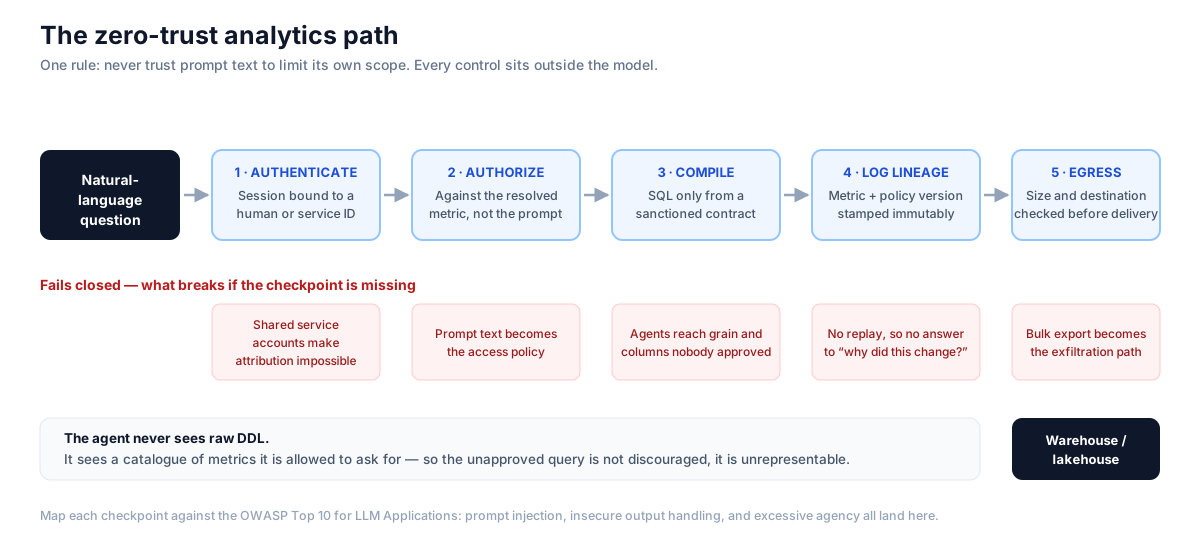
Zero-trust analytics path. Authenticate, authorize metrics, compile SQL, log lineage, inspect egress—never trust prompt text to self-limit scope. LLM-specific risks such as prompt injection are catalogued in the OWASP Top 10 for LLM Applications.
Semantic-first consumption. Agents and BI should share metric IDs. Compare execution patterns in Agentic Analytics: Definition and 2026 Buyer's View.
Environment segregation. Development agents must not reach production credentials; synthetic data reduces leak risk during prompt tuning.
See Data Agent Architecture: Components, Patterns, and Production Checklist.
Consumption Patterns
The shift from dashboard-only reporting to agent-assisted exploration—part of the broader move to augmented analytics—increases query volume sharply. Model-adjacent stores such as embeddings need classification labels equal to the source tables they summarize; decommissioning that drops warehouse partitions but leaves vectors intact creates audit findings years later. Capacity planning should model agent concurrency separately from human analyst load.
Buyer Scorecard
Score each enterprise data platform candidate on these five signals.
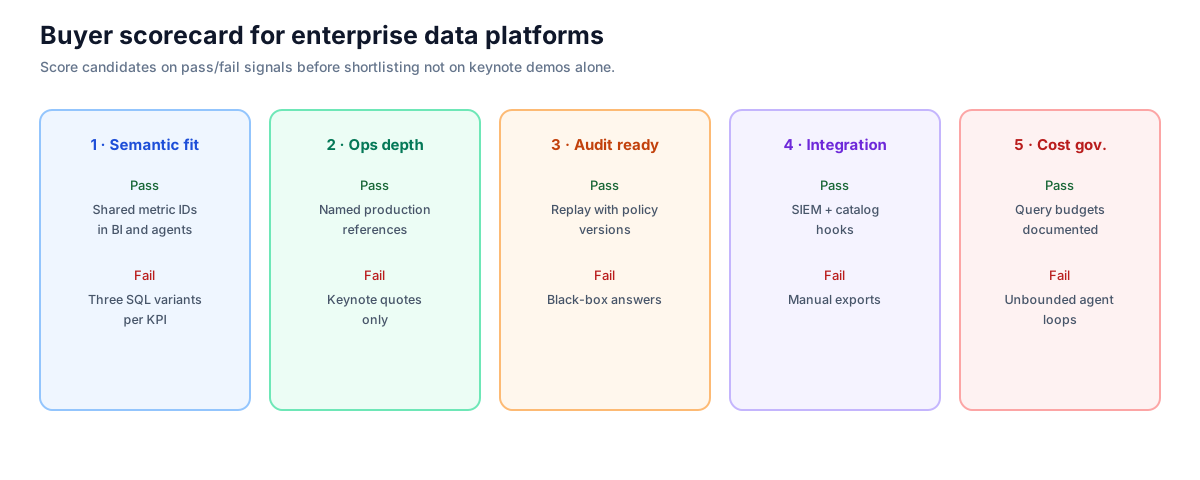
| Dimension | Pass signal | Fail signal |
|---|---|---|
| Semantic fit | Shared metric IDs in BI and agents | Three SQL variants per KPI |
| Operational depth | Named production references | Keynote quotes only |
| Audit readiness | Replay with policy versions | Black-box answers |
| Integration | SIEM + catalog hooks | Manual exports |
| Cost governance | Query budgets documented | Unbounded agent loops |
Sibling guide: enterprise data analytics.
90-Day Rollout Playbook
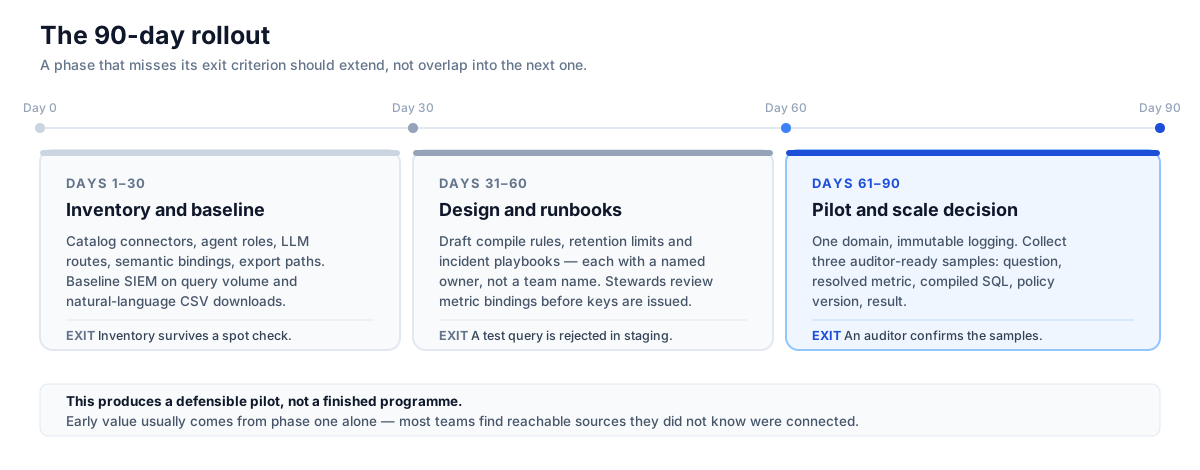
Days 1–30 — Inventory and baseline. Catalog connectors, agent roles, LLM routes, semantic bindings, and export paths. Establish SIEM baselines for query volume and NL CSV downloads.
Days 31–60 — Design and runbooks. Draft compile rules, retention limits, and incident playbooks with named owners. Stewards review metric-binding changes before production keys issue.
Days 61–90 — Pilot and scale decision. Run a bounded pilot with immutable logging. Collect three auditor-ready session samples. Expand only after export monitors meet agreed thresholds.
Implementation order: (1) assess against Enterprise Data Security Solutions (2026); (2) document a RACI spanning platform, stewards, and security; (3) pilot one domain with full logging; (4) review replay samples monthly and adjust policies. Public-sector buyers should also review ISO/IEC 42001 when procuring analytics agents.
Where InfiniSynapse Fits
Disclosure: this is our product—use it only where a governed Data Agent matches your need; a traditional catalog or warehouse-native controls may be enough for simpler estates.
| Layer | Component | Role |
|---|---|---|
| Orchestration | InfiniAgent | Multi-step governed analysis |
| Query | InfiniSQL | Dialect-aware execution + audit |
| Knowledge | InfiniRAG | Scoped retrieval + redaction |
| Semantics | Metric bindings | NL grounding |
| Audit | Workflow log | Replay for assessors |
InfiniSynapse maps these layers to customer control matrices before production access scales. It is one option among catalogs, warehouse-native controls, and agent platforms—pick by workload, not brand.
Common Failure Modes
Most programs fail in one of four predictable ways.
Failure 1 — Tool-first rollouts. Teams buy platforms before metric contracts exist. Fix: publish ten executive metrics with version IDs first.
Failure 2 — Governance theater. Catalogs without compile enforcement. Fix: block unapproved joins at compile time.
Failure 3 — Silent drift after migration. Cutover without semantic validation. Fix: parallel-run canonical executive questions—see Enterprise Data Migration.
Failure 4 — Export blind spots. DLP tuned for email only. Fix: monitor NL CSV downloads with agent-session attribution.
Glossary
| Term | Meaning in this guide |
|---|---|
| Enterprise data | Organization-wide governed assets—operational, analytical, and model-adjacent—under shared ownership and definitions |
| Compile-time enforcement | Rejecting unsanctioned joins and filters when NL binds to governed objects, before SQL executes |
| Semantic layer | Contract layer for metric IDs, approved sources, joins, grain, and filters shared by BI and agents |
| Bronze / silver / gold | Lifecycle zones from raw landing through conformed to certified metrics agents may join |
| Replay stamp | Metric version, policy version, and result metadata retained for auditor-ready session samples |
Frequently Asked Questions
What is enterprise data, in one sentence?
It is the organization-wide set of governed data assets—operational, analytical, and model-adjacent—managed under shared ownership and definitions so it can be trusted for decisions.
How does enterprise data relate to Data Agents?
Agents add orchestration, semantic compile paths, and export surfaces that must meet the same trust bar as traditional BI and pipelines. That raises the stakes on shared definitions and access control.
Do we need a semantic layer first?
For demos, optional. For production recurring executive metrics, yes—agents without governed definitions produce fluent but unreliable answers.
Can small platform teams begin?
Yes—one warehouse, ten governed metrics, immutable logs, and quarterly access reviews form a credible starting point for an enterprise data program.
What evidence do auditors request?
Replay samples, policy version stamps, access attestations, and vendor reports covering the LLM sub-processors agents invoke.
Who wrote this
Named author. William Zhu — InfiniSynapse cofounder. Professional background (public): GitHub @allwefantasy. Org profile: github.com/InfiniSynapse.
Team byline & About page. Published by the InfiniSynapse Data Team. Public About / Team page (traceable org authority): https://infinisynapse.com/en/editorial-standards · section About InfiniSynapse · Named accountability & team.
Reviewer credentials (published resumes). Analytics engineering · Data platform · LLM security · Editor. Each card states industry scope and the public standards used as qualification frames (e.g. OWASP LLM Top 10, NIST AI RMF).
Corrections & external peer review. zhuhl@infinisynapse.com · corrections policy · peer-review archive.
Suggested citation
APA (7th): InfiniSynapse Data Team. (2026, July 28). What is enterprise data? A 2026 guide for AI analytics. InfiniSynapse. https://infinisynapse.com/en/blog/enterprise-data
References
- [Reference] DAMA International. Data Management Body of Knowledge (DMBOK). dama.org
- [Reference] EDM Council. Data Management Capability Assessment Model (DCAM). edmcouncil.org
- [Standard] ISO. ISO 8000 — Data quality. iso.org
- [Standard] NIST. AI Risk Management Framework (AI RMF 1.0). nist.gov
- [Standard] ISO/IEC. 42001:2023 — AI management systems. iso.org
- [Standard] OWASP. Top 10 for LLM Applications. owasp.org
- [Independent] Gartner Peer Insights. Analytics and Business Intelligence Platforms. gartner.com
- [Independent] G2. Data Governance category. g2.com
- [Independent] BARC. Research overview. barc.com
- [Policy / About] InfiniSynapse. About the research desk & editorial standards (team + credentials). infinisynapse.com/en/editorial-standards
- [Person] William Zhu. Cofounder, InfiniSynapse — public engineering profile. github.com/allwefantasy
Conflict-of-interest note: InfiniSynapse is our product and competes with several categories referenced here; recommendations are framed as a rubric you can apply to any vendor.
Conclusion
Strong enterprise data programs let teams scale governed AI analytics without surprise audit or reconciliation failures. Start with shared definitions and quality signals that agents read at compile time; treat catalogs as control planes, not documentation. Use the hub, sibling guides such as Enterprise Data Governance and Enterprise Data Strategy, and auditor-ready replay trails to close evidence gaps early. Sequence the platform itself with the enterprise data platform strategy.