Enterprise Data Migration: Strategy & Checklist
By William Zhu & the InfiniSynapse Data Team · Published: 2026-06-24 · Last updated: 2026-09-24 · We build data-analysis software. This guide separates reproducible migration controls from illustrative examples; cited benchmarks and platform capabilities remain attributed to their named sources.
Secondary keywords: enterprise data migration strategy, data migration framework, data migration testing, data migration checklist
Table of Contents
- TL;DR
- What Enterprise Data Migration Means
- Migration Types
- Five-Phase Framework
- Migration Methods
- Mapping and Transformation
- Testing and Reconciliation
- Cutover and Rollback
- Risks and Security
- Worked Example
- Checklist
- FAQ
TL;DR
Direct answer: Enterprise data migration is the planned transfer of structured and unstructured data from legacy systems, applications, databases, or storage environments to a target platform while preserving accuracy, security, lineage, and business continuity.
A defensible enterprise data migration does more than copy rows. It inventories the source, maps fields and business rules, cleans or transforms records, tests the target, controls cutover, reconciles business totals, and retains a tested rollback path. The best method—ETL, ELT, replication, bulk transfer, or a hybrid—depends on transformation complexity, data volume, downtime tolerance, and the source and target technologies.
For a practical starting point, use the five phases in this guide:
- discover and scope;
- profile and map;
- build and transform;
- test and cut over;
- reconcile and decommission.
What Migration Means
The IBM data migration overview defines data migration as transferring data from one storage system or computing environment to another. In enterprise data migration, that transfer spans multiple owners, dependent applications, security classifications, business rules, and service-level commitments.
An enterprise data migration program therefore has four simultaneous goals:
- move the required records and files;
- preserve their meaning and relationships;
- keep unauthorized users and systems out;
- let the business continue operating through cutover.
Migration is not synchronization or integration
Enterprise data migration has a destination and an exit condition. Synchronization keeps two systems aligned over time. Integration moves or exposes data continuously so applications can cooperate. A migration may temporarily use replication or integration, but it ends when the target is accepted and the legacy path is retired or archived.
Why enterprises migrate data
Common enterprise data migration triggers include replacing an ERP or CRM, consolidating acquired systems, moving databases to cloud infrastructure, modernizing an enterprise data platform, separating a divested business, or meeting residency and retention requirements.
The business case should name the decision, not merely “modernization.” Examples include reducing license cost, retiring unsupported infrastructure, shortening reporting latency, improving recovery, or creating one governed customer record.
Types of Data Migration
Classify the enterprise data migration before selecting tools. The categories can overlap, but each has different dependencies and acceptance tests.
Storage and database migration
Storage migration moves files, objects, blocks, or archives between storage technologies. Database migration moves schemas, tables, procedures, users, and operational data between database engines, versions, or hosting environments.
Cross-engine enterprise data migration requires special attention to data types, collations, sequences, stored procedures, transaction semantics, and SQL behavior. The target can contain every row and still be wrong if these semantics change.
Application and platform migration
Application migration accompanies a replacement, upgrade, or consolidation of software such as ERP, CRM, HRIS, or support systems. Source fields rarely map one-to-one because workflows and data models change with the application.
Platform migration moves data and dependent workloads to a new operating environment, warehouse, lakehouse, or cloud platform. It should align with the wider enterprise data platform strategy, including which systems become authoritative.
Cloud, data-center, and business migration
Cloud or data-center migrations may include databases, file stores, virtual machines, identity dependencies, and network controls. Merger, acquisition, and divestiture migrations add legal-entity boundaries, consent, retention, and data-separation obligations.
Structured and unstructured assets need different checks. Tables can be reconciled with counts and aggregates; documents and media need manifests, hashes, metadata checks, permissions, and retrieval tests.
A Five-Phase Migration Framework
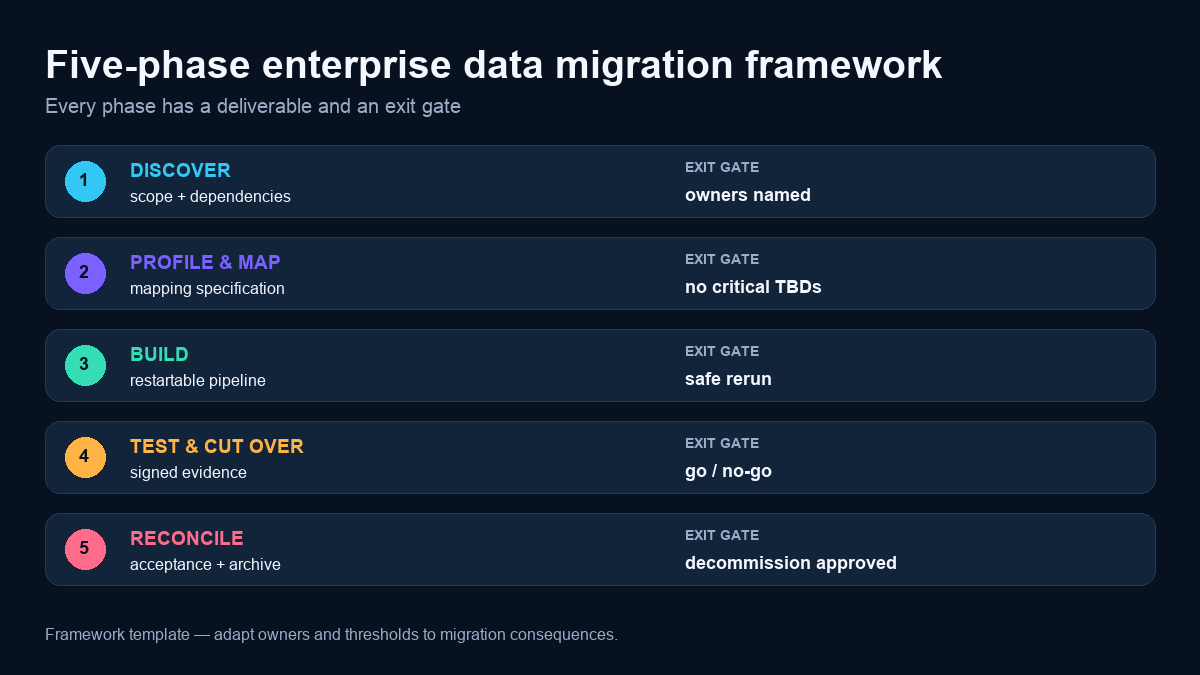
This enterprise data migration framework gives each phase a deliverable and exit gate. A calendar alone is not a migration plan.
Phase 1: Discover and scope
Inventory sources, target systems, owners, consumers, interfaces, volumes, data classifications, retention rules, and outage constraints. Record what will not move and why.
The output is a signed scope and dependency map. Exit only when critical consumers, hidden extracts, scheduled jobs, and regulatory constraints have named owners.
Phase 2: Profile and map
Profile nulls, duplicates, ranges, encodings, orphan keys, date formats, and historical depth. Create a source-to-target mapping for every migrated field, including the transformation rule, default behavior, owner, and acceptance test.
The output is a versioned mapping specification and baseline profile. Exit when unresolved rules have an owner and no critical field is labeled “TBD.”
Phase 3: Build and transform
Implement extraction, staging, transformation, loading, error handling, observability, and restart behavior. Keep migration code in version control and make runs idempotent where possible.
The output is a repeatable pipeline with run logs. Exit when a failed batch can resume or safely rerun without duplicate records.
Phase 4: Test and cut over
Run unit, integration, performance, security, reconciliation, and user-acceptance tests. Rehearse the production cutover using production-like volumes and a timed runbook.
The output is signed evidence and a go/no-go decision. Exit only when rollback triggers, owners, communications, and the freeze window are explicit.
Phase 5: Reconcile and decommission
During hypercare, compare source and target totals, investigate exceptions, monitor downstream jobs, and collect business-owner acceptance. Archive required evidence before revoking credentials and retiring the legacy system.
The output is an acceptance record, exception log, and decommission approval. Do not decommission merely because the copy job completed.
Choose ETL, ELT, Replication, or Bulk Transfer
The enterprise data migration method should match the risk and operating constraints.
ETL and ELT
ETL transforms data before loading it into the target. It suits strict target schemas, sensitive staging requirements, or transformations that must occur outside the destination. ELT loads first and transforms in the target, which can simplify large analytical migrations when the destination has scalable compute.
The broader data pipeline architecture guide explains batch, streaming, ETL, and ELT components. For enterprise data migration, add restartability, reconciliation, and a finite completion condition.
Bulk transfer and phased migration
Bulk transfer works when the dataset is stable, the outage window is acceptable, and source-to-target conversion is limited. A phased migration reduces blast radius by moving domains, tenants, regions, or time partitions incrementally.
Enterprise data migration phases create temporary coexistence costs. Define which system is authoritative for each object at every stage, or users may update both sides.
Replication and change data capture
Replication or change data capture can reduce downtime by copying a baseline and then applying ongoing changes until cutover. The PostgreSQL logical replication documentation illustrates the publish-and-subscribe model used by many low-downtime patterns.
Replication is not automatic validation. Schema changes, unsupported types, delete handling, lag, ordering, and conflict behavior still need tests.
The AWS Database Migration Service best-practices guide and Google Cloud Database Migration Service documentation are useful implementation references, but platform support must be checked against the exact source engine, target engine, and migration mode.
Map, Clean, and Transform the Data
A source-to-target map is the contract between business meaning and technical execution in an enterprise data migration.
For each field, record:
- source table and column;
- target object and field;
- source and target types;
- transformation or lookup rule;
- null and default behavior;
- primary and foreign-key treatment;
- owner and approval;
- validation query and threshold.
Resolve quality problems deliberately
Do not silently “clean everything.” Some defects must be corrected at source, some can be transformed, and some must move unchanged for legal or historical reasons. Put exceptions in a decision log.
The enterprise data migration team should coordinate ownership and quality rules with enterprise data governance. Migration code should not become an undocumented second source of business definitions.
Preserve lineage and semantics
Record where each target field came from, which rule changed it, and which migration version produced it. For analytical data, migrate metric definitions and dimensions alongside tables. Otherwise dashboards may reconcile at row level while reporting different business results.
Test and Reconcile Migrated Data
Enterprise data migration testing should progress from technical completeness to business equivalence.
Structural and record-level checks
Check schema objects, required indexes, permissions, row counts, null rates, duplicate keys, rejected records, hashes, and sampled source-to-target values.
Counts alone are weak evidence. A transformation can preserve the number of rows while assigning the wrong customer, currency, or date.
Aggregate and business checks
Compare sums, counts, balances, distinct entities, period totals, and critical KPIs by meaningful partitions such as date, region, product, or legal entity.
Use tolerances only when the reason is documented. “Within 1%” is not a safe default for cash, regulatory records, or primary identifiers.
A reusable acceptance matrix
Use a matrix with these columns:
| Test | Scope | Source query | Target query | Threshold | Owner | Evidence | Status |
|---|---|---|---|---|---|---|---|
| Row completeness | orders by month | source count | target count | exact | Data engineering | query result | open/pass |
| Revenue reconciliation | currency + month | source sum | target sum | exact after FX rule | Finance | signed workbook | open/pass |
| Referential integrity | order customer key | orphan count | orphan count | zero new orphans | Data steward | exception log | open/pass |
| Access test | restricted customer fields | role test | role test | deny unauthorized roles | Security | test record | open/pass |
This matrix is an original operational template, not a survey result. Adapt thresholds to the data's business and regulatory consequences.
Plan Cutover, Downtime, and Rollback
An enterprise data migration can use big-bang, parallel, phased, strangler, or blue-green cutover based on dependency complexity and tolerated disruption.
Define the cutover runbook
The runbook should specify:
- change-freeze start;
- final extraction or replication catch-up;
- integrity and business checks;
- application or connection switch;
- smoke tests;
- stakeholder approval;
- rollback deadline;
- hypercare ownership.
Microsoft's Cloud Adoption Framework migration guidance reinforces the need to assess, deploy, release, and review workloads rather than treating transfer as the final step.
Set measurable rollback triggers
Examples include replication lag beyond the agreed limit, failed financial reconciliation, unacceptable error rate, missing critical interfaces, or target latency above the service objective.
A rollback plan must identify how writes made after cutover will be preserved or reversed. “Point DNS back” is not sufficient when both systems can accept transactions.
Manage Migration Risks, Security, and Compliance
An enterprise data migration risk register should cover data, operations, security, vendors, and business adoption.
High-priority risks include incomplete inventory, incorrect mappings, data loss, duplicate records, broken dependencies, unexpected downtime, performance regression, excessive privileges, unencrypted staging, residency violations, and premature legacy deletion.
Protect data in transit and at rest
Use encrypted transport and storage, short-lived credentials, least-privilege service accounts, isolated staging, secrets management, access logging, and controlled exports. Extend the site's enterprise data protection guidance to migration files, temporary databases, logs, and backups—not only the final platform.
The NIST Cybersecurity Framework 2.0 provides a useful govern-identify-protect-detect-respond-recover structure for assigning migration controls and evidence.
Control third parties and temporary assets
Document every vendor, transfer appliance, cloud bucket, subcontractor, and support account that can access migrated data. Define deletion evidence and credential expiry before granting access.
Temporary staging often outlives the project unless deletion has an owner and deadline. Include staging removal in the formal decommission checklist.
Worked Example: Migrate an Orders Domain
Consider an illustrative enterprise data migration from a legacy order database to a cloud warehouse. The source stores amount_cents, a local timestamp, and a nullable legacy customer ID. The target expects decimal amount, UTC time, and a governed customer key.
Map the transformations
amount_cents→order_amount: divide by 100 using fixed decimal arithmetic.created_local→created_at_utc: apply the documented source timezone before conversion.legacy_customer_id→customer_key: join through an approved crosswalk; quarantine unmatched records.- cancelled orders: preserve them with status rather than deleting history.
Validate before release
Run counts and amount totals by month and currency. Compare distinct order IDs, unmatched customers, null timestamps, duplicate keys, and cancelled-order totals. Finance signs the amount reconciliation; the steward signs the customer crosswalk; security verifies that restricted fields remain inaccessible to analyst roles.
This worked example demonstrates the framework without presenting invented outcomes. A real program must publish its own mappings, queries, thresholds, timestamps, and approvers.
Execution Checklist
Use this enterprise data migration checklist as a release-control starting point, then adapt every threshold to the affected business process.
Before build
- Business objective and success measures approved
- Source, target, owner, consumer, and dependency inventory complete
- Data classification, residency, retention, and deletion rules recorded
- Volumes, change rates, outage budget, RTO, and RPO measured
- Source-to-target mapping and exception owners approved
Before cutover
- Migration pipeline reruns safely
- Production-scale rehearsal completed
- Structural, record, aggregate, business, performance, and access tests passed
- Go/no-go authority and communications confirmed
- Rollback triggers, deadline, and write-recovery method tested
- Hypercare dashboards and escalation rota active
Before decommission
- Business owners accepted reconciled results
- Open exceptions have owners and deadlines
- Required audit evidence is archived
- Legacy retention and legal-hold obligations are satisfied
- Temporary files, staging systems, vendor access, and migration credentials are removed
- Downstream users confirm the target is operational
Frequently Asked Questions
What are the five migration phases?
The main enterprise data migration phases are discovery and scoping, profiling and mapping, pipeline build and transformation, testing and cutover, and post-migration reconciliation and decommissioning. Each phase should have a deliverable, owner, and exit gate.
How long does enterprise data migration take?
There is no reliable universal duration for enterprise data migration. Timeline depends on source count, data volume and change rate, mapping complexity, application dependencies, quality defects, regulatory approvals, outage limits, and rehearsal results. Estimate by workstream and evidence, not only by terabytes.
What is the difference between ETL and ELT migration?
ETL transforms data before loading it into the destination. ELT loads data first and transforms it using target compute. Both can support enterprise data migration; the right choice depends on security constraints, transformation complexity, target capability, and restart requirements.
How do you validate migrated data?
Validate schemas, counts, nulls, duplicates, keys, hashes, sampled records, aggregates, business totals, permissions, performance, and downstream behavior. Reconcile by meaningful dimensions and keep query results or signed evidence for every release gate.
How can a team minimize migration downtime?
Use a rehearsed enterprise data migration runbook, baseline copy plus change replication, a defined freeze window, automated validation, and a clear go/no-go authority. Phased or blue-green patterns can reduce disruption, but temporary coexistence must have an authoritative-system rule.
What should trigger a rollback?
Rollback triggers should be measurable: failed critical reconciliation, unacceptable error or latency, missing interfaces, excessive replication lag, security-control failure, or inability to process a critical business transaction. Define the triggers before cutover.
Conclusion
Successful enterprise data migration preserves meaning and operations, not merely bytes. Start with an explicit scope, profile the source, approve every mapping, build a restartable pipeline, test technical and business equivalence, rehearse cutover, and retain a credible rollback path.
Use the five-phase framework and acceptance matrix as working documents. When each claim has an owner and each release gate has evidence, migration leaders can make defensible go/no-go decisions without hiding uncertainty behind a completed copy job.
InfiniSynapse is optional tooling, not a migration service or benchmark source. Teams that need to inspect and reconcile analytical outputs after migration can evaluate the InfiniSynapse web app after the target data and access controls are ready.