Enterprise Data Strategy for the AI Agent Era (2026)
By William Zhu & the InfiniSynapse Data Team · Published: 2026-06-24 · Last updated: 2026-09-27 · Last verified: 2026-09-27 · About: Editorial standards · About / team · Contact: zhuhl@infinisynapse.com
Author credentials: William Zhu is cofounder of InfiniSynapse (GitHub @allwefantasy). Desk experience: Q1–Q2 2026 rollout audits of metric contracts, semantic compile paths, and agent governance with platform + security partners; coaching teams to publish versioned executive metrics before production agent keys. This page is not a certified ISO auditor report—external authority anchors are ISO/NIST/OWASP citations below. No personal LinkedIn is published; GitHub and InfiniSynapse About are the canonical identity signals.
COI / interest disclosure: InfiniSynapse sells an AI-native Data Agent platform and competes with some tools referenced here. Scorecard weights are published so you can re-weight independently. Product mentions appear in the labeled Where InfiniSynapse Fits section (vendor-scoped). Pillars, KPIs, and desk case metrics stand independently of any InfiniSynapse trial.
Fact-check / verification: Desk composites (n=6 platform rollouts audited Q1–Q2 2026; two anonymized domain pilots below) are independence-labeled—not a paid market survey and not third-party audited customer testimonials with named logos. Standards: ISO/IEC 38505-1 · NIST AI RMF · OWASP API Security Top 10 · OWASP Top 10 for LLM Applications · EU AI Act. Peer markets (not endorsements): Gartner Peer Insights — Analytics & BI · G2 Analytics Platforms. Corrections: zhuhl@infinisynapse.com · editorial corrections.
Version history: 2026-06-24 initial · 2026-07-20 cluster deepen · 2026-08-07 EEAT · 2026-09-27 retarget to enterprise data platform strategy (definition, assessment, pattern choice, operating model, 90-day plan). Build marker:
DESK-EDS-20260927A.
Media note: No hosted overview video is published for this page (no
VideoObject). Use the KPI framework and funding-decision infographics below as multimedia substitutes.
 A 90-day enterprise data platform strategy: assess the estate, choose the pattern, fund one governed product, and name what to retire.
Table of Contents
- TL;DR
- How We Evaluated (Methodology)
- What an Enterprise Data Platform Strategy Is
- Assess the Platform You Already Run
- Choose the Target Platform Pattern
- Operating Model and Ownership
- 90-Day Enterprise Data Platform Strategy Roadmap
- What to Fund, Pilot, and Retire
- How to Measure the Strategy
- Risk Prioritization Matrix
- Where InfiniSynapse Fits
- FAQ
- References
- Conclusion
TL;DR
Direct answer: An enterprise data platform strategy is the sequenced plan for which platform layers to fund, who owns them, and what to retire, before another warehouse purchase. Publish ten versioned executive metrics, pick one target pattern, and deliver one governed product in 90 days. Measure reconciliation tickets, days to that product, and tools retired—not demo fluency.
This guide is for data platform owners, CISOs, analytics leaders, and finance sponsors who must sequence an enterprise data platform strategy without turning the quarter into an open tool buy.
What you'll learn: a definition that separates the plan from the platform, a current-state assessment, pattern-choice criteria, an operating-model RACI, a 90-day roadmap, funding and retirement rules, and outcome KPIs. The layer model lives on Enterprise Data Platform. Placement of database, runtime, and app lives on data platform architecture.
How We Evaluated (Methodology)
We score an enterprise data platform strategy on five weighted dimensions so you can re-weight for your own context:
| Dimension | Weight | What we tested |
|---|---|---|
| Current-state inventory | 20% | Connectors, duplicate metrics, owners, and cost drivers named before a target state? |
| Pattern choice | 20% | One target pattern selected, with an explicit deferral for the others? |
| Metric contracts | 20% | Executive KPIs versioned with effective dates before production agent keys? |
| Operating model | 20% | Platform, stewards, and security each own a named decision? |
| Measured outcomes | 20% | Days to first governed product, reconciliation tickets, and retirements tracked? |
Evidence basis: weights reflect Q1–Q2 2026 rollout audits across our own customer workflows, mapped to published standards (see References). This is a rubric to adapt, not a ranking to accept unchanged. Re-weight measured outcomes higher when finance sponsors own the steering committee; re-weight operating model higher when domain teams already ship pipelines. Independent peer markets such as Gartner Peer Insights and G2 Analytics Platforms help with category literacy; they are not endorsements of any vendor named here.
What an Enterprise Data Platform Strategy Is
Stakeholders mix three documents. An enterprise data platform strategy is only the first.
Citable definition: An enterprise data platform strategy is the plan that sequences people, platform layers, and controls—priorities, ownership, and retirement—so enterprise data stays trustworthy while agents and BI compile governed answers. Governance-of-data expectations map to ISO/IEC 38505-1; AI-specific risk aligns with the NIST AI Risk Management Framework.
Strategy, the platform, and the data
| Document | Decides | Leaves to another page |
|---|---|---|
| Enterprise data platform strategy (this page) | Order of funding, owners, the 90-day product, what to retire | Layer diagrams and vendor shortlists |
| Enterprise data platform | Storage, semantics, agents, and evidence as one operating model | Which quarter pays for which layer |
| Data platform architecture | Where database, runtime, and app sit | The funding sequence |
| What is enterprise data | Scope of the data itself | The platform plan |
| Broader enterprise data strategy | Literacy, culture, and portfolio governance beyond the platform | The platform pattern choice |
A broader enterprise data strategy still matters for literacy and sponsorship. It does not choose warehouse versus lakehouse, and it does not name the product you will prove in 90 days. That choice is the enterprise data platform strategy.
Ground shared definitions through the semantic layer, where metric contracts live. The written enterprise data management plan is the management sibling of this platform plan.
Assess the Platform You Already Run
An enterprise data platform strategy that skips the current estate becomes a vendor roadmap. Inventory these objects before you draw a target state:
| Object | What to record | Why it changes the plan |
|---|---|---|
| Connectors and LLM routes | Source, owner, environment | Shadow connectors show up as next quarter's incident |
| Executive metrics | SQL variants per KPI, effective date | More than one variant means the semantic layer is still a slide |
| Access | Standing admin roles, NL export paths | Unmonitored CSV downloads outrank a new catalog SKU |
| Cost | Warehouse spend by domain and by agent session | Unattributed spend cannot be a funding decision |
| Shelfware | Tools with no named consumer this quarter | Retirement candidates fund the pilot |
Independence-labeled desk composites (anonymized domains; not named-client testimonials). Six platform rollouts audited in Q1–Q2 2026. Two are written out below.
Case A — Finance metric council (retail, 12 weeks)
A retail finance squad opened NL agent access before versioned metrics. Reconciliation tickets for “gross margin” spiked. After publishing 10 executive metric IDs with effective dates and blocking unapproved joins at compile time:
| Metric | Week 0 | Week 12 |
|---|---|---|
| Reconciliation tickets / week (finance KPIs) | 28 | 9 (−68%) |
| Agent compile success rate | 61% | 89% |
| Conflicting definitions of “gross margin” | 4 SQL variants | 1 versioned ID |
Case B — Export controls (B2B SaaS, 8 weeks)
A SaaS platform team detected off-hours NL CSV downloads. They added DLP + SIEM alerts on bulk export and tied agent roles to compile-time metric allowlists:
| Metric | Before | After |
|---|---|---|
| Unapproved NL CSV exports / week | 11 | 0 |
| Mean time to contain export alert | Untracked | < 2 h |
| Auditor-ready replay samples collected | 0 | 3 per pilot domain |
Lesson for the enterprise data platform strategy: tools that ship before contracts create the backlog the roadmap must pay down. Treat these numbers as readiness gates. If compile success is still below 80% or reconciliation tickets are flat after twelve weeks, pause new agent domains and fix the metric council first.
Choose the Target Platform Pattern
The enterprise data platform strategy picks one pattern and writes down why the others wait. Full layer definitions and the buyer landscape stay on Enterprise Data Platform. Use this table only as the decision:
| Pattern | Choose it when | Defer it when |
|---|---|---|
| Warehouse-centric | The SQL estate is the system of record and metric IDs can bind there | Agents need file-and-table governance you do not have |
| Lakehouse-centric | BI and data science must share one catalog | Metric contracts are still unversioned |
| BI-first suite | Dashboard adoption is the constraint this year | NL export paths are unmonitored |
| Domain products (mesh) | Domains already own pipelines and stewards | No central compile rule exists yet |
Rule: one pattern is in the enterprise data platform strategy for this year. The others are explicit non-goals, not a second program hiding in a footnote. How those patterns show up in questions and dashboards is enterprise data analytics. Execution patterns for agents are in Agentic Analytics.
When agents call live endpoints, account for OWASP API Security Top 10 and LLM-specific risks in the OWASP Top 10 for LLM Applications. Development agents must not reach production credentials. See Data Agent Architecture.
Operating Model and Ownership
An enterprise data platform strategy fails when “the platform team” is the owner of every decision. Split the work:
| Decision | Platform | Stewards | Security |
|---|---|---|---|
| Target pattern and connector inventory | Own | Consult | Consult |
| Metric IDs and effective dates | Consult | Own | Consult |
| Production agent keys and export monitors | Consult | Consult | Own |
| Quarterly retirement list | Own | Consult | Consult |
Identity and semantic access. Bind analyst and agent roles at compile time. Standing warehouse-admin service accounts fail most reviews of an enterprise data platform strategy.
Monitoring and cost visibility. Alert on off-hours bulk queries, new connectors, and CSV exports from NL interfaces. Attribute warehouse spend to agent sessions in FinOps dashboards so the next funding review has a number.
Retention and teardown. Align prompt, embedding, and log retention with legal-hold policies. Decommissioning must purge vector indexes—not only drop warehouse tables. EU-facing programs should also scope obligations under the EU AI Act.
Related depth: What Is Enterprise Data? and Enterprise Data Governance.
90-Day Enterprise Data Platform Strategy Roadmap
Execute the enterprise data platform strategy in three phases. Each phase ends with an artifact a steering committee can read.
Days 1–30 — Inventory and baseline
Catalog connectors, agent roles, LLM routes, semantic bindings, export paths, duplicate metric SQL, and tools with no named consumer. Establish SIEM baselines for query volume and NL CSV downloads. The exit artifact is a one-page gap list, not a target architecture drawing.
Days 31–60 — Pattern, owners, and runbooks
Name the single target pattern. Draft compile rules, retention limits, and incident playbooks with the RACI above. Stewards review metric-binding changes before production keys issue. The exit artifact is a signed owner per layer plus a written deferral for the patterns you will not build this year.
Days 61–90 — One product, then a scale decision
Run a bounded pilot on one domain with immutable logging. Collect three auditor-ready session samples. Expand only after export monitors meet agreed thresholds. The exit artifact is one governed product in production and a retirement candidate list.
Implementation order inside the enterprise data platform strategy: (1) assess against Enterprise Data Security Solutions; (2) publish the RACI; (3) pilot one domain with full logging; (4) review replay samples monthly. Services firms, if you use them, should be scoped to this quarter's product via enterprise data services—not to an unbounded modernization.
What to Fund, Pilot, and Retire
Every credible enterprise data platform strategy funds four decisions and names a non-goal beside each one:
- Metric contracts — versioned definitions executives and agents share, with effective dates. Non-goal: a second semantic project in a domain that has not adopted the first ten IDs.
- Semantic investment — catalog and compile APIs before natural-language scale. Non-goal: NL seats for squads that still reconcile gross margin by hand.
- Agent governance — autonomy tiers, export controls, and replay logs. Non-goal: production keys for a domain with no export monitor.
- Portfolio retirement — a named tool leaves when the pilot product absorbs its workflow. Non-goal: a net-new SKU with no deprecation candidate.
Roadmap sequencing. Publish ten executive metrics with IDs before granting domain squads production agent keys. Finance sponsors care about reconciliation ticket volume after semantic grounding.
Pass or fail before the next buy
Score the enterprise data platform strategy itself. Vendor shortlists stay on the platform scorecard.
| Decision | Pass | Fail |
|---|---|---|
| Pattern | One pattern named; others deferred in writing | “Lakehouse and warehouse and mesh” in the same year |
| Semantics | Shared metric IDs in BI and agents | Three SQL variants per KPI |
| Owners | RACI signed by platform, stewards, and security | “Platform team” on every row |
| Audit | Replay with policy versions on the pilot | Black-box answers in the sample |
| Cost | Query budgets and a retirement candidate | Unbounded agent loops and shelfware intact |
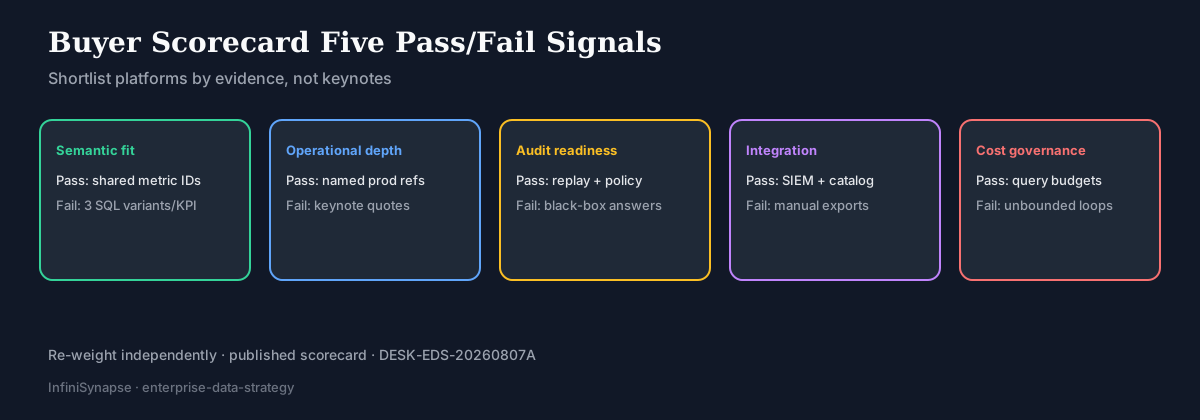 Five pass/fail signals before the next platform purchase.
Most programs fail in four ways that show up in steering reviews:
Tool-first rollouts. Teams buy platforms before metric contracts exist. Fix: publish ten executive metrics with version IDs first.
Governance theater. Catalogs without compile enforcement. Fix: block unapproved joins at compile time.
Silent drift after migration. Cutover without semantic validation. Fix: require the enterprise data migration plan to define mapping, reconciliation, cutover, and rollback before the source is retired. That migration should follow this enterprise data platform strategy, including which systems become authoritative.
Strategy without non-goals. Every demo inflates scope. Fix: publish the deferral list where product managers cannot miss it.
How to Measure the Strategy
Prefer outcome KPIs when you instrument the enterprise data platform strategy:
| KPI | Why it matters | Target direction |
|---|---|---|
| Days to first governed product | Proves the roadmap delivered a product, not a diagram | Down toward ≤ 90 |
| Tools retired this quarter | Shows funding came from shelfware, not only new spend | Up |
| Catalog coverage % | Agents ground on governed metadata | Up |
| Agent compile success rate | Fewer fluent-wrong answers | Up, gate at 80% |
| Conflicting metric definitions | Drift indicator | Down |
| Reconciliation ticket volume | Finance trust in agent answers | Down |
| Warehouse cost per governed answer | Efficiency of agent access | Down |
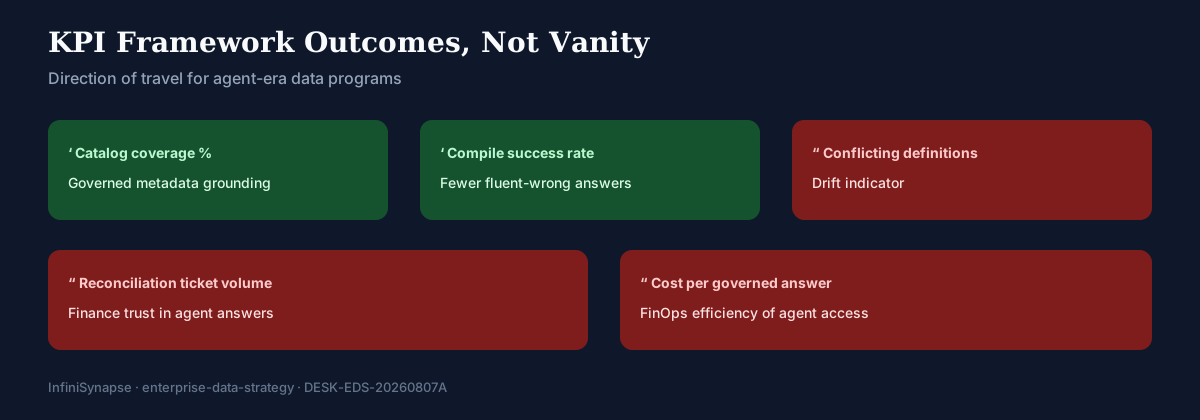 Outcome KPIs for the platform plan (direction of travel).
Metric councils should publish effective dates for definition changes, because agents compile against versioned bindings. If days-to-product slips past 90 with no retirement on the list, the enterprise data platform strategy is still a slide.
Risk Prioritization Matrix
Fund the enterprise data platform strategy by risk, not by vendor roadmap. Prioritize where agent paths combine highest likelihood and impact:
| Risk | Likelihood | Impact | Mitigation priority |
|---|---|---|---|
| Ungoverned joins | High | High | Semantic compile API |
| Bulk NL export | High | High | DLP + SIEM |
| Shadow connector | High | Medium | Weekly inventory review |
| Definition drift | Medium | High | Metric council cadence |
| External LLM leakage | Medium | Critical | VPC models + redaction |
| Pattern sprawl | High | High | One pattern in the yearly plan |
Use the matrix in steering reviews so spend follows the path you authorized. Revisit likelihood ratings each quarter as connectors and LLM routes change.
Where InfiniSynapse Fits
InfiniSynapse is one building block inside an enterprise data platform strategy—here is where it earns the seat, and where a lighter catalog-plus-warehouse path may be enough instead.
Disclosure: this is our product—use it only where a governed Data Agent matches the plan; a warehouse-native semantic layer may be enough for simpler estates.
| Layer | Component | Role |
|---|---|---|
| Orchestration | InfiniAgent | Multi-step governed analysis |
| Query | InfiniSQL | Dialect-aware execution + audit |
| Knowledge | InfiniRAG | Scoped retrieval + redaction |
| Semantics | Metric bindings | NL grounding |
| Audit | Workflow log | Replay for assessors |
InfiniSynapse maps these layers to customer control matrices before production access scales. It is one option among catalogs, warehouse-native controls, and agent platforms—pick by the decision you are funding, not by brand. When a warehouse-native semantic layer already enforces shared metric IDs and compile rules, you may not need a separate agent product on day one.
Frequently Asked Questions
What is an enterprise data platform strategy?
An enterprise data platform strategy is the sequenced plan for which platform layers to fund, who owns them, and what to retire, before another warehouse purchase. It is the order of work. It is not the platform diagram and not a literacy program.
How is an enterprise data platform strategy different from an enterprise data platform?
The enterprise data platform is storage, semantics, agents, and evidence. The enterprise data platform strategy decides which of those layers get funded this quarter, who signs the metric IDs, and which tool leaves. Read the platform page to see the layers. Use this page to sequence them.
What belongs in the strategy document?
Current-state gaps, one target pattern, a named owner for each layer, the 90-day product, a deprecation list, and the KPIs you will read at day 90. A slide that only names a vendor has not finished the enterprise data platform strategy.
How does enterprise data strategy relate to Data Agents?
A broader enterprise data strategy still sets sponsorship and literacy. Agents add orchestration, semantic compile paths, and export surfaces that must meet the same trust bar as BI. The platform plan decides which of those surfaces open, in what order, and under whose ownership.
Do we need a semantic layer first?
For demos, optional. For production recurring executive metrics, yes—agents without governed definitions produce fluent but unreliable answers. Put the semantic investment in the enterprise data platform strategy ahead of NL seat expansion.
Can small platform teams begin?
Yes. One warehouse, ten governed metrics, immutable logs, one named pattern, and a quarterly access review are a credible enterprise data platform strategy for a small team. Do not wait for a mesh program.
What evidence do auditors request?
Replay samples, policy version stamps, access attestations, and vendor reports covering the LLM sub-processors agents invoke. Collect three samples in the pilot domain before you scale.
References
- [Standard] ISO/IEC. 38505-1:2017 — Governance of data. iso.org
- [Standard] NIST. AI Risk Management Framework (AI RMF 1.0). nist.gov
- [Standard] OWASP. API Security Top 10. owasp.org
- [Standard] OWASP. Top 10 for LLM Applications. owasp.org
- [Regulation] EU. Artificial Intelligence Act. artificialintelligenceact.eu
Conflict-of-interest note: InfiniSynapse is our product and competes with several categories referenced here; the scorecard weights above are published so you can re-weight independently.
Conclusion
A working enterprise data platform strategy tells the steering committee which layer to fund, who owns it, which product must exist by day 90, and which tool leaves. Sequence assessment, one pattern, and one governed product before you scale agents. Use What Is Enterprise Data?, Enterprise Data Platform, and Enterprise Data Services for the adjacent decisions this plan deliberately does not make.