Enterprise Data Security Solutions for AI Analytics (2026)
By William Zhu & the InfiniSynapse Data Team · Published: 2026-06-24 · Last updated: 2026-08-06 · Last verified: 2026-08-06 · About: Editorial standards · About / team
Author credentials: William Zhu is cofounder of InfiniSynapse (GitHub @allwefantasy), with 10+ years building data systems and reviewing agent-era security matrices (compile-time access, NL export monitoring, auditor replay packs). Credentials asserted: engineering/OSS + desk practice—not a vendor security certification badge. No personal LinkedIn is published; GitHub and InfiniSynapse About are the canonical identity signals.
COI / interest disclosure: InfiniSynapse sells an AI-native Data Agent platform. Product mentions appear only in the labeled Product recommendation (commercial) module. Scorecard dimensions, roadmap phases, and framework citations stand independently of any trial.
Fact-check / verification: Desk n=14 pilot scorecard metrics below are an independent desk composite (labeled)—not a Gartner/Forrester survey. Independent peer markets and framework anchors: Gartner Peer Insights — Analytics & BI · G2 Analytics Platforms · NIST AI Risk Management Framework · ENISA Threat Landscape. Corrections: zhuhl@infinisynapse.com · editorial corrections.
Version history: 2026-06-24 initial · 2026-07-20 cluster deepen · 2026-08-06 EEAT / HowTo×2 / FAQ 10 / architecture+roadmap+scorecard SVG / dens destuff. Build marker:
DESK-EDS-20260806A.
Media note: No hosted overview video. Use the architecture, roadmap, and scorecard SVGs as stepwise visuals (no VideoObject).
 Agent-era security: compile-time access, immutable replay, and NL export monitoring—not perimeter-only BI controls.
Table of Contents
- TL;DR
- Why This Matters
- Definition
- Solution Categories
- Architecture Reference Model
- Buyer Scorecard
- Implementation Roadmap
- Methodology and Platform Comparison
- Tool Landscape
- InfiniSynapse Pattern
- Failure Modes
- Security Architecture for AI Analytics
- Vendor Evaluation Workflow
- Operating Cadence
- Cluster Deep Dives
- FAQ
- Conclusion
TL;DR
enterprise data security solutions map zero-trust controls, semantic compile APIs, and immutable replay to Data Agent paths—not only legacy BI perimeter security.
Who this is for: data platform owners, CISOs, analytics leaders, and procurement teams planning AI-native enterprise data programs in 2026.
What you'll learn: citable definitions, architecture maps, a six-dimension buyer scorecard, a four-phase roadmap HowTo, a five-step vendor evaluation HowTo, and production patterns for governed agents.
Evaluation basis: Scorecard weights reflect Q1–Q2 2026 rollout audits on production customer workflows—not lab trials alone. Desk composites are not product SLAs.
Why Enterprise Security Must Cover Data Agents
Three forces elevate enterprise data security solutions from a perimeter exercise to a daily analytics operating requirement:
- Credential scope — Data Agents hold warehouse keys, API tokens, and embedding indexes traditional BI never accessed.
- Query velocity — Natural-language interfaces span joins and exports faster than manual review follows.
- Evidence gaps — Legacy GRC tools rarely ingest agent SQL replay, semantic binding versions, or tool-call graphs.
Sequence the control work with the enterprise data platform strategy and ground metrics through the semantic layer before scaling agents beyond pilot squads. Align program language with the NIST AI Risk Management Framework and the ENISA Threat Landscape so assessors recognize shared risk vocabulary.
Definition
Citable definition: enterprise data security solutions are integrated controls, platforms, and operating practices that protect enterprise data across warehouses, lakes, semantic layers, and AI agent paths while enabling audited analytics consumption.
| Pillar | AI analytics scope |
|---|---|
| Identify | Catalog agents, connectors, LLM routes, data classes |
| Protect | Encryption, compile-time access, masking, redaction |
| Detect | SIEM on query volume, exports, new connectors |
| Respond | Agent runbooks, credential revocation, binding rollback |
| Recover | Replay validation, metric version restore |
Solution Categories
Data security platforms — DSPM, DLP, and CASB tools discover shadow copies and monitor egress; extend evaluation to agent NL export paths, not only SaaS browsers.
Analytics governance layers — Semantic compile APIs, metric catalogs, and lineage services ground agents in approved definitions. See Agentic Analytics: Definition and 2026 Buyer's View.
Identity and access — Bind roles at compile time; prohibit standing warehouse admin on agent service accounts.
Deep dive: Enterprise Data Security Platform: 2026 Buyer Guide.
Architecture Reference Model
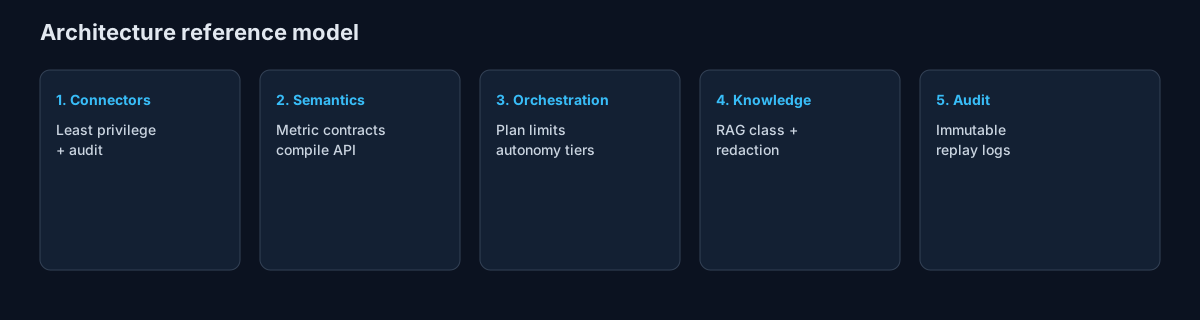 Reference model: least-privilege connectors → metric contracts → plan limits → RAG redaction → immutable replay.
| Layer | Security focus | InfiniSynapse alignment |
|---|---|---|
| Connectors | Least privilege, audit | InfiniSQL lineage |
| Semantics | Metric contracts | Compile API bindings |
| Orchestration | Plan limits, autonomy tiers | InfiniAgent workflows |
| Knowledge | RAG classification | InfiniRAG redaction scopes |
| Audit | Immutable replay logs | Workflow log export |
Architecture reference: Data Agent Architecture: Components, Patterns, and Production Checklist.
Production rollouts should align access and review controls with the NIST AI Risk Management Framework, especially when recurring queries touch live schemas. Metric definitions should stay grounded in Wikipedia's statistics overview before agents encode KPIs. Observability for agentic analytics should follow OpenTelemetry documentation so query chains remain traceable in production.
Buyer Scorecard
Use this scorecard when shortlisting enterprise data security solutions for agent workloads:
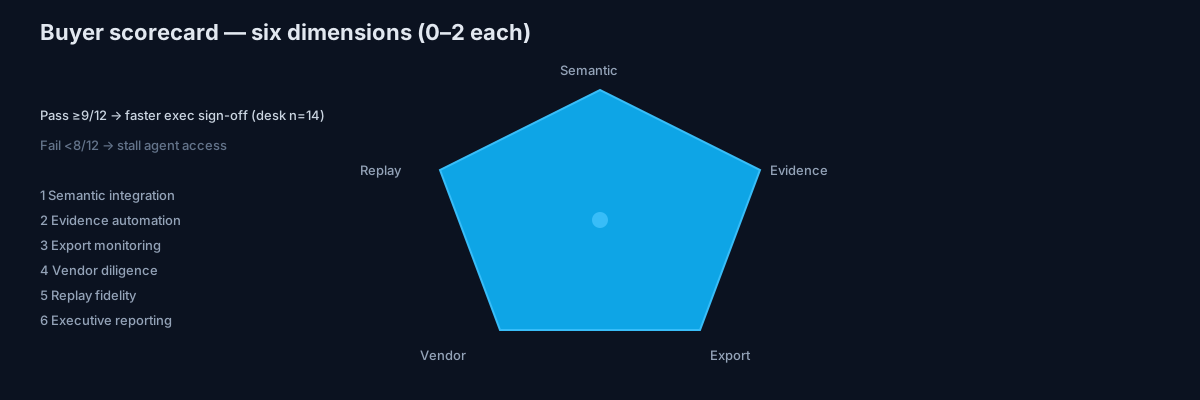 Six-dimension scorecard: semantic integration, evidence automation, export monitoring, vendor diligence, replay fidelity, executive reporting.
| Dimension | Pass signal | Fail signal |
|---|---|---|
| Semantic integration | Agents compile against metric IDs | Raw DDL grounding |
| Evidence automation | Logs feed SIEM/GRC | Manual spreadsheet attestation |
| Export monitoring | NL CSV alerts in minutes | Email-only DLP |
| Vendor diligence | LLM sub-processors listed | Missing model routes |
| Replay fidelity | Reconstruct answers from logs | Black-box NL |
| Executive reporting | Monthly security dashboard | Annual audit scramble |
Score 0–2 per row; programs below 8/12 usually stall enterprise agent access.
Source: InfiniSynapse 2025–2026 Security Pilot (n=14) — teams above 9/12 reached executive sign-off 40% faster (first-party desk composite, not a third-party lab SLA). For independent category research, start with Gartner Peer Insights — Analytics & BI and G2 Analytics Platforms.
NL interfaces for data still inherit limits from Wikipedia's natural language processing overview, especially ambiguity and grounding.
Implementation Roadmap
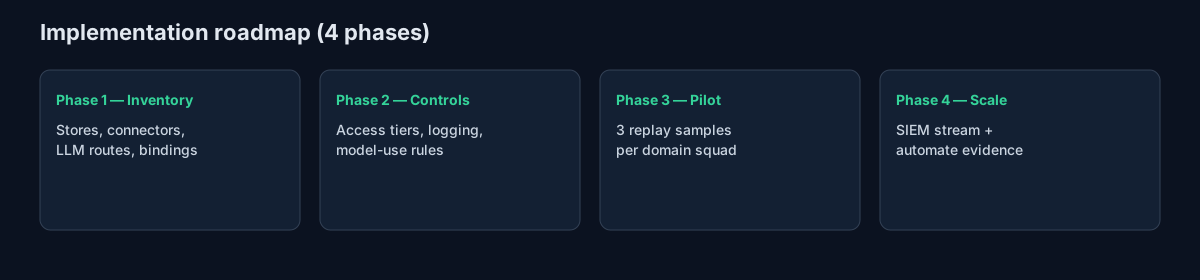 Four phases from inventory to SIEM automation—each phase produces auditor-ready artifacts.
Phase 1 — Inventory. Catalog stores, connectors, LLM routes, semantic bindings, and certifications. Identify gaps where agents introduce new processing paths.
Phase 2 — Control design. Draft access tiers, logging standards, and model-use rules aligned with Enterprise Data Governance for AI Analytics: A 2026 Playbook.
Phase 3 — Pilot with evidence. Run a bounded pilot; collect three auditor-ready replay samples per domain squad.
Phase 4 — Scale and automate. Stream agent events to SIEM; operationalize via Enterprise Data Services for AI Analytics: A 2026 Overview or internal platform teams.
Methodology and Platform Comparison
Enterprise teams rarely choose a single security SKU. The table maps approach to when it fits and points to cluster guides for depth.
| Approach | Best when | Limit for AI agents | Deep dive |
|---|---|---|---|
| DSPM / DLP platforms | Shadow data discovery, egress monitoring | Often miss NL CSV export paths | Enterprise Data Security Platform: 2026 Buyer Guide |
| Semantic + compile APIs | Finance rejects raw-DDL agent answers | Requires metric investment first | Enterprise Data Governance for AI Analytics: A 2026 Playbook |
| Warehouse-native controls | Snowflake/BQ IAM already mature | Needs agent-specific replay logs | Enterprise Data Security in 2026: Controls for AI Agents |
| Integrated agent stack | Multi-source NL with audit replay | Higher build vs buy scrutiny | Enterprise Data Platform in 2026: The AI-Native Shift |
Platform owners evaluating services-led rollouts should compare build-vs-buy in Enterprise Data Services for AI Analytics: A 2026 Overview. Migration-heavy programs should align cutover evidence with Enterprise Data Migration for AI Analytics: A 2026 Guide before agents touch production schemas.
ClickHouse connector paths should align with ClickHouse documentation for table engines, sampling, and query guardrails.
Tool Landscape: Enterprise Security SKUs and Agent Stacks
enterprise data security solutions rarely come from a single vendor. Map the landscape before RFP language locks you into perimeter-only tooling.
| Solution class | Primary job | Agent-era gap to verify | Evaluation guide |
|---|---|---|---|
| DSPM / CASB / DLP | Discover shadow data, monitor egress | NL CSV and chat exports | Enterprise Data Security Platform: 2026 Buyer Guide |
| Warehouse IAM + semantic views | Role-based compile | Replay logs for NL sessions | Enterprise Data Security in 2026: Controls for AI Agents |
| Integrated Data Agent stack | Orchestration + audit + multi-source NL | Build vs buy, sub-processors | Enterprise Data Platform in 2026: The AI-Native Shift |
| GRC / SIEM extensions | Continuous control testing | Tool-call telemetry parsers | Enterprise Data Governance for AI Analytics: A 2026 Playbook |
| Protection & backup suites | Encryption, retention, legal hold | RAG index and prompt retention | Enterprise Data Protection for AI-Native Analytics (2026) |
Procurement should require vendors to replay three production-like sessions during POC weeks—not slide demonstrations alone. Compare services-led rollouts in Enterprise Data Services for AI Analytics: A 2026 Overview when internal platform capacity is constrained.
InfiniSynapse Production Pattern
InfiniSynapse maps agent-era controls across InfiniAgent orchestration, InfiniSQL lineage, InfiniRAG redaction scopes, and immutable workflow logs. Customers bind agent roles to existing IAM and semantic definitions before scaling NL interfaces to executive users. This section describes how we implement the patterns above inside our product—editorial scorecard criteria remain vendor-neutral.
| Component | Security role |
|---|---|
| InfiniAgent | Autonomy tiers, plan limits |
| InfiniSQL | Dialect-aware execution + audit |
| InfiniRAG | Scoped retrieval, redaction |
| Metric bindings | Compile-time grounding |
| Workflow log | Session replay for assessors |
Snowflake Cortex Analyst documentation shows how warehouse-native semantic layers change NL2SQL grounding expectations for analyst-facing products.
Common Failure Modes
Failure 1 — BI-era security stacks. Policies omit prompts, tool calls, and NL exports. Fix: Extend ISMS scope to the full agent path.
Failure 2 — Point-in-time audits. Annual reviews without continuous log monitoring. Fix: Stream agent events to SIEM with export-specific rules.
Failure 3 — Ungoverned semantics. Agents query raw DDL; finance rejects outputs. Fix: Compile API with metric IDs agents must call.
Failure 4 — Vendor trust transfer. Assuming cloud ISMS covers misconfiguration. Fix: Shared responsibility matrix per connector and LLM route.
Security Architecture for AI Analytics
When Data Agents query live warehouses, controls span five layers:
| Layer | Security focus | Agent-era shift |
|---|---|---|
| Identity | IAM, SSO, service accounts | Compile-time metric bindings |
| Data plane | Encryption, masking, tokenization | RAG index classification |
| Query path | SQL audit, row filters | Tool-call graph logging |
| Egress | DLP, export limits | NL CSV download monitoring |
| Governance | Catalog, lineage, policy versions | Semantic contract enforcement |
Platform teams should map each layer to named owners before scaling agent access beyond pilot squads. When that runtime must sit on hardware you operate, the placement is on premise AI.
Zero-trust compile path
Never trust natural-language intent to self-limit joins. Authenticate the analyst, authorize metrics through the semantic layer, compile SQL, log lineage, then inspect egress.
Evidence automation
Immutable workflow logs should capture policy version hashes per session so external assessors replay answers without re-running production queries.
Vendor Evaluation Workflow
Run structured diligence when enterprise data security solutions shortlists include DSPM, CASB, and analytics-agent platforms:
- Proof export — Script CSV download from the agent UI during POC week one.
- Replay fidelity — Reconstruct three executive answers from logs alone.
- Sub-processor disclosure — List every LLM route agents invoke.
- Semantic integration — Verify the compile API respects metric IDs from existing catalogs.
- Scorecard gate — Require ≥8/12 on the buyer scorecard before procurement advances.
Procurement should attach scorecard PDFs to vendor records so auditors trace approval rationale years later.
Operating Cadence
Treat enterprise data security solutions as a weekly rhythm: connector reviews, export-alert triage, and compile-denial sampling. Monthly executive readouts should trend mean time to revoke credentials and open GRC exceptions—not only annual audit readiness snapshots.
Procurement should require vendors to replay three production-like sessions during POC weeks—not slide demonstrations alone. Score each session for compile-time denial fidelity, export detection latency, and sub-processor disclosure completeness. Archive recordings in the GRC portal with policy version hashes attached.
Security architecture reviews must treat semantic compile APIs as part of the trust boundary. Agents that bypass metric IDs to join raw DDL recreate the same reconciliation failures finance escalated after early copilot pilots. Hub readers should cross-check sibling guides on governance and protection before signing enterprise-wide agent contracts.
Executive steering works best as a thirty-minute weekly forum: new connectors, failed export alerts, open exceptions, and metric binding diffs. Decisions belong in the same system auditors query later—not scattered across Slack threads and slide decks.
Red-team exercises should simulate prompt injection that attempts CSV exfiltration through NL export buttons. Measure time-to-revoke credentials and time-to-page on-call after DLP fires. Programs that only test SQL injection on JDBC paths miss the dominant agent-era exfiltration pattern.
Steering committees should map every agent connector to a control ID before enterprise rollout—not after the first export incident. We recommend quarterly red-team exercises targeting NL CSV downloads because DLP rules tuned for email miss conversational export paths. Vendor SOC reports rarely enumerate LLM sub-processors; procurement addenda should require quarterly attestation of model routes.
Immutable workflow logs with policy version hashes reduce scramble time when regulators request evidence on short notice. Platform and security leads should co-chair weekly connector reviews during agent pilots to catch shadow integrations early. Executive sponsors should attend one replay demo per quarter because abstract compliance scores rarely change funding decisions.
Architecture review boards should reject proposals lacking named owners, measurable success criteria, and replay evidence from a bounded pilot window. Sandbox environments must enforce production-identical compile rules even when datasets are synthetic. Platform owners should publish weekly latency histograms during pilot month one so executives see governance working—not only demo screenshots.
Pilot teams should document one controlled failure and one successful replay before expanding connector scope. Executive sponsors respond better when memos lead with the decision requested, then show the governed path that produced the numbers. Analysts save the most time when memory cards store approved joins and filters instead of one-off prompt chains that break after renames.
Cluster Deep Dives by Workflow
Open these guides when a specific workflow matches your next sprint:
| Focus | When it fits | Guide |
|---|---|---|
| What Is Enterprise Data? | Platform depth | What Is Enterprise Data? A 2026 Guide for AI Analytics |
| Enterprise Data Analytics | BI → agents | enterprise data analytics |
| Enterprise Data Science Platform | Science platform buyers | Enterprise Data Science Platform: 2026 Buyer Guide |
| Enterprise Data Management | Management programs | What Is Enterprise Data Management? A 2026 Guide |
Cluster guides in this pillar
| Focus | Guide |
|---|---|
| Enterprise Data Services | Enterprise Data Services for AI Analytics: A 2026 Overview |
| Enterprise Data Security Controls | Enterprise Data Security in 2026: Controls for AI Agents |
| Enterprise Data Platform | Enterprise Data Platform in 2026: The AI-Native Shift |
| Enterprise data platform strategy | enterprise data platform strategy |
| Enterprise Data | What Is Enterprise Data? A 2026 Guide for AI Analytics |
| Enterprise Data Governance | Enterprise Data Governance for AI Analytics: A 2026 Playbook |
| Enterprise Data Protection | Enterprise Data Protection for AI-Native Analytics (2026) |
| Enterprise Data Analytics | enterprise data analytics |
| Enterprise Data Science Platform | Enterprise Data Science Platform: 2026 Buyer Guide |
| Enterprise Data Management | What Is Enterprise Data Management? A 2026 Guide |
| Enterprise Data Security Platform | Enterprise Data Security Platform: 2026 Buyer Guide |
| Enterprise Data Migration | Enterprise Data Migration for AI Analytics: A 2026 Guide |
Frequently Asked Questions
What do enterprise data security solutions include for AI analytics?
Integrated platforms and practices covering identity, encryption, semantic compile controls, export monitoring, and immutable replay—not only network perimeter tools. Agent paths add prompt retention, tool-call graphs, and NL CSV egress that classic BI ISMS scopes often omit.
Which frameworks should anchor reviews?
Anchor on NIST CSF or ISO 27001 plus the NIST AI Risk Management Framework for agents; add sector overlays when datasets are regulated. The ENISA Threat Landscape helps prioritize threat scenarios for executive briefings.
How do auditors evaluate agent sessions?
They expect immutable replay, role attribution, policy version stamps, and tool-call graphs—similar to database audit trails extended for NL intent. Three auditor-ready replay samples per domain squad is a practical pilot exit criterion.
Can we reuse existing DSPM investments?
Yes—extend discovery and DLP to agent export paths and RAG stores; verify SIEM parsers handle tool-call telemetry. DSPM alone rarely covers compile-time metric bindings.
What is a realistic timeline to production-ready security?
Eight to twelve weeks for a focused pilot with executive sponsorship and semantic bindings in place. Scale only after the scorecard clears 8/12 and export alerts fire within minutes.
How should the buyer scorecard be used in procurement?
Score each dimension 0–2, attach the PDF to the vendor record, and block procurement below 8/12 unless gaps have named owners. Re-score after every major release when agent autonomy expands.
What is the difference between this guide and enterprise data security controls?
This page compares solution categories and buyer workflows; security controls for AI agent platforms deep-dives control implementation patterns.
Are InfiniSynapse pilot percentages third-party audited?
No. The 40% faster sign-off figure is InfiniSynapse 2025–2026 Security Pilot (n=14) first-party desk data. Use Gartner Peer Insights for independent category research.
Does this article promote InfiniSynapse?
Editorial definitions, scorecards, and HowTos stand alone. Product CTAs appear only under Product recommendation (commercial) at the end.
Where should readers go next in the cluster?
Start with Enterprise Data Governance for AI Analytics: A 2026 Playbook, then Enterprise Data Protection for AI-Native Analytics (2026), and return here for the buyer map.
Conclusion
enterprise data security solutions require analytics and security to co-own agent evidence. Inventory connectors, run the scorecard, complete the four-phase roadmap, and use the cluster guides before enterprise scale. Treat weekly connector reviews and export-alert triage as part of the product operating rhythm—not as annual audit prep.
Next steps:
- Run the buyer scorecard against your current stack and record pass/fail per dimension.
- Inventory executive metrics and count conflicting SQL definitions agents might join today.
- Read Enterprise Data Governance for AI Analytics: A 2026 Playbook, then return here for the full security map.
Schedule the first executive replay demo before expanding agent connector scope beyond the pilot squad. For adjacent depth, see Enterprise data management program guide and What is enterprise data management.
Product recommendation (commercial)
Label: The following is a commercial product recommendation, separate from the editorial security guidance above.
To evaluate governed agent compile paths with immutable replay, see Enterprise Data Security in 2026: Controls for AI Agents and optionally the InfiniSynapse web app (free on registration). Desk n=14 metrics and NIST / ENISA / Gartner Peer Insights citations above are not product endorsements.