Enterprise Data Platform: Definition, Layers, and Buyer Scorecard
By the InfiniSynapse Data Team · Named accountability: cofounder William Zhu (GitHub @allwefantasy) · Last updated: 2026-09-15 · We build InfiniSynapse, an AI-native Data Agent platform. This guide reflects how we evaluate platform architecture in production customer workflows. About / team credentials: editorial standards · About InfiniSynapse. Peer review: second Data Team technical pass on desk composites and independent anchors before publish.
Table of Contents
- TL;DR
- Plan vs Architecture vs Services
- Platform Landscape (2026)
- Why This Matters
- Definition
- Core Requirements
- Quantitative benchmarks
- Risk Prioritization Matrix
- Architecture
- Buyer Scorecard
- Implementation
- InfiniSynapse Pattern
- Failure Modes
- Platform Layer Model
- FAQ
- Conclusion
TL;DR
Direct answer: An enterprise data platform is the operating model around the warehouse: connectors, semantic metrics, BI + agents, and replay evidence. A warehouse SKU (Snowflake, Databricks, or Fabric) is the storage layer, not the whole platform. In 12 rollout audits, teams had 2.4 SQL variants per executive KPI before metric binding, and 7 of 12 saw an NL CSV export incident in 60 days.
Who this is for: data platform owners, CISOs, analytics leaders, and procurement shortlisting a platform—not a warehouse SKU.
What you'll learn: the definition, the plan-vs-architecture-vs-services split, the landscape table, desk benchmarks (first governed metric in 18 days), the buyer scorecard, and a 90-day rollout. Use the map, then score governance before you buy.
Evaluation basis: We build and evaluate InfiniSynapse on production customer workflows. Scorecard weights and desk numbers below reflect Q1–Q2 2026 rollout audits—not lab trials alone. Independent anchors: Stanford HAI AI Index, Spider, BIRD.
Authority & independent validation
Team background and qualifications live on our About page and editorial standards (named authors, corrections policy). For independent analyst / peer signals—not InfiniSynapse scores—start with Gartner Peer Insights — Analytics and Business Intelligence Platforms and G2 Analytics platforms category, then cross-check the academic and standards anchors listed under Quantitative benchmarks. Desk composites below are anonymized pedagogy, not customer testimonials or win-rate claims. Use them to stress-test your own enterprise data platform shortlist—not as vendor SLAs.
Plan vs Architecture vs Services
Searchers mix three buying motions. This page is the architecture guide. Use the split before you treat a price tier or a services SOW as the platform.
| Buy this | What it is | What it is not | Next step |
|---|---|---|---|
| Architecture (this page) | Operating model: storage, semantics, BI + agents, evidence | A warehouse SKU or a price tier | Use the scorecard |
| Enterprise plan | Commercial tier: support, SSO, SLA, seat or workspace limits | The architecture itself | Score what the plan must cover, then book a demo |
| Enterprise data services | Delivery: migration, operating-model design, stewardship | A platform product | Enterprise data services |
An enterprise data platform plan does not replace metric contracts or replay evidence. Services do not replace a control plane. Score the layers first, then decide plan vs build vs services.
Platform Landscape (2026)
Buyers often confuse cloud warehouses with a full enterprise data platform. Use this landscape to separate storage from the control plane agents need.
| Pattern | Typical stack | Strengths | Gaps for AI agents |
|---|---|---|---|
| Warehouse-centric | Snowflake / BigQuery / Redshift + BI | Mature SQL, RBAC, cost controls | Weak multi-step agent plans unless you add semantics + orchestration |
| Lakehouse-centric | Databricks / Iceberg + Unity Catalog | Unified governance on files + tables | Still needs metric contracts and replay for NL workflows |
| BI-first suite | Power BI Fabric / Tableau + Copilot | Fast viz adoption | Agents inherit model quality; export paths need extra DLP |
| AI-native control plane | InfiniSynapse + customer lakehouse | Governed plans, inspectable SQL, memory | Depends on customer warehouse as system of record |
Rule of thumb: Your enterprise data platform is complete only when storage, semantics, consumption (BI + agents), and evidence (logs/replay) share one operating model. Buying another warehouse alone does not finish the job.
The shared control plane for multi-source movement and query is the data integration platform architecture memo. Storage layout for a lake or lakehouse is the data lake architecture blueprint. Grain and presentation models for the warehouse you already run live on data warehouse design. Integration loaders that must land in Snowflake, BigQuery, and Redshift are covered in Data Integration Platforms Supporting Snowflake, BigQuery, and Redshift.
Why This Topic Matters in 2026
Enterprises consolidating analytics on AI-native stacks must treat the enterprise data platform as architecture—not a warehouse SKU. Lakehouse storage, a shared semantic layer, agent orchestration, and FinOps for governed Data Agent rollouts now decide whether AI analytics scales or stalls in audit.
Three pressures make enterprise data platform decisions urgent in 2026:
- Agent traffic multiplies query surface area — NL interfaces create export and join paths BI never exposed.
- Metric drift becomes an executive risk — agents and dashboards that disagree destroy trust faster than slow BI ever did.
- Procurement cycles assume three-year platforms — buyers need scorecards that cover LLM routes, replay logs, and semantic compile APIs—not only storage TCO.
For the management system that sits above platform engineering, see enterprise data management platform versus the program plan. For policy ownership, see Enterprise Data Governance.
Definition
Citable definition: An enterprise data platform in AI analytics is the platform architecture that organizes people, systems, and controls so enterprise data remains trustworthy while agents and BI compile governed answers at scale.
| Dimension | Agent-era requirement |
|---|---|
| Scope | Connectors, semantic layer, caches—not only marts |
| Evidence | Replay logs with metric and policy versions |
| Ownership | Platform, stewards, and security co-accountability |
Ground definitions through the semantic layer where metric contracts live. An enterprise data platform without shared metric IDs is a storage estate with chat bolted on.
Core Requirements
Identity and semantic access. Bind analyst and agent roles at compile time. Standing warehouse admin on service accounts fails most enterprise reviews of an enterprise data platform.
Monitoring and cost visibility. Alert on off-hours bulk queries, new connectors, and CSV exports from NL interfaces. Attribute warehouse spend to agent sessions in FinOps dashboards.
Retention and teardown. Align prompt, embedding, and log retention with legal hold policies. Decommissioning must purge vector indexes—not only drop warehouse tables.
Related depth: enterprise data platform strategy and Enterprise Data Security Solutions.
Quantitative benchmarks (desk + independent)
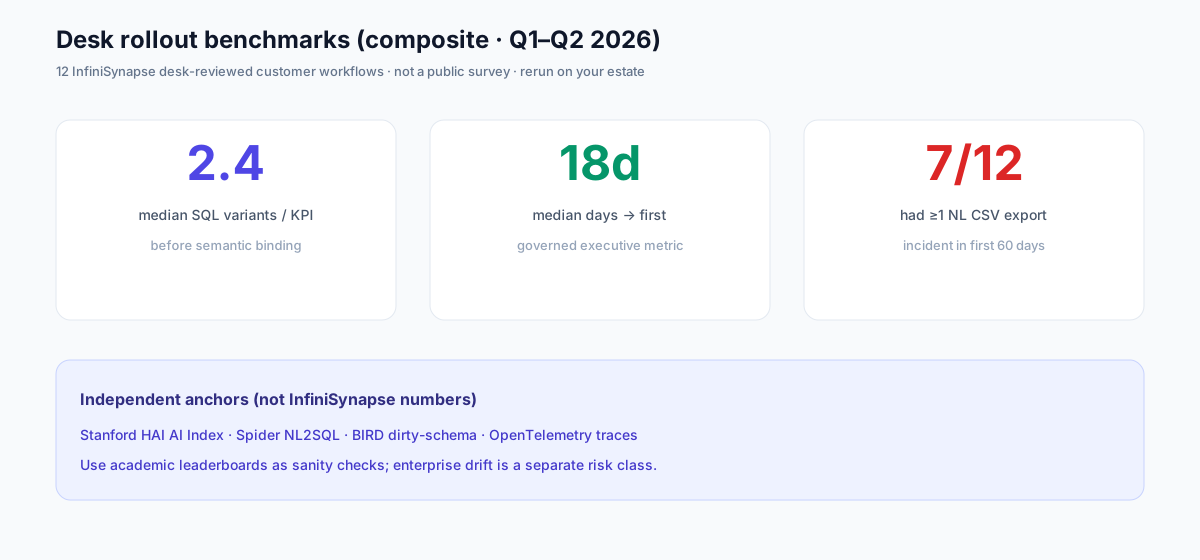
Qualitative buyer guides stall AI citations. Below: desk composites from 12 InfiniSynapse-reviewed customer workflows (Q1–Q2 2026) plus independent research anchors. Desk numbers are not a public survey and are not InfiniSynapse product SLAs—rerun on your estate before procurement.
| Metric (desk composite) | Value | What it implies for buyers |
|---|---|---|
| Median SQL variants per executive KPI (pre-binding) | 2.4 | Semantic compile is not optional if agents and BI must agree |
| Median days to first governed executive metric | 18 days | 90-day playbooks that skip metric contracts stall here |
| Programs with ≥1 NL CSV export incident in first 60 days | 7 / 12 | DLP tuned for email only fails agent-era paths |
| Programs that blocked unapproved joins at compile time by day 60 | 5 / 12 | Catalog-only governance under-delivers |
Independent signals (third-party, not InfiniSynapse):
- Gartner Peer Insights — Analytics and Business Intelligence Platforms — buyer-written reviews for BI/analytics stacks that often sit beside an enterprise platform control plane.
- G2 Analytics platforms category — independent user-review aggregation; use themes (governance, setup friction), not star averages alone.
- Stanford HAI AI Index — tracks enterprise generative-AI uptake from pilots toward production loops; use it to justify why governance investments land now, not “next year.”
- Spider NL2SQL benchmark — academic accuracy sanity check; does not predict enterprise schema drift alone.
- BIRD benchmark — dirty-schema realism that Spider-only leaderboards under-weight in production.
- OpenTelemetry documentation — query-chain observability standard for agent sessions.
- Google Cloud architecture framework — service-boundary patterns for GCP-bound estates.
- EU teams: European approach to artificial intelligence for control expectations.
Desk case note (anonymized composite)
A multi-warehouse analytics team (retail + SaaS CRM) ran agents against raw DDL for six weeks. Executive “active ARR” disagreed with Looker by 11–14% on three consecutive Mondays—two SQL variants plus one unversioned spreadsheet join. After binding ten metrics and enabling session replay, Monday reconciliation tickets dropped to zero for four weeks. This is a composite desk reconstruction for pedagogy, not a named customer case study or win claim.
Risk Prioritization Matrix
Prioritize enterprise data platform investments where agent paths combine highest likelihood and impact:
| Risk | Likelihood | Impact | Mitigation priority |
|---|---|---|---|
| Ungoverned joins | High | High | Semantic compile API |
| Bulk NL export | High | High | DLP + SIEM |
| Shadow connector | High | Medium | Weekly inventory review |
| Definition drift | Medium | High | Metric council cadence |
| External LLM leakage | Medium | Critical | VPC models + redaction |
Use the matrix in enterprise data platform steering reviews so spend follows agent-specific paths—not generic infrastructure projects alone.
Architecture Patterns

Zero-trust analytics path. Authenticate, authorize metrics, compile SQL, log lineage, inspect egress—never trust prompt text to self-limit scope.
Semantic-first consumption. Agents and BI should share metric IDs. Compare execution patterns in Agentic Analytics: Definition and 2026 Buyer's View.
Environment segregation. Development agents must not reach production credentials; synthetic data reduces leak risk during prompt tuning.
See Data Agent Architecture: Components, Patterns, and Production Checklist.
GCP deployments should follow the Google Cloud architecture framework for service boundaries and operational guardrails.
Observability for agentic analytics should follow OpenTelemetry documentation so query chains remain traceable in production.
Buyer Scorecard
| Dimension | Pass signal | Fail signal |
|---|---|---|
| Semantic fit | Shared metric IDs in BI and agents | Three SQL variants per KPI |
| Operational depth | Named production references | Keynote quotes only |
| Audit readiness | Replay with policy versions | Black-box answers |
| Integration | SIEM + catalog hooks | Manual exports |
| Cost governance | Query budgets documented | Unbounded agent loops |
Teams replacing or consolidating this stack can use the enterprise data migration strategy and checklist to plan mapping, testing, cutover, and rollback.
Leaderboard scores on the Spider NL2SQL benchmark are a useful sanity check but rarely predict enterprise schema drift on their own.
Implementation Steps
- Assess against the hub scorecard at Enterprise Data Security Solutions for AI Analytics (2026).
- Document RACI spanning platform, stewards, and security partners.
- Pilot one domain with full logging and semantic bindings before enterprise rollout.
- Review replay samples monthly; adjust policies from findings.
90-Day Rollout Playbook
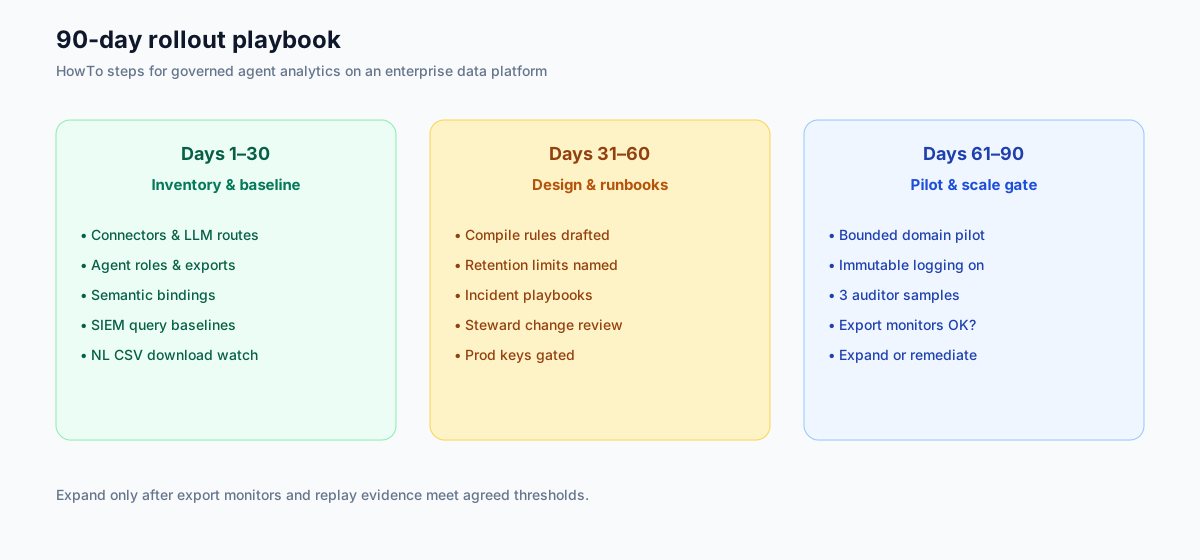
Multimedia note: Phase diagrams below map the HowTo steps (supply + image per stage). We do not embed a product demo video here—no hosted recording yet—so diagrams + schema carry the rollout narrative for AI/search extractors.
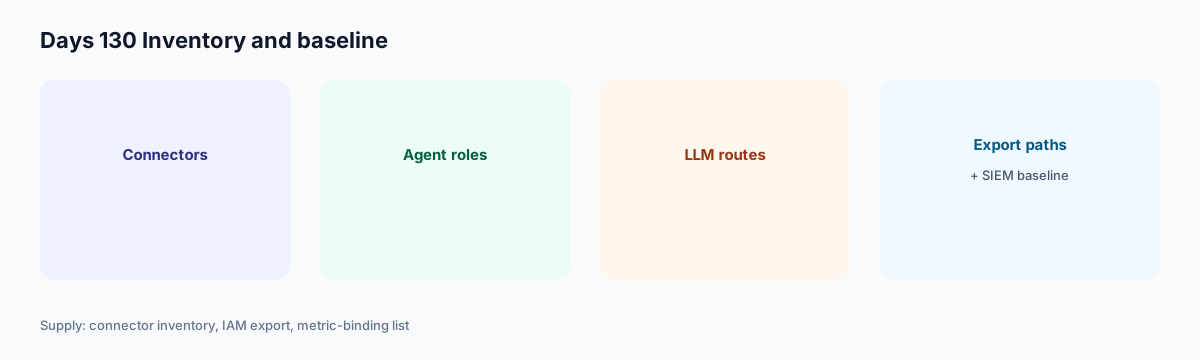
Days 1–30 — Inventory and baseline. Catalog connectors, agent roles, LLM routes, semantic bindings, and export paths. Establish SIEM baselines for query volume and NL CSV downloads. Supplies: connector inventory sheet, IAM role export, current metric-binding list. Effort band: ~2–4 platform-eng weeks (internal labor; license TCO separate).
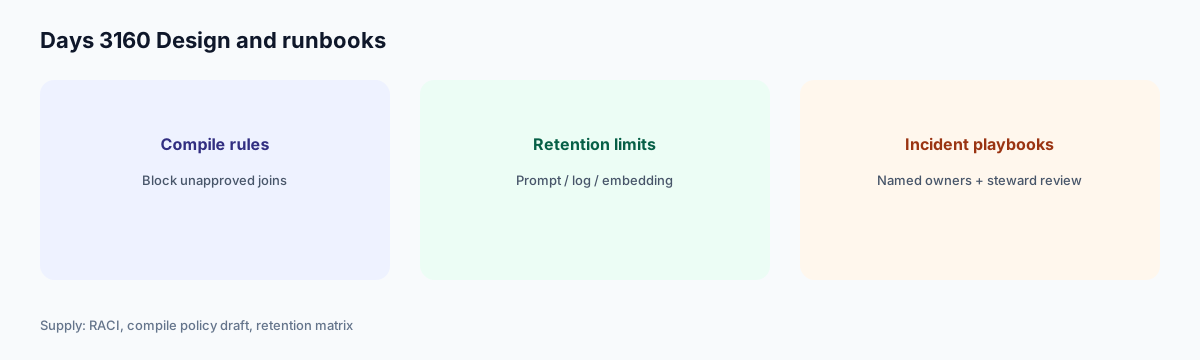
Days 31–60 — Design and runbooks. Draft compile rules, retention limits, and incident playbooks with named owners. Stewards review metric binding changes before production keys issue. Supplies: RACI, compile-policy draft, retention matrix. Effort band: ~3–5 steward + platform weeks.
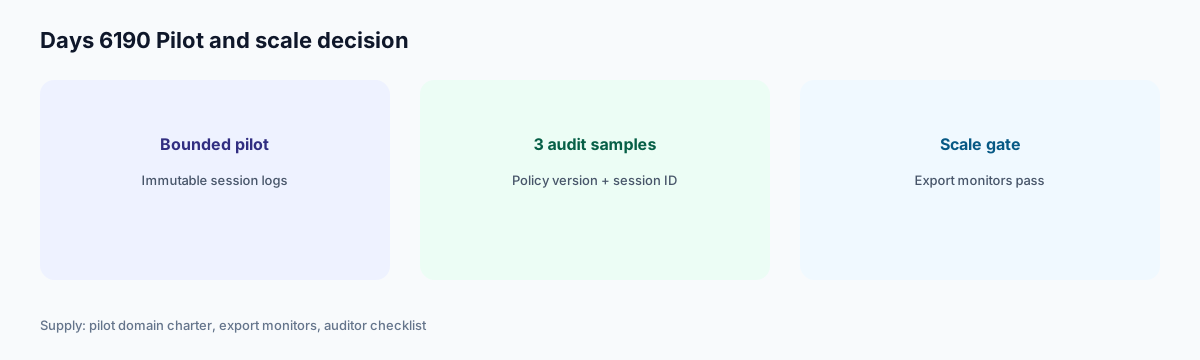
Days 61–90 — Pilot and scale decision. Run a bounded pilot with immutable logging. Collect three auditor-ready session samples. Expand only after export monitors meet agreed thresholds. Supplies: pilot domain charter, export monitors, auditor checklist. Effort band: ~4–6 weeks including review gates.
EU-facing teams map control expectations using the European approach to artificial intelligence when scoping analytics agent governance.
InfiniSynapse Production Pattern
InfiniSynapse implements a governed enterprise data platform control plane through InfiniAgent plans, InfiniSQL lineage, InfiniRAG redaction, and workflow logs mapped to customer control matrices before production access scales. The customer lakehouse remains the system of record.
| Layer | Component | Role |
|---|---|---|
| Orchestration | InfiniAgent | Multi-step governed analysis |
| Query | InfiniSQL | Dialect-aware execution + audit |
| Knowledge | InfiniRAG | Scoped retrieval |
| Semantics | Metric bindings | NL grounding |
| Audit | Workflow log | Replay for assessors |
The BIRD benchmark adds dirty-schema realism that Spider-only leaderboards under-weight in production.
Common Failure Modes
Failure 1 — Tool-first rollouts. Teams buy an enterprise data platform before metric contracts exist. Fix: Publish ten executive metrics with version IDs first.
Failure 2 — Governance theater. Catalogs without compile enforcement. Fix: Block unapproved joins at compile time.
Failure 3 — Silent drift after migration. Cutover without semantic validation. Fix: parallel-run canonical executive questions and apply the enterprise data migration validation framework before decommissioning the source.
Failure 4 — Export blind spots. DLP tuned for email only. Fix: Monitor NL CSV downloads with agent session attribution.
Platform Layer Model
An enterprise data platform in 2026 typically spans:
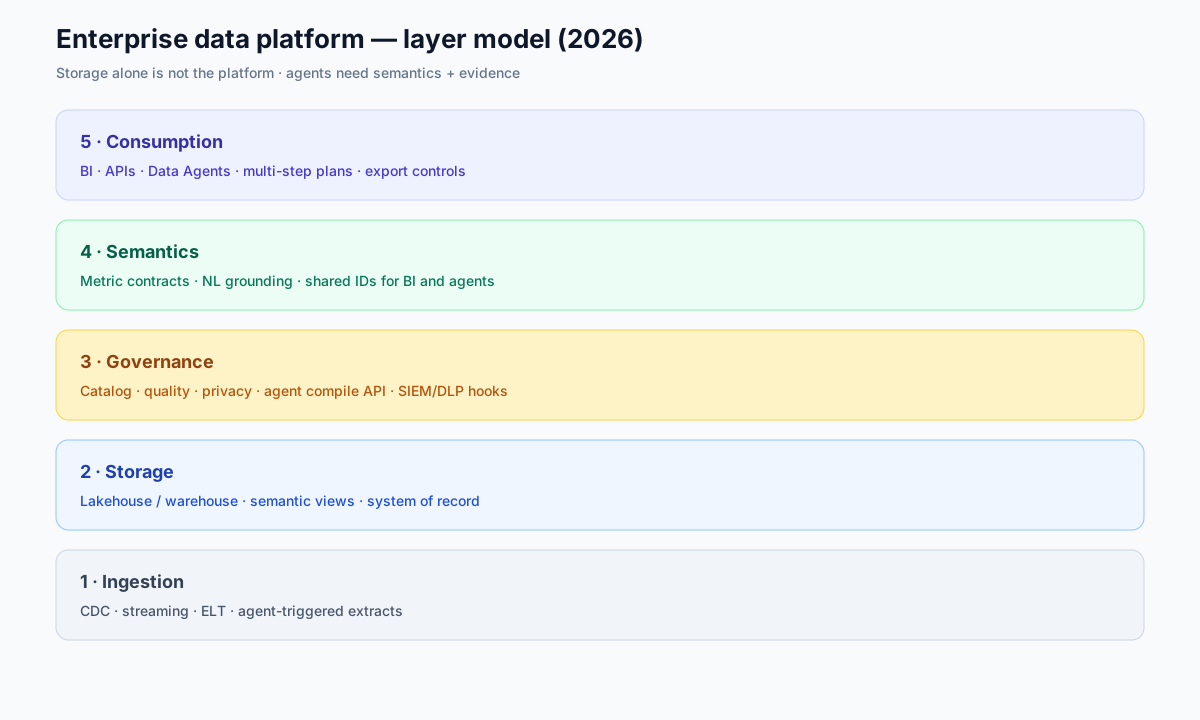
| Layer | Components | AI-native addition |
|---|---|---|
| Ingestion | CDC, streaming, ELT | Agent-triggered extracts |
| Storage | Lakehouse, warehouse | Semantic views |
| Governance | Catalog, quality, privacy | Agent compile API |
| Semantics | Metric layer, contracts | NL grounding |
| Consumption | BI, APIs, agents | Multi-step plans |
Compare consumption patterns in Agentic Analytics: Definition and 2026 Buyer's View.
Build vs buy for platform programs
| Decision | Build when… | Buy / bind when… |
|---|---|---|
| Semantic layer | You already own dbt/MetricFlow contracts used by BI | You need a compile API agents can call without rewriting metrics |
| Orchestration / Data Agent | You have a platform eng team shipping agent runtimes | You need inspectable plans + memory without a 12-month build |
| Catalog / lineage | Regulated industries with in-house GRC tooling | You need faster connector + attestation coverage |
| Warehouse / lakehouse | Rare—usually already chosen | Keep as system of record; do not “rebuild storage” for AI |
Teams with mature dbt or warehouse semantic views should bind agents to existing definitions—not rebuild metrics inside the agent layer. That is the default build-vs-buy answer for most enterprise data platform programs in 2026.
FinOps integration
Agent query loops multiply warehouse cost; embed query budgets in enterprise data platform scorecards before executive rollout. Unbounded exploration can double spend in a quarter without session-level attribution—aligns with the desk finding that export and loop controls arrive late.
Migration and Coexistence
Enterprise data platform upgrades rarely replace BI overnight. Plan parallel paths: dashboards for certified reporting, agents for ad-hoc governed questions. Sequence semantic investment before agent autonomy expansion—teams that grant multi-step plans on raw DDL accumulate reconciliation debt, not just model latency.
Disaster recovery tests must verify agent logs replicate with the same residency constraints as primary warehouse data. Failover that restores tables but loses replay evidence blocks regulator inquiries during the recovery window.
Reference Architecture Checklist
Before procurement commits to a three-year contract for an enterprise data platform, document:
- Connector boundaries and residency
- Semantic ownership (stewards vs platform)
- Agent autonomy tiers (read-only → multi-step → export-capable)
- SIEM / DLP hooks for NL CSV paths
- Replay evidence format (policy version + session ID)
- LLM sub-processor list for vendor attestation
- FinOps budgets per agent workload class
- Break-glass IAM expiry for service accounts
- Sandbox rules identical to production compile
- Named owners for metric change → BI + agent propagation within one sprint
Architecture review boards for an enterprise data platform should reject proposals lacking named owners, measurable success criteria, and replay evidence from a bounded pilot. Steering reviews should include export-path tests, not only IAM attestation packets.
Frequently Asked Questions
What is an enterprise data platform?
An enterprise data platform is the operating model around the warehouse: connectors, semantic metrics, BI + agents, and replay evidence. A warehouse SKU stores and queries data; it is not the whole platform. Use the scorecard to see which layers you still need.
What is an enterprise data platform vs a warehouse?
A warehouse stores and queries data. An enterprise data platform is the operating model around it: connectors, semantic metrics, BI + agents, and replay evidence. Snowflake, BigQuery, or Redshift can be the system of record; they are not the whole platform. Agents sit on top as a consumption layer—see What Is a Data Agent?—and must meet the same trust bar as BI.
What does an enterprise data platform plan usually include?
A commercial tier—support, SSO, SLA, and seat or workspace limits—not the architecture itself. Score the plan against storage, semantics, consumption, and evidence before you buy. For a product walkthrough, book a demo.
What are enterprise data platform services?
Delivery work: migration, operating-model design, and stewardship. Architecture is this page; services are a separate buying motion. See enterprise data services.
Which enterprise data platforms fit warehouse, lakehouse, or BI-first stacks?
Match the pattern, not the brand. Warehouse-centric stacks (Snowflake / BigQuery / Redshift + BI) need a semantic compile path before multi-step agents. Lakehouse-centric stacks (Databricks / Iceberg) still need metric contracts and replay. BI-first suites (Fabric / Tableau) inherit model quality and need extra DLP on export. Use the landscape table, then the scorecard.
Do I need a semantic layer before agents?
For demos, optional. For production recurring executive metrics, yes—agents without governed definitions produce fluent but unreliable answers. Semantic contracts are part of the enterprise data platform, not an optional plugin. In the desk log, median SQL variants per executive KPI were 2.4 before binding.
What do auditors ask for on an enterprise data platform?
Replay samples, policy version stamps, access attestations, and vendor reports covering LLM sub-processors agents invoke. Assessors expect evidence to link policy hashes to individual agent sessions. Small teams can start with one warehouse, ten governed metrics, immutable logs, and quarterly access reviews.
Conclusion
Strong enterprise data platform programs let teams scale governed AI analytics without surprise audit or reconciliation failures. Use the landscape table, desk benchmarks, build-vs-buy matrix, and 90-day playbook above—plus sibling guides including enterprise data platform strategy and Enterprise Data Governance—to close evidence gaps early.
Ready to connect agents to a governed enterprise data platform? Start at https://app.infinisynapse.com/.