On this page本文目录
What Is a Data Integration Platform?什么是数据集成平台?
Place this specific workflow in context with the complete data integration guide, which connects the definitions, alternatives, validation steps, and related implementation guides.
可通过完整的数据集成指南理解本专题在整体流程中的位置;该指南串联了定义、替代方案、验证步骤与相关实施文章。
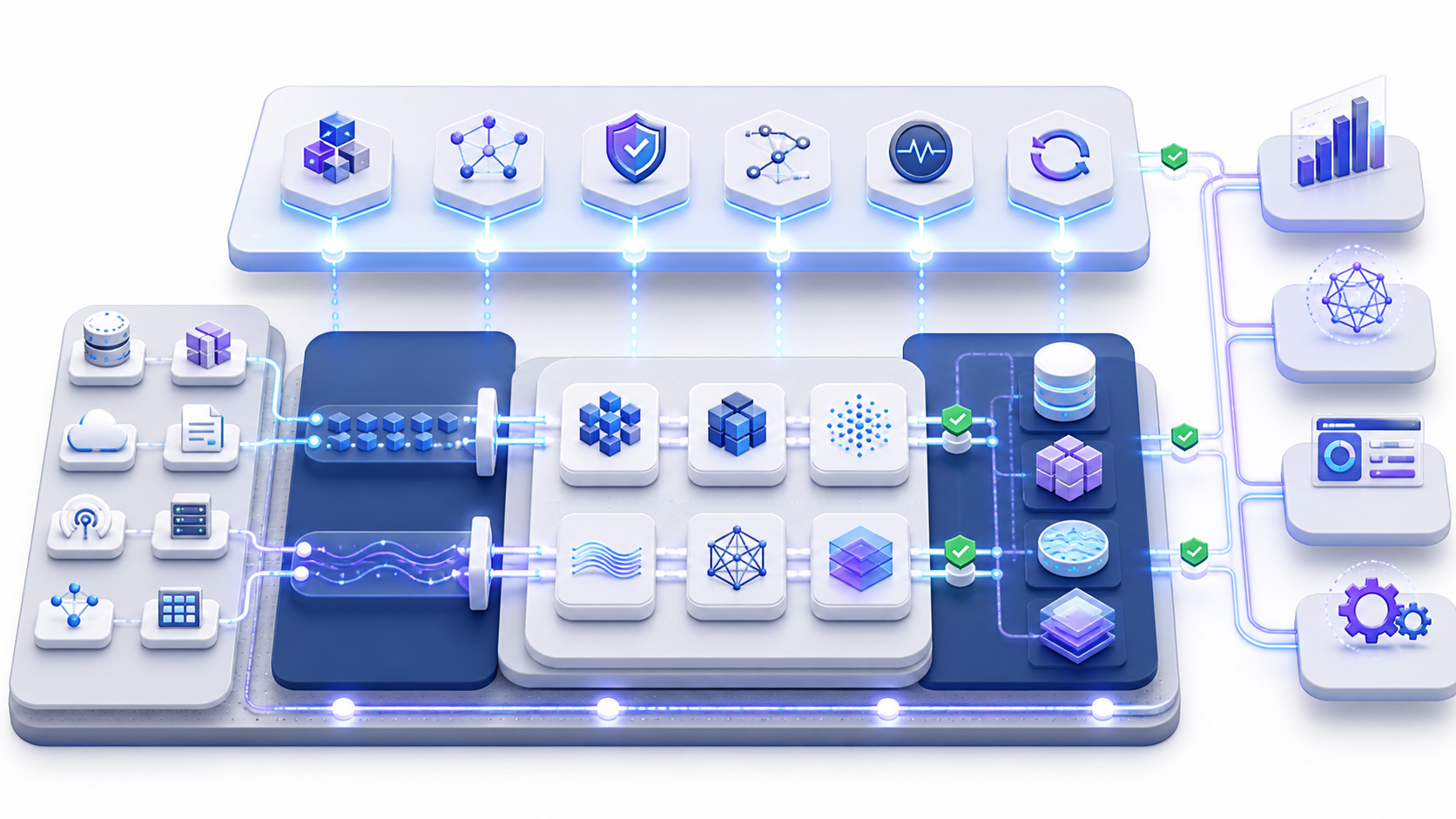
A data integration platform is the shared foundation for multi-data platform integration: connecting sources, moving or querying data, transforming it, enforcing policy, and running those jobs reliably across teams. It combines execution services with a control plane for metadata, orchestration, security, observability, deployment, and recovery.
数据集成平台是多数据平台集成的共享基础:连接数据源、搬运或查询数据、执行转换、落实策略,并让多个团队可靠运行这些作业。它将执行服务与元数据、编排、安全、可观测性、部署和恢复控制面结合起来。
The word platform matters. A connector or ETL engine may solve one task; a platform defines how many tasks are created, governed, promoted, monitored, and retired. It can be one integrated product or an intentionally assembled set of services. What makes it a platform is the shared operating model, not the number of logos in the stack.
“平台”二字很重要。连接器或ETL引擎可以解决单个任务;平台则规定大量任务如何创建、治理、发布、监控和退役。它可以是一体化产品,也可以是经过明确设计的一组服务。决定其是否为平台的是共享运作模式,而不是技术栈中Logo的数量。
When a Platform Is Needed—and When It Is Not何时需要平台,何时不需要
A platform becomes useful when integrations share recurring concerns: authentication, secrets, deployment, schema change, retries, lineage, alerting, cost allocation, and audit evidence. Without shared controls, every pipeline invents its own solution and operational inconsistency grows faster than data volume.
当集成任务反复面对身份验证、密钥、部署、Schema变更、重试、血缘、告警、成本归属和审计证据时,平台开始产生价值。缺少共享控制时,每条管道都会自行实现这些能力,运维不一致往往比数据量增长得更快。
Multiple domains, repeated connectors, regulated data, mixed batch and real-time workloads, independent delivery teams, or a growing on-call burden all justify common services.
多个业务域、重复连接器、受监管数据、批处理与实时混合负载、独立交付团队或不断增加的值班压力,都说明需要共享服务。
One bounded source-to-target transfer with low change frequency may need a managed connector and clear ownership—not a new internal platform program.
若只有一个边界清晰、变化频率低的源到目标传输,可能只需要托管连接器和明确责任人,而不是新建内部平台项目。
A platform is also the wrong answer when the real requirement is one-time migration, interactive analysis, or application workflow automation. Migration tooling, federated query, and iPaaS can be better fits. Define the outcome before selecting an architecture.
如果真实需求是一次性迁移、交互式分析或应用工作流自动化,平台也可能不是正确答案。迁移工具、联邦查询和iPaaS可能更合适。应先定义结果,再选择架构。
Core Components of a Data Integration Platform数据集成平台的核心组件
A durable architecture separates the data plane, where records or queries are processed, from the control plane, where policy and lifecycle decisions are made. This separation makes responsibilities testable and prevents orchestration metadata from becoming tangled with workload data.
可持续的架构会区分处理记录或查询的数据面与做出策略和生命周期决策的控制面。这种分离让职责可以测试,也避免编排元数据与工作负载数据纠缠。
| Layer层 | Responsibilities职责 | Evidence to retain应保留证据 |
|---|---|---|
| Connectivity连接层 | Protocols, credentials, extraction boundaries, source quotas协议、凭证、抽取边界与源端配额 | Connector version, permissions, configuration连接器版本、权限与配置 |
| Data plane数据面 | Batch, CDC, streams, transforms, delivery, virtual queries批处理、CDC、流、转换、交付与虚拟查询 | Counts, checksums, offsets, run logs计数、校验和、位点与运行日志 |
| Control plane控制面 | Scheduling, dependency state, deployment, policy, secrets调度、依赖状态、部署、策略与密钥 | Version history, approvals, policy decisions版本历史、审批与策略决策 |
| Metadata and governance元数据与治理 | Schemas, ownership, lineage, classifications, quality rulesSchema、所有权、血缘、分类与质量规则 | Catalog entries, rule results, lineage edges目录条目、规则结果与血缘关系 |
| Operations运维层 | Metrics, traces, alerts, retries, backfills, recovery指标、追踪、告警、重试、回填与恢复 | SLO history, incidents, recovery testsSLO历史、事件与恢复测试 |
| Consumption消费层 | Warehouses, lakes, APIs, applications, analytics仓库、湖、API、应用与分析 | Contracts, freshness, access records契约、新鲜度与访问记录 |
Platform vs ETL Tool, iPaaS, and Data Platform平台与ETL工具、iPaaS及数据平台的区别
These categories overlap, so compare primary responsibility rather than marketing language. A product can occupy more than one category, but the team must still assign each operational obligation—who owns the pager, the reconciliation, and the metric contract. That SLO map is how you tell a data integration platform from an ETL tool or an iPaaS.
这些类别存在重叠,因此应比较核心职责,而不是营销术语。一个产品可以跨多个类别,但团队仍必须为每项运维责任指定归属——谁接值班、谁做对账、谁守指标契约。这张SLO地图用来区分数据集成平台、ETL工具和iPaaS。
| Category类别 | Primary job主要任务 | Typical gap常见缺口 |
|---|---|---|
| ETL / ELT tool | Move and transform analytical data搬运并转换分析数据 | May not supply enterprise-wide lifecycle controls可能缺少企业级生命周期控制 |
| iPaaS | Coordinate applications, APIs, and business events协调应用、API与业务事件 | May not optimize high-volume analytical models可能不擅长高容量分析模型 |
| Data integration platform数据集成平台 | Standardize multiple integration patterns and their operation标准化多种集成模式及其运维 | Does not automatically provide a full data product or BI layer不会自动提供完整数据产品或BI层 |
| Enterprise data platform企业数据平台 | Combine storage, governance, semantics, and consumption组合存储、治理、语义与消费 | May depend on separate integration services可能依赖独立集成服务 |
| Federated query联邦查询 | Analyze across sources without materializing every copy无需物化每份副本即可跨源分析 | Not a replacement for operational synchronization or history不能替代运营同步或历史留存 |
For a broader storage and AI-consumption architecture, the existing enterprise data platform architecture guide covers a different scope.
对于更广泛的存储和AI消费架构,可参阅现有的企业数据平台架构指南,其范围与本页不同。
Choose the Platform Pattern from the Workload从工作负载选择平台模式
Managed ingestion lands data in a warehouse; transformations and quality checks run near storage. This favors analytics and repeatable batch or micro-batch delivery.
托管采集将数据落入仓库,转换与质量检查靠近存储执行,适合分析及可重复的批处理或微批交付。
CDC, brokers, and stream processors preserve change order and distribute events. Partitioning, replay, and consumer isolation become core design decisions.
CDC、消息代理与流处理器保留变更顺序并分发事件,分区、重放和消费者隔离成为核心设计决策。
A common catalog, policy layer, and observability model coordinate cloud and on-premises runtimes. The hard problem is consistent identity and evidence across boundaries.
共享目录、策略层和可观测模型协调云端与本地运行时,难点在于跨边界保持一致身份与证据。
Queries execute across connected systems when copying would be wasteful or slow. Pushdown, source load, permissions, and reproducibility determine whether it is viable.
当复制成本高或速度慢时,查询可跨已连接系统执行。下推能力、源端负载、权限与可复现性决定其可行性。
Most enterprises use more than one pattern. Standardization should happen at the policy, metadata, deployment, and observability layers while allowing execution engines to match their workloads.
多数企业会同时使用多种模式。标准化应发生在策略、元数据、部署和可观测层,同时允许执行引擎适配各自工作负载。
What Multi-Data Platform Integration Actually Means多数据平台集成实际指什么
Multi-data platform integration is one operating model across more than one system of record—not a second ETL project per warehouse. The platform must name the source, the compile or load path, the owner, and the recovery evidence for every recurring job. If finance numbers live in Snowflake, product events in a lake, and billing in a SaaS export, the integration problem is the shared contract, not another connector logo.
多数据平台集成是跨多个记录系统的同一运作模式,而不是每个仓库再做一次ETL。平台必须为每条复发作业标明来源、装载或编译路径、责任人和恢复证据。若财务在Snowflake、产品事件在湖、计费在SaaS导出,真正的集成问题是共享契约,而不是再多一个连接器Logo。
| Source class来源类型 | Typical systems典型系统 | What the platform must lock平台必须锁定的内容 |
|---|---|---|
| Cloud warehouse云仓库 | Snowflake, BigQuery, Redshift | Grain, identity, load SLO粒度、身份与装载SLO |
| Lake / lakehouse湖 / 湖仓 | Databricks, Iceberg, S3 — data lake architecture | Table format, permissions, replay表格式、权限与重放 |
| SaaS | CRM, billing, support | Object scope, deletes, quota对象范围、删除与配额 |
| Events事件 | CDC, brokers, product streams | Offset, order, consumer isolation位点、顺序与消费者隔离 |
Vendor-by-vendor warehouse loaders stay on the Snowflake / BigQuery / Redshift scorecard. This page answers the architecture question behind multi-data platform integration.
按厂商比较的仓库装载器见Snowflake / BigQuery / Redshift评分卡。本页回答多数据平台集成背后的架构问题。
One Control Plane Across Warehouses and Lakes跨越仓库与湖的同一控制面
Teams asking how to integrate Snowflake and Databricks usually need shared identity, policy, lineage, and run evidence—not a forced merge of two engines. Multi-cloud data integration fails when each cloud keeps its own secret store, approval path, and definition of “revenue.” Standardize those four fields first. Execution can stay native: ELT in the warehouse, Spark or SQL in the lake, CDC in the event layer.
被问到如何打通Snowflake与Databricks时,团队通常需要共享身份、策略、血缘和运行证据,而不是强行合并两套引擎。每个云各自保管密钥、审批路径和“收入”定义时,多云数据集成就会失败。应先统一这四个字段。执行可以保持原生:仓库内ELT、湖内Spark或SQL、事件层CDC。
A practical test: rename one column and add one null-heavy week, then rerun the same executive question in both systems. If the two compiles disagree on grain, you do not yet have a control plane—you have two warehouses with a slide that says “integrated.” Lock that grain in data warehouse design before you add another connector.
一个可操作测试:重命名一列并加入一周高空值数据,再在两套系统中重跑同一条高管问题。若两次编译在粒度上不一致,你还没有控制面,只是两座仓库外加一张写着“已集成”的幻灯片。
Copy vs Query: When Federation Is the Platform复制还是查询:何时联邦就是平台
Not every cross-source question deserves another persistent copy. A data integration platform should decide, per workload, whether to materialize or to federate. Federation wins when the query is selective, the source must stay authoritative, and copying would be slower or restricted. Movement wins when you need history, independent availability, or isolation from operational systems. The architecture primer is data federation; this page only assigns the decision to the platform, not to each analyst.
并非每个跨源问题都值得再物化一份副本。数据集成平台应按工作负载决定物化还是联邦。当查询具有选择性、源系统必须保持权威、复制更慢或受限时,联邦更合适;当需要历史、独立可用性或与业务系统隔离时,应选择搬运。架构说明见数据联邦;本页只是把这个决定交给平台,而不是每个分析师。
If a weekly board pack scans the same three tables every Monday, copy them. If a one-off investigation needs two fields from a production replica, federate with a source-load budget. Mixing those two without a rule is how multi-data platform integration turns into silent warehouse sprawl.
若每周董事会材料总是扫描同样三张表,就应复制;若一次性调查只需生产副本中的两个字段,则在源端负载预算内做联邦。没有规则地混用这两种做法,多数据平台集成就会变成静默的仓库蔓延。
Batch, CDC, and Streams on the Same Operating Model批处理、CDC与流共用同一运作模式
A CDC data integration platform is not a separate product category. It is the same control plane with a different failure model: offsets instead of partitions, ordering instead of daily checksums, replay instead of backfill. Hybrid batch-and-streaming estates break when alerts, lineage, and identity stop at the engine boundary. Keep those three consistent; let the runtime differ.
CDC数据集成平台并不是另一个产品类别,而是同一控制面配上不同的失败模型:用位点代替分区,用顺序代替每日校验和,用重放代替回填。当告警、血缘和身份止于引擎边界时,批流混合环境就会断裂。应保持这三项一致,允许运行时不同。
| Path路径 | Breaks when何时失败 | Shared evidence共享证据 |
|---|---|---|
| Batch / ELT批处理 / ELT | Late file, partial load marked complete迟到文件、部分装载被标为完成 | Counts, checksums, owner计数、校验和、责任人 |
| CDC | Slot growth, missed deletes, duplicate apply复制槽膨胀、漏删除、重复应用 | Offset, order, idempotency位点、顺序、幂等 |
| Streams流 | Hot partition, consumer lag, poison event热点分区、消费者滞后、毒事件 | Lag, replay window, DLQ滞后、重放窗口、死信 |
Open-Source Platform vs Managed Control Plane开源平台与托管控制面
An open-source data integration platform can be production-ready when the organization supplies hosting, upgrades, connector ownership, monitoring, incident response, backups, and tested recovery. License type does not decide readiness. Managed control planes trade that labor for subscription, egress, and switching cost. Write both sides down before the bake-off—not after the first outage.
开源数据集成平台可以用于生产,前提是组织补齐托管、升级、连接器责任、监控、事件响应、备份和经过测试的恢复。许可类型不能决定就绪度。托管控制面用订阅、出站和切换成本换取这些人力。应在选型对比之前写清两边,而不是第一次故障之后。
The buy signal is the same as for any platform: a named owner can diagnose a failed run, name the last valid checkpoint, and restore without a vendor screen-share. If only one engineer can do that, you bought a project, not an open-source data integration platform.
购买信号与任何平台相同:有具名责任人能诊断失败运行、指出最后有效检查点,并且无需厂商共享屏幕即可恢复。若只有一位工程师能做到,你买到的是项目,而不是开源数据集成平台。
A 30-Day Multi-Platform Evaluation Pack30天多平台评估包
How to choose a data integration platform is not a feature-matrix exercise. Run three representative workloads against the same control-plane contract, then keep the winner.
如何选择数据集成平台,不是填功能矩阵。应对同一控制面契约跑三条代表性负载,再留下赢家。
- Stable batch. One finance-shaped daily load with known totals. Pass only if a failed run cannot publish a partial set as complete.稳定批处理。一条有已知汇总的财务型每日装载。仅当失败运行无法把部分数据标为完整时才算通过。
- Schema-changing source. A SaaS or CDC path that adds a column and a soft-delete mid-pilot. Pass only if the platform forces an explicit decision instead of silent truncation.会变更Schema的来源。试点中增加一列和软删除的SaaS或CDC路径。仅当平台强制明确决策、而不是静默截断时才算通过。
- Cross-platform question. One executive metric that touches a warehouse and a second system. Pass only if both paths share owner, grain, and freshness fields—or the platform documents why one path is federated.跨平台问题。一条同时触及仓库和第二个系统的高管指标。仅当两条路径共享责任人、粒度和新鲜度字段,或平台写明为何走联邦时才算通过。
This pack is the first thirty days of multi-data platform integration. Expanding connectors before those three pass recreates the stitched toolchain you were trying to retire. Category comparisons belong on the data integration tools guide.
这就是多数据平台集成的前三十天。这三条尚未通过就扩大连接器,只会重建你本想退役的拼凑工具链。品类比较见数据集成工具指南。
Cost of a Platform vs a Stitched Toolchain平台成本对比拼凑工具链
Data integration platform cost is mostly labor, incidents, and duplicate pipelines—not the list price of a connector. A stitched toolchain looks cheaper until two teams load the same SaaS object with two grains, or an on-call engineer spends a night reconstructing a missing offset. Attribute compute, egress, connector maintenance, and engineering hours to the same scorecard. Do not invent a universal dollar figure; use your last quarter’s incident log.
数据集成平台成本主要是人力、事故和重复管道,而不是连接器标价。拼凑工具链看起来更便宜,直到两个团队以两种粒度装载同一SaaS对象,或值班工程师花一整晚重建缺失位点。应将计算、出站、连接器维护和工程工时记入同一评分卡。不要虚构通用美元数字;用上个季度的事故记录。
If cycle time falls while definition reopen climbs, you bought a faster wrong number. Pause new sources until the contract is cheaper than the incident.
若周期变短而定义重开率上升,你买到的是更快的错误数字。在契约成本低于事故成本之前,应暂停新来源。
A Repeatable Data Integration Platform Rollout可重复的数据集成平台实施流程
- Set the platform boundary. Name supported use cases, excluded use cases, data classifications, environments, and the owner of each shared service.确定平台边界。列出支持与排除的用例、数据分类、环境及每项共享服务的责任人。
- Baseline the current estate. Record pipelines, credentials, schedules, incidents, duplicated connectors, source impact, and operating cost.建立当前基线。记录管道、凭证、调度、事件、重复连接器、源端影响与运维成本。
- Design control-plane contracts. Define metadata, deployment stages, approval rules, secrets, observability fields, lineage, and evidence retention.设计控制面契约。定义元数据、部署阶段、审批规则、密钥、可观测字段、血缘和证据保留。
- Select representative workloads. Choose one stable batch flow, one schema-changing source, and one latency-sensitive path; avoid an easy demo-only pilot.选择代表性负载。选择一个稳定批处理、一个会变更Schema的来源和一条延迟敏感路径,避免只选容易演示的PoC。
- Build the paved path. Supply templates, least-privilege identities, environment promotion, standard alerts, reconciliation, and rollback instructions.建设标准路径。提供模板、最小权限身份、环境晋级、标准告警、核对和回滚说明。
- Run failure tests. Simulate expired credentials, source throttling, schema drift, duplicate delivery, network interruption, and partial target failure.执行故障测试。模拟凭证过期、源端限流、Schema漂移、重复交付、网络中断和部分目标失败。
- Measure adoption and reliability. Expand only after teams can deploy through the standard path and operators can diagnose and recover without hidden expertise.衡量采用与可靠性。只有当团队能通过标准路径部署,运维人员无需隐性知识即可诊断和恢复时,才扩大范围。
Hypothetical Platform Architecture Example假设平台架构示例
This is a hypothetical example, not a customer case. A regional retailer needs daily finance loads, near-real-time inventory changes, and governed analysis across customer and fulfillment systems. The team chooses warehouse-centered ELT for finance, CDC through an event layer for inventory, and federated queries for a small set of exploratory questions that do not justify another persistent copy.
以下是假设示例,不是客户案例。某区域零售商需要每日财务装载、近实时库存变更,以及跨客户与履约系统的受治理分析。团队为财务采用以仓库为中心的ELT,为库存采用经过事件层的CDC,并对少量不值得建立新持久副本的探索性问题使用联邦查询。
All three paths publish the same ownership, classification, freshness, run status, and lineage fields into a shared metadata model. Deployments move from development to test to production through versioned configuration. Operators receive alerts with the failed asset, last valid checkpoint, affected consumer, and runbook. The platform does not force one engine onto every workload; it makes evidence and operations consistent.
三条路径都把所有权、分类、新鲜度、运行状态和血缘字段发布到同一元数据模型。部署通过版本化配置从开发进入测试和生产。运维人员收到的告警包含失败资产、最后有效检查点、受影响使用者和运行手册。平台并不强迫所有负载使用同一引擎,而是统一证据与运维方式。
Validation rule: reconcile finance totals against the source, verify inventory event ordering and replay, test source permissions, and compare federated-query results with an approved snapshot. Example thresholds must be set from the organization's own SLOs; this guide does not invent universal pass numbers.
验证规则:将财务汇总与源端核对,验证库存事件顺序与重放,测试源端权限,并将联邦查询结果与批准快照比较。示例阈值必须依据组织自己的SLO设定;本指南不虚构通用通过数字。
How to Validate Platform Readiness如何验证平台就绪度
A successful demo is weak evidence. Require a test record that maps every platform requirement to a workload, test action, expected result, actual result, owner, and retained artifact. Repeat the highest-risk tests after upgrades and connector changes.
演示成功只是弱证据。测试记录应把每项平台需求映射到工作负载、测试动作、预期结果、实际结果、责任人和保留材料。升级与连接器变更后,应重复最高风险测试。
- Confirm a failed run cannot silently publish a partial dataset as complete.确认失败运行不会把部分数据静默标记为完整。
- Verify schema changes produce an explicit decision rather than accidental truncation or type coercion.验证Schema变更会触发明确决策,而不是意外截断或类型强制转换。
- Measure operator time to identify cause, affected consumers, and safe recovery point.测量运维人员识别原因、受影响使用者和安全恢复点所需时间。
- Test that least-privilege identities cannot reach excluded schemas or fields.测试最小权限身份无法访问被排除的Schema或字段。
Common Platform Failure Modes常见平台失败模式
Purchasing a broad tool without assigning connector, policy, incident, and retirement ownership creates a product estate, not an operating platform.
购买功能广泛的工具却不分配连接器、策略、事件和退役责任,只会形成产品集合,而不是运行平台。
Batch, CDC, streaming, application events, and virtual queries have different failure and scaling models. Standardize interfaces and evidence, not every runtime.
批处理、CDC、流、应用事件和虚拟查询具有不同失败与扩展模型。应统一接口与证据,而不是统一所有运行时。
Aggressive extraction can exhaust connections, locks, quotas, or logs. Platform observability must include source health, not only pipeline throughput.
激进抽取可能耗尽连接、锁、配额或日志。平台可观测性必须包含源端健康,而不仅是管道吞吐。
Opaque transformations and proprietary metadata raise migration cost. Exportable configuration, documented contracts, and tested decommissioning reduce lock-in risk.
不透明转换和专有元数据会提高迁移成本。可导出配置、文档化契约和经过测试的退役流程能降低锁定风险。
Other risks include centralized teams becoming ticket queues, self-service without guardrails, alerts without consumer impact, lineage that stops at platform boundaries, and cost models that omit engineering labor. Treat these as design failures, not adoption problems.
其他风险包括中心团队沦为工单队列、无护栏自助服务、告警缺少使用者影响、血缘止于平台边界,以及成本模型遗漏工程人力。应把这些视为设计失败,而不是采用问题。
Where InfiniSynapse Fits—and Where It Does NotInfiniSynapse适用位置与能力边界
InfiniSynapse's public website describes direct connections to supported databases and multi-source analysis without requiring a complex migration first. That places it on the analytical consumption and federated-access side of the architecture. It can help test whether a question requires a new persistent data copy.
InfiniSynapse官网描述了对受支持数据库的直接连接和无需先进行复杂迁移的多源分析。这使其位于架构中的分析消费与联邦访问一侧,可用于判断某个问题是否真的需要新增持久数据副本。
InfiniSynapse should not be described as an ETL, ELT, CDC, streaming, iPaaS, replication, or workflow-orchestration platform. Use a dedicated integration platform when the requirement is durable movement, operational synchronization, event delivery, historical materialization, or shared pipeline operations.
不应把InfiniSynapse描述为ETL、ELT、CDC、流处理、iPaaS、复制或工作流编排平台。当需求是持久搬运、运营同步、事件交付、历史物化或共享管道运维时,应使用专用数据集成平台。
Prepare approved read-only connection details, permitted schemas, security boundaries, and a clearly scoped cross-source question. Use the InfiniSynapse web app to evaluate connected-source analysis; keep platform procurement separate when the workload needs durable delivery or orchestration.
请准备批准的只读连接信息、允许访问的Schema、安全边界和范围明确的跨源问题。使用InfiniSynapse Web App评估已连接来源分析;如果工作负载需要持久交付或编排,应单独进行平台采购。
Evaluate connected-source analysis评估已连接来源分析Data Integration Platform FAQ数据集成平台常见问题
What is the function of a data integration platform?
数据集成平台的功能是什么?
A data integration platform provides shared services for connecting sources, moving or querying data, transforming schemas, scheduling work, enforcing policies, observing runs, and recovering failures across multiple integration workloads.
数据集成平台为多个集成工作负载提供共享服务,包括连接来源、搬运或查询数据、转换Schema、调度任务、落实策略、观察运行状态和从故障中恢复。
How is a data integration platform different from an ETL tool?
数据集成平台与ETL工具有何不同?
An ETL tool performs a specific extract-transform-load pattern. A platform may support ETL, ELT, CDC, streaming, APIs, or virtualization while adding shared metadata, policy, deployment, observability, and lifecycle controls.
ETL工具执行特定的抽取、转换和装载模式。平台可以支持ETL、ELT、CDC、流处理、API或虚拟化,并增加共享元数据、策略、部署、可观测性和生命周期控制。
Can an open-source data integration platform be production-ready?
开源数据集成平台能否用于生产?
Yes, when the organization supplies the missing operating model: secure hosting, upgrades, connector ownership, monitoring, incident response, backups, access review, and tested recovery. License type alone does not determine readiness.
可以,前提是组织补齐运行模式,包括安全托管、升级、连接器所有权、监控、事件响应、备份、访问审查和经过测试的恢复。许可类型本身不能决定就绪度。
How should a data integration platform be validated before rollout?
上线前应如何验证数据集成平台?
Validate representative sources and targets, schema changes, deletes, retries, backfills, permission boundaries, lineage, alerting, recovery objectives, cost attribution, and operator runbooks in a time-boxed pilot before expanding scope.
扩大范围前,应在限时试点中验证代表性来源与目标、Schema变更、删除、重试、回填、权限边界、血缘、告警、恢复目标、成本归属和运维运行手册。
Can one platform integrate Snowflake and Databricks?
一个平台能否打通Snowflake与Databricks?
Yes, if identity, policy, lineage, and run evidence are shared. The engines can stay native. That is multi-data platform integration. Forcing one runtime onto both systems is optional and often the wrong first step.
可以,前提是身份、策略、血缘和运行证据共享。引擎可以保持原生。这就是多数据平台集成。强迫两套系统使用同一运行时是可选项,而且常常是错误的第一步。
Is multi-data platform integration the same as iPaaS?
多数据平台集成与iPaaS是一回事吗?
No. iPaaS coordinates application events and APIs. A data integration platform standardizes analytical and operational data movement or query, plus the control plane those jobs share. Some products span both; the SLO owner still has to be named.
不是。iPaaS协调应用事件与API。数据集成平台标准化分析与运营数据的搬运或查询,以及这些作业共享的控制面。有些产品跨越两者,但仍必须指定SLO责任人。
Authoritative Sources and Next Steps权威来源与下一步
Use first-party documentation to confirm technical scope, deployment constraints, and responsibility boundaries. An overview defines a category; it does not prove that a particular workload will meet its SLO. Preserve pilot configuration, test logs, reconciliation evidence, incidents, cost assumptions, and approval records.
应使用第一方文档确认技术范围、部署约束和责任边界。类别概览只能定义概念,不能证明特定工作负载一定满足SLO。应保留试点配置、测试日志、核对证据、事件、成本假设和审批记录。
- AWS explanation of data integration platforms and processesAWS关于数据集成平台与流程的说明
- IBM comparison of iPaaS and ETL responsibilitiesIBM对iPaaS与ETL职责的比较
- OpenTelemetry documentation for shared operational telemetry用于共享运维遥测的OpenTelemetry文档
- InfiniSynapse guide to warehouse-target platform compatibilityInfiniSynapse面向数据仓库目标的平台兼容性指南
- InfiniSynapse enterprise data platform architecture guideInfiniSynapse企业数据平台架构指南
- InfiniSynapse data federation guide — when not to copyInfiniSynapse数据联邦指南——何时不应复制