
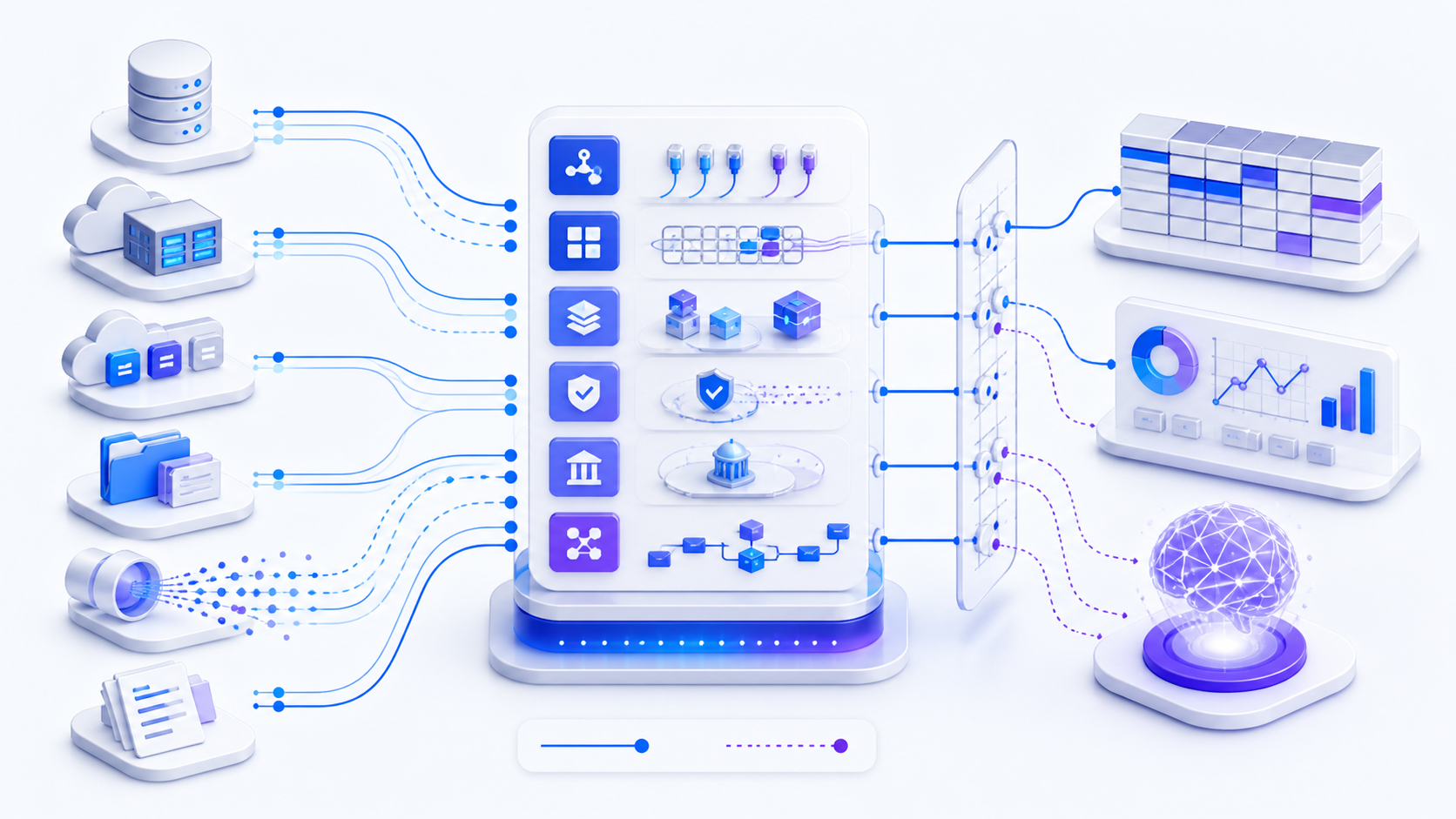
Data Integration Guide: The Short Answer数据集成指南:短答
This data integration guide starts here: data integration is the disciplined process of making data from different systems usable together. It combines technical work—connecting, moving or querying, mapping, transforming, validating, and synchronizing data—with governance work such as ownership, access control, lineage, and shared definitions. The result may be a consolidated warehouse, a synchronized operational system, a real-time stream, or a virtual view across sources. Integration is therefore an outcome and an operating capability, not one product or one pipeline pattern.
数据集成是让不同系统中的数据能够被共同使用的一套受控流程。它既包括连接、移动或查询、映射、转换、校验和同步等技术工作,也包括数据责任、访问控制、血缘和统一定义等治理工作。最终结果可能是集中式数据仓库、已同步的业务系统、实时数据流,也可能是跨数据源的虚拟视图。因此,数据集成是一种结果和持续运营能力,并不等同于某个产品或某种单一管道模式。
For a beginner, the most useful mental model is “shared meaning with controlled access.” Moving records into one place does not integrate them if customer, order, revenue, or timestamp fields still mean different things. Conversely, some use cases can be integrated without copying all records: a governed query layer may combine results at request time. A sound strategy chooses the least complex method that meets the required freshness, performance, security, quality, and cost.
对初学者来说,最有用的理解方式是“在受控访问下建立共同含义”。如果客户、订单、收入或时间字段的含义仍然不一致,即使把记录搬到同一个地方,也不能算真正完成集成。反过来,有些场景并不需要复制全部记录:受治理的查询层可以在请求发生时组合结果。合理的策略应选择能够满足时效、性能、安全、质量和成本要求的最简单方法。
This Data Integration Guide as a Tutorial把数据集成指南当教程用
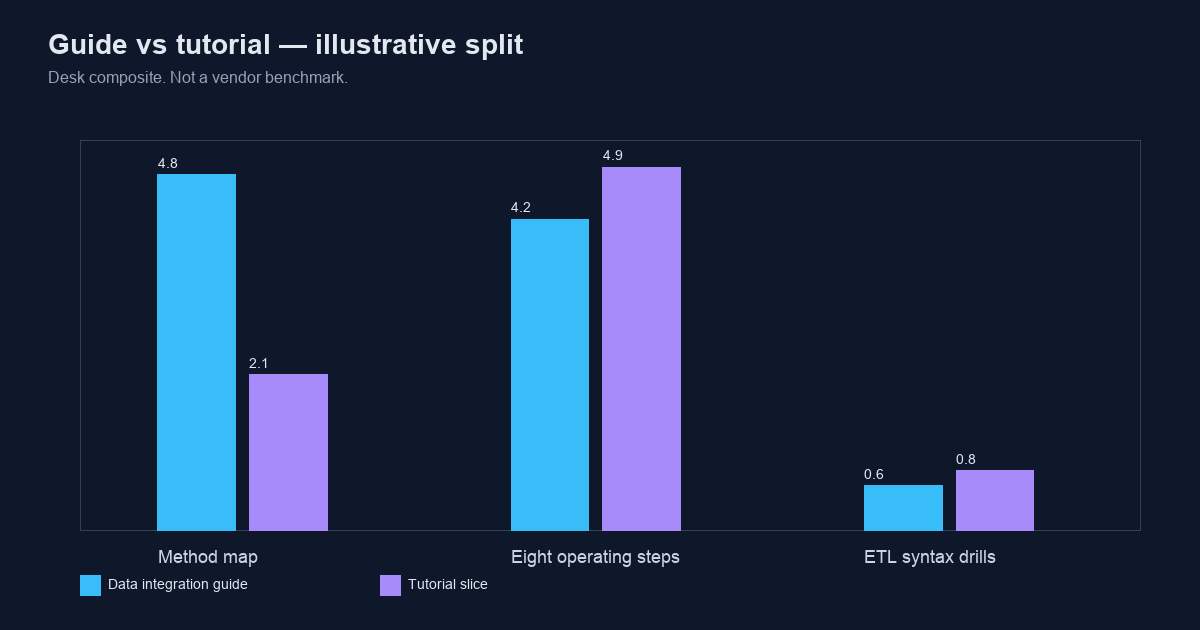
A data integration tutorial in this data integration guide is the operating slice, not a second syllabus. The eight steps already live in Best Practices: decision → contract → govern → pattern → slice → quality → replay → observe. Use that list when you landed from “tutorial.” Stay here for the method map. Syntax drills stay out; ETL vs ELT still belongs in Major integration methods.
本数据集成指南里的data integration tutorial只是运营切片,不是第二套课纲。八步已在最佳实践:决策 → 契约 → 治理 → 模式 → 切片 → 质量 → 重放 → 观测。从 tutorial 进来就走那张表。方法图留在本页。语法课不写;ETL 与 ELT 仍在主要方法。
1. What Is Data Integration?1. 什么是数据集成?
Organizations rarely design their entire data estate at once. A finance application records invoices, a customer relationship management system stores opportunities, an ecommerce platform captures orders, support software holds tickets, and devices or applications emit logs and events. Acquisitions, departmental buying decisions, cloud adoption, and older on-premises systems add more boundaries. Each system is optimized for its own job, so identifiers, formats, update schedules, and business rules naturally diverge. These isolated stores are commonly called data silos.
企业几乎不会一次性设计完整的数据体系。财务应用记录发票,客户关系管理系统保存商机,电商平台采集订单,客服软件保存工单,设备或应用持续产生日志和事件。并购、部门独立采购、云服务采用以及旧有本地系统又会增加更多边界。每个系统都围绕自己的任务进行优化,因此标识符、格式、更新时间和业务规则自然会发生分化。这些彼此隔离的数据存储通常被称为数据孤岛。
Data integration connects those sources so an authorized consumer can answer a question, run a process, train a model, or serve an application with coherent data. A typical flow discovers source metadata, extracts or accesses selected data, maps source fields to a target or common model, applies quality and transformation rules, and delivers the result to a destination. The destination might be a warehouse, lakehouse, operational database, dashboard, API, machine-learning feature store, or virtual semantic layer. Integration also keeps the result current through schedules, events, or change data capture.
数据集成将这些来源连接起来,使获得授权的使用者能够基于一致的数据回答问题、运行流程、训练模型或为应用提供数据。典型流程会发现源数据的元数据,提取或访问选定数据,把源字段映射到目标模型或公共模型,应用质量与转换规则,再将结果交付给目的地。目的地可能是数据仓库、湖仓、业务数据库、仪表板、API、机器学习特征库或虚拟语义层。集成还需要通过定时任务、事件或变更数据捕获持续保持结果更新。
Consumers can work across relevant sources without manually reconciling exports for every question.
使用者可以跨相关数据源开展工作,无需为每个问题手工核对多个导出文件。
Shared definitions, mappings, and quality rules make measures such as active customer or net revenue repeatable.
共同定义、映射和质量规则让活跃客户、净收入等指标能够被重复计算。
Approved users and systems receive the right data through governed interfaces with known freshness and service expectations.
获批用户和系统通过受治理的接口获得正确数据,并明确了解数据时效与服务预期。
Monitoring, retry logic, lineage, and change management keep integration dependable after the first successful run.
监控、重试逻辑、血缘和变更管理保证集成在首次成功运行后仍能持续可靠工作。
Data integration is broader than data ingestion. Ingestion gets data from a source to a destination; integration makes it fit for a defined use across sources. It is also broader than ETL. ETL is a valuable pattern, but integration can also use ELT, replication, event streaming, APIs, federation, and virtualization. Finally, integration is not the same as putting every record into a single database. Centralization is one possible architecture, not the definition of success.
数据集成的范围大于数据摄取。数据摄取负责把数据从来源送到目的地;数据集成则要让来自多个来源的数据适合某个明确用途。它的范围也大于ETL:ETL是一种重要模式,但集成还可以采用ELT、复制、事件流、API、联邦和虚拟化。最后,集成也不等于把所有记录都塞进同一个数据库。集中化只是一种可选架构,并不是成功的定义。
A useful acceptance test is simple: can the intended consumer obtain the necessary data, interpret it correctly, verify where it came from, understand how fresh it is, and use it without an undocumented manual reconciliation step? If not, the organization may have connected systems but has not yet created a dependable integration capability. Successful integration also makes failure visible: owners can identify which source, rule, or delivery step caused a discrepancy, estimate its impact, and restore trustworthy service without rebuilding the entire data flow.
一个实用的验收问题是:目标使用者能否取得所需数据、正确解释其含义、核实数据来源、了解数据新鲜度,并且无需依赖未记录的人工核对步骤就能使用?如果答案是否定的,那么企业可能只是连接了系统,还没有形成可靠的数据集成能力。成功的集成还应让故障清晰可见:负责人可以识别造成差异的数据源、规则或交付步骤,评估影响,并在不重建整个数据流的情况下恢复可信服务。
2. Why Data Integration Matters2. 为什么数据集成很重要?
The business value of integration comes from shortening the distance between fragmented evidence and a trustworthy action. Business intelligence needs consistent facts across sales, finance, operations, and customer systems. AI and machine-learning workflows need data that is accessible, representative, documented, and governed. Real-time decisions—such as fraud screening, inventory alerts, personalization, or equipment monitoring—need fresh signals rather than yesterday’s batch export. In each case, the visible dashboard, model, or application is only as dependable as the data path underneath it.
数据集成的业务价值,在于缩短“分散证据”与“可信行动”之间的距离。商业智能需要销售、财务、运营和客户系统提供口径一致的事实;AI和机器学习工作流需要可访问、具有代表性、经过记录并受到治理的数据;欺诈筛查、库存预警、个性化或设备监控等实时决策,则需要新鲜信号,而不是昨天导出的批次文件。无论是哪种场景,最终看到的仪表板、模型或应用,都只能和底层数据路径一样可靠。
Data growth makes manual reconciliation less viable, but variety is usually the harder problem. Structured tables, JSON events, spreadsheets, documents, application APIs, and time-series records do not share one schema or quality profile. Multi-cloud and hybrid environments add network, identity, regional, and egress constraints. Integration provides repeatable controls for connecting that variety while preserving the operational strengths of source systems.
数据规模增长会让人工核对越来越不可行,但更棘手的往往是数据多样性。结构化表、JSON事件、电子表格、文档、应用API和时间序列记录并不共享同一种模式或质量特征。多云和混合环境还会带来网络、身份、区域和数据传出等约束。数据集成通过可重复执行的控制手段连接这些不同类型的数据,同时保留源系统原有的运营优势。
Consider a hypothetical order-to-cash analysis. The CRM identifies the account and opportunity, the ecommerce or order system records the purchase, the billing platform records invoices and credits, and support software records complaints. Summing each export separately cannot reliably answer which customer segments are profitable. The team first needs identity resolution, currency and time-zone normalization, order-status rules, refund handling, and a shared definition of net revenue. Data aggregation can then produce segment totals, but aggregation is trustworthy only after those integration rules are explicit.
以一个假设的订单到回款分析为例:CRM识别客户和商机,电商或订单系统记录购买,计费平台记录发票与贷项,客服软件记录投诉。分别汇总每个导出文件,并不能可靠回答哪些客户群体真正有利润。团队首先要完成身份解析、币种与时区标准化、订单状态规则、退款处理,以及净收入的共同定义。之后才能通过数据聚合生成分群结果,而这些聚合结果是否可信,取决于前面的集成规则是否清晰。
Integration also improves organizational leverage. Analysts spend less time finding and cleaning the same inputs. Engineers can reuse connectors, contracts, and transformation components. Security teams can enforce access at managed boundaries instead of discovering uncontrolled copies. Business owners can see which definition produced a number and who is accountable for it. These benefits do not require a universal “single source of truth.” A more realistic target is a network of authoritative sources and certified data products connected by transparent rules.
数据集成还会提升组织杠杆。分析人员减少反复查找和清洗相同输入的时间;工程人员可以复用连接器、数据契约和转换组件;安全团队能够在受管理的边界执行访问控制,而不是事后发现无法控制的数据副本;业务负责人可以知道某个数字由哪套定义产生、由谁负责。这些收益并不要求企业建立一个包办一切的“唯一事实来源”。更现实的目标,是让多个权威来源和认证数据产品通过透明规则组成网络。
Value test: define the decision, consumer, required evidence, acceptable delay, and cost of an incorrect answer before choosing technology. “Integrate all enterprise data” is not measurable; “publish governed daily net-revenue data by 07:00 for finance close” is.
价值检验:在选择技术之前,先定义决策、使用者、所需证据、可接受延迟以及错误答案的成本。“集成企业所有数据”无法衡量;“每天07:00前向财务关账提供受治理的净收入数据”则可以衡量。
3. The Core Challenges of Data Integration3. 数据集成的核心挑战
Most integration failures are not caused by an inability to move bytes. They arise because meaning, quality, timing, ownership, and change were treated as afterthoughts. A connector can read a table while the project still fails to deliver trustworthy data. The following challenges should therefore be designed into the architecture and operating model from the beginning.
多数集成失败并不是因为系统无法搬运字节,而是因为语义、质量、时效、责任和变更被当成事后问题。连接器即使能够读取一张表,项目仍然可能无法交付可信数据。因此,下列挑战必须从一开始就进入架构和运营模式设计。
Heterogeneous structures and interfaces. Relational databases expose tables and typed columns; object stores may hold Parquet, CSV, images, or documents; SaaS products expose versioned APIs; streams deliver events that can arrive late or out of order. Even apparently identical fields differ in encoding, precision, time zone, units, null behavior, and identifier scope. Integration must handle structured, semi-structured, and unstructured data without pretending they are interchangeable.
结构与接口异构。关系数据库提供表和带类型的列;对象存储可能保存Parquet、CSV、图片或文档;SaaS产品提供带版本的API;流式系统传递的事件可能迟到或乱序。即便看似相同的字段,也可能在编码、精度、时区、单位、空值行为和标识符范围上不同。集成必须处理结构化、半结构化和非结构化数据,不能假设它们可以直接互换。
Data quality and identity. Duplicate customers, missing keys, impossible dates, invalid states, stale reference data, and conflicting records become more visible when sources are joined. The pipeline needs profiling, validation, standardization, reconciliation, and quarantine rules. It must also distinguish a technical match from a valid business match. Two records sharing an email address may represent one person, a household, a recycled address, or an error; the correct rule depends on the use case.
数据质量与身份。重复客户、缺失主键、不可能出现的日期、无效状态、过期参考数据和相互冲突的记录,在多源关联后会更加明显。管道需要数据剖析、校验、标准化、对账和隔离规则,还必须区分技术匹配与有效业务匹配。两条记录共享同一个邮箱,可能代表同一个人、同一家庭、被重新使用的地址或数据错误;正确规则取决于具体用途。
Freshness, latency, and performance. “Real time” is not one requirement. A fraud decision may need hundreds of milliseconds; an operations dashboard may accept five minutes; finance close may need one certified daily snapshot. Lower latency increases engineering and operational complexity, and virtual queries can transfer load back to source systems. Teams should define freshness as a service objective, including how it is measured, what happens during delay, and whether consumers prefer stale data with a warning or no data at all.
新鲜度、延迟与性能。“实时”并不是一个统一要求。欺诈决策可能需要在数百毫秒内完成,运营仪表板可能接受五分钟延迟,财务关账可能只需要每天一份经过认证的快照。延迟越低,工程和运营复杂度通常越高;虚拟查询还可能把负载重新施加到源系统。团队应把新鲜度定义为服务目标,明确如何测量、延迟时如何处理,以及使用者更愿意看到带警告的旧数据还是完全不显示数据。
Security, privacy, and governance. Movement creates copies, and copies expand the surface that must be protected, retained, deleted, and audited. Virtual access reduces some duplication but does not remove authorization, masking, logging, or cross-border constraints. Integration should propagate classification where possible, enforce least privilege, separate development from production credentials, encrypt transport and storage, and record lineage from source through transformation to consumption.
安全、隐私与治理。数据移动会产生副本,而副本扩大了需要保护、保留、删除和审计的范围。虚拟访问可以减少部分重复,但并不会消除授权、脱敏、日志记录或跨境限制。数据集成应尽可能传递分类标签,执行最小权限,分离开发与生产凭据,对传输和存储加密,并记录从来源、转换到消费端的完整血缘。
Schema evolution and operational ownership. Sources change: fields are renamed, data types widen, APIs are deprecated, and business workflows introduce new states. A pipeline that silently drops a new field or reinterprets a status can produce plausible but wrong results. Data contracts, compatibility tests, change notifications, versioned mappings, and named owners turn schema change from a surprise into a managed event. The operating model must also specify who responds when the source is healthy but the integrated output is wrong.
模式演进与运营责任。源系统会不断变化:字段重命名、数据类型扩展、API停用、业务流程增加新状态。管道若悄悄丢弃新字段或错误解释状态,可能产生“看似合理但实际错误”的结果。数据契约、兼容性测试、变更通知、版本化映射和明确责任人,可以把模式变化从意外转化为受控事件。运营模式还必须说明:当源系统正常、集成输出却错误时,究竟由谁响应。
| Challenge挑战 | Useful control有效控制 | Validation signal验证信号 |
|---|---|---|
| Heterogeneous data异构数据 | Canonical types, explicit mappings, connector tests公共类型、显式映射、连接器测试 | Parsing and compatibility pass rates解析与兼容性通过率 |
| Poor quality质量不佳 | Rules, profiling, quarantine, reconciliation规则、剖析、隔离、对账 | Completeness, validity, duplicate, and balance checks完整性、有效性、重复率与平衡检查 |
| Freshness risk时效风险 | SLOs, watermarks, backpressure, replaySLO、水位线、背压与重放 | End-to-end lag and late-event rate端到端延迟与迟到事件比例 |
| Security exposure安全暴露 | Least privilege, masking, encryption, audit最小权限、脱敏、加密与审计 | Access reviews and unauthorized-request alerts访问复核与未授权请求告警 |
| Schema change模式变更 | Contracts, versioning, compatibility checks契约、版本管理与兼容性检查 | Breaking-change detection before release发布前识别破坏性变更 |
4. Major Data Integration Methods4. 主要的数据集成方法
There is no universally modern method and no universally obsolete one. A warehouse, operational application, regulatory archive, and interactive cross-source analysis have different requirements. Many production architectures combine methods: replicate changes from operational databases, load raw history into a lakehouse, transform certified models in the target, process urgent events through a stream, and virtualize selected sources that should remain in place. The important decision is not which acronym wins, but where data should live, when it should move, where transformation should occur, and which system bears the query load.
不存在适用于所有场景的“现代方法”,也不存在对所有场景都过时的方法。数据仓库、业务应用、监管归档和交互式跨源分析的需求各不相同。许多生产架构会组合使用多种方法:从业务数据库复制变更,把原始历史加载到湖仓,在目标端转换认证模型,通过流处理紧急事件,并对需要保留在原位的部分来源进行虚拟访问。真正重要的问题不是哪个缩写获胜,而是数据应该存放在哪里、何时移动、在哪里转换,以及由哪个系统承担查询负载。
ETL: transform before the target. Extract, transform, load reads data from sources, applies transformations in a processing layer, and loads prepared data into the target. ETL is useful when the destination should receive only validated, standardized, policy-compliant records; when sensitive fields must be removed before landing; or when the target has limited transformation capacity. It can reduce clutter in the destination and make published schemas predictable. The trade-off is that transformation logic sits in the path to delivery, so changing downstream requirements may require reprocessing from retained source or staging data.
ETL:在进入目标之前转换。抽取、转换、加载会从来源读取数据,在处理层应用转换,再把准备好的数据加载到目标。若目的地只应接收经过校验、标准化和合规处理的记录,敏感字段必须在落地前移除,或者目标端转换能力有限,ETL通常更合适。它可以减少目标端杂乱并让发布模式更可预测。代价是转换逻辑位于交付路径中,下游需求改变时,可能需要从保留的源数据或暂存数据重新处理。
ELT: load first, transform in the target. Extract, load, transform lands source data—often with minimal normalization—before using warehouse or lakehouse compute to create downstream models. ELT preserves flexible raw or lightly processed history, supports multiple transformations from the same input, and takes advantage of scalable target engines. It is not a license to load everything without control. Landing zones still require access restrictions, retention rules, metadata, quality checks, and cost management. Microsoft’s official Data Factory overview describes support for both ETL and ELT, reflecting how teams frequently mix the patterns.
ELT:先加载,再在目标端转换。抽取、加载、转换先把源数据落入目标端,通常只进行最少的规范化,然后利用数据仓库或湖仓的计算能力生成下游模型。ELT能够保留灵活的原始或轻度处理历史,让同一份输入支持多种转换,并利用可扩展的目标引擎。但它并不意味着可以不受控制地加载一切。落地区仍然需要访问限制、保留规则、元数据、质量检查和成本管理。微软官方的Data Factory概览同时说明了ETL与ELT,反映出团队在实践中经常混合使用两种模式。
Replication and change data capture. Replication copies data from a source to another system, while change data capture (CDC) identifies inserts, updates, and deletes so only changes need to move after an initial snapshot. These patterns support disaster recovery, analytics offload, migration, and near-real-time synchronization. They preserve source structure more directly than a curated ETL model, which makes them fast building blocks but not complete semantic integration. Teams must handle ordering, duplicate delivery, deletes, schema changes, transaction boundaries, and recovery from an invalid checkpoint. “Zero-ETL” services automate portions of this pattern; for example, AWS documents managed synchronization from RDS into analytical targets. The name reduces operational ETL work, but mapping, security, validation, and consumption design still remain.
数据复制与变更数据捕获。数据复制把来源中的数据复制到另一个系统;变更数据捕获(CDC)则识别插入、更新和删除,因此在初始快照之后只需移动变化部分。这些模式可用于灾难恢复、分析卸载、迁移和近实时同步。它们比经过整理的ETL模型更直接地保留源结构,因此可以快速搭建基础能力,但并不能自动完成语义集成。团队仍要处理顺序、重复投递、删除、模式变化、事务边界以及检查点失效后的恢复。“Zero-ETL”服务会自动化其中部分流程,例如AWS官方文档说明了从RDS到分析目标的托管同步。这个名称意味着减少ETL运维,但映射、安全、验证和消费设计仍然存在。
Streaming and event-driven integration. Streaming processes a continuous flow of events instead of waiting for a complete batch. It suits use cases where value decays quickly: operational monitoring, fraud detection, personalization, telemetry, and alerting. A robust stream design addresses event time versus processing time, late and out-of-order events, idempotency, partitioning, backpressure, replay, and state. Some transformations happen within the stream; others land events first and build materialized views. Streaming should be chosen for a defined latency requirement, not because “real time” sounds advanced. Batch remains simpler, cheaper, and easier to reconcile for many business processes.
流式与事件驱动集成。流处理面向连续事件,而不是等待完整批次。它适合价值会快速衰减的场景,例如运营监控、欺诈检测、个性化、遥测和告警。可靠的流架构要处理事件时间与处理时间、迟到和乱序事件、幂等性、分区、背压、重放和状态。有些转换在流中完成,另一些则先落地事件,再构建物化视图。选择流处理应基于明确的延迟要求,而不是因为“实时”听起来更先进。对于许多业务流程,批处理仍然更简单、更便宜,也更容易对账。
Data virtualization and federation. Virtualization creates an access layer that presents data from multiple physical sources through a consistent interface, often without copying all underlying data first. A query is planned across connectors, work is pushed to sources when appropriate, and results are combined for the consumer. This can shorten time to access, reduce unnecessary duplication, and preserve data residency. It also introduces dependencies on source availability, network latency, connector capability, metadata accuracy, and query optimization. Heavy analytical joins may still require caching, materialization, or replication. IBM’s data virtualization documentation describes a semantic virtual layer that accesses multiple sources without requiring users to know their physical location or format.
数据虚拟化与联邦。数据虚拟化建立一个访问层,通过一致接口呈现多个物理来源中的数据,通常无需先复制全部底层数据。查询会跨连接器进行规划,在适当情况下把工作下推到源系统,再把结果组合后交给使用者。这种方法可以缩短数据访问时间、减少不必要副本并满足数据驻留要求;同时也会依赖源系统可用性、网络延迟、连接器能力、元数据准确性和查询优化。大规模分析关联仍可能需要缓存、物化或复制。IBM的数据虚拟化文档描述了一个语义虚拟层,让用户无需了解物理位置或格式就能访问多个来源。
| Method方法 | Data movement数据移动 | Best fit适合场景 | Main caution主要注意点 |
|---|---|---|---|
| ETL | Prepared data is copied复制已准备数据 | Controlled target schemas, pre-load compliance受控目标模式、落地前合规 | Transformation can slow requirement changes转换可能降低需求变化速度 |
| ELT | Raw or lightly normalized data is copied复制原始或轻度规范化数据 | Scalable warehouse or lakehouse analytics可扩展的数据仓库或湖仓分析 | Raw zones still need strong governance原始区仍需强治理 |
| Replication / CDC复制 / CDC | Snapshot plus ongoing changes快照加持续变更 | Synchronization, migration, analytics offload同步、迁移、分析卸载 | Source structure is not shared business meaning源结构不等于共同业务含义 |
| Streaming流式集成 | Continuous events连续事件 | Time-sensitive decisions and operations时效敏感决策与运营 | Ordering, replay, and state add complexity顺序、重放和状态增加复杂度 |
| Virtualization数据虚拟化 | Primarily query-time access主要在查询时访问 | Cross-source access with less duplication减少复制的跨源访问 | Source load, latency, and optimizer limits源负载、延迟和优化器限制 |
A practical selection sequence. First ask whether data is allowed and useful to move. If a durable history, repeated heavy computation, or source isolation is required, ETL, ELT, or replication is likely. If the consumer needs events within seconds, consider streaming or CDC. If data must remain in place and query-time performance is acceptable, consider virtualization. Then test volume, freshness, transformation complexity, source impact, failure recovery, security, and total operating cost. Hybrid architecture is normal, but each added method should have a clear job and owner.
实用选择顺序。首先判断数据是否允许移动、移动是否有价值。如果需要持久历史、重复执行重计算或隔离源系统,ETL、ELT或复制通常更合适;如果使用者需要在数秒内获得事件,应考虑流处理或CDC;如果数据必须保留在原位且查询时性能可以接受,则可考虑虚拟化。随后验证数据量、新鲜度、转换复杂度、源系统影响、故障恢复、安全和总运营成本。混合架构很正常,但每增加一种方法,都必须有清晰任务和责任人。
The next guide goes deeper into query planning, pushdown, federation architecture, distributed sources, and governance. Continue with the federated queries and data virtualization guide when your primary requirement is unified access without broad data movement.
下一篇指南将深入介绍查询规划、下推、联邦架构、分布式来源和治理。如果首要需求是在不大规模移动数据的情况下实现统一访问,可继续阅读联邦查询与数据虚拟化指南。
5. Data Mapping and Transformation5. 数据映射与转换
Moving data answers “where”; mapping and transformation answer “what does it become?” Data mapping defines how a source element corresponds to a target or shared element. A map can be simple—copy `customer_id` into `customer_key`—or conditional: derive a standardized order status from several source codes, join a country code to reference data, split a full address, or reject records that violate a contract. Mappings should be version-controlled, testable, documented in business language, and traceable to their source.
数据移动回答“去哪里”,映射与转换则回答“变成什么”。数据映射定义一个源元素如何对应目标元素或公共元素。映射可以很简单,例如把`customer_id`复制到`customer_key`;也可以包含条件逻辑,例如根据多个源状态生成标准订单状态、关联国家代码参考数据、拆分完整地址,或拒绝违反契约的记录。映射应进行版本控制、能够测试、使用业务语言记录,并且可以追溯到来源。
Schema mapping focuses on structural correspondence: tables, fields, nested paths, types, keys, and relationships. It answers questions such as whether a source timestamp maps to a target timestamp with time zone, whether a nested JSON array becomes a child table, and how a composite source key becomes a durable target key. Explore the planned guide to schema mapping for patterns and validation checks.
模式映射关注结构对应关系:表、字段、嵌套路径、类型、键和关系。它需要回答源时间戳是否映射为带时区的目标时间戳、嵌套JSON数组是否转换为子表,以及源复合键如何成为稳定目标键等问题。关于具体模式和验证方法,可继续阅读规划中的模式映射指南。
Semantic mapping focuses on meaning. Two fields can both be decimals called `revenue` yet represent gross bookings, recognized revenue, or net cash after refunds. A semantic map connects source terms to governed concepts, metric definitions, entities, taxonomies, or ontologies. It records business rules, not just compatible types. This is essential when multiple domains publish data products or when AI and self-service analytics need consistent context. The planned semantic mapping guide explains how to turn ambiguous labels into shared concepts.
语义映射关注含义。两个字段都可能是小数类型并命名为`revenue`,但分别表示总预订额、已确认收入或扣除退款后的净现金。语义映射把源术语连接到受治理的概念、指标定义、实体、分类体系或本体,记录的是业务规则,而不仅是兼容的数据类型。当多个业务域发布数据产品,或者AI与自助分析需要一致上下文时,这一点尤其重要。规划中的语义映射指南将进一步说明如何把模糊标签转化为共同概念。
Transformation is the executable logic built on those mappings. Common transformations include parsing and casting types; trimming and standardizing text; converting currencies, units, and time zones; filtering invalid records; deduplicating entities; joining reference data; calculating derived attributes; aggregating detail; masking protected values; and reshaping tables. The sequence matters. Currency conversion before aggregation produces a different result from aggregating mixed currencies first. Deduplication before a slowly changing dimension update behaves differently from deduplication afterward.
转换是建立在映射之上的可执行逻辑。常见转换包括解析与类型转换、清理并标准化文本、转换币种/单位/时区、过滤无效记录、实体去重、关联参考数据、计算派生属性、聚合明细、遮蔽受保护字段,以及重塑表结构。执行顺序会影响结果:先做币种转换再聚合,与先聚合混合币种会得到不同结果;在缓慢变化维度更新之前去重,与更新之后去重也会产生不同影响。
Profile before mapping. Inspect types, ranges, null patterns, cardinality, duplicates, and representative samples. Declared schemas often omit the behavior that breaks integration.
映射前先做剖析。检查类型、范围、空值模式、基数、重复和代表性样本。声明的模式往往没有说明真正会破坏集成的数据行为。
Define business meaning and ownership. State what each target element represents, who approves the definition, and which source is authoritative when records conflict.
定义业务含义和责任。说明每个目标元素代表什么、由谁批准定义,以及记录冲突时哪个来源具有权威性。
Specify mapping and exception rules. Include conversions, defaults, rejected conditions, identity logic, and how unknown or late values are handled.
明确映射与异常规则。包括转换、默认值、拒绝条件、身份逻辑,以及未知值或迟到值的处理方式。
Test at multiple levels. Use unit tests for individual rules, contract tests for schemas, reconciliation tests for totals, and acceptance tests against the business decision.
进行多层测试。对单条规则做单元测试,对模式做契约测试,对汇总做对账测试,并围绕业务决策进行验收测试。
Publish lineage and quality status. Consumers should see the source, transformation version, refresh time, owner, and known limitations alongside the output.
发布血缘与质量状态。使用者应能同时看到来源、转换版本、刷新时间、责任人和已知限制。
A mapping spreadsheet can start discovery, but it is not a durable control by itself. Production logic should be reviewable as code or governed configuration, deployed through a repeatable process, and observed after release. Whenever a mapping changes meaning, teams should assess downstream compatibility rather than treating it as a purely technical refactor.
映射表格可以用于启动需求发现,但它本身不是持久控制。生产逻辑应以代码或受治理配置的形式接受审查,通过可重复流程部署,并在发布后持续观测。只要某项映射改变了含义,团队就应评估下游兼容性,而不能把它视为纯技术重构。
6. The Data Abstraction Layer6. 数据抽象层
A data abstraction layer separates consumers from the physical complexity of storage, formats, and source-specific interfaces. Instead of requiring every dashboard, application, analyst, or AI agent to understand where a table lives and how its fields are encoded, the abstraction exposes stable business-oriented objects through SQL views, semantic models, APIs, data products, or a virtual query layer.
数据抽象层把使用者与存储位置、格式和源系统专用接口等物理复杂性分开。它不要求每个仪表板、应用、分析人员或AI Agent都了解某张表位于何处、字段如何编码,而是通过SQL视图、语义模型、API、数据产品或虚拟查询层提供稳定、面向业务的对象。
The value is controlled decoupling. A source database may migrate, a column may be renamed, or an integration method may move from nightly ETL to CDC. If the abstraction’s contract remains stable, consumers do not all need to change at once. It also centralizes reusable policies: a customer object can apply the same identity rule, row-level authorization, masking, and certified metric definition across many consumers. The abstraction becomes a governed interface rather than an informal collection of convenience views.
其核心价值是受控解耦。源数据库可能迁移,列可能重命名,集成方式也可能从夜间ETL切换到CDC。只要抽象层契约保持稳定,所有使用者就不必同时修改。它还能集中执行可复用策略:一个客户对象可以向多个使用者统一应用身份规则、行级授权、脱敏和认证指标定义。这样,抽象层会成为受治理接口,而不是随意堆积的便捷视图。
Presents consistent entities, relationships, names, and types independent of source layout.
提供不依赖源布局的一致实体、关系、名称和类型。
Defines measures, dimensions, business terms, and calculation rules for repeatable analysis.
定义指标、维度、业务术语和计算规则,支持可重复分析。
Offers stable, task-oriented access for applications without exposing underlying storage credentials.
为应用提供稳定、面向任务的访问,无需暴露底层存储凭据。
Plans access across physical sources and may push filters, joins, or aggregation toward them.
跨物理来源规划访问,并可将过滤、关联或聚合下推到源系统。
Abstraction does not eliminate underlying complexity; it assigns and contains it. Poor source data still needs quality controls, expensive queries still consume resources, and ambiguous definitions remain ambiguous unless owners resolve them. An overly broad abstraction can become another monolith, hiding performance behavior and slowing change. Keep interfaces aligned to real consumer tasks, define service expectations, expose lineage and freshness, and allow domain-specific products where one enterprise model would erase meaningful differences.
抽象不会消除底层复杂性,而是重新分配并限制复杂性。质量差的源数据仍需要控制,昂贵查询仍会消耗资源,含义模糊的问题也必须由责任人解决。过度宽泛的抽象可能变成新的单体系统,掩盖性能行为并拖慢变化。接口应围绕真实消费任务设计,定义服务预期,公开血缘与新鲜度,并在单一企业模型会抹去重要差异时允许存在领域数据产品。
For InfiniSynapse, this concept is directly relevant to multi-source analysis: the product’s public site describes direct connections to supported databases and joint analysis without complex migration. That makes a governed access and abstraction pattern a truthful product connection, not a claim that every integration problem disappears. Before trying the workflow, prepare approved read-only credentials, identify the sources and tables relevant to one question, document join keys and definitions, and define what a correct result should look like.
对InfiniSynapse来说,这一概念与多源联合分析直接相关:官网说明产品可以直接连接受支持数据库,并在无需复杂迁移的情况下进行联合分析。这体现的是受治理访问与抽象模式,并不意味着所有集成问题都会自动消失。尝试工作流之前,应准备获批的只读凭据,确定与一个具体问题相关的数据源和表,记录关联键与业务定义,并预先定义正确结果应满足的条件。
Prepare read-only source access, the relevant schemas, a known join key, and an expected control total. Then use the InfiniSynapse web app to explore whether direct multi-source analysis fits the use case before designing broader movement.
准备只读数据源权限、相关模式、已知关联键和预期控制总数,然后使用InfiniSynapse Web应用验证直接多源分析是否适合当前场景,再决定是否需要更大范围的数据移动。
Try multi-source analysis online在线尝试多源分析7. Data Integration Tools and Platforms7. 数据集成工具与平台
A tool automates part of the integration lifecycle; a platform coordinates several parts under a shared operating model. Product labels overlap, so evaluate capabilities rather than category names. Some offerings focus on managed connectors and replication, others on transformation and orchestration, streaming, application integration, virtualization, cataloging, quality, or observability. A broad platform may bundle many functions, while a composable stack combines specialized components. Neither is automatically simpler: a suite can create vendor dependence, and a stack can create integration work between the integration tools.
工具用于自动化数据集成生命周期中的某个部分;平台则在统一运营模式下协调多个部分。产品标签经常重叠,因此应评估实际能力,而不是只看类别名称。有些产品侧重托管连接器与复制,有些侧重转换与编排、流处理、应用集成、虚拟化、目录、质量或可观测性。综合平台可能把多项功能打包,组合式技术栈则由多个专业组件组成。二者都不天然更简单:套件可能带来厂商依赖,技术栈则可能产生“集成各种集成工具”的额外工作。
Open-source versus commercial. Open-source components can offer transparency, extensibility, community connectors, and deployment control. They also require engineering capacity for upgrades, scaling, security hardening, connector maintenance, and incident response. Commercial services can reduce setup and operations, provide supported connectors and service commitments, and centralize administration. Their trade-offs include subscription and usage costs, egress, proprietary metadata, connector-specific limits, and switching cost. Compare the full operating model, not license price alone.
开源与商业产品。开源组件可以提供透明度、可扩展性、社区连接器和部署控制,但团队需要承担升级、扩容、安全加固、连接器维护和故障响应。商业服务可以减少搭建与运维工作,提供受支持的连接器、服务承诺和集中管理;相应代价包括订阅与使用成本、数据传出费用、专有元数据、连接器限制和切换成本。比较时应考察完整运营模式,而不仅是许可证价格。
Cloud-native versus self-managed. A cloud-native service is attractive when sources and targets already sit in the same ecosystem and managed identity, networking, monitoring, and billing reduce friction. Self-managed or on-premises deployment may be necessary for air-gapped environments, strict data residency, specialized connectors, or deep runtime control. Hybrid organizations should test private connectivity, firewall behavior, certificate rotation, regional availability, and where metadata and temporary data are stored.
云原生与自管理部署。当来源和目标已经位于同一云生态中,托管身份、网络、监控和计费能够减少阻力,云原生服务通常更有吸引力。隔离网络、严格数据驻留、专用连接器或深度运行时控制,则可能要求自管理或本地部署。混合环境应测试私有连接、防火墙行为、证书轮换、区域可用性,以及元数据和临时数据实际存放的位置。
| Selection area选型维度 | Questions to verify需要验证的问题 |
|---|---|
| Source and target coverage来源与目标覆盖 | Are required versions, objects, deletes, custom fields, and incremental modes supported and maintained?是否支持并维护所需版本、对象、删除、自定义字段和增量模式? |
| Latency and scale延迟与规模 | Can the product meet measured volume and freshness without harming sources or causing unpredictable cost?能否在不损害源系统或造成不可预测成本的情况下满足实际数据量与时效? |
| Transformation and orchestration转换与编排 | Can teams version, test, schedule, backfill, retry, and promote logic across environments?团队能否对逻辑进行版本管理、测试、调度、回填、重试和跨环境发布? |
| Security and governance安全与治理 | How are secrets, least privilege, encryption, masking, lineage, audit, residency, and deletion handled?如何处理密钥、最小权限、加密、脱敏、血缘、审计、驻留和删除? |
| Reliability可靠性 | Are failures observable, replay safe, idempotent, and recoverable to a known checkpoint?故障是否可观测、可安全重放、具备幂等性,并能恢复到已知检查点? |
| People and portability人员与可移植性 | Do current skills fit, can metadata and logic be exported, and what happens if the service changes?现有技能是否匹配,元数据与逻辑能否导出,服务变化后如何应对? |
Shortlist categories before vendors. The data integration tools guide compares capability types; the data integration platform memo covers multi-data platform integration and the shared control plane; and the data integration software guide explains deployment and packaging. For any purchase, run a proof of concept with a difficult representative source, a schema change, a backfill, a failed run, and a reconciliation—not only a successful demo path.
应先筛选产品类别,再筛选厂商。数据集成工具指南比较能力类型;数据集成平台备忘录覆盖多数据平台集成与共享控制面;数据集成软件指南解释部署与包装。任何采购都应使用具有代表性的困难数据源进行概念验证,并主动测试模式变化、历史回填、任务失败和对账,而不是只演示成功路径。
8. Data Integration Guide Best Practices8. 数据集成指南最佳实践
The data integration tutorial steps below sit inside this data integration guide. Successful integration is a product discipline, not a one-time transfer project. The integrated output has consumers, owners, service expectations, versions, incidents, and retirement decisions. The following sequence keeps architecture tied to value while making quality and governance operational.
成功的数据集成是一种产品化能力,而不是一次性搬运项目。集成输出具有使用者、责任人、服务预期、版本、事故和退役决策。下面的顺序能够让架构始终与价值相连,并让质量和治理进入实际运营。
Prepare the inputs before implementation. A team should not begin with connector configuration. Assemble a source inventory that records system owner, location, interface, expected volume, update pattern, data classification, retention, and known maintenance windows. Capture representative samples rather than only a schema screenshot: samples reveal blank strings, malformed dates, reused identifiers, precision loss, and undocumented status codes. Document the target consumer, decision, output grain, history requirement, and freshness objective. Identify the join keys and metric definitions that require business approval. Finally, record network routes, read-only service identities, secret rotation, environments, and a non-production test path. These inputs make a proof of concept representative and prevent access questions from being mistaken for architecture questions.
实施前准备输入。团队不应从配置连接器开始。首先建立数据源清单,记录系统责任人、位置、接口、预期数据量、更新模式、数据分类、保留要求和已知维护窗口;同时取得具有代表性的样本,而不只是模式截图,因为样本才能暴露空字符串、错误日期、重复使用的标识符、精度损失和未记录状态码。还要记录目标使用者、业务决策、输出粒度、历史需求和新鲜度目标,找出需要业务批准的关联键与指标定义。最后确认网络路径、只读服务身份、密钥轮换、环境和非生产测试路径。这些输入能让概念验证具有代表性,也能避免把访问问题误判为架构问题。
Use a worked acceptance scenario. Suppose a retailer wants a daily customer profitability dataset combining orders, refunds, support costs, and account attributes. This is a hypothetical example, not an InfiniSynapse customer case. The output grain is one customer per calendar day; finance owns net-revenue rules; operations owns fulfillment cost; and the data team owns delivery by 07:00. The team retains source timestamps and ingestion timestamps, maps customer identifiers through an approved crosswalk, converts currency using a dated reference rate, associates refunds with original orders, and quarantines unmatched records. A control report compares order counts, gross amounts, refund amounts, and customer counts with source totals. A sample of high-value and refunded orders is traced end to end. The dataset is released only when freshness, reconciliation tolerance, access control, and lineage checks pass. This scenario is small enough for a vertical slice but complete enough to expose semantic and operational risk.
使用可执行的验收场景。假设一家零售企业希望每天生成客户盈利数据,组合订单、退款、客服成本和账户属性。这只是说明性示例,并非InfiniSynapse客户案例。输出粒度为“每位客户每天一条记录”;财务负责净收入规则,运营负责履约成本,数据团队负责每天07:00前交付。团队保留源时间戳和摄取时间戳,通过获批对照表映射客户标识符,使用带日期的参考汇率转换币种,将退款关联到原订单,并隔离无法匹配的记录。控制报告会把订单数、总金额、退款金额和客户数与源系统总数进行比较,同时对高价值订单和退款订单进行端到端抽样追踪。只有新鲜度、对账容差、访问控制和血缘检查全部通过,数据集才会发布。这个场景足够小,适合纵向切片,也足够完整,能够暴露语义和运营风险。
| Acceptance area验收领域 | Example measure示例指标 | Decision决策方式 |
|---|---|---|
| Freshness新鲜度 | Age of newest complete source event and end-to-end delivery time最新完整源事件的时间差与端到端交付时间 | Compare with the documented service objective; alert before breach与已记录服务目标比较,并在违约前告警 |
| Completeness完整性 | Expected partitions, record counts, and required-field population预期分区、记录数量与必填字段填充情况 | Stop publication or label partial output according to policy按策略停止发布或明确标记部分输出 |
| Reconciliation对账 | Source-to-output balances by date, currency, and status按日期、币种和状态比较来源与输出余额 | Investigate differences beyond an approved, documented tolerance调查超出已批准且有记录容差的差异 |
| Reliability可靠性 | Successful runs, retry recovery, duplicate rate, and replay result成功运行、重试恢复、重复率和重放结果 | Require idempotent recovery before expanding critical use在扩大关键用途前要求具备幂等恢复能力 |
| Governance治理 | Access tests, classification coverage, lineage, owner, and retention访问测试、分类覆盖、血缘、责任人和保留规则 | Do not certify output with unresolved high-risk control gaps存在未解决高风险控制缺口时不得认证输出 |
Separate delivery metrics from outcome metrics. Pipeline success rate, throughput, lag, and cost show whether the integration operates as designed. They do not prove that it improves the business workflow. Also measure time saved in data preparation, reduction in manual reconciliations, decision cycle time, consumer adoption, repeated quality incidents, and the rate of questions that can be answered from certified outputs. A technically healthy integration that nobody trusts or uses should be redesigned or retired. Conversely, a heavily used integration with recurring control exceptions needs investment before more consumers depend on it.
区分交付指标与结果指标。管道成功率、吞吐量、延迟和成本说明集成是否按设计运行,却不能证明业务工作流得到改善。还应衡量数据准备节省的时间、人工对账减少程度、决策周期、使用者采用率、重复质量事故,以及可以通过认证输出回答的问题比例。技术上健康但无人信任或使用的集成,应重新设计或退役;使用频繁却反复出现控制异常的集成,则应在更多使用者依赖之前获得投入。
Plan the operating handoff. Before production release, name the on-call owner, escalation path, business contact, and recovery authority. Write a runbook that distinguishes source outage, credential failure, schema incompatibility, data-quality breach, late delivery, and downstream misuse. For each condition, state the evidence to collect, whether processing should stop, whether old data may remain visible, and how consumers will be notified. Schedule reviews for access, cost, quality thresholds, unused fields, and source changes. Integration remains reliable when routine ownership and controlled change continue after the project team moves on.
规划运营交接。生产发布前应明确值班责任人、升级路径、业务联系人和恢复授权,并编写运行手册,区分源系统中断、凭据失败、模式不兼容、数据质量违约、交付延迟和下游误用。每种情况都应说明需要收集的证据、是否停止处理、旧数据是否可以继续显示,以及如何通知使用者。还要定期审查访问、成本、质量阈值、未使用字段和源系统变化。只有在项目团队离开后仍能保持日常责任与受控变更,集成才真正可靠。
Start with a decision or workflow. Name the consumer, question, action, source evidence, acceptable delay, expected volume, and consequence of error. Establish a baseline for current time, cost, and failure before proposing technology.
从决策或工作流开始。明确使用者、问题、行动、来源证据、可接受延迟、预期数据量和错误后果,并在提出技术方案前记录当前耗时、成本和失败基线。
Assign owners and define contracts. Identify source, transformation, platform, and business owners. Specify schema, semantics, quality thresholds, freshness, access, change notification, and support expectations in a versioned contract.
指定责任人并定义契约。明确来源、转换、平台和业务责任人,并在版本化契约中规定模式、语义、质量阈值、新鲜度、访问、变更通知和支持预期。
Govern before copying broadly. Classify data, minimize collected fields, use least-privilege identities, document legal and residency constraints, define retention and deletion, and decide which environments may contain sensitive values.
在大规模复制之前落实治理。对数据分类,最小化采集字段,使用最小权限身份,记录法律与驻留限制,定义保留和删除规则,并确定哪些环境允许包含敏感值。
Choose the simplest suitable pattern. Do not build a stream for a daily requirement or copy a full source for one occasional query. Estimate total cost across compute, storage, networking, licenses, engineering, support, and source impact.
选择最简单且适用的模式。不要为每日需求建设流处理,也不要为一次偶发查询复制整个数据源。总成本应包括计算、存储、网络、许可证、工程、支持和源系统影响。
Deliver one thin vertical slice. Integrate a small but end-to-end path from source to validated consumer output. Include security, metadata, tests, monitoring, and documentation in the first slice instead of postponing them.
交付一条薄而完整的纵向切片。从来源到经过验证的消费输出,集成一条规模较小但端到端完整的路径,并在第一条路径中就纳入安全、元数据、测试、监控和文档。
Automate quality and reconciliation. Test schema compatibility, required fields, accepted values, referential integrity, uniqueness, freshness, record counts, financial balances, and representative business scenarios. Quarantine bad records rather than silently discarding them.
自动化质量与对账。测试模式兼容性、必填字段、允许值、引用完整性、唯一性、新鲜度、记录数量、财务平衡和代表性业务场景;隔离错误记录,不要悄悄丢弃。
Design for replay and change. Make operations idempotent where possible, retain checkpoints and source history appropriate to recovery needs, rehearse backfills, and test schema evolution. Document how to pause, roll back, or rebuild output.
围绕重放与变更设计。尽可能保证操作幂等,根据恢复需要保留检查点与源历史,演练回填并测试模式演进,同时记录如何暂停、回滚或重建输出。
Observe end to end. Monitor freshness, throughput, latency, errors, retries, rejected records, source load, cost, and downstream use. Route alerts to a named owner with a runbook, and review whether unused pipelines should be retired.
端到端观测。监控新鲜度、吞吐量、延迟、错误、重试、拒绝记录、源负载、成本和下游使用情况,把告警发送给明确责任人并配套运行手册,同时定期退役无人使用的管道。
Validation should include technical correctness and fitness for use. A pipeline can finish on time while publishing the wrong business population. Combine automated controls with a consumer acceptance test: trace representative records from source to output, reconcile known totals, compare results across a defined period, and verify access with both permitted and denied identities. Record the release decision and known limitations so later users do not mistake provisional data for certified output.
验证既要检查技术正确性,也要检查是否适合实际用途。管道可能准时完成,却发布了错误的业务群体。自动化控制应与使用者验收结合:追踪代表性记录从来源到输出的全过程,对账已知总数,在指定期间比较结果,并分别用允许和拒绝的身份验证访问。发布决策和已知限制也应被记录,避免后续用户把临时数据误认为认证输出。
9. The Future of Data Integration9. 数据集成的未来趋势
AI-assisted integration will increasingly help profile sources, suggest mappings, generate transformations, explain failures, and detect anomalies. These capabilities can accelerate work, but generated logic still requires contracts, tests, review, and runtime controls. Similar field names do not prove equal business meaning, and an AI-generated join can be syntactically valid while duplicating revenue. The highest-value pattern is assisted engineering with evidence and approval, not unreviewed autonomous change.
AI辅助数据集成会越来越多地用于数据源剖析、映射建议、转换生成、故障解释和异常检测。这些能力可以加速工作,但生成的逻辑仍需要契约、测试、审查和运行时控制。字段名称相似并不能证明业务含义相同;AI生成的关联即使语法正确,也可能造成收入重复。更有价值的模式是有证据、有审批的辅助工程,而不是未经审查的自主变更。
Data mesh changes ownership more than it dictates a specific technology. Domains publish data as products with accountable owners, discoverable metadata, quality expectations, and interoperable standards. Central teams provide a self-service platform and federated governance. Integration remains necessary between domain products; the aim is to distribute responsibility without returning to disconnected silos.
数据网格(Data Mesh)主要改变责任分配,而不是规定某一种技术。各领域把数据作为产品发布,提供明确责任人、可发现元数据、质量预期和互操作标准;中央团队提供自助平台与联邦治理。领域数据产品之间仍然需要集成,其目标是在分散责任的同时避免重新回到数据孤岛。
Data fabric emphasizes an integrated layer of metadata, governance, automation, movement, and access across heterogeneous environments. It is best treated as an architectural direction rather than a single box to buy. Its practical value depends on connectors, active metadata, policy enforcement, lineage, and the ability to recommend or automate actions while retaining human accountability.
数据编织(Data Fabric)强调在异构环境之上建立由元数据、治理、自动化、移动和访问组成的集成层。更合理的理解是把它视为一种架构方向,而不是一款可以一次性购买的产品。实际价值取决于连接器、主动元数据、策略执行、血缘,以及在保留人类责任的前提下建议或自动执行操作的能力。
Active metadata management moves catalogs from passive documentation toward operational signals. Runtime lineage, query use, quality incidents, schema changes, cost, and ownership can inform impact analysis, recommendations, and automated policy. This creates a feedback loop: the integration system learns which assets matter and where risk is accumulating. The caution is governance of the automation itself—recommendations need provenance, permissions, rollback, and measurable outcomes.
主动元数据管理让目录从被动文档转向运营信号。运行时血缘、查询使用、质量事故、模式变化、成本和责任信息可以支持影响分析、建议和自动化策略,从而形成反馈循环:集成系统能够识别哪些资产真正重要、风险正在何处累积。需要注意的是,自动化本身也要受到治理,所有建议都应具备来源、权限、回滚和可衡量结果。
10. Summary and Next Steps10. 总结与下一步
This data integration guide makes information from separate systems usable together through shared meaning, controlled access, reliable delivery, and visible lineage. ETL, ELT, replication, streaming, and virtualization are complementary methods. Mapping and transformation reconcile structure and semantics; abstraction protects consumers from avoidable physical complexity; governance and observability keep the result dependable after launch.
数据集成通过共同含义、受控访问、可靠交付和可见血缘,让分散系统中的信息能够被共同使用。ETL、ELT、复制、流处理和虚拟化是彼此补充的方法;映射与转换用于协调结构和语义;抽象层帮助使用者避免不必要的物理复杂性;治理与可观测性则保证结果在上线后继续可靠运行。
Begin with one measurable decision, document source and semantic contracts, choose the simplest method that meets freshness and control needs, deliver a thin end-to-end slice, and validate it with quality checks and business reconciliation. Then expand reusable connectors, mappings, policies, and monitoring. If your next question is how to analyze across sources without moving all data first, continue to the complete guide to federated queries and data virtualization.
从一个可衡量的决策开始,记录来源契约与语义契约,选择满足新鲜度和控制需求的最简单方法,交付一条薄而完整的端到端路径,并通过质量检查与业务对账进行验证。之后再扩展可复用连接器、映射、策略和监控。如果下一步问题是如何在不先移动全部数据的情况下进行跨源分析,可继续阅读联邦查询与数据虚拟化完整指南。
Frequently Asked Questions常见问题
A data integration guide is the map of methods and controls that make separate systems usable together. It compares ETL, ELT, streaming, replication, and virtualization, then names owners, contracts, and replay—not a vendor shortlist.
数据集成指南是让分散系统能一起用的方法与控制图。它对比 ETL、ELT、流式、复制与虚拟化,再点名责任人、契约和重放,不是厂商短名单。
This data integration guide doubles as a data integration tutorial only in the operating sense: eight steps from one decision to observe. It is not an ETL syntax course.
本数据集成指南只在运营意义上兼作 data integration tutorial:从一项决策到观测的八步。不是 ETL 语法课。
Data integration is the process of making data from different systems usable together through controlled access, movement, mapping, transformation, quality checks, and governance. The output can be physically consolidated or presented through a virtual view.
数据集成是通过受控访问、移动、映射、转换、质量检查和治理,让不同系统中的数据能够被共同使用。输出既可以进行物理集中,也可以通过虚拟视图呈现。
No. ETL is one data integration method. Integration also includes ELT, replication, change data capture, streaming, APIs, and data virtualization. The broader discipline also covers semantics, security, lineage, quality, and operations.
不是。ETL只是数据集成方法之一。数据集成还包括ELT、复制、变更数据捕获、流处理、API和数据虚拟化,并覆盖语义、安全、血缘、质量和运营。
ETL transforms data before loading it into the target. ELT loads data first and performs most transformations in the target platform. Choose based on governance, target compute, flexibility, cost, and whether raw data is permitted to land.
ETL在加载到目标之前转换数据;ELT先加载数据,再在目标平台中完成大部分转换。选择时应考虑治理、目标计算能力、灵活性、成本以及是否允许原始数据落地。
Use data virtualization when consumers need governed access across sources without first copying all data, provided source capacity, latency, and query behavior are suitable. Materialize or replicate workloads that are too heavy, repetitive, or dependent on durable history.
当使用者需要跨源受治理访问、又不希望先复制全部数据,并且源容量、延迟和查询行为能够满足要求时,可以采用数据虚拟化。过重、重复频繁或依赖持久历史的工作负载,仍应物化或复制。
A successful project starts with a measurable use case, assigns data ownership, defines contracts and quality rules, automates testing, monitors freshness and failures, and expands incrementally. Business reconciliation is as important as a technically successful run.
成功项目从可衡量的用例出发,明确数据责任,定义契约与质量规则,自动化测试,监控新鲜度和故障,并逐步扩展。业务对账与技术运行成功同样重要。
Choose tools against required sources, latency, deployment, security, transformation, observability, governance, skills, portability, and total operating cost. Test a difficult source, schema change, recovery, backfill, and reconciliation in a representative proof of concept.
应根据数据源、延迟、部署、安全、转换、可观测性、治理、技能、可移植性和总运营成本选型,并通过代表性概念验证测试困难来源、模式变化、恢复、回填和对账。