On this page本文目录
What Is Data Integration Software?什么是数据集成软件?
This focused article is part of the complete data integration guide; use the pillar guide to compare related concepts, methods, and implementation decisions across the full topic. Deployment and packaging live here; the shared data integration platform operating model lives on the architecture memo.
本文是完整的数据集成指南内容集群中的专题文章;如需比较完整主题下的相关概念、方法与实施决策,请返回基石指南。部署与包装在本页;共享的数据集成平台运作模式在架构备忘录。
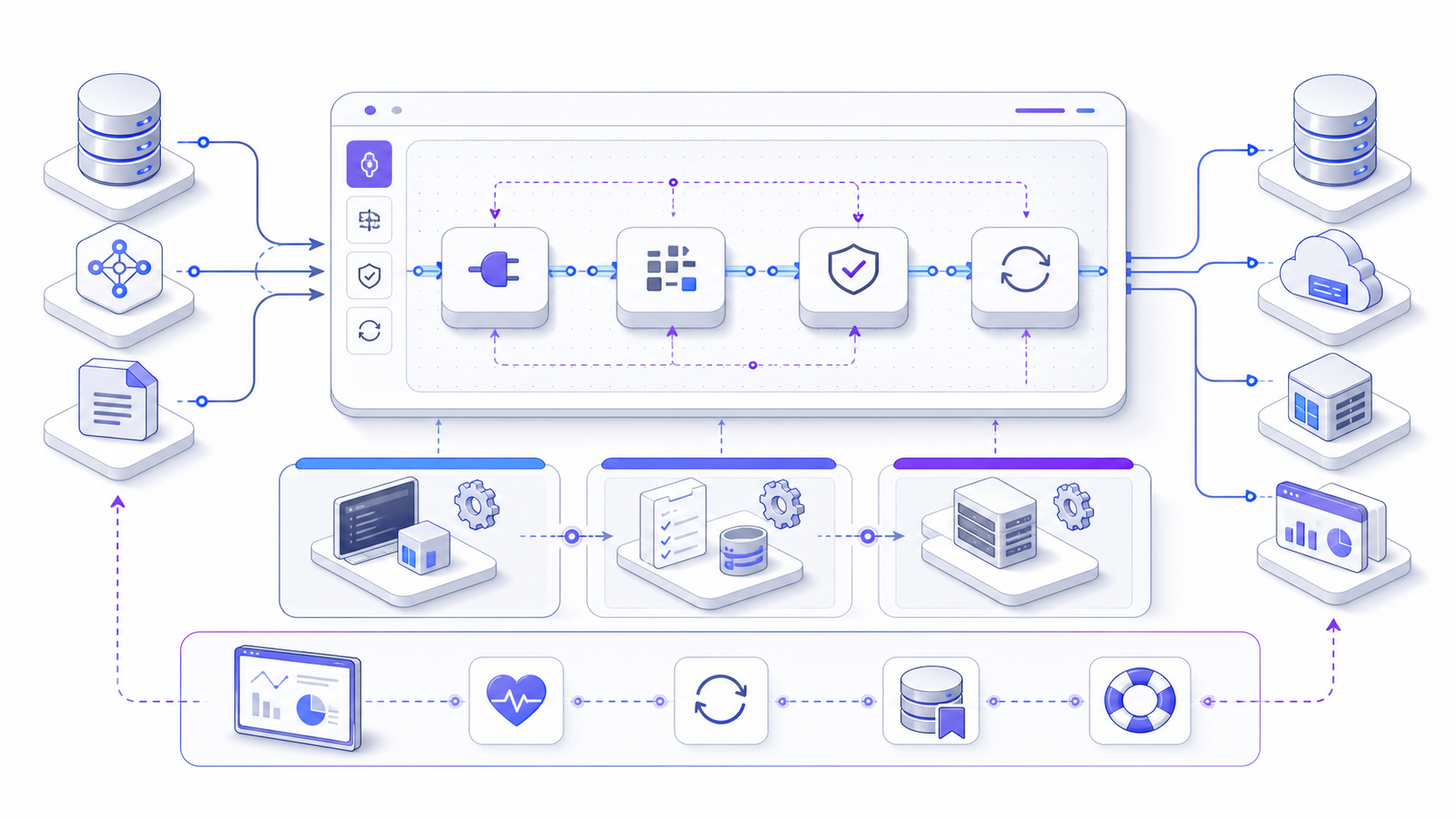
Data integration software connects approved sources and targets, extracts or queries records, maps and validates fields, delivers changes, and exposes enough run state for operators to detect and recover failures. Depending on the product and workload, it may implement ETL, ELT, replication, change data capture, streaming, API transfer, or virtual access.
数据集成软件连接获准的数据源与目标,抽取或查询记录,映射并验证字段,交付变更,并公开足够的运行状态,让运维人员能够发现故障并执行恢复。依据产品与负载,它可以实现ETL、ELT、复制、变更数据捕获、流式处理、API传输或虚拟访问。
The term describes executable software, not a guarantee that every integration concern is covered. A connector library may move records but omit transformation testing. An ELT service may load reliably but leave modeling to the warehouse. A self-hosted engine may be flexible while making your team responsible for upgrades and availability. Selection therefore starts with a workload contract and an operating model, not a feature count.
这个术语描述的是可执行软件,并不保证所有集成问题都已覆盖。连接器库可能能搬运记录,却没有转换测试;ELT服务可能可靠装载,却把建模留给数据仓库;自托管引擎可能很灵活,却要求团队自行负责升级与可用性。因此,选型应从工作负载契约和运作模式开始,而不是从功能数量开始。
Use this page when you need to understand capabilities, compare deployment choices, prepare a proof of concept, or define production acceptance. For related foundations, use the deployed data pipelines guide to understand repeatable delivery and the data sources guide to inventory upstream systems.
当你需要理解能力、比较部署选择、准备概念验证或定义生产验收时,可使用本页。如需补充基础知识,可参阅已上线的数据管道指南了解可重复交付,并使用数据源指南盘点上游系统。
When Data Integration Software Fits—and When It Does Not数据集成软件何时适用,何时不适用
Use dedicated software when a recurring workflow needs reliable movement or access, repeatable mappings, scheduled or continuous execution, and operational evidence. Typical jobs include loading SaaS and database data into a warehouse, synchronizing operational records, consolidating files, replicating database changes, and supplying governed extracts to downstream systems.
当重复工作流需要可靠搬运或访问、可复用映射、计划或连续执行以及运维证据时,应使用专用软件。典型任务包括把SaaS和数据库数据装载到仓库、同步运营记录、汇总文件、复制数据库变更,以及向下游系统提供受治理的抽取结果。
The flow runs repeatedly, the source and target have explicit owners, latency and correctness are measurable, failures need recovery, and configuration must be versioned.
流程会重复运行,源与目标有明确责任人,延迟和正确性可以衡量,失败需要恢复,配置必须版本化。
A one-time migration may need migration utilities; interactive cross-source questions may suit federated query; application actions may suit iPaaS; a small local cleanup may be safer as reviewed code.
一次性迁移可能更适合迁移工具;交互式跨源问题可能适合联邦查询;应用动作可能适合iPaaS;小型本地清洗也许用经过审查的代码更安全。
Software cannot repair missing ownership, ambiguous definitions, unlawful access, or a target model that nobody accepts. It also cannot make source outages, API quotas, network delay, or malformed records disappear. Those constraints must become explicit tests and response procedures.
软件无法弥补缺失的所有权、含糊的定义、不合规访问或无人认可的目标模型,也无法让源端故障、API配额、网络延迟或畸形记录消失。这些约束必须转化为明确测试和响应流程。
Core Capabilities to Verify in Data Integration Software数据集成软件需要验证的核心能力
Feature names vary. Test the behavior and evidence behind each name. A connector is not ready merely because its logo appears in a catalog; it must preserve required data types, changes, deletes, ordering, and permissions under your conditions.
功能名称会变化,应测试每个名称背后的行为与证据。连接器目录出现某个Logo并不表示已经就绪;它必须在你的条件下正确保留所需数据类型、变更、删除、顺序和权限。
| Capability能力 | What to verify需要验证 | Evidence证据 |
|---|---|---|
| Connectivity连接 | Authentication, data types, filters, quotas, reconnect behavior身份验证、数据类型、过滤、配额、重连行为 | Permissions, connector version, source-impact log权限、连接器版本、源端影响日志 |
| Extraction and change capture抽取与变更捕获 | Initial load, inserts, updates, deletes, offsets, replay初始装载、插入、更新、删除、位点、重放 | Counts, checkpoints, ordered change sample计数、检查点、有序变更样本 |
| Transformation转换 | Mapping, joins, types, tests, deterministic reruns映射、连接、类型、测试、确定性重跑 | Versioned logic and expected-result fixtures版本化逻辑与预期结果夹具 |
| Delivery交付 | Append, merge, upsert, idempotency, partial failure追加、合并、更新插入、幂等、部分失败 | Target reconciliation and duplicate test目标核对与重复测试 |
| Operations运维 | Schedules, dependencies, alerts, retries, backfills, recovery调度、依赖、告警、重试、回填、恢复 | Run history, incident record, recovery drill运行历史、事件记录、恢复演练 |
| Governance治理 | Ownership, lineage, masking, approvals, audit export所有权、血缘、脱敏、审批、审计导出 | Lineage edge, policy result, access review血缘关系、策略结果、访问审查 |
Cloud, Self-Hosted, or Open-Source Software?选择云托管、自托管还是开源软件?
Deployment determines who can see credentials and records, who patches the runtime, where network traffic flows, how workers scale, and who responds when it fails. “Open source,” “cloud,” and “managed” describe different dimensions; an open-source engine may be self-hosted or offered as a managed service.
部署方式决定谁能看到凭证与记录、谁负责修补运行时、网络流量经过哪里、工作节点如何扩展以及失败时由谁响应。“开源”“云”和“托管”描述的是不同维度;开源引擎既可以自托管,也可以由服务商托管。
| Model模式 | Strong fit适合场景 | Responsibility to confirm需要确认的责任 |
|---|---|---|
| Managed SaaS托管SaaS | Fast setup, elastic workers, smaller operations team快速设置、弹性工作节点、较小运维团队 | Residency, egress, private networking, provider incident process驻留、出站流量、私有网络、服务商事件流程 |
| Hybrid agent混合代理 | Managed control with execution near private data托管控制面,执行靠近私有数据 | Metadata exposure, agent upgrades, outbound access, failover元数据暴露、代理升级、出站访问、故障转移 |
| Self-hosted commercial自托管商业软件 | Strict network control with vendor support严格网络控制并需要厂商支持 | Capacity, patching, backups, high availability, license limits容量、修补、备份、高可用、许可限制 |
| Self-hosted open source自托管开源软件 | Extensibility and control with capable engineering有成熟工程能力时追求扩展性与控制 | Connector ownership, security fixes, upgrades, support, recovery连接器所有权、安全修复、升级、支持、恢复 |
Compare total operating cost, not license price alone. Include compute, storage, network egress, observability, nonproduction environments, upgrades, security work, support, engineering labor, and incident impact. Treat numbers in a vendor calculator as assumptions until reproduced with your workload.
应比较总运行成本,而不是只比较许可价格。成本应包含计算、存储、网络出站、可观测、非生产环境、升级、安全工作、支持、工程人力和事件影响。厂商计算器中的数字在用自身负载复现前都只能视为假设。
A Repeatable Data Integration Software Implementation可重复的数据集成软件实施流程
- Define one production-shaped contract. Name the source, target, owners, allowed fields, transformation rules, freshness, recovery objectives, and acceptance evidence.定义一个接近生产的契约。明确源、目标、责任人、允许字段、转换规则、新鲜度、恢复目标和验收证据。
- Shortlist by hard constraints. Remove software that cannot meet required connectors, deployment, residency, identity, data types, change semantics, or support boundaries.按硬约束建立候选清单。排除无法满足连接器、部署、驻留、身份、数据类型、变更语义或支持边界的软件。
- Build a production-shaped proof of concept. Use representative volume and change behavior, version every configuration, and preserve expected results before execution.构建接近生产的概念验证。使用有代表性的数据量与变更行为,版本化所有配置,并在执行前保留预期结果。
- Test normal and edge behavior. Run initial load, incremental updates, deletes, late records, nulls, type changes, schema drift, duplicates, and reruns.测试正常与边界行为。执行初始装载、增量更新、删除、迟到记录、空值、类型变化、Schema漂移、重复和重跑。
- Run failure and security tests. Expire credentials, throttle the source, interrupt the network, fail the target, rotate secrets, and attempt access to excluded fields.执行故障与安全测试。让凭证过期、限制源端、断开网络、使目标失败、轮换密钥,并尝试访问被排除字段。
- Measure operations and economics. Record alert quality, diagnosis time, safe checkpoint, recovery steps, source impact, compute, egress, storage, and operator effort.测量运维与经济性。记录告警质量、诊断时间、安全检查点、恢复步骤、源端影响、计算、出站、存储和运维投入。
- Promote with rollback. Move versioned configuration through development, test, and production; define cutover, parallel validation, rollback trigger, and post-launch review.带回滚发布。让版本化配置经过开发、测试和生产环境,并定义切换、并行验证、回滚触发条件和上线后复盘。
Hypothetical Software Proof of Concept假设的软件概念验证示例
This is a hypothetical example, not a customer case. A distributor wants to synchronize approved order fields from an operational database and daily carrier files into an analytical warehouse. The database provides a stable key and change log; carrier files may arrive late, repeat a prior file, or add an optional column. Finance needs daily reconciliation, while operations wants more frequent order status updates.
以下是假设示例,不是客户案例。某分销商希望把运营数据库中的获准订单字段和每日承运商文件同步到分析仓库。数据库提供稳定键与变更日志;承运商文件可能迟到、重复上一份文件或新增可选列。财务需要每日核对,运营团队希望更频繁更新订单状态。
The team tests one initial database load, ordered inserts and updates, a delete, a duplicate file, a missing column, a new nullable column, expired credentials, target unavailability, and a rerun from the last valid checkpoint. Expected rows and aggregates are stored before each test. The software passes a capability only when the actual target, logs, alerts, and recovery evidence match the written expectation.
团队测试一次数据库初始装载、有序插入与更新、一次删除、重复文件、缺失列、新增可空列、凭证过期、目标不可用,以及从最后有效检查点重跑。每次测试前都保存预期行和汇总结果。只有当实际目标、日志、告警和恢复证据与书面预期一致时,该能力才算通过。
No universal pass number exists. Freshness, recovery time, throughput, and cost thresholds must come from the organization's approved objectives. Any numbers used during a pilot are local test criteria, not general performance claims.
不存在通用通过数字。新鲜度、恢复时间、吞吐量和成本阈值必须来自组织批准的目标。试点中使用的任何数字都是本地测试标准,不是一般性能声明。
Validate Production Readiness with Evidence用证据验证生产就绪度
Create a scorecard in which each requirement points to a test action, expected result, actual result, owner, and retained artifact. Weight hard requirements as pass or fail. Weight preferences only after every hard requirement passes. A polished interface should not compensate for lost deletes, silent type coercion, weak alerting, or an untested recovery path.
建立评分表,让每项需求都对应测试动作、预期结果、实际结果、责任人和保留材料。硬性需求应按通过或失败评定;只有全部硬性需求通过后,才为偏好项加权。漂亮界面不能抵消删除丢失、静默类型强制转换、告警薄弱或恢复路径未测试。
- Reconcile source and target counts, business totals, null rates, and representative records.核对源与目标计数、业务汇总、空值率和代表性记录。
- Confirm partial failures cannot publish incomplete data as a complete run.确认部分失败不会把不完整数据发布为完整运行。
- Verify alerts identify the failed asset, affected consumer, last safe checkpoint, and runbook.验证告警能指出失败资产、受影响使用者、最后安全检查点和运行手册。
- Repeat high-risk tests after connector, runtime, source, or target upgrades.连接器、运行时、源或目标升级后重复高风险测试。
Common Data Integration Software Failure Modes数据集成软件的常见失败模式
Catalog presence does not prove data-type fidelity, delete handling, version compatibility, source impact, or vendor support for the exact connector.
目录中存在不等于能保证数据类型保真、删除处理、版本兼容、源端影响或特定连接器支持。
Clean samples hide late records, malformed values, schema drift, duplicates, throttling, and recovery behavior.
干净样本会隐藏迟到记录、畸形值、Schema漂移、重复、限流和恢复行为。
When nobody owns source access, mappings, alerts, rejected records, and retirement, failures persist even when the engine works.
如果无人负责源端访问、映射、告警、拒绝记录和退役,即使引擎正常,故障仍会持续。
Opaque configuration and proprietary metadata raise migration cost. Test export, documentation, credential removal, and decommissioning before commitment.
不透明配置和专有元数据会提高迁移成本。承诺采购前应测试导出、文档、凭证移除和退役。
Other risks include extracting too aggressively from production, treating at-least-once delivery as exactly once, retaining raw sensitive data without purpose, relying on a single operator's memory, and comparing subscription price while omitting engineering labor. Document these as design decisions with owners and review dates.
其他风险包括过度抽取生产源、把至少一次交付当成恰好一次、无目的保留原始敏感数据、依赖单个运维人员记忆,以及比较订阅价却遗漏工程人力。应把这些风险记录为有责任人与复审日期的设计决策。
Where InfiniSynapse Fits in the WorkflowInfiniSynapse在工作流中的位置
InfiniSynapse's public website describes direct connections to supported databases and analysis across connected sources. That makes it relevant when the desired outcome is analytical access and a team wants to test whether another persistent copy is necessary.
InfiniSynapse官网描述了对受支持数据库的直接连接,以及跨已连接来源的分析。当目标是分析访问,并希望先判断是否有必要新增持久副本时,它具有相关性。
InfiniSynapse must not be treated as ETL software, ELT software, CDC, replication, streaming, iPaaS, or pipeline orchestration. Use dedicated data integration software when records must be durably moved, operational systems synchronized, events delivered, history materialized, or scheduled pipelines operated.
不得把InfiniSynapse当作ETL软件、ELT软件、CDC、复制、流处理、iPaaS或管道编排工具。当记录必须持久搬运、运营系统需要同步、事件需要交付、历史需要物化或计划管道需要运维时,应使用专用数据集成软件。
Prepare approved read-only connection details, permitted schemas, security boundaries, and a clearly scoped cross-source question. Use the InfiniSynapse web app to evaluate analytical access. Keep integration-software selection separate if the workload requires durable delivery, synchronization, or orchestration.
请准备获准的只读连接信息、允许访问的Schema、安全边界和范围明确的跨源问题。使用InfiniSynapse Web App评估分析访问;如果负载需要持久交付、同步或编排,应把数据集成软件选型作为独立工作。
Evaluate connected-source analysis评估已连接来源分析Data Integration Software FAQ数据集成软件常见问题
What does data integration software do?
数据集成软件做什么?
Data integration software connects approved sources and targets, extracts or queries records, applies mappings and quality rules, delivers changes in batch or continuously, and exposes run state so operators can validate and recover the workflow.
数据集成软件连接获准的源与目标,抽取或查询记录,应用映射与质量规则,以批处理或连续方式交付变更,并公开运行状态,让运维人员验证和恢复工作流。
How do you choose data integration software?
如何选择数据集成软件?
Choose from a written workload contract, then test connector fidelity, transformation semantics, schema evolution, security, deployment, monitoring, recovery, source impact, and total operating cost with representative data.
应从书面工作负载契约出发,再用代表性数据测试连接器保真、转换语义、Schema演进、安全、部署、监控、恢复、源端影响和总运行成本。
Is open-source data integration software free to operate?
开源数据集成软件的运行成本为零吗?
No. A license may be free, but production use still requires infrastructure, upgrades, security hardening, connector maintenance, monitoring, incident response, backups, and skilled operators.
不是。许可可能免费,但生产使用仍需要基础设施、升级、安全加固、连接器维护、监控、事件响应、备份和具备相应技能的运维人员。
How should a data integration software proof of concept be tested?
如何测试数据集成软件概念验证?
Use representative sources and targets, preserve expected results, and test initial loads, incremental changes, deletes, schema drift, retries, backfills, credential rotation, source throttling, observability, and recovery before scoring the software.
应使用代表性源与目标,保存预期结果,并在评分前测试初始装载、增量变更、删除、Schema漂移、重试、回填、凭证轮换、源端限流、可观测性和恢复。
Authoritative Sources and Next Steps权威来源与下一步
Use first-party documentation to confirm technical scope, connector behavior, security responsibilities, and deployment limits. Category explainers establish terminology; they do not prove that a product meets your contract. Preserve the test package, expected results, configuration, logs, reconciliation, incidents, cost assumptions, and approval record.
应使用第一方文档确认技术范围、连接器行为、安全责任和部署限制。类别说明可以建立术语,却不能证明产品满足你的契约。应保留测试包、预期结果、配置、日志、核对结果、事件、成本假设和审批记录。
- AWS explanation of data integration methods and use casesAWS关于数据集成方法与用例的说明
- IBM overview of ETL, ELT, replication, and CDC tool typesIBM关于ETL、ELT、复制与CDC工具类型的概览
- OpenTelemetry documentation for operational telemetryOpenTelemetry运维遥测文档
- InfiniSynapse guide to data pipelinesInfiniSynapse数据管道指南
- InfiniSynapse guide to data sourcesInfiniSynapse数据源指南
- Data integration platform operating model数据集成平台运作模式