Data Pipelines: Patterns & Anti-Patterns (2026)
By the InfiniSynapse Data Team · Last updated: 2026-07-15 · We build an AI-native data analysis platform and design many flows; this guide covers the data pipelines patterns and anti-patterns that hold up in 2026, not a catalog of tools.
Table of Contents
- TL;DR
- How We Approach It
- What They Are
- The Patterns That Work
- The Anti-Patterns to Avoid
- Designing for Reliability
- Managing Them at Scale
- Pipelines in the Age of AI
- Reliability Scorecard
- Common Misconceptions
- Frequently Asked Questions
- Conclusion
TL;DR
Direct answer: data pipelines are the automated flows that move and transform data from sources to destinations, and at scale their reliability depends on a handful of patterns — idempotency, validation, explicit dependencies, loud alerting — and on avoiding a handful of anti-patterns. In 2026, the number of data pipelines a team maintains is itself a cost, so the best pattern is often building fewer of them.
Who this is for: engineers managing many data pipelines in 2026.
What you'll learn: the patterns that work, the anti-patterns to avoid, how to design for reliability, how to manage them at scale, and how AI fits in.
This guide sits under the data engineering hub.
For the plain definition, see what a data pipeline is.
Also see data pipeline architecture.
How We Approach It
Implementation details are commonly grounded in Azure architecture center when teams translate concepts into production practice.
We approach data pipelines as a portfolio to be minimized, not maximized, because every pipeline is a maintenance liability. Every recommendation reflects flows we have watched stay reliable or decay. We anchor the concepts to the MongoDB documentation) and weigh patterns against the reference architectures at Wikipedia ETL overview.
The table below maps the patterns and anti-patterns of data pipelines.
| Pattern | Anti-pattern |
|---|---|
| Idempotent steps | Non-re-runnable steps |
| Validation at each stage | Trusting inputs blindly |
| Explicit dependencies | Hidden ordering assumptions |
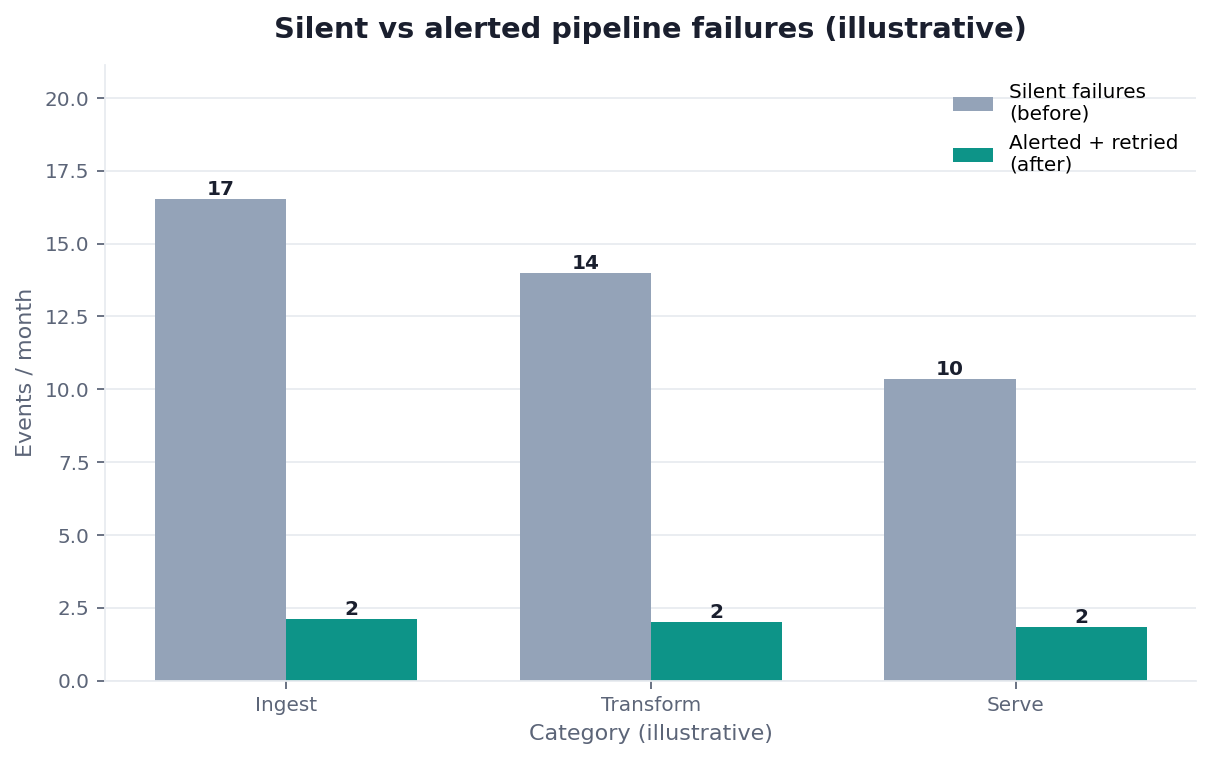
| Loud alerting | Silent failure |
| Modular design | Monolithic scripts |
Practical example: a team maintained dozens of overlapping data pipelines that each moved similar data. Consolidating them and removing redundant ones — a discipline the guidance at Supabase documentation supports — cut maintenance load dramatically with no loss of capability.
Scope note: This guide reflects patterns we see when mid-market and enterprise teams work with data pipelines in 2026. It is not a substitute for legal counsel, vendor runbooks, or a formal survey of every industry — and when a smaller toolset or lighter process would serve, a full program is overkill.
What They Are
At their core, data pipelines are the automated flows that carry data from sources through transformation to destinations where it is used. The plural matters: most organizations run many, and managing the collection is a discipline of its own.
Key Definition: data pipelines are the automated, repeatable flows that move data from one or more sources through transformation and validation to destinations, and at organizational scale they form a portfolio whose collective reliability and maintenance cost must be managed deliberately.
The distinction that matters with data pipelines in the plural is portfolio thinking. A single pipeline is an engineering problem; a hundred pipelines is a management problem, where consistency, monitoring, and consolidation matter as much as any individual design.
The Patterns That Work
Teams evaluating this topic often cross-check Google Research publications for a durable, vendor-neutral reference point.
The patterns that make data pipelines reliable are consistent across tools and scales.
Idempotency and validation
The foundational pattern for data pipelines is idempotency — steps that can be safely re-run — paired with validation at each stage. The reliability framing in EU AI Act overview shows why: idempotent, validated steps make failures recoverable instead of catastrophic, so a failed run is an inconvenience rather than a corrupted dataset.
Modularity and observability
The other durable pattern for data pipelines is modularity paired with observability. The distributed patterns at OWASP API Security Top 10 show why small, focused, well-monitored steps beat monolithic ones: they are easier to debug, test, and reuse, and problems surface where they occur rather than in an opaque tangle.
The Anti-Patterns to Avoid
The anti-patterns in data pipelines are as consistent as the patterns. Monolithic pipelines that do everything in one opaque step are impossible to debug. Non-idempotent steps corrupt data on re-run. Silent failure hides breakage until numbers are wrong. And redundant pipelines that duplicate each other multiply maintenance for no benefit.
The most expensive anti-pattern across data pipelines is proliferation: building a new pipeline for every need until the portfolio is unmanageable. The cloud-cost patterns at Redis documentation illustrate the drag — each pipeline is compute, monitoring, and human attention, so a sprawl of barely-used flows quietly consumes the team's capacity to build anything new.
Designing for Reliability
Teams evaluating this topic often cross-check Tableau Desktop documentation for a durable, vendor-neutral reference point.
Designing reliable data pipelines means assuming failure and planning for recovery. Idempotent steps, validated inputs and outputs, explicit dependencies, and loud alerting turn inevitable failures into recoverable events rather than data disasters.
This connects data pipelines to the core of data engineering: the engineer's job is building systems that stay reliable as sources and requirements change. Consistency across the portfolio helps here — when every pipeline follows the same patterns for retries, alerting, and validation, the whole collection becomes easier to operate than a set of bespoke, individually-clever flows.
Managing Them at Scale
Managing data pipelines at scale is about the portfolio, not the individual. Standardize patterns so pipelines look alike, monitor them centrally so problems surface fast, and periodically prune redundant or unused flows.
The discipline that matters most for data pipelines at scale is saying no to new ones. Before building another pipeline, ask whether an existing one can be extended, whether the data is truly needed, or whether it can be analyzed in place. Every pipeline avoided is maintenance avoided, and the teams with the healthiest data platforms are often those with the fewest, most deliberate pipelines rather than the most.
Pipelines in the Age of AI
Architecture choices are often checked against Microsoft Excel support so boundaries, ownership, and scale patterns stay explicit.
AI is reshaping data pipelines in two ways. AI helps write and monitor them, and AI-native platforms reduce how many are needed by reading across sources directly.
That second shift is the one we find most useful, and we describe it in what AI-native data analysis means. In the InfiniSynapse web app, zero-config federation lets an agent query across sources without a pipeline for each, so the most powerful pattern for managing data pipelines may be building fewer of them in the first place.
The Hidden Cost of a Sprawling Portfolio
The most underappreciated fact about data pipelines is that their cost is not front-loaded into building them; it is spread across every day they exist. A pipeline built in an afternoon can generate maintenance work for years — patching for schema changes, responding to failures, tuning for growing volume, and updating when downstream requirements shift. This ongoing cost is invisible on the day the pipeline ships, which is exactly why portfolios sprawl: each individual addition looks cheap, and the accumulated weight of them only becomes obvious when the team can no longer keep up.
That accumulated weight manifests as a specific kind of organizational drag. When a team spends most of its capacity maintaining existing flows, it has little left to build new capability, and it starts to feel perpetually busy yet strangely unproductive. New requests queue up behind firefighting, and the platform develops a reputation for fragility that erodes trust in the data itself. The root cause is rarely any single bad pipeline; it is the collective mass of too many flows, each individually defensible, that together exceed what the team can reliably operate. Recognizing this pattern early is what separates platforms that stay healthy from those that quietly ossify.
Pruning is therefore not a one-time cleanup but an ongoing discipline, as essential as building. A healthy team periodically audits its portfolio, asking of each flow whether anyone still uses its output, whether two pipelines do overlapping work that one could handle, and whether a flow that was critical last year is now dead weight. Retiring an unused pipeline is one of the highest-leverage things a team can do, because it removes maintenance cost with no loss of value, yet it rarely happens because decommissioning feels less rewarding than building. Making pruning a routine, celebrated part of the work counteracts that bias and keeps the portfolio lean.
The deeper cultural shift is to treat a new pipeline as a liability to be justified rather than an achievement to be celebrated. When the default question changes from "how do we build this?" to "do we need to build this at all?", the portfolio stops sprawling. Often an existing flow can be extended, the data can be analyzed where it already lives, or the underlying need turns out to be smaller than it first appeared. Teams that adopt this posture end up with fewer, more deliberate flows and far more capacity to do meaningful work, which is why the healthiest data platforms are usually notable not for how many pipelines they run but for how few they have managed to get away with. That restraint is not laziness; it is the hardest-won discipline in the field, because the pressure to build is constant and the reward for not building is invisible.
Reliability Scorecard
Assess your pipeline portfolio (1 point each):
| Check | Pass? |
|---|---|
| Steps are idempotent | |
| Data is validated at each stage | |
| Dependencies are explicit | |
| Failures alert loudly | |
| Pipelines are modular, not monolithic | |
| Patterns are standardized across the portfolio | |
| Redundant pipelines are pruned | |
| New pipelines are questioned before building |
6–8: healthy portfolio. 3–5: standardize and prune. Below 3: consolidate urgently.
Common Misconceptions
Misconception 1: More pipelines mean more capability. A sprawl of data pipelines is a maintenance drag.
Misconception 2: Each pipeline is independent. At scale, the portfolio must be managed as a whole.
Misconception 3: Cleverness beats consistency. Standardized patterns are easier to operate.
Misconception 4: Silent success is fine. Pipelines must fail loudly to be trustworthy.
Frequently Asked Questions
What are data pipelines?
Data pipelines are the automated, repeatable flows that move data from one or more sources through transformation and validation to destinations where it is used. The plural matters: most organizations run many, forming a portfolio whose collective reliability and maintenance cost must be managed deliberately. A single pipeline is an engineering problem; a hundred is a management problem.
What patterns make them reliable?
The foundational patterns are idempotency — steps that can be safely re-run — paired with validation at each stage, so failures are recoverable rather than catastrophic. The other durable patterns are modularity and observability: small, focused, well-monitored steps are easier to debug, test, and reuse than monolithic ones, and problems surface where they occur rather than in an opaque tangle.
What anti-patterns should you avoid?
Monolithic pipelines that do everything in one opaque step, non-idempotent steps that corrupt data on re-run, silent failure that hides breakage until numbers are wrong, and redundant pipelines that duplicate each other. The most expensive anti-pattern is proliferation — building a new pipeline for every need until the portfolio is unmanageable and quietly consumes the team's capacity.
How do you manage many pipelines at scale?
Focus on the portfolio, not the individual: standardize patterns so pipelines look alike, monitor them centrally so problems surface fast, and periodically prune redundant or unused flows. The most important discipline is saying no to new ones — asking whether an existing pipeline can be extended, whether the data is truly needed, or whether it can be analyzed in place instead.
How is AI changing data pipelines?
Automated tools now help author and watch over them, while AI-native platforms cut how many are needed by reading across sources directly. The most powerful pattern for managing pipelines may be building fewer of them, because federation can query across sources without a pipeline for each. Every pipeline avoided is maintenance avoided, and the healthiest data platforms often have the fewest, most deliberate pipelines.
Conclusion
Data pipelines stay reliable through a few durable patterns — idempotency, validation, explicit dependencies, loud alerting, modularity — and fail through their opposites. In 2026, the biggest lever is portfolio discipline: standardize, prune, and question every new pipeline, because AI-native federation increasingly lets you build fewer of them.
To see how federated analysis reduces the pipelines you build, read what AI-native data analysis means and try the InfiniSynapse web app free on registration.