Data Engineering: Platform, Pipelines, Insights
By William Zhu & the InfiniSynapse Data Team · Last updated: 2026-09-16 · Last verified: 2026-09-16
Direct answer: data engineering is designing, building, and operating the pipelines, storage, and transforms that make data reliable for analysis. In 2026 it runs on a data engineering platform (ingest, warehouse or lakehouse, tested transforms, orchestration, observability). The useful data engineering insights are which pipelines to keep, which to drop, and how AI-native access shrinks glue work.
Authors ship production pipelines and review enterprise stacks weekly. This hub is the operating map for data engineering — pipelines, the platform they run on, and the insights that decide what to build — not a textbook syllabus or a vendor scorecard. About / team · GitHub @allwefantasy · zhuhl@infinisynapse.com
Table of Contents
- TL;DR
- How We Evaluated This Guide
- What It Is
- The Core Building Blocks
- Pipelines and Orchestration
- ETL, ELT, and Transformation
- The Platform Layer
- The Engineer Role
- Tools and the Modern Stack
- Insights That Change What You Build
- Readiness Scorecard
- Common Misconceptions
- Cluster Guides in This Pillar
- Frequently Asked Questions
- Conclusion
TL;DR
Who this is for: engineers, analysts, and data leaders learning or maturing the discipline in 2026.
What you'll learn: the definition, the building blocks, pipelines and orchestration, ETL versus ELT, what a data engineering platform actually is, the engineer role, and the data engineering insights that change what you build.
This hub maps the whole pillar; the cluster guides below go deep on pipelines, orchestration, and the role. For where the prepared data ultimately lands, see the data warehouse and lakehouse guide. The job that reads those facts is hosted by data infrastructure. The analysis layer on top of those pipelines is an ai native data platform. For the governance rules that trustworthy pipelines depend on, see the data governance frameworks guide. For a dated briefing, see data engineering news.
How We Evaluated This Guide
We built this guide from production systems rather than tutorials. Every section reflects what we see when teams operate at scale and then hand the results to analysts and AI systems. Shared vocabulary still tracks the Wikipedia data engineering overview and the Wikipedia data warehouse overview. Orchestration and reliability language we use in reviews comes from the Google SRE book (SLOs, toil, error budgets), not from launch decks.
Author note (William Zhu): On weekly stack reviews I still see teams equate “more pipelines” with progress. The logistics composite below is the opposite pattern: fewer jobs, louder failures, less firefighting. Corrections: zhuhl@infinisynapse.com.
The table below summarizes the dimensions we see most often when teams plan their next move. Use it as a map; the cluster guides linked throughout this pillar go deeper on each row.
| Dimension | What to know in 2026 | Where to go deeper |
|---|---|---|
| Pipelines | Reliability beats cleverness | What is a data pipeline |
| Orchestration | Schedule, retry, observe | Data orchestration |
| Transformation | ELT + tests is the default | ETL for data |
| The role | Broad, systems-oriented craft | The data engineer role |
| Tooling | dbt, Spark, cloud services | What is dbt |
| Definition | Precise, citable wording | What is data engineering |
| Platform | Layers, not a single product | This page, The Platform Layer |
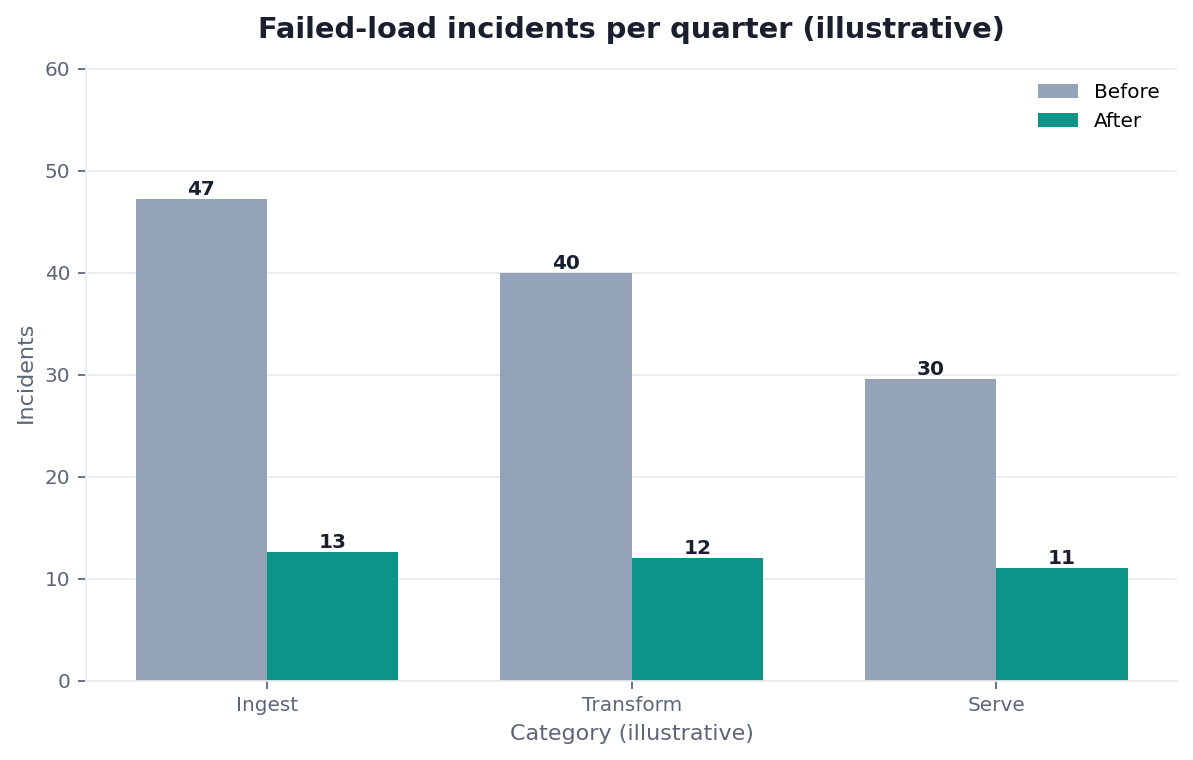
Practical example: a logistics company running fourteen brittle nightly jobs consolidated them into a tested, orchestrated pipeline and cut failed-load incidents by roughly 70% in one quarter — because retries, alerts, and lineage replaced hand-run scripts. That reliability, not raw throughput, is what makes data engineering valuable.
Scope note: This guide reflects patterns we see when mid-market and enterprise teams run this work in 2026. It is not a substitute for legal counsel, vendor runbooks, or a formal survey of every industry — and when a smaller toolset or lighter process would serve, a full program is overkill.
What It Is
At its core, data engineering is plumbing for decisions. It builds the systems that collect data from many sources, transform it into consistent shapes, and deliver it where analysts and applications can use it. Where an analyst asks questions of data, an engineer makes sure the data is there, correct, and fresh in the first place. Vendor primers such as Databricks’ data engineering overview say the same thing in lakehouse language: the data has to show up on time and in good shape.
Key Definition: data engineering is the discipline of designing, building, and operating the pipelines, storage, and transformation systems that make data reliable, consistent, and available for analysis and downstream applications.
The distinction from adjacent work matters. Analysts and scientists consume data; engineers produce the reliable supply. That supply chain is invisible when it works and painfully visible when it breaks, which is why the craft prizes reliability and observability over novelty. For the precise wording teams cite, see what is data engineering.
The Core Building Blocks
Most data engineering work reduces to a few repeatable building blocks, and mastering them matters more than chasing every new framework. Cloud reference shapes in Microsoft’s data architecture guidance are a useful cross-check when a slide deck implies you should redraw the estate.
| Block | Purpose | Typical tools |
|---|---|---|
| Ingestion | Pull data from sources | Connectors, Kafka |
| Transformation | Shape and clean data | dbt, Spark, SQL |
| Orchestration | Schedule and monitor | Airflow, Dagster |
| Storage | Persist for analysis | Warehouse, lakehouse |
| Observability | Freshness, failures, lineage | OpenTelemetry, job SLOs |
Ingestion often relies on streaming systems; the Stanford HAI AI Index is useful context for how event-heavy and AI-consuming workloads keep growing. The other blocks are covered in depth across this pillar, from the data pipeline concept to the broader set of patterns that experienced teams learn to avoid. For more, see data pipelines.
Pipelines and Orchestration
A pipeline is the fundamental unit of data engineering: a defined path that moves data from source to destination, transforming it along the way. The introductory concept is covered in what is a data pipeline.
Orchestration — deciding when each step runs, what happens on failure, and how the whole graph is observed — is covered in data orchestration.
Reliability is the theme that unites both. A pipeline that succeeds 99% of the time but fails silently on the 1% is worse than one that fails loudly, because bad data flowing downstream corrupts every report built on it. This is why mature teams treat alerting, retries, and idempotency as first-class concerns rather than afterthoughts, and why they increasingly borrow reliability practices from software operations.
Two design choices separate resilient pipelines from fragile ones. The first is idempotency: a step that produces the same result whether it runs once or five times, so a retry after a partial failure never double-counts rows or duplicates records. The second is a deliberate backfill strategy, so that when historical data changes or a bug is fixed, the team can reprocess an affected date range cleanly rather than patching production by hand. Teams that get these two right spend far less time firefighting, because most incidents become routine reruns instead of emergencies. Observability ties it together: structured logs, freshness checks, and a clear owner for every scheduled job turn silent corruption into an alert someone actually receives.
ETL, ELT, and Transformation
Transformation is where raw data becomes analysis-ready, and the industry has largely shifted from ETL to ELT — loading data first, then transforming it in the destination. The classic model is explained in ETL for data. Shared vocabulary for the older warehouse path still tracks the Wikipedia business intelligence overview.
The tool that popularized tested, version-controlled transformation is covered in what is dbt in data engineering. Primary docs we actually open in reviews: dbt documentation and Apache Airflow docs.
For teams that transform with code, Python for data engineering remains the default language, and cloud services fill in the managed layer.
Microsoft's managed integration service, for example, is covered in Azure Data Factory.
Heavier patterns sit in our complex transformation guide.
The Platform Layer
A data engineering platform is not a single product you buy. It is the assembled system that lets data engineering run as an operating model: ingestion, storage, transformation, orchestration, contracts, and observability on one set of standards. Teams that treat “the platform” as a vendor logo keep paying for the same incident twice — once in the tool, once in the handoff.
Layers you can name
| Layer | What it owns | Fail mode if missing |
|---|---|---|
| Ingest | Connectors, CDC, landing zones | Manual extracts, stale bronze |
| Storage | Warehouse / lakehouse contracts | “Which engine wrote this?” |
| Transform | Tested SQL/Spark (usually ELT) | Undocumented business rules |
| Orchestrate | Schedule, retry, backfill | Cron races, silent skips |
| Observe | Freshness SLOs, lineage, on-call | Dashboards lie for a week |
| Contract | Grain, owners, access evidence | Every consumer invents a metric |
That last row is the 2026 gap. Competitors now treat data contracts and observability as first-class, not a slide after go-live. If your data engineering platform cannot name an owner, a grain, and a freshness SLO for a dataset an agent will read, it is a pile of jobs — not a platform.
When you need a platform vs a few pipelines
A handful of warehouse SQL jobs is enough when one team owns one mart and one dashboard. You need a data engineering platform when more than one engine reads the same tables, when on-call is a rotation, or when AI-native analysis will query across sources. Microsoft’s data architecture guidance is a useful external map for those layers; it is not a shopping list.
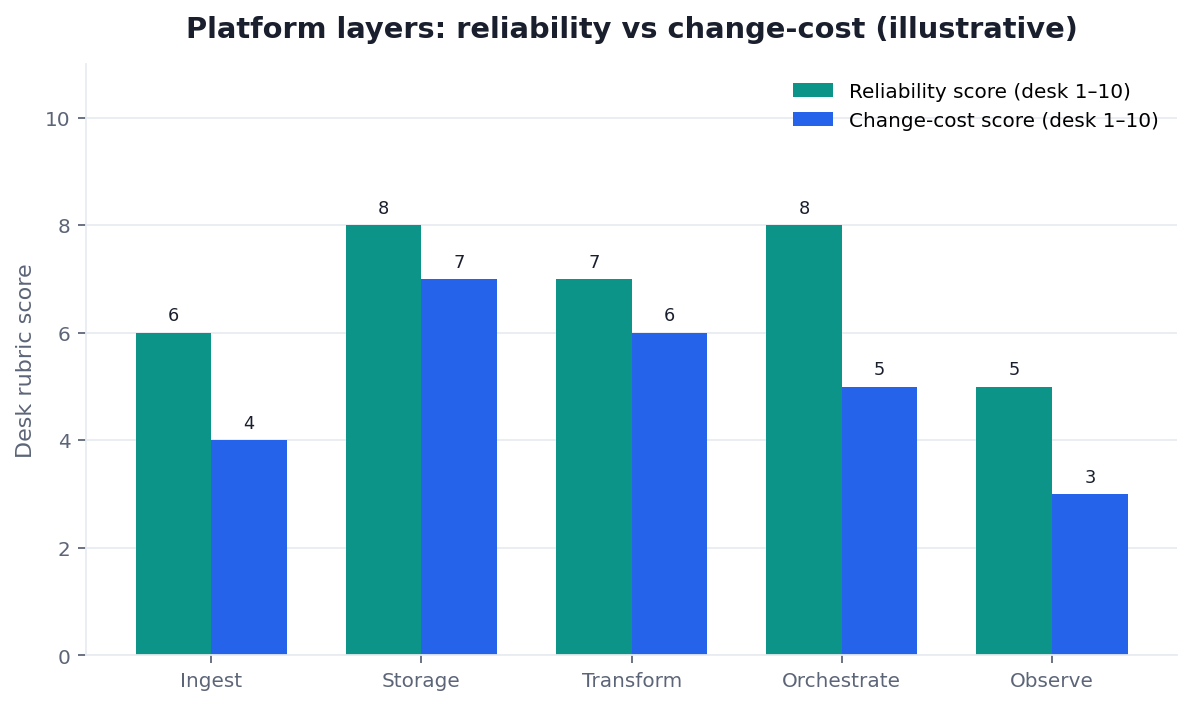
Chart note: illustrative desk rubric, not a vendor lab study. Independence label: InfiniSynapse synthesis from production reviews.
The Engineer Role
The person behind the systems is the subject of several cluster guides, because "engineer" means different things at different companies. The role is defined in the data engineer role.
A complementary definition is in what is a data engineer.
Day-to-day views are in what does a data engineer do and what do data engineers do.
A common point of confusion is how the role differs from data science, which we address in data engineer vs data scientist. The short version: engineers build the reliable data supply, scientists model it, and analysts interpret it. Success is measured by whether the data others depend on is correct and available, a standard that rewards discipline over flash.
Tools and the Modern Stack
The modern stack is modular, and teams assemble it from ingestion, transformation, orchestration, and storage layers. Managed services and open-source tools coexist, and the right mix depends on scale, cloud, and team skills rather than fashion. That assembly is the data engineering platform — dbt plus Airflow plus a warehouse is a platform if the contracts are written down; a branded suite is not a platform if lineage and on-call are missing.
Real-time needs pull teams toward streaming platforms, covered in Databricks Delta streaming for real-time data.
Consulting-style delivery is covered in data engineering services.
Teams tracking the fast-moving Python ecosystem follow Python data engineering news to keep their stack current.
Whatever the mix, the goal of data engineering is the same: a reliable supply of trustworthy data.
Insights That Change What You Build
This is the section that matches how practitioners actually use data engineering insights: not a newsletter dump, but the judgments that change an architecture review. We keep the 2026 AI-native shift here because it is still the highest-leverage insight on the page — and we add the two others that keep showing up in desk reviews.
Insight 1 — AI-native access shrinks glue. When an agent can read many sources directly and reconcile them at query time, some of the pipelines built purely to pre-join data for a dashboard become unnecessary. The brittle surface area shrinks, and engineers spend less time on glue code and more on reliability, governance, and the hard transformations that genuinely need engineering. That pattern is described in what AI-native data analysis means. For the query layer, see how natural language becomes SQL.
Insight 2 — Contracts beat extra copies. A named grain, owner, and freshness SLO on the system of record often beats another nightly clone. That is a data engineering insights item you can take to a steering meeting: show the copy’s on-call cost before you fund it.
Insight 3 — Observability is part of the build. Freshness checks and lineage are not a phase-two add-on. Instrumentation patterns from OpenTelemetry and error-budget language from the SRE book belong in the same review as the DAG.
This does not eliminate the discipline; it refocuses it. You can see the federation pattern in the InfiniSynapse web app, where the agent reads sources directly so data engineering teams build fewer one-off pipelines and invest more in the ones that carry real business logic. That product CTA is optional and separate from the three insights above.
Readiness Scorecard
Assess your team's data engineering maturity (1 point each):
| Check | Pass? |
|---|---|
| Pipelines have alerting and retries | |
| Transformations are tested | |
| We use version control for data logic | |
| Orchestration is centralized and observable | |
| Lineage is captured automatically | |
| Storage layers are clearly defined | |
| We measure pipeline reliability | |
| We avoid pipelines an agent could replace | |
| The platform has named owners and freshness SLOs |
7–9: strong maturity. 4–6: prioritize testing and observability. Below 4: start with reliability.
Common Misconceptions
Misconception 1: It is just moving data. Data engineering is about making data reliable, not merely relocating it.
Misconception 2: More pipelines mean more value. Fewer, well-tested pipelines usually beat many fragile ones.
Misconception 3: It is the same as data science. Engineers build the supply; scientists model it.
Misconception 4: AI makes it obsolete. AI shrinks glue work and refocuses engineers on reliability and governance.
Misconception 5: A platform is a logo. A data engineering platform is layers plus contracts. Buying a suite without owners and SLOs is still a pile of jobs.
Cluster Guides in This Pillar
This hub is the map; the guides below go deep on each part of the discipline.
| Guide | Focus |
|---|---|
| What is a data pipeline | Pipeline concept |
| Azure Data Factory | Managed integration |
| Data engineering news | Trends |
| The data engineer role | The role in 2026 |
| Data pipeline | Architecture and patterns |
| Python for data engineering | Python for the job |
| Data engineering services | Services explained |
| Databricks Delta streaming | Real-time processing |
| ADF complex transformation | Complex transforms |
| Python data engineering news | Python ecosystem |
| What is data engineering | Definition |
| Data pipelines | Patterns and anti-patterns |
| Engineer vs scientist | Role comparison |
| What do data engineers do | Tasks by team |
| What does a data engineer do | Day to day |
| What is dbt | dbt explained |
| Data orchestration | Orchestration |
| What is a data engineer | Role defined |
| ETL for data | Extract, transform, load |
Frequently Asked Questions
What is data engineering?
Data engineering is the discipline of designing, building, and operating the pipelines, storage, and transformation systems that make data reliable, consistent, and available for analysis and applications. Where analysts consume data, engineers produce the trustworthy supply — collecting it from sources, transforming it into consistent shapes, and delivering it fresh.
What is a data engineering platform?
A data engineering platform is the assembled stack — ingest, storage, tested transforms, orchestration, observability, and contracts — that lets the discipline run as an operating model. It is not one vendor logo. You need one when more than one engine reads the same tables, when on-call is a rotation, or when agents will query across sources. A few warehouse SQL jobs can wait.
Which insights change what teams build?
The data engineering insights that change a review in 2026 are: AI-native access can retire “just in case” copy jobs; contracts (grain, owner, freshness) beat extra clones; and observability belongs in the build, not in a later phase. Newsletter volume is not an insight.
What is the difference between ETL and ELT?
ETL transforms data before loading it into the destination, while ELT loads raw data first and transforms it inside the destination — usually a warehouse. Most modern stacks favor ELT because warehouses are powerful enough to transform at scale, and tested, version-controlled transformation tools make in-warehouse logic auditable and reproducible.
How is AI changing the discipline?
AI-native analysis lets agents read many sources directly and reconcile them at query time, which shrinks the number of pipelines built purely to pre-join data for dashboards. The discipline does not disappear — it refocuses on reliability, governance, and the hard transformations that genuinely need engineering, while glue code declines.
Conclusion
Data engineering builds the reliable data supply that every analysis depends on. In 2026 the work sits on a data engineering platform of named layers, and the data engineering insights that matter are which pipelines to keep, which to drop, and how AI-native access shrinks glue. Master the building blocks, prize reliability, and build fewer, better pipelines.
To see how direct source federation reduces one-off pipelines, read what AI-native data analysis means and try the InfiniSynapse web app free on registration, no credit card required.