Data Engineering News: What Matters This Quarter
By William Zhu & the InfiniSynapse Data Team · Last updated: 2026-09-16 · Last verified: 2026-09-16 · About / team · Credentials: GitHub @allwefantasy (InfiniSQL / open-source data systems) · Desk: zhuhl@infinisynapse.com
Authors ship production pipelines and review enterprise stacks weekly. This page is a filtered reading of data engineering news — a dated Q3 2026 briefing plus the durable filter we still use after the headlines move. It is not a product launch calendar or a vendor scorecard. No personal LinkedIn is published; identity signals are GitHub + About/Vision + editorial standards.
Table of Contents
- TL;DR
- How We Track It
- What Counts as News
- This Quarter's Headlines
- The Trends That Matter
- Comparative Snapshot: Signal vs Noise
- What to Ignore
- How to Stay Current
- Common Mistakes
- Case Study: Headline Chasing vs Durable Filters
- News in the Age of AI
- Signal Scorecard
- Common Misconceptions
- Frequently Asked Questions
- Conclusion
TL;DR
Direct answer: data engineering news this quarter is three durable moves: Iceberg v3 is production-stable but engine support is uneven; you can resize stateful streams without rebuilding checkpoints; and AI reads across sources so fewer copy jobs are justified. Act only when architecture, on-call, or cost would change.
Who this is for: data engineers and leaders who need a durable filter for data engineering news — not another unread tab.
What you'll learn: what counts as real data engineering news, the Q3 2026 headlines that pass, the trends that still matter after those headlines age, what to ignore, a measured case comparison, and how to stay current.
Editorial vs commercial: The body below is practitioner synthesis. The closing line mentioning the InfiniSynapse web app is a product CTA and is labeled as such — it is not part of the trend filter or case composite.
This guide sits under the data engineering hub.
For the Python-specific angle, see the Python-focused engineering roundup.
Also see data orchestration. Publisher identity: About / editorial standards · company About.
How We Track It
We separate durable shifts from noise, because most product launches do not change how you should build. Judgments come from production reviews: what teams adopt, reverse, and write into incident postmortems — not launch-day press. That is why this page of data engineering news is shorter than a newsletter and denser than a vendor calendar.
Author note (William Zhu): I still see teams schedule rebuilds around launch calendars, then reverse them within a quarter when failure modes and FinOps baselines did not move. The Q3 briefing is that habit applied to this cycle. Corrections: zhuhl@infinisynapse.com.
Primary sources we prioritize (over vendor blogs) when we triage data engineering news:
| Source | Why it is high-signal |
|---|---|
| Apache Airflow docs | Orchestration primitives and operational patterns |
| dbt documentation | Transformation-as-code / ELT practice |
| Apache Iceberg docs | Open table formats shaping lakehouse storage |
| Delta Lake docs | Lakehouse table semantics on the Delta path |
| OpenTelemetry docs | Pipeline / job observability standards |
| Google SRE book | Reliability language (SLOs, toil, error budgets) |
Independent industry context (triangulate desk judgment; not a substitute for primary project docs):
- Gartner Data and Analytics glossary — shared vocabulary for data/analytics programs
- IDC — industry research on ICT and data/analytics spending patterns (use their published research for budget context; we do not reproduce paywalled numbers here)
- Wikipedia’s data engineering overview — a stable public definition when a sponsor asks what the discipline is
Where we also skim (secondary): project changelogs, one newsletter (not twelve), and vendor posts after the primary spec moved. Lakehouse vocabulary still tracks the Wikipedia data warehouse overview more reliably than a keynote.
Watch categories:
| Category | Why it matters | Example “act” signal |
|---|---|---|
| AI in engineering | Changes how pipelines are built and avoided | Agents query federated sources; codegen for boilerplate ETL |
| Open table formats | Changes storage contracts | Iceberg/Delta become the default for multi-engine reads |
| Cost & efficiency | Dominant 2026 pressure | FinOps reviews force incremental loads / warehouse rightsizing |
| Reliability | Observability and data quality | OTel traces on jobs; freshness SLOs |
| Orchestration | How work is scheduled and owned | Airflow/Dagster/ADF as conductors, not transform engines |
Scope note: Practitioner synthesis for mid-market and enterprise teams following data engineering news in 2026 — not a census, not legal advice, and not a vendor endorsement.
What Counts as News
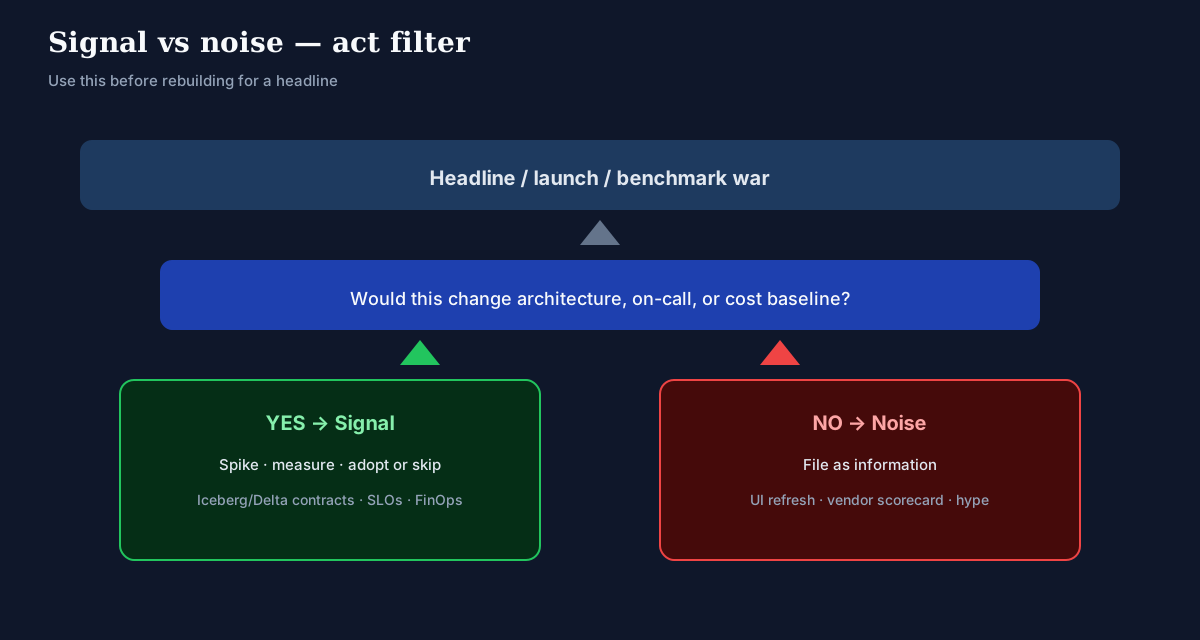
The most useful lens is distinguishing durable shifts from product noise. A durable shift changes how you should architect systems for years; product noise is a launch you can safely evaluate later.
Key Definition: data engineering news worth acting on is any development that durably changes how teams should ingest, transform, store, or serve data — as opposed to incremental product releases that do not alter underlying practice.
Decision test: if the headline would not change your architecture diagram, your on-call runbook, or your cost baseline, file it as information — not as data engineering news you must act on this quarter.
This Quarter's Headlines
Below is the Q3 2026 desk read of data engineering news we would bring to an architecture review — each item scored against architecture, on-call, and cost.
Iceberg v3 is GA; your engine matrix is not
Apache Iceberg 1.11.0 declared the v3 spec production-stable in May 2026 (deletion vectors, row lineage, variant, geospatial types). That is real data engineering news for storage contracts — not a fleet-upgrade mandate.
Compatibility is the story. Databricks Runtime 18.0 is the most complete v3 path in our reviews. Snowflake’s v3 is generally available, but new managed tables often still default to v2. AWS is fragmented: Glue 6.0 and S3 Tables advertise v3; Athena still cannot read version-3 tables. Open-source Trino and PyIceberg writes remain blockers for mixed fleets.
30-day action: pick one critical table, write the read/write matrix, and spike v3 only where every reader already supports it. If Athena, OSS Trino, or a Python writer is on the path, watch — do not act.
Streaming state you can resize
On 14 September 2026, Databricks published on-demand state repartitioning for Structured Streaming: resize a stateful query’s partitions on Databricks Runtime 18+ with RocksDB, without rebuilding the checkpoint. For fraud, sessionization, and stream-stream joins, that is data engineering news that can change an on-call runbook. It does not change a warehouse team whose “real-time” dashboard is a 15-minute incremental model. Act only if you already run stateful streams and have hit a partition wall.
Lakehouse ops and “fewer pipelines” claims
Two ops items keep showing up in data engineering news feeds. AWS described Tubular Labs rebuilding a 70TB estate on Iceberg and Amazon S3 Tables. Iceberg materialized views in SageMaker are being sold as medallion ETL collapsed into scheduled SQL. Both are Watch until your compaction, snapshot expiration, and CDC ownership are measured. Map the claim to a data pipeline you already own before you copy the architecture.
The chart scores this quarter’s headline types on architecture, on-call, and cost — not hype volume.
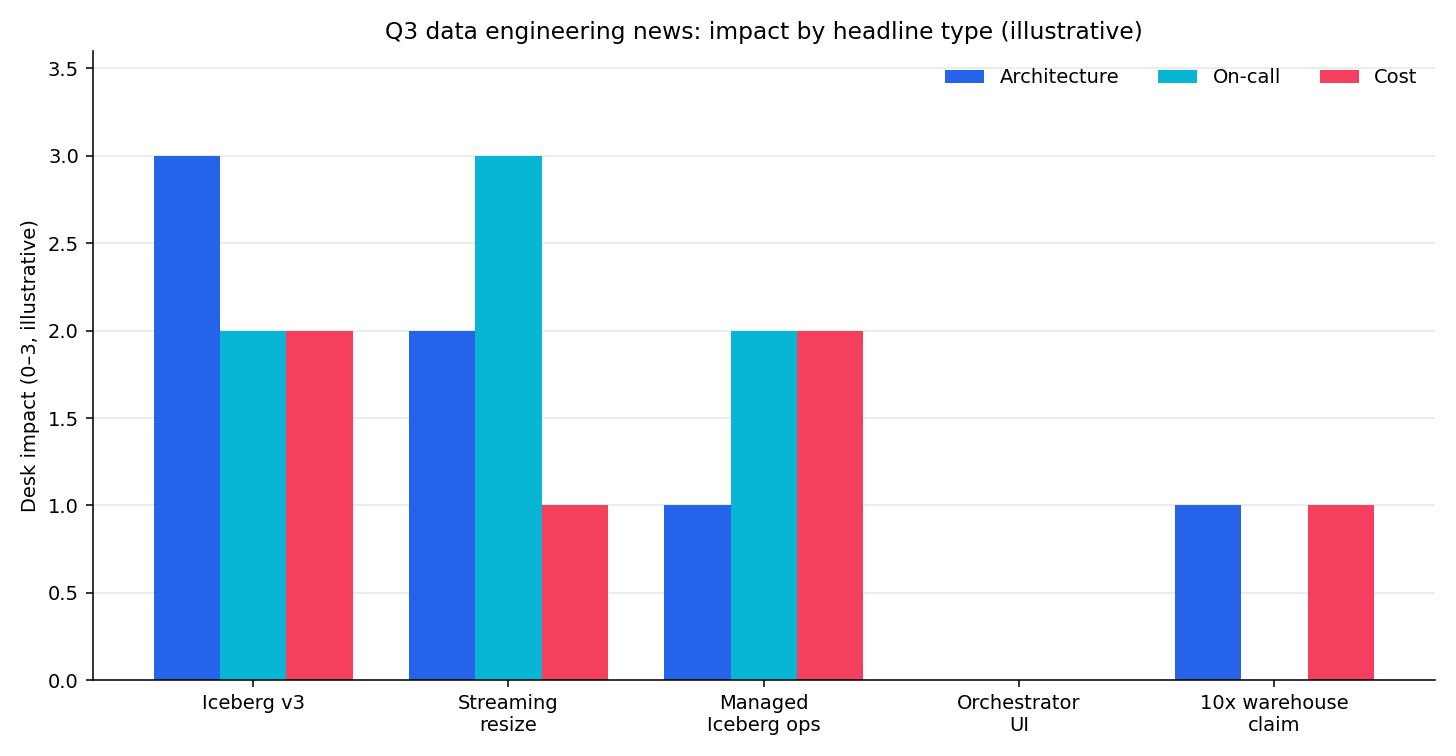
Chart note: illustrative desk rubric (0–3 per dimension), not a multi-vendor lab study. Independence label: InfiniSynapse synthesis from production reviews — not an IDC or Gartner survey sample.
| Headline (Q3 2026) | Desk call | Why | 30-day move |
|---|---|---|---|
| Iceberg v3 GA + uneven engines | Act on one table | Storage contract can change | Spike + write the engine matrix |
| Streaming state repartition (DBR 18) | Act if stateful | On-call / scale path changes | Confirm RocksDB + DBR 18; skip if batch |
| S3 Tables / managed Iceberg ops | Watch | Ops time is real; your bill is not theirs | Measure compaction + snapshot toil first |
| dbt config mapped onto Iceberg increments | Watch | Layout becomes expressible in model config | Read adapter docs; no rewrite |
| Orchestrator vNext UI / “10x cheaper warehouse” | Ignore | Rarely changes failure modes or your $/TB | Keep the baseline; do not rebuild |
The Trends That Matter
The headlines that genuinely matter in 2026 still cluster into a few durable trends. Q3 data engineering news sits on top of these; it does not replace them.
1) AI-native access (and fewer “just in case” pipelines)
AI is no longer only a downstream consumer. Teams ask agents to answer across warehouses, lakes, and SaaS extracts — so engineering must expose governed, documented interfaces rather than one more brittle copy job. Orchestrators still move data that must land (SLAs, dimensional models, compliance zones); exploratory analysis no longer justifies a new pipeline for every question. That is the AI thread inside data engineering news, not a separate beat.
Watch three layers:
- Semantic / catalog metadata agents can read (ownership, grain, freshness).
- Query federation / zero-copy access where security allows.
- Codegen for boilerplate (stubs for connectors and tests) — useful, but not a substitute for ownership of failure modes.
2) Open table formats as the storage contract
Lakehouse coverage is less about “Spark vs warehouse” slogans and more about table-format contracts. Apache Iceberg and Delta Lake standardize ACID-ish table semantics, time travel, and multi-engine reads. If Parquet folders are still the contract, you will keep paying for “which engine wrote this?” incidents. That year-long story is the substrate under this quarter’s v3 data engineering news.
3) Transformation stays in ELT; orchestration stays thin
dbt-style transformation-as-code and warehouse/Spark compute continue to absorb heavy logic. Orchestrators — see Airflow patterns — win when they schedule, retry, and observe, not when they become an untested visual ETL maze. That “conductor vs orchestra” lesson still holds when data engineering news promises an orchestrator will “maintain the lakehouse by itself.” For the transformation-layer definition, see what dbt is in data engineering.
4) Cost, reliability, and governance as first-class SLOs
After years of “move fast,” efficiency dominates. Pair FinOps baselines with reliability language from the SRE book (SLOs, error budgets) and instrumentation from OpenTelemetry. Governance is lineage and access evidence — not a slide deck. Gartner’s Data and Analytics glossary keeps sponsor language consistent; IDC is useful for budget context — neither replaces your baselines. Microsoft’s data architecture guidance is a useful cross-check when a headline implies you should redraw the estate.
| Trend | Engineering artifact to demand | Counter-case (when not to rush) |
|---|---|---|
| AI-native access | Documented datasets + freshness SLO for agent-readable sources | Regulated data that cannot leave its system of record |
| Iceberg / Delta | Table format choice written into platform standards | Tiny estates where a single warehouse SQL model is enough |
| Thin orchestration | DAGs call dbt/Spark/SQL; no business rules in UI graphs | Legacy SSIS lift-and-shift with a fixed sunset date |
| Observability | Traces/metrics on job failure + data freshness | Greenfield week-1 prototypes (add before production cutover) |
Comparative Snapshot: Signal vs Noise
| Headline type | Usually signal? | Why | What to do in 30 days |
|---|---|---|---|
| New open table format features (Iceberg/Delta) | Often yes | Changes storage contracts across engines | Spike one critical table; measure read compatibility |
| Orchestrator vNext UI | Rarely | Rarely changes failure modes | Ignore until your ops pain maps to a specific feature |
| “10x cheaper warehouse” claim | Maybe | Only vs your measured baseline | Capture current $/TB scanned and p95 job duration first |
| Agent that “builds pipelines” | Partial | Useful for stubs; weak on ownership | Pilot on non-critical DAGs with human review |
| Benchmark war (vendor A vs B) | No | Workloads are not yours | Reproduce with your query mix or skip |
This comparative filter is how we keep data engineering news from becoming a rebuild mandate every sprint.
What to Ignore
Most product launches, benchmark wars, and framework-of-the-week debates do not change how you should build. Chasing them costs more than it returns.
Apply the same filter to data engineering news every week: does this change a decision you would otherwise make? If not, let it pass. Protect engineering time the same way you protect an error budget. File the rest as unread data engineering news, not as a backlog.
How to Stay Current
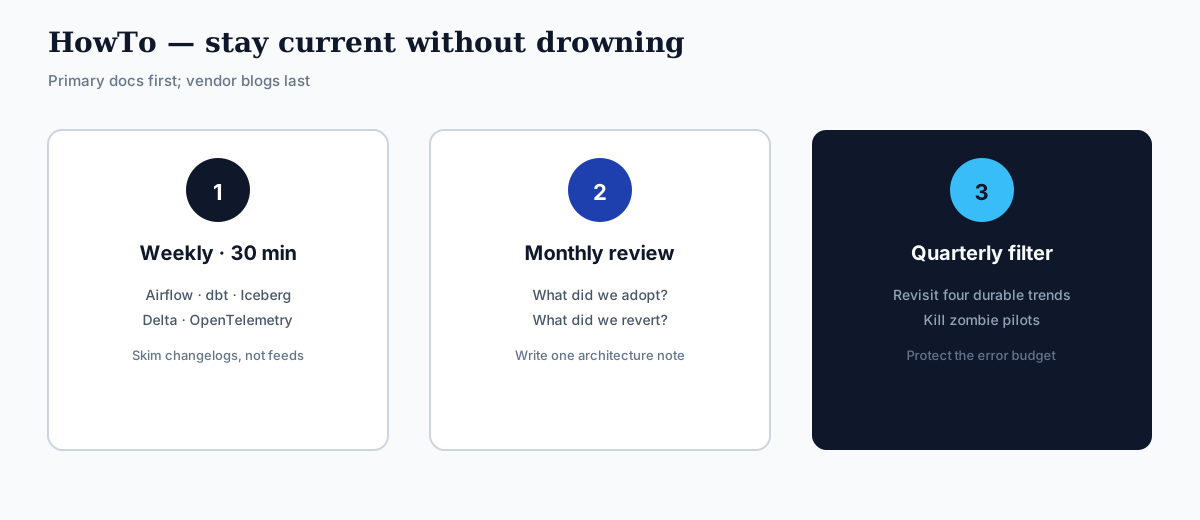
Staying current without drowning means a small watchlist, quarterly trend reviews, and tool evaluations against measured needs — so consuming data engineering news does not become a second job.
| Cadence | Action |
|---|---|
| Weekly (30 min) | Skim primary project docs/changelogs (Airflow, dbt, Iceberg/Delta, OTel) — not Twitter threads |
| Monthly | One architecture review: what did we adopt/revert and why? |
| Quarterly | Revisit the four durable trends; kill zombie pilots; refresh this page’s headline table |
This connects the discipline of data engineering itself: judgment beats volume of data engineering news.
Common Mistakes
- Chasing every launch → churn and fewer shipped features.
- Adopting for novelty → complexity without a baseline.
- Confusing reading with being informed → activity without decisions.
- Ignoring the field entirely → missing durable shifts like open table formats and AI-native access.
- Treating vendor roadmaps as plans → rebuilds around promises that slip.
These mistakes show up when a team equates volume of data engineering news with progress. Progress is measured outcomes, not feed velocity.
Case Study: Headline Chasing vs Durable Filters
Composite comparison (two mid-market analytics orgs, similar headcount, 2025–2026; desk composite, not a third-party audited customer case):
| Metric (12 months) | Team A — chased headlines weekly | Team B — durable-filter only |
|---|---|---|
| Major stack rebuilds | 2 | 0 |
| Net-new production data products shipped | 4 | 11 |
| Median time to recover failed daily job | 95 min | 28 min |
| Cloud data spend vs prior year | +38% | +7% (with explicit FinOps) |
| Open table format standard | None (mixed Parquet conventions) | Iceberg for lake; warehouse for marts |
| Orchestration role | Heavy transforms inside orchestrator UI | Thin DAGs → dbt/SQL |
Team A’s rebuilds tracked launch cycles; Team B’s changes tracked measured pain (failed jobs, spend, cross-engine reads). The chart below illustrates the same pattern we see repeatedly: fewer rebuilds, more shipped value, when data engineering news is filtered for durability.
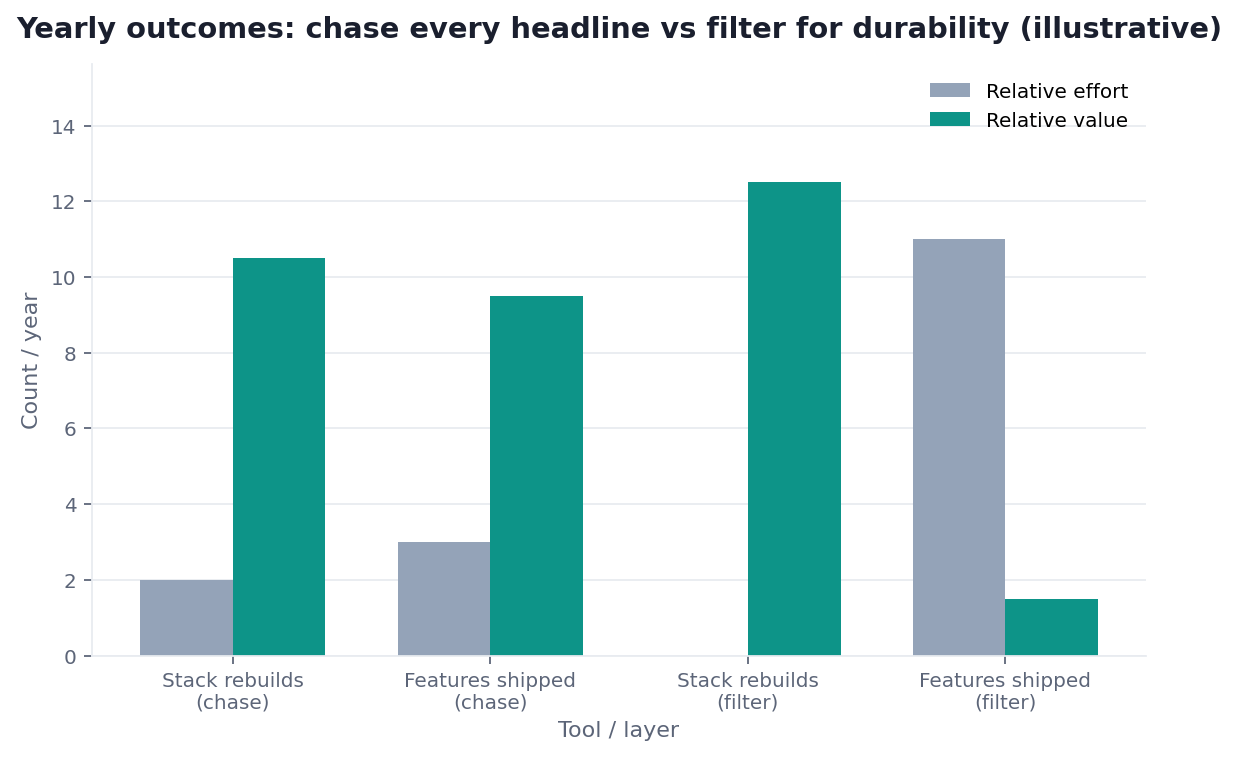
Chart note: composite observation used to illustrate the filter, not a multi-vendor lab study. Independence label: InfiniSynapse desk synthesis from production reviews — not an IDC or Gartner survey sample.
News in the Age of AI
The dominant story in data engineering news still cuts two ways. AI raises the bar for the pipelines it consumes, and it reduces how many pipelines you build when federation and governed metadata are good enough.
That second shift is the architectural one. How AI-native analysis changes what must be moved versus queried in place is a pattern we describe in what AI-native data analysis means. For every AI headline: does this remove a pipeline, harden a contract, or only add another tool? The same question applies to ETL versus ELT: codegen can draft jobs; it cannot own grain or idempotency.
Signal Scorecard
Assess how you follow data engineering news (1 point each):
| Check | Pass? |
|---|---|
| We filter durable shifts from noise | |
| We follow primary project docs, not only vendor blogs | |
| We evaluate tools against measured baselines | |
| We revisit trends quarterly | |
| We do not rebuild for every trend | |
| We track cost and reliability with SLOs | |
| We watch AI-native access and table formats | |
| We act on news, not just consume it |
6–8: disciplined. 3–5: tighten your filter. Below 3: pick trusted sources and focus.
Common Misconceptions
Misconception 1: More news is better. Filtered data engineering news beats endless headline consumption.
Misconception 2: Every launch is news. Most launches do not change how you build.
Misconception 3: Being busy reading means being current. Judgment, not volume, is being current.
Misconception 4: You can ignore it all. The durable shifts in data engineering news genuinely matter.
Misconception 5: A dated briefing makes the filter obsolete. Without a filter, Q3 data engineering news is just a longer unread pile.
Frequently Asked Questions
What is the latest data engineering news this quarter?
Three items pass in Q3 2026: Iceberg v3 is production-stable while engines stay uneven (spike one table); Databricks can resize stateful Structured Streaming partitions without rebuilding checkpoints on DBR 18+ / RocksDB; and managed Iceberg ops (S3 Tables, materialized views) are Watch until your compaction and CDC toil are measured. Everything else is information until architecture, on-call, or cost would change.
How do you tell real news from noise?
Ask whether a development would change a decision you would otherwise make — architecture, on-call, or cost baseline. Real data engineering news changes how teams ingest, transform, store, or serve data; noise is an incremental launch that does not alter underlying practice.
What trends matter most right now?
Four clusters still sit under the weekly feed: AI-native access, open table formats, thin orchestration + ELT transforms, and cost/reliability/governance as SLOs. Q3 headlines are instances of those clusters, not a fifth theme.
How do you stay current on data engineering news?
Follow a short list of primary docs (Airflow, dbt, Iceberg/Delta, OpenTelemetry), review monthly what you adopted or reverted, and revisit durable trends quarterly. Depth beats breadth. Use Gartner and IDC for sponsor language — not for an on-call fix. Skim one newsletter; do not subscribe to twelve.
How is AI itself changing the field?
AI raises the bar for pipeline reliability and reduces the number of pipelines needed when federation and metadata are strong. For each AI-related item in data engineering news, ask whether it removes a pipeline, hardens a contract, or only adds tooling.
Conclusion
Data engineering news this quarter is Iceberg v3 compatibility, resizable streaming state, and AI-native access — sitting on cost, reliability, and governance. Stay current by filtering data engineering news for shifts that change how you build, demanding measured baselines, and ignoring launch churn.
To go deeper on the AI-native access shift reshaping what must be pipelined, read what AI-native data analysis means.
Product CTA (commercial): If you want to try federated analysis in practice, the InfiniSynapse web app is free on registration. That offer is separate from the editorial filter above.