What Is dbt in Data Engineering?
60-second answer. What is dbt in data engineering? dbt (data build tool) is the warehouse transformation layer: versioned, tested SQL models that run after load. It is the T in ELT — not ingest, and not a full ETL suite.
Full form: dbt = data build tool. Use it when shared warehouse SQL needs tests and Git; skip it when a handful of scripts is enough.
By the InfiniSynapse Data Team · Named accountability: cofounder William Zhu (GitHub @allwefantasy) · Last updated: 2026-09-14 · Next review: 2026-12-01 · We build an AI-native data analysis platform and work across modern transformation stacks; this explainer answers the transformation-layer question in practical terms for 2026, not a marketing overview. About / credentials: editorial standards. Company overview: About InfiniSynapse.
Conflict of interest: InfiniSynapse publishes this guide and sells an AI-native analytics product that can reduce some ad-hoc pre-modeling. dbt strengths and limits below are stated honestly; desk case metrics are labeled composites, not customer SLAs. Corrections: corrections policy.
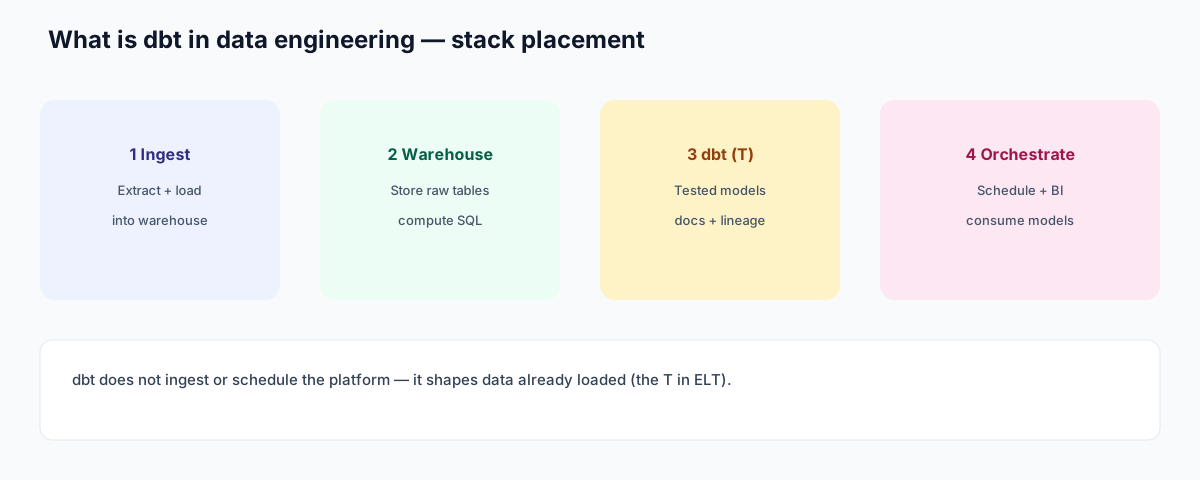
Table of Contents
- TL;DR
- How We Answer This
- Desk case study
- What It Is
- dbt vs ETL
- Why It Caught On
- How It Works
- When It Fits
- Common Pitfalls
- dbt vs the semantic layer
- dbt in the Age of AI
- How It Fits the Modern Stack
- Readiness Scorecard
- Common Misconceptions
- Authority References
- Frequently Asked Questions
- Conclusion
TL;DR
Direct answer: what is dbt in data engineering? dbt (data build tool) is a warehouse-side transformation framework: you write version-controlled, tested SQL models that run inside the warehouse. It is the “T” of ELT — not an ingest tool, and not a full ETL suite.
Who this is for: anyone asking what is dbt in data engineering, including the full form and whether data engineers need it.
What you'll learn: the definition, dbt vs ETL, who should adopt it, and how it differs from a semantic layer.
This guide sits under the data engineering hub.
For the ETL fundamentals, see ETL for data.
Also see data orchestration.
How We Answer This
Governance and risk expectations are framed by NIST SP 800-53 security controls when programs need an external control reference.
We answer what is dbt in data engineering by focusing on the problem it solves, because dbt is easy to describe and easy to misuse. Every point reflects transformation layers we have built. We anchor the concept to the Databricks Genie architecture post and weigh dbt's place against the reference architectures at Wikipedia business intelligence overview, where warehouse-side transformation is central.
The table below frames what is dbt in data engineering in capability terms.
| Capability | What it adds |
|---|---|
| SQL transformation | Models as SELECT statements |
| Version control | Transformations in Git |
| Testing | Assertions on data quality |
| Documentation | Auto-generated lineage and docs |
| Modularity | Reusable, referenced models |
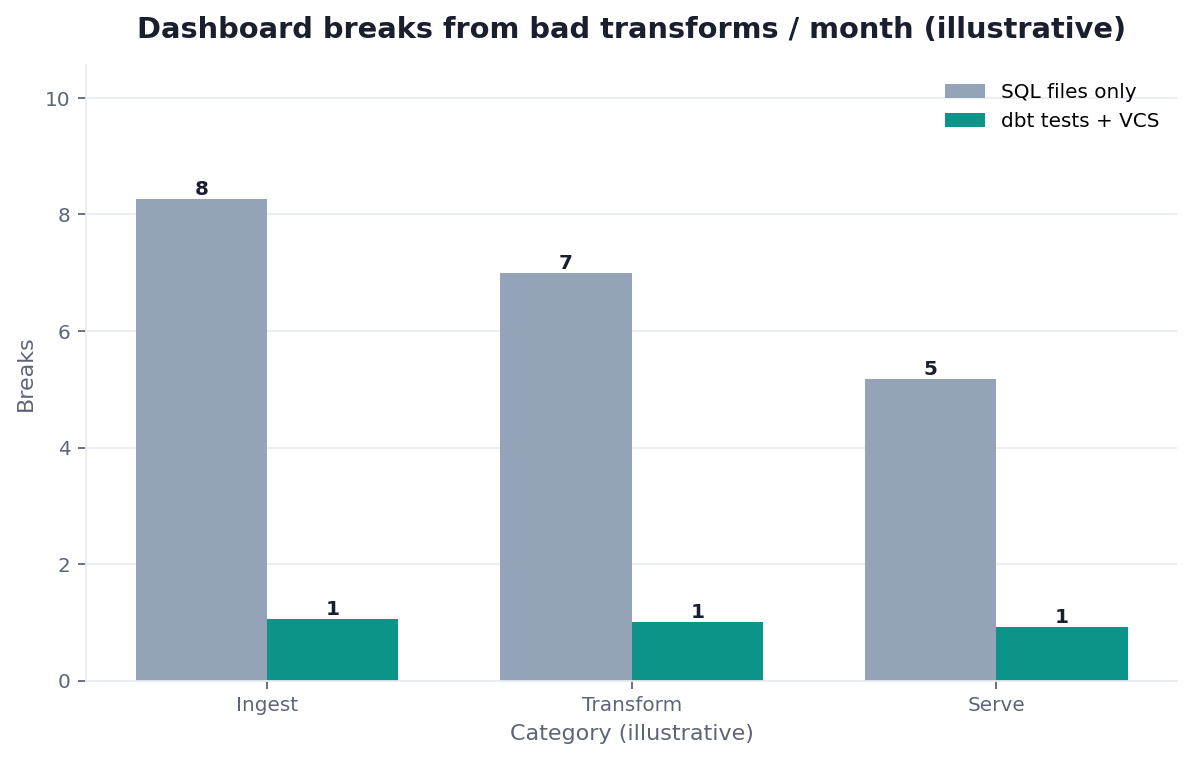
Practical example: a team's answer to what is dbt in data engineering was "just SQL files," until untested transformations kept breaking dashboards. Adding dbt tests and version control — the discipline echoed at OWASP API Security Top 10 — made the transformation layer trustworthy.
Desk case study (composite metrics)
This desk case makes what is dbt in data engineering concrete with scale and break-rate numbers.
An anonymized desk composite answering what is dbt in data engineering looks like on a SaaS analytics transformation layer (not a customer SLA):
| Metric | Before tests + CI | After dbt tests + CI |
|---|---|---|
| Warehouse scope | ~2 TB modeled tables | ~2 TB (same) |
| Team size | 4 data engineers | 4 data engineers |
| Owned models | ~80 ad-hoc SQL scripts | ~80 dbt models |
| Dashboard breaks / month | ~11 | ~2 |
| Time to root-cause a break | often 1–2 days | usually same-day via failing tests |
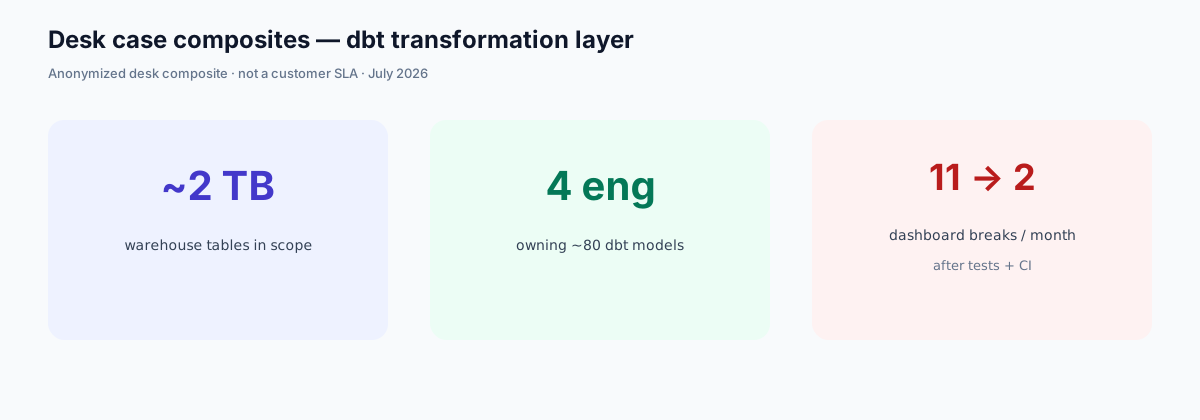
Figure: citeable desk composites for planning conversations — labeled non-SLA.
What It Is
At its core, the answer to what is dbt in data engineering is a transformation framework: dbt lets you define transformations as SQL SELECT statements, then handles running them in the right order, testing them, and documenting them.
Key Definition: dbt (data build tool) is a transformation framework that lets data teams write, version-control, test, and document SQL transformations that run inside a data warehouse, bringing software-engineering practices to the transformation layer of the modern data stack.
Full form: dbt = data build tool.
The key to what is dbt in data engineering is that it does not move data — it transforms data already loaded in the warehouse. dbt sits in the "T" of ELT, turning raw loaded data into clean, modeled, tested tables ready for analysis.
dbt vs ETL
dbt is not a modern rename of ETL. ETL suites extract, transform, then load. dbt assumes the load already happened and only transforms inside the warehouse.
| Job | Classic ETL suite | dbt |
|---|---|---|
| Extract from SaaS / ops DBs | Yes | No — pair an ingest tool |
| Transform before the warehouse | Typical | No — SQL runs in the warehouse |
| Transform after load (ELT) | Sometimes bolted on | Primary job |
| Tests, Git, model DAG | Vendor-dependent | Native |
| Metric contracts (MetricFlow) | Out of scope | Adjacent — see dbt semantic layer |
If you still need to move data, you still need ingest. If you need a single revenue ID for BI and agents, that is MetricFlow, not a dbt model test. Depth on the metrics contract: dbt semantic layer.
Why It Caught On
Implementation details are commonly grounded in Google Cloud architecture framework when teams translate concepts into production practice.
Understanding why dbt spread is central to what is dbt in data engineering. Before dbt, warehouse transformations were often untested, undocumented SQL scripts that broke silently and no one dared change.
dbt caught on because it answered what is dbt in data engineering with software discipline: transformations became version-controlled, testable, modular, and documented. The enterprise-adoption framing at OpenTelemetry documentation shows why this mattered — as transformation moved into the warehouse with ELT, teams needed engineering rigor for SQL, and dbt provided it in an accessible form that analysts could adopt.
How It Works
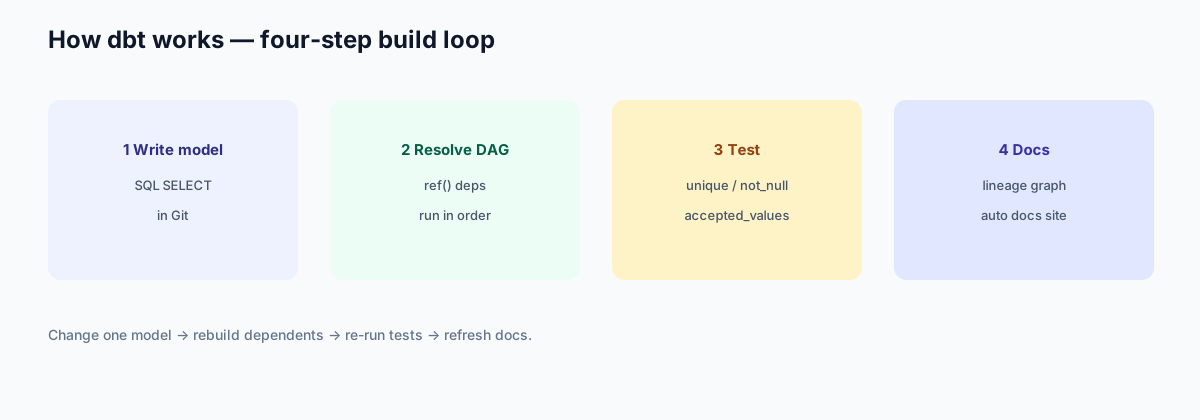
The mechanics behind what is dbt in data engineering are straightforward. You write models as SQL SELECT statements; dbt figures out dependencies between them and runs them in order; you add tests that assert data quality; and dbt generates documentation and lineage automatically.
A minimal model shape looks like this:
-- models/marts/fct_orders.sql
select
  o.order_id,
  o.customer_id,
  o.ordered_at,
  o.order_total
from {{ ref('stg_orders') }} o
where o.order_status = 'completed'
version: 2
models:
  - name: fct_orders
    columns:
      - name: order_id
        tests: [unique, not_null]
      - name: order_total
        tests: [not_null]
The reference guidance at Apache Spark documentation on warehouse transformation shows why this model works: dbt delivers a build system for SQL, much like build tools for software. Change one model and dbt rebuilds what depends on it, runs the tests, and updates the docs, turning ad-hoc SQL into a maintainable, dependable transformation pipeline.
When It Fits
Governance and risk expectations are framed by NIST Cybersecurity Framework when programs need an external control reference.
Knowing when to use it is part of evaluating what is dbt in data engineering. dbt fits when you have a modern warehouse, you are doing ELT, and your transformation layer is complex enough to benefit from testing and modularity.
| Use dbt | Skip dbt (for now) |
|---|---|
| Warehouse + ELT, ≥ a handful of interdependent models | A few SQL scripts nobody else will inherit |
| Dashboards break when an untested column changes | One analyst, one notebook, no shared mart |
| You need Git review and CI on transforms | You still need ingest more than you need a DAG |
This connects what is dbt in data engineering to the broader field of data engineering: dbt is a tool for the transformation layer, not a whole platform. It does not ingest data or orchestrate across systems, so it pairs with ingestion and orchestration tools rather than replacing them. For very simple transformation needs, dbt can be more structure than the problem requires.
Common Pitfalls
The common pitfalls around what is dbt in data engineering are consistent. Treating dbt as a full pipeline tool — expecting it to ingest or orchestrate everything — leads to disappointment. Skipping tests reintroduces the fragility dbt was meant to fix. And over-modeling creates a tangle of models harder to maintain than the SQL it replaced.
A subtler pitfall is adopting dbt for prestige rather than need. Dbt shines when the transformation layer is genuinely complex; for a handful of simple transformations, it adds ceremony without benefit. We favor adopting dbt when the testing and modularity solve a real problem, not because it is the fashionable choice.
dbt vs the semantic layer
dbt models build trusted tables. MetricFlow names how those tables aggregate — monthly_recurring_revenue as a versioned metric ID, not another SELECT. If you are asking what is dbt in data engineering, stop at models and tests. If you are asking whether an LLM can compile the same metric twice, open the dbt semantic layer. Do not treat MetricFlow as a reason to skip model tests.
dbt in the Age of AI
Core definitions remain usefully summarized in Wikipedia natural language processing overview for shared vocabulary across stakeholders.
AI intersects what is dbt in data engineering in two ways. AI tools help write and refactor dbt models, and AI-native platforms raise a question about how much transformation must be pre-built at all.
That second point connects to what we describe in what AI-native data analysis means. Iceberg-native incremental config in the current data engineering news briefing is a Watch item — read the adapter docs; do not rewrite the project for a headline. In the InfiniSynapse web app (product trial — optional, separate from this explainer), try the online workspace where zero-config federation and business definitions bound to sources let an agent reason over data with less pre-modeling. The answer is evolving: dbt remains valuable for shared, tested models, while some ad-hoc transformation shifts to query time.
How It Fits the Modern Stack
To place dbt correctly, it helps to see the whole modern data stack and where each piece sits, because the most common confusion about what is dbt in data engineering comes from expecting it to do jobs that belong to other tools. At the front of the stack sit ingestion tools that extract data from sources and load it into the warehouse. In the middle sits the warehouse itself, the powerful engine where data is stored and transformed. Dbt operates inside that middle layer, orchestrating the SQL that turns raw loaded tables into clean, modeled ones, but it does not extract data and it does not schedule the broader platform.
That division of labor is the key insight. Ingestion tools answer "how does data get here," dbt answers "how do we shape it once it arrives," and orchestration tools answer "when and in what order does everything run." Understanding what is dbt in data engineering means understanding that it is one specialized instrument in an ensemble, not a one-tool band. Teams that grasp this pair dbt with an ingestion tool and an orchestrator and get a clean, maintainable stack; teams that miss it try to make dbt do everything and end up frustrated by the gaps.
The reason this layered arrangement won out is that each layer can then use the best tool for its job and evolve independently. You can swap an ingestion tool without touching your transformation logic, or change orchestrators without rewriting your models, because the layers communicate through the warehouse rather than through tight coupling. This modularity is a large part of why the modern stack displaced the monolithic ETL suites of the past, and it is why dbt's narrow focus is a strength rather than a limitation — it does one layer well and stays out of the others.
For a team deciding what is dbt in data engineering means for their build, the practical takeaway is to design the stack layer by layer rather than searching for a single product that promises everything. Decide how data will be ingested, choose the warehouse, adopt dbt for transformation if the transformation layer is complex enough to warrant it, and add orchestration to tie the schedule together. This deliberate, layered approach produces a platform that is easier to reason about, easier to change, and easier to hand to a new engineer than any all-in-one tool, and it lets each part — including the transformation layer where dbt lives — be as good as it can be.
Readiness Scorecard
Implementation details are commonly grounded in Snowflake Cortex Analyst when teams translate concepts into production practice.
Assess your fit once you understand what is dbt in data engineering (1 point each):
| Check | Pass? |
|---|---|
| You use a modern warehouse and ELT | |
| Your transformation layer is genuinely complex | |
| Models are tested | |
| Models are version-controlled | |
| Documentation and lineage are used | |
| Models are modular, not over-modeled | |
| dbt pairs with ingestion/orchestration tools | |
| You adopted it for need, not prestige |
6–8: what is dbt in data engineering fits your stack. 3–5: tighten testing and scope. Below 3: reconsider whether you need it.
Common Misconceptions
Misconception 1: dbt moves data. What is dbt in data engineering is transformation, not ingestion.
Misconception 2: dbt is a full pipeline platform. It handles the transformation layer only.
Misconception 3: dbt means you can skip tests. Its value depends on writing them.
Misconception 4: Everyone should use dbt. It fits complex transformation, not trivial needs.
Authority References
- NIST SP 800-53 Rev. 5 — security control framing for transformation platforms.
- NIST Cybersecurity Framework — governance expectations for production data programs.
- OWASP API Security Top 10 — discipline parallel for tested, reviewable interfaces.
- Google Cloud Architecture Framework — production architecture practice.
- OpenTelemetry documentation — enterprise adoption framing for observability of pipelines.
- Apache Spark documentation — warehouse-side transformation reference.
- Databricks Genie architecture post — AI agents alongside modeled data.
- Wikipedia — Business intelligence — warehouse-side transformation context.
- [Policy / About] Editorial standards · About InfiniSynapse.
Frequently Asked Questions
What is dbt in data engineering?
dbt (data build tool) is a transformation framework that lets data teams write, version-control, test, and document SQL transformations that run inside a data warehouse. It brings software-engineering practices to the transformation layer of the modern data stack. Crucially, it does not move data — it transforms data already loaded in the warehouse, sitting in the "T" of ELT and turning raw tables into clean, modeled, tested ones.
What does dbt stand for?
dbt stands for data build tool. That is the full form used in data engineering job posts and warehouse docs: a build system for SQL models, not a database and not an ingest product.
Is dbt the same as ETL?
No. ETL suites extract and often transform before load. dbt assumes the load already happened and only transforms inside the warehouse. See dbt vs ETL.
Do you need to know dbt to be a data engineer?
Not universally, but it has become common enough that familiarity helps. What matters more is understanding the principles dbt embodies — version-controlled, tested, modular transformation — because those principles transfer to any transformation tool. An engineer who grasps why testing and modularity matter can pick up dbt quickly, whereas one who has memorized dbt commands without understanding the reasoning will struggle when the tool or the team's stack changes. Learn the principles first, and the tool follows easily.
Why did dbt become popular?
Before dbt, warehouse transformations were often untested, undocumented SQL scripts that broke silently and nobody dared change. Dbt made transformations version-controlled, testable, modular, and documented. As transformation moved into the warehouse with ELT, teams needed engineering rigor for SQL, and dbt provided it in an accessible form that analysts, not just engineers, could adopt.
How does dbt work?
You define models as SQL SELECT statements; dbt works out the dependencies among them and executes them in the right sequence; you attach tests that assert data quality; and dbt produces documentation and lineage on its own. It is a build system for SQL: change one model and dbt rebuilds what depends on it, runs the tests, and updates the docs.
When should you use dbt?
Use it when you have a modern warehouse, you are doing ELT, and your transformation layer is complex enough to benefit from testing and modularity. dbt is a tool for the transformation layer, not a whole platform — it does not ingest or orchestrate across systems, so it pairs with those tools rather than replacing them. When the transformation work is trivial, dbt tends to add more ceremony than the problem warrants.
How is dbt different from a semantic layer?
dbt models build tables. MetricFlow names how those tables aggregate. If an LLM needs the same revenue ID twice, that is the dbt semantic layer, not another model test.
How does AI change dbt's role?
Automated tools now help author and refactor dbt models, while AI-native platforms prompt a harder question about how much transformation truly needs to be pre-built. Dbt remains valuable for shared, tested models, while some ad-hoc transformation shifts to query time, because federation and business definitions bound to sources let an agent reason over data with less pre-modeling. Its role is evolving rather than disappearing.
A useful checkpoint for what is dbt in data engineering is whether owners, metrics, and escalation paths are written down — not just discussed. When stakeholders ask for a short takeaway, start from the decision the models must support and work backward.
Conclusion
What is dbt in data engineering? A framework that brings testing, version control, and modularity to warehouse SQL transformation — the discipline the transformation layer badly needed. In 2026, use it when your transformation is genuinely complex, write the tests, keep models modular, and expect AI-native federation to shift some ad-hoc transformation to query time.
To see how federated analysis reduces pre-built transformation, read what AI-native data analysis means. Product trial (optional): InfiniSynapse web app free on registration.