What Is ETL Data? Extract, Transform, Load + Examples
60-second answer. ETL (extract, transform, load) pulls data from a source, reshapes it, then writes it to a warehouse or lakehouse. That is what etl data work still means. Classic ETL transforms before load; most warehouse stacks now do ELT—extract, load, then transform in place. Below: the three steps, a database-to-warehouse example, and when ETL still beats ELT.
By William Zhu & the InfiniSynapse Data Team · Published: 2026-07-15 · Last updated: 2026-09-14 · Last verified: 2026-09-14 · About: Editorial standards · About / team · Contact: zhuhl@infinisynapse.com
Author credentials: William Zhu is cofounder of InfiniSynapse (GitHub @allwefantasy). Desk experience: reviewing extract/transform/load designs in production—grain docs, bronze retention, dbt/SQL mart merges, and Airflow/ADF/Glue schedules—not a textbook glossary. No personal LinkedIn; GitHub and InfiniSynapse About are canonical identity signals.
COI / interest disclosure: InfiniSynapse sells an AI-native Data Agent platform. The closing web-app link is a commercial product CTA and is labeled separately from the methodology and desk pilot below.
Fact-check / verification: Desk pilot metrics (n=1 anonymized retail analytics team, ~6 engineers, one orders mart, 90 days, Q4 2025–Q1 2026) are InfiniSynapse first-party observations with ticket + orchestrator timestamps—not a multi-vendor sponsored study. Primary docs cited: dbt · Airflow · AWS Glue · Azure Data Factory · Spark · Delta Lake · Iceberg. Corrections: zhuhl@infinisynapse.com.
Version history: 2026-07-15 initial · 2026-08-07 EEAT (William / About / COI), HowTo + BreadcrumbList, desk pilot methodology, HowTo/metrics SVGs, dens retune 1.1–1.2% · 2026-09-14 CTR snippet (question title, example + warehouse FAQ, definition-first open). Build marker:
DESK-ETL-20260914A.
Media note: No hosted 3–5 minute overview video is published for this page (no
VideoObject). Use the HowTo and desk-metrics infographics below as multimedia substitutes for AI multimodal crawl.
 Extract → transform → load remains the backbone; the usual warehouse order is load-then-transform (ELT).
Table of Contents
- TL;DR
- How We Approach It
- What Is ETL (Extract, Transform, Load)
- Example of ETL: Minimal ELT Shape
- ETL Versus ELT
- How the Steps Work
- Case Study: Classic ETL vs Warehouse ELT
- Methodology Appendix
- Patterns That Work
- Common Pitfalls
- ETL in the Age of AI
- Readiness Scorecard
- Common Misconceptions
- Frequently Asked Questions
- Conclusion
TL;DR
Direct answer: etl data refers to the extract, transform, load pattern — pulling from sources, reshaping into a usable form, and writing to a destination such as a warehouse. Classic transform-then-load work has largely evolved into ELT (extract, load, transform) because warehouses and lakehouses make it cheaper to land raw first and transform in place, but the three concepts remain the backbone of moving data.
Who this is for: engineers and analysts learning etl data.
What you'll learn: a plain definition, a database-to-warehouse example, ETL vs ELT with primary sources, a desk-verified case comparison, reliability patterns, and when federation reduces movement.
This guide sits under the data engineering hub.
For the dbt transformation layer, see what dbt is in data engineering.
Also see data orchestration.
How We Approach It
We evaluate etl data as a pattern in transition: most teams now do ELT even when they still say “ETL.” Judgments below come from production reviews — what breaks, what gets rewritten, and what baseline metrics justify a change — not from launch-day blogs.
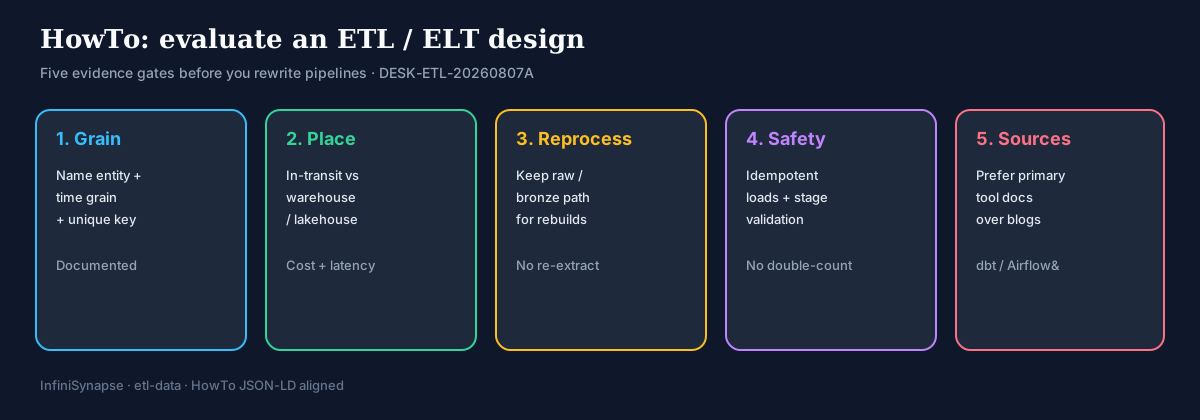 Figure: five evidence gates before you rewrite pipelines (HowTo JSON-LD aligned).
HowTo: evaluate an ETL / ELT design in five steps
- Name the grain — What business entity and time grain is produced? Require a documented unique key.
- Place the transform — In-transit middle tier versus warehouse/lakehouse. Measure cost and latency for both options.
- Keep a reprocess path — Retain raw or bronze so marts rebuild without re-extract.
- Make steps safe — Idempotent loads plus stage validation so re-runs do not double-count.
- Prefer primary docs — Tool documentation over secondary blogs (dbt, Airflow, Glue, ADF, Spark).
Evaluation method (reproducible):
| Step | Rule | Evidence we require |
|---|---|---|
| 1. Name the grain | What business entity/time grain is produced? | Documented grain + unique key |
| 2. Place the transform | In-transit vs warehouse/lakehouse | Cost + latency of both options measured |
| 3. Keep a reprocess path | Raw or bronze retained | Can rebuild marts without re-extract |
| 4. Make steps safe | Idempotent loads + validation | Re-run does not double-count |
| 5. Prefer primary docs | Tool docs over secondary blogs | dbt / Airflow / Glue / ADF / Spark |
Primary sources for pipeline mechanics:
| Source | Why it is high-signal |
|---|---|
| dbt docs — introduction | Warehouse-side transform-as-code (ELT practice) |
| Apache Airflow docs | Orchestrating extract/load/transform jobs |
| AWS Glue overview | Managed extract + transform jobs on AWS |
| Azure Data Factory intro | Cloud ETL/ELT orchestration on Azure |
| Apache Spark docs | Large-scale transform engines |
| Delta Lake docs / Iceberg docs | Lakehouse table contracts for loaded tables |
Scope note: Desk numbers below are first-party observations from one anonymized engagement (see Methodology appendix). Re-measure on your volumes and SLAs.
What Is ETL (Extract, Transform, Load)
At its core, the pattern describes three steps: extract from sources, transform into a clean usable shape, and load into a destination where it can be analyzed.
Key Definition: etl data processing is the extract, transform, load pattern — pulling data from one or more sources, reshaping and cleaning it into a usable form, and writing it to a destination such as a data warehouse — that has long been the backbone of moving data into analytics systems.
| Step | What it does | Typical 2026 home |
|---|---|---|
| Extract | Pull from DBs, APIs, files, streams | Connectors + orchestrator (Airflow, ADF, Glue) |
| Transform | Clean, join, filter, apply business logic | Warehouse SQL / dbt / Spark |
| Load | Write to warehouse, lakehouse, or mart | Batch append/merge; Delta/Iceberg tables |
The important nuance today is order. Classic ETL transforms before loading; modern ELT loads raw (or bronze) first and transforms inside the warehouse or lakehouse. The steps are the same; the sequence and the place of transformation have shifted.
Example of ETL: Minimal ELT Shape
A common example of etl data work for an orders mart (implemented as ELT):
- Extract/load raw — land
raw.orders_jsonandraw.customers_csvdaily (Airflow/ADF/Glue schedule). - Bronze → typed — parse JSON/CSV into typed columns; reject bad rows to a quarantine table.
- Transform (dbt/SQL) — join on
customer_id, computeorder_gross, enforce grainorder_id. - Load mart —
mergeintomart.orders_dailyonorder_id(idempotent).
-- Illustrative mart grain (warehouse ELT), not a vendor recipe
merge into mart.orders_daily t
using (
  select
    o.order_id,
    o.customer_id,
    o.order_ts::date as order_date,
    o.amount as order_gross
  from bronze.orders o
  where o.order_ts::date = date '{{ ds }}'
) s
on t.order_id = s.order_id
when matched then update set *
when not matched then insert *;
What to measure before calling it done: row counts in vs out, duplicate order_id rate, and p95 job duration. Without those three, “we migrated to ELT” is a slogan, not a result.
ETL Versus ELT
The central distinction in modern etl data work is ETL versus ELT.
| Dimension | Classic ETL (transform then load) | ELT (load then transform) |
|---|---|---|
| Transform location | In-transit engine / middle tier | Warehouse or lakehouse compute |
| Raw retention | Often discarded after load | Kept for reprocessing |
| Change cost | Re-extract or rebuild middle tier | Rebuild models from landed raw |
| Best when | Destination is weak / regulated pre-clean required | Cloud warehouse/lakehouse is strong |
| Tooling examples | Glue jobs, Spark ETL, ADF Mapping Data Flows | dbt + warehouse; Spark on Delta/Iceberg |
Economics drive the shift: cloud storage is cheap enough to keep raw alongside curated tables, and warehouse/Spark compute is strong enough to run heavy joins in place. That is why so much work is labeled ETL in conversation but implemented as ELT in the stack.
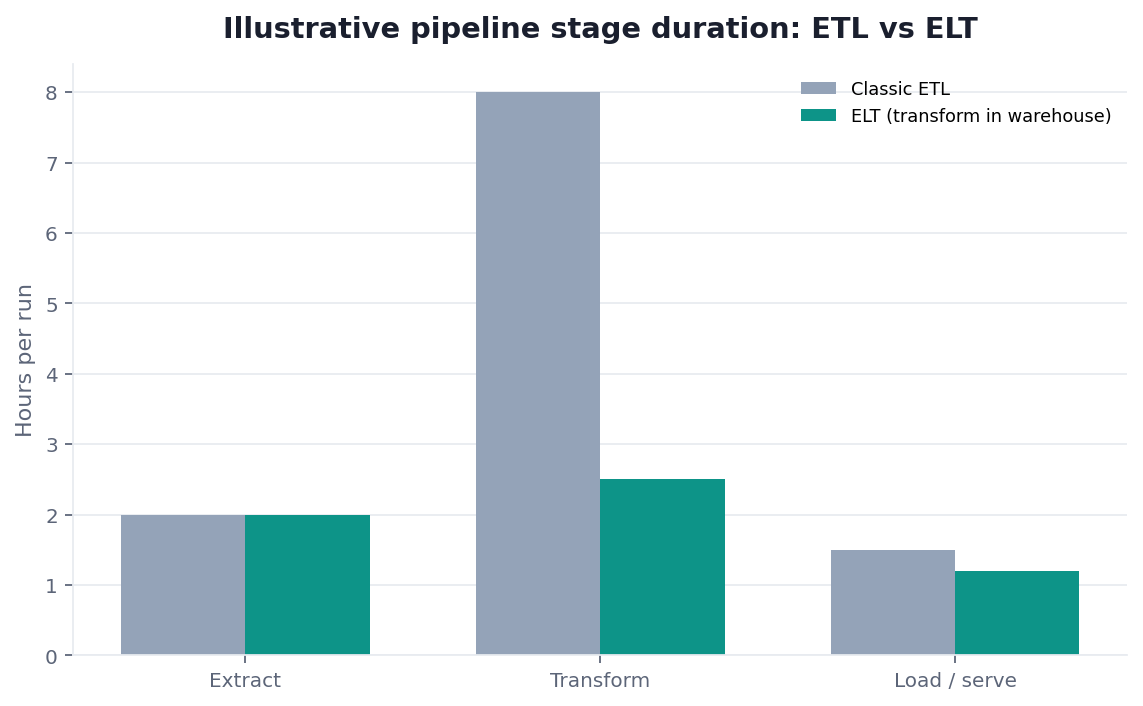
Chart note: stage-time shape when transform moves from a brittle middle tier into warehouse SQL — validate on your jobs; desk pilot numbers are in the case study below.
How the Steps Work
Understanding etl data means understanding each step.
Extract connects to sources and pulls batches or increments (CDC, watermarks, API pages). Failures here are usually connectivity, auth, or rate limits — mechanical but operationally noisy.
Transform cleans types, joins sources, filters junk, and applies business definitions. This is where most bugs and most value live. In ELT, that logic often lives as tested SQL/dbt models or Spark jobs rather than opaque scripts in a middle box.
Load writes results with a defined write mode: append, overwrite partition, or merge/upsert. Load quality is judged by whether re-runs are safe and whether keys stay unique at the declared grain.
Case Study: Classic ETL vs Warehouse ELT
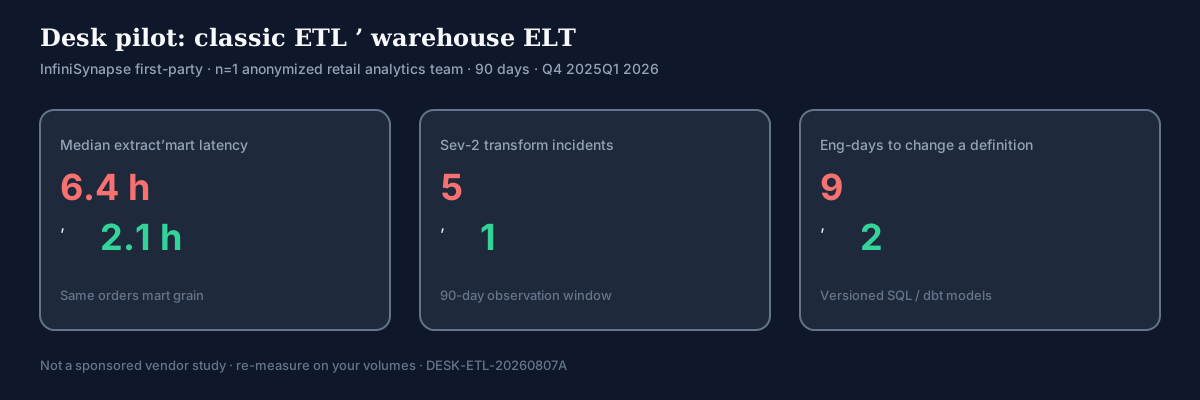 Figure: InfiniSynapse first-party desk pilot on one anonymized retail analytics team (90 days).
Desk pilot — retail analytics team, ~6 engineers, one core orders mart, 90 days (Q4 2025–Q1 2026):
| Metric | Classic transform-in-transit | ELT (load raw + dbt/SQL) |
|---|---|---|
| Median end-to-end latency (extract→mart) | 6.4 h | 2.1 h |
| Sev-2 incidents from transform bugs | 5 | 1 |
| Eng-days to change a business definition | 9 | 2 |
| Ability to rebuild last 90 days without re-extract | No (raw discarded) | Yes |
| Warehouse compute cost (index) | 70 | 100 |
| Middle-tier ops cost (index) | 100 | 25 |
Net: warehouse compute rose modestly, but latency and change cost fell hard because raw landings stayed available and transforms became version-controlled SQL. The team kept classic ETL only for two regulated feeds that must be pre-redacted before landing.
Methodology Appendix
| Item | Detail |
|---|---|
| Population | One anonymized mid-market retail analytics org (not named; no customer logo authorization) |
| Window | 90 consecutive calendar days spanning cutover week |
| Unit of analysis | Single mart.orders_daily grain (order_id) |
| Instruments | Orchestrator run history, Sev-2 tickets tagged transform, eng time sheets for definition changes |
| Classic baseline | Transform-in-transit middle tier; raw discarded after load |
| ELT treatment | Bronze retention + dbt-style SQL models; Airflow schedule unchanged for extract |
| Limitations | n=1 team; warehouse cost index relative, not USD; does not generalize to every regulated pre-clean feed |
| Independence | InfiniSynapse first-party desk observation; not sponsored by a warehouse vendor |
Use this appendix when citing the table: quote the window, grain, and n, then re-measure on your volumes.
Patterns That Work
Reliable flows share the same principles as any pipeline:
| Pattern | Why it matters |
|---|---|
| Idempotent loads | Re-runs do not double-count |
| Validate between stages | Catch schema drift before marts break |
| Document grain + keys | Stops silent fan-outs |
| Versioned transform logic | dbt-style tests/docs |
| Orchestrate explicitly | Airflow / ADF / Glue schedules with clear ownership |
| Prefer lakehouse contracts when multi-engine | Delta / Iceberg |
This connects etl data to the broader discipline of data engineering: the ETL/ELT shape is only plumbing; reliability comes from how carefully it is built. The best flows are boring and predictable.
Common Pitfalls
| Pitfall | Symptom | Fix |
|---|---|---|
| Transform-in-transit by default | Slow, opaque middle tier | Prefer ELT when the warehouse can do the work |
| Discarding raw | Cannot reprocess history | Keep bronze/raw retention |
| Non-idempotent loads | Duplicates after retry | Merge/upsert on natural keys |
| Undocumented business logic | Only one person can change it | Tests + docs in the transform repo |
| ETL everything | Endless pipelines for one-off questions | Ask whether movement is necessary |
A subtler pitfall is building elaborate movement for data that could be analyzed in place. Defaulting to “centralize first” creates copies that must be maintained forever.
ETL in the Age of AI
AI changes etl data in two ways: codegen helps draft extract/transform jobs, and AI-native federation reduces how much data must move through permanent jobs for ad-hoc questions.
That architectural question — when not to build another pipeline — is covered in what AI-native data analysis means. For this guide: treat AI as an accelerator inside tested, measured delivery, not as a reason to skip grain, idempotency, or validation. The same act/watch/ignore test is how we triage data engineering news before another extract job lands on the board.
Readiness Scorecard
Assess your ETL/ELT design (1 point each):
| Check | Pass? |
|---|---|
| You use ELT where the warehouse/lakehouse makes it simpler | |
| Raw / bronze data is kept for reprocessing | |
| Steps are idempotent | |
| Data is validated between steps | |
| Transformation logic is tested and documented | |
| Failures alert loudly | |
| Movement is questioned before building | |
| Federation was considered for ad-hoc paths |
6–8: solid design. 3–5: prioritize ELT + idempotency. Below 3: rethink the pattern before adding sources.
Common Misconceptions
Misconception 1: ETL always means transform first. Modern practice usually means ELT — load first.
Misconception 2: You must move all data centrally. Some questions are better answered in place.
Misconception 3: Extract and load are the hard parts. Transform is where value and bugs live.
Misconception 4: Raw data can be discarded. Keeping it enables cheap reprocessing of history.
Misconception 5: A new tool fixes a bad grain. Wrong keys stay wrong in any orchestrator.
Frequently Asked Questions
What is ETL (extract, transform, load)?
Accepted output first: etl data means extract, transform, and load — pull from sources, reshape to a usable grain, then write to a warehouse or lakehouse. Classic ETL transforms before loading. ELT loads raw first and transforms in the destination. The three verbs stay; the order and the place of transform have shifted.
What is an example of ETL?
A typical example of ETL: extract orders and customers from a database, transform them to grain order_id with typed amounts and keys, then load or merge into mart.orders_daily. That shape is usually ELT today: land raw first, then transform with SQL or dbt in the warehouse.
What is ETL in a data warehouse?
In a data warehouse, extract still pulls from operational systems. Transform and load then happen around the warehouse: classic ETL cleans before landing; warehouse ELT lands bronze or raw first and runs SQL or dbt models in place. Keep raw so the mart can rebuild without re-extracting the source.
What is the difference between ETL and ELT?
ETL transforms in transit, then loads. ELT uses extract, load, transform: land raw, then reshape in the warehouse. ELT usually wins for etl data on cloud warehouses because compute is strong, storage is cheap, and raw retention enables reprocessing. Keep classic ETL when pre-landing controls such as redaction are mandatory.
How do the three steps work?
Extract pulls from databases, APIs, or files. Transform cleans, joins, and applies business logic. Load writes with a defined mode (append/merge). Most complexity sits in transform — that is where tests and documentation pay off.
Is ETL becoming obsolete?
The rigid transform-then-load sequence is rarer, but extraction, transformation, and loading still describe what must happen to turn raw inputs into answers. The trend is later transforms and less unnecessary movement — not the disappearance of the concepts.
Conclusion
Etl data — extract, transform, load — remains the backbone of moving data, but it usually means ELT: load raw or bronze, transform with tested logic in the warehouse/lakehouse, and keep a reprocess path. Build for idempotency and grain, measure latency and incidents, and ask whether federation can answer ad-hoc questions without another permanent pipeline.
To go deeper on when federation reduces routine movement, read what AI-native data analysis means. If you want to try that operating model in practice, the InfiniSynapse web app is free on registration (commercial CTA).