What Is a Data Pipeline? Definition, Types, and How It Works
60-second answer. A data pipeline is an automated sequence that ingests data from one or more sources, transforms and validates it, and loads it to a destination—warehouse, dashboard, or model—so it arrives usable without a nightly export. It is repeatable automation, not a one-time copy. Brittle pipelines are the most common reason a CEO dashboard goes stale overnight.
Types at a glance: batch vs streaming (when data moves); ETL vs ELT (where transform runs). Most data pipeline for analytics work is batch + ELT.
By the InfiniSynapse Data Team · Named accountability: cofounder William Zhu (GitHub @allwefantasy) · Last updated: 2026-09-14 · Next review: 2026-12-01 · We build an AI-native Data Agent platform and design pipelines constantly; this explainer answers the definition in practical terms for 2026, not a vendor diagram. About / credentials: editorial standards. Company overview: About InfiniSynapse.
Conflict of interest: InfiniSynapse publishes this guide and sells federation that can reduce brittle ETL hops. Strengths and limits below are stated honestly; desk tallies are labeled composites, not customer SLAs. Corrections: corrections policy.
Table of Contents
- TL;DR
- How We Answer This
- What It Means
- How It Works
- The Main Types
- How to Build One Well
- Stream Processing and Data Quality
- Common Pitfalls
- Ownership Is Part of the Answer
- Pipelines in the Age of AI
- Readiness Scorecard
- Common Misconceptions
- Frequently Asked Questions
- Who wrote this
- References
- Conclusion
TL;DR
Direct answer: what is a data pipeline? It is an automated series of steps that moves data from one or more sources, transforms it along the way, and delivers it to a destination where it can be used. Pipelines are the plumbing behind every dashboard, model, and AI answer; brittle ones are the most common cause of broken analytics.
Who this is for: analysts, engineers, and leaders asking what is a data pipeline before they buy a tool or draw an architecture.
What you'll learn: a one-sentence definition, how pipelines work, batch vs stream, ETL vs ELT, the pitfalls to avoid, and how AI is changing how many you need.
This guide sits under the data engineering hub.
For the architecture view, see data pipeline architecture.
Also see data pipelines.
How We Answer This
Governance and risk expectations are framed by NIST AI Risk Management Framework when programs need an external control reference.
We answer what is a data pipeline from building and maintaining them rather than a glossary. Every explanation reflects what we see when pipelines run reliably or break. We anchor the definition to the FTC consumer protection guidance and weigh design against the reference architectures at Google SRE book, which show how ingestion, transformation, and serving fit together.
The table below maps the stages behind what is a data pipeline.
| Stage | What it does |
|---|---|
| Ingestion | Pulls data from sources |
| Transformation | Cleans and reshapes data |
| Validation | Checks quality |
| Loading | Writes to a destination |
| Orchestration | Schedules and monitors the flow |
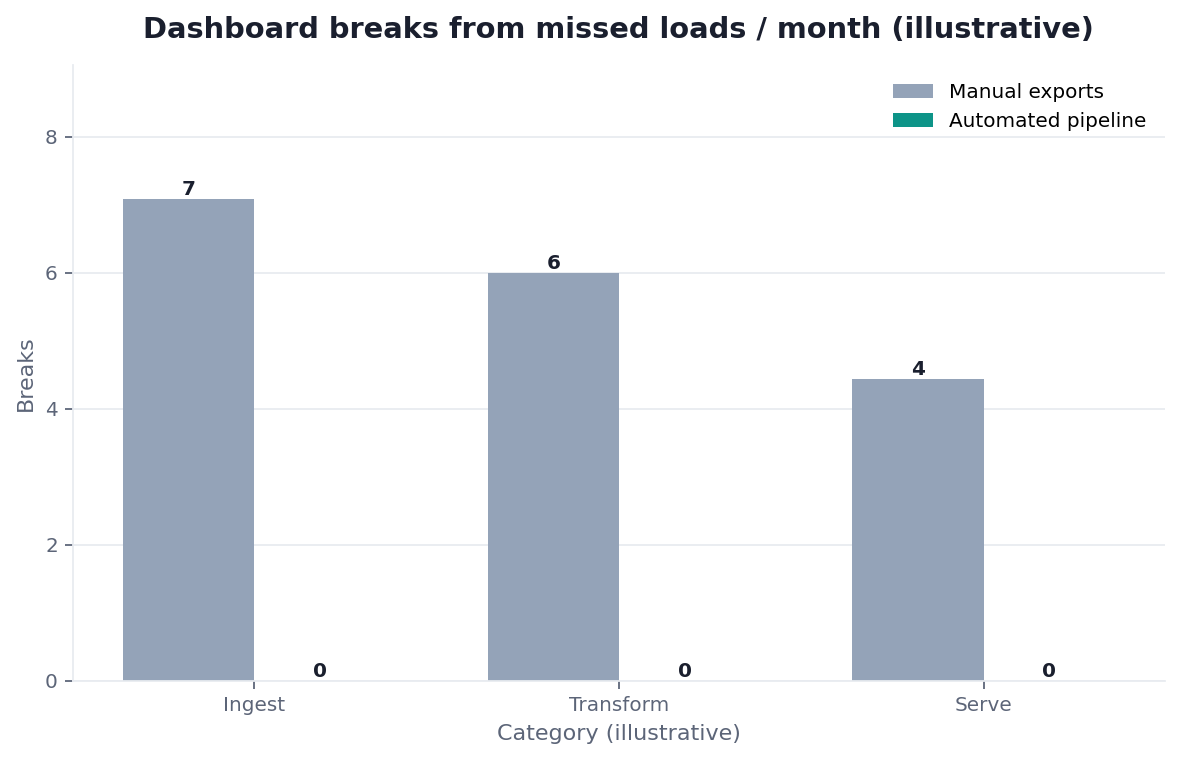
Practical example: a team asking what is a data pipeline for the first time was manually exporting spreadsheets nightly; one missed export broke the CEO dashboard. Automating the flow — using orchestration patterns like those at Databricks documentation — ended the manual breakage. Automation, not more people, made the data reliable.
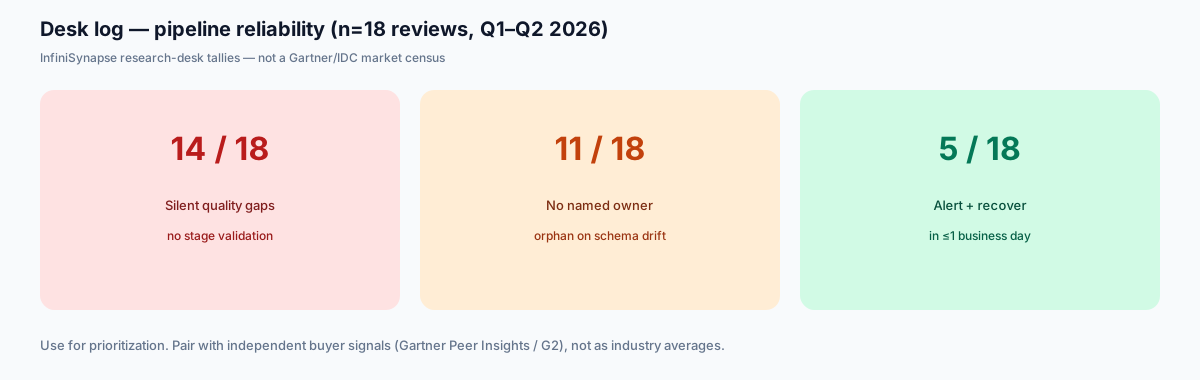
Desk log: reliability tallies (Q1–Q2 2026)
Label: InfiniSynapse research-desk review of 18 mid-market / enterprise pipeline packets (runbooks, incident notes, and stakeholder retros). Internal desk tally—not a commissioned Gartner/IDC census.
| Finding (desk) | Share of 18 | Implication |
|---|---|---|
| No stage-level validation before load | 14 / 18 (78%) | Silent quality gaps reach dashboards |
| No named pipeline owner | 11 / 18 (61%) | Schema drift goes unfixed |
| Alert + recover path proven in ≤1 business day | 5 / 18 (28%) | Observability still scarce |
Independent buyer signals (third-party, not our tallies): Gartner Peer Insights — Analytics & BI and G2 Data Integration for category themes; use themes, not star averages alone.
Scope note: This guide reflects patterns we see when teams run what is a data pipeline in production. It is not legal counsel, a vendor runbook, or a census — and a smaller toolset is fine when it serves.
What It Means
The clearest answer to what is a data pipeline is that it is the automated path data travels from where it is created to where it is used, with cleaning and reshaping along the way.
Key Definition: a data pipeline is an automated sequence of steps that ingests data from one or more sources, transforms and validates it, and loads it into a destination — such as a warehouse, dashboard, or model — so the data arrives in a usable, trustworthy form without manual effort.
Understanding what is a data pipeline means seeing it as automation, not a one-time move. Anyone can copy a file once; a pipeline does it reliably, repeatedly, and on schedule, handling failures and changes. That reliability is the entire point, because the data behind a daily decision must arrive correctly every day, not just the first time.
How It Works
Core definitions remain usefully summarized in Wikipedia SQL overview for shared vocabulary across stakeholders.
A practical answer to what is a data pipeline follows the data through its stages: it is ingested from sources, transformed and validated, then loaded to a destination, with an orchestrator scheduling and monitoring the whole flow.
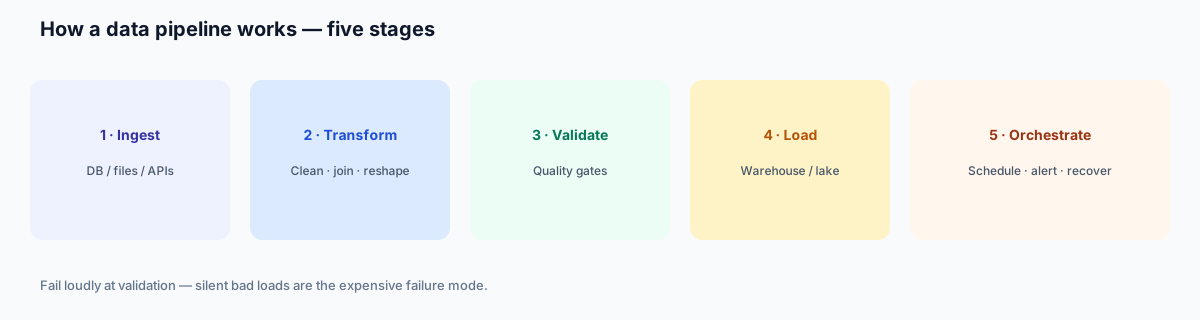
Ingestion and transformation
Ingestion pulls data from databases, files, and APIs; transformation cleans, joins, and reshapes it into a usable form. These two stages hold most of the work of what is a data pipeline in practice, and enterprise adoption patterns from NIST SP 800-53 security controls show why reliable transformation is the hardest and most valuable part.
Loading and orchestration
Loading writes the result to its destination, and orchestration schedules the steps, handles failures, and alerts when something breaks — the difference between a script and a real answer to what is a data pipeline. The reliability framing in EU AI Act overview shows why orchestration is what separates a robust pipeline from a fragile script, because a pipeline that cannot recover from a failure is a pipeline that will eventually break your dashboard silently.
The Main Types
Teams asking what is a data pipeline get more than one answer, because pipelines come in distinct types suited to different needs.
| Split | Options | Best for analytics dashboards |
|---|---|---|
| Timing | Batch vs streaming | Batch (nightly / hourly) |
| Transform order | ETL vs ELT | ELT in a cloud warehouse |
Batch and streaming
Batch pipelines process data in scheduled chunks — nightly, hourly — while stream processing (streaming pipelines) processes events continuously as they arrive. Batch suits most analytics; streaming suits fraud detection, ops alerts, and product telemetry where minutes matter.
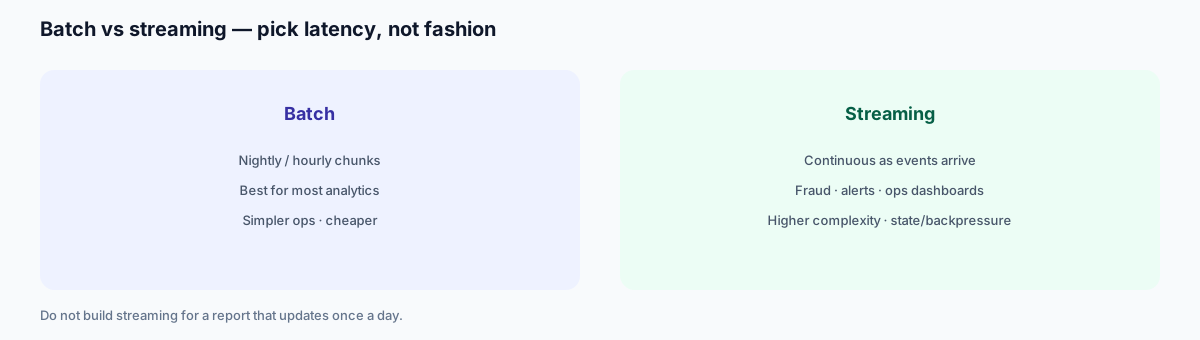
Stream processing in practice: you pay for stateful windows, late data, and backpressure. A Kafka/Flink-style path is justified when the decision window is seconds-to-minutes; it is waste for a dashboard that refreshes overnight. Knowing which your use case requires is central to answering what is a data pipeline for your situation.
ETL and ELT
ETL transforms data before loading it; ELT loads raw data first and transforms it in the destination. Modern cloud warehouses have made ELT common, but both remain valid patterns, and the choice shapes how a pipeline is built — which is why what is a data pipeline is incomplete without saying where the transform runs.
How to Build One Well
Implementation details are commonly grounded in Python documentation when teams translate concepts into production practice.
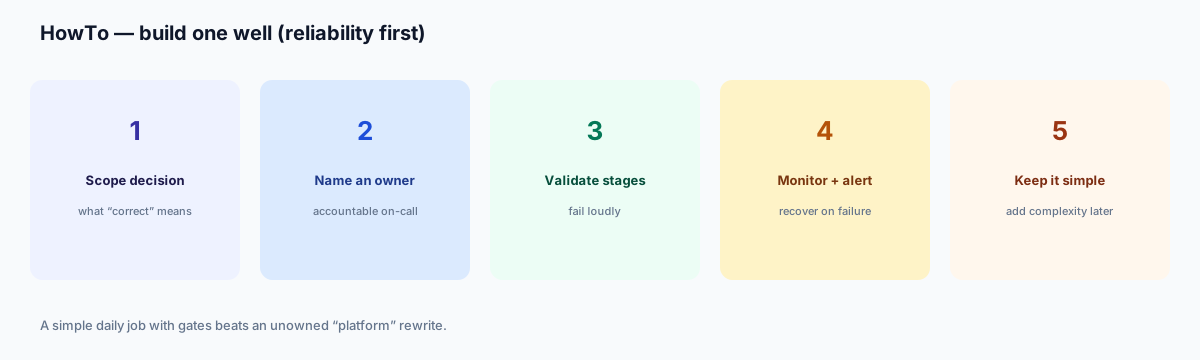
A reliable answer to what is a data pipeline starts with reliability, not features. The pipeline should fail loudly and recover gracefully, rather than breaking silently and corrupting the data downstream.
This connects what is a data pipeline to the broader discipline of data engineering, which is largely about building pipelines that stay reliable as sources and requirements change.
Step 1 — Scope the decision. Write which report or model the pipeline feeds and what “correct” output looks like.
Step 2 — Name an owner. One accountable person (or rota) for schema changes and incidents.
Step 3 — Validate at each stage. Null keys, row-count floors, and freshness checks before load.
Step 4 — Monitor and recover. Alerts on failure; documented replay/backfill path.
Step 5 — Keep it simple. Prefer batch until latency requirements force streaming; add complexity only when justified.
Minimal validation sketch (adapt to your warehouse dialect):
from dataclasses import dataclass

@dataclass
class StageCheck:
    name: str
    null_key_rows: int
    row_count: int
    min_rows: int

def assert_stage_ok(check: StageCheck) -> None:
    if check.null_key_rows > 0:
        raise ValueError(f"{check.name}: null keys={check.null_key_rows}")
    if check.row_count < check.min_rows:
        raise ValueError(f"{check.name}: rows={check.row_count} < {check.min_rows}")
    # Fail loudly — never load when quality gates trip
A simple pipeline that runs reliably every day beats a sophisticated one that breaks unpredictably. That reliability test is how we judge whether a team actually knows what is a data pipeline, versus a script someone remembers to run.
Stream Processing and Data Quality
Stream processing is still part of what is a data pipeline—same ownership and quality bar—with continuous ingestion. Watermarks, late events, and exactly-once (or effectively-once) semantics replace “did last night’s job finish?” as the reliability questions. If you cannot answer them, stay on batch.
Data quality is not a separate product bolted on at the end. Completeness (required fields present), accuracy (matches a trusted reference), and freshness (arrives within the SLA) should gate loads the same way unit tests gate deploys. In our desk sample, 78% of packets lacked stage-level validation—exactly the failure mode that makes stakeholders ask what is a data pipeline after a wrong board number.
Map quality checks to orchestration: block the load step on failed gates, page the named owner, and keep a sample of rejected rows for debugging. That pattern aligns with control expectations in NIST SP 800-53 when pipelines touch regulated or customer data.
Common Pitfalls
The pitfalls when teams half-answer what is a data pipeline are consistent. Treating it as a one-time script means it breaks the moment a source changes. Skipping validation lets bad data flow silently to dashboards. And building for imagined scale adds complexity that makes the pipeline harder to maintain than the problem requires.
A script moves data once when a person runs it; a pipeline does it on schedule and handles failures. A script that worked once is not a pipeline the moment that data must arrive every day.
A subtler pitfall is ignoring observability. A pipeline that is well understood tells you when it fails and why; one that fails silently corrupts trust in every number it produces. We treat monitoring and alerting as core to the definition, not an add-on, because an unobserved pipeline is one you only discover is broken when a stakeholder notices wrong numbers — the most expensive possible way to learn.
Ownership Is Part of the Answer
Governance and risk expectations are framed by ISO/IEC 42001 AI management when programs need an external control reference.
A complete answer to what is a data pipeline includes who owns it. A pipeline without a named owner is a pipeline nobody fixes when it breaks, and because pipelines feed decisions, an orphaned one quietly becomes a liability the moment a source changes. Ownership turns a technical artifact into an accountable service.
The most common way pipelines rot — after a team thinks they already know what is a data pipeline — is organizational: the author moved on, a source schema changed, and nobody noticed until a report was wrong. Name an owner. Write which decision the pipeline feeds and what “correct” looks like. A purpose that is written down survives staff changes.
Pipelines in the Age of AI
Teams evaluating this topic often cross-check Elastic documentation for a durable, vendor-neutral reference point.
AI is changing what is a data pipeline in two ways. First, AI analysis depends on reliable pipelines feeding it trustworthy data. Second, an AI-native approach can reduce how many pipelines you need at all, by reading across sources directly rather than moving everything into one place first.
That second shift is the one we find most useful, and we describe it in what AI-native data analysis means. When a lakehouse headline claims you can collapse those pipelines, score it with the quarter’s filter in data engineering news. In the InfiniSynapse web app, zero-config federation lets an agent query across sources without building a brittle ETL hop for each, so the answer to what is a data pipeline increasingly includes "sometimes you need fewer of them than you think."
Readiness Scorecard
Assess whether your stack really answers what is a data pipeline (1 point each):
| Check | Pass? |
|---|---|
| It runs automatically on schedule | |
| It validates data at each stage | |
| It fails loudly, not silently | |
| It recovers from failures | |
| We monitor and get alerts | |
| It matches batch or streaming need | |
| It is as simple as the problem allows | |
| Its output is trustworthy for AI |
6–8: robust. 3–5: add validation and monitoring. Below 3: start with reliability.
Common Misconceptions
Misconception 1: A pipeline is a one-time move. Anyone asking what is a data pipeline should hear: it is repeatable automation that handles change.
Misconception 2: More complexity is better. Simple, reliable pipelines beat sophisticated brittle ones.
Misconception 3: Validation is optional. Skipping it lets bad data flow silently, which is how a “working” answer to what is a data pipeline still ships a wrong board number.
Misconception 4: You always need more pipelines. AI-native federation can reduce how many you need.
Frequently Asked Questions
What is a data pipeline?
A data pipeline is an automated sequence of steps that ingests data from one or more sources, transforms and validates it, and loads it into a destination — such as a warehouse, dashboard, or model — so the data arrives in a usable, trustworthy form without manual effort. It is repeatable automation, not a one-time move, which is what makes the data behind daily decisions arrive correctly every day.
What is the meaning of a data pipeline?
The meaning of what is a data pipeline is the same as the definition: automated, scheduled movement of data from source to a usable destination, with transformation and validation in between. If a person still has to export a file or click run, you have a script, not a pipeline.
How does a data pipeline work?
It follows stages: ingestion pulls data from sources, transformation cleans and reshapes it, validation checks quality, loading writes the result to a destination, and orchestration schedules the steps and handles failures. Ingestion and transformation hold most of the work, while orchestration is what separates a robust pipeline from a fragile script by recovering from failures rather than breaking silently.
What are the main types of data pipelines?
Pipelines split by timing and by transformation order. Batch pipelines process data in scheduled chunks and suit most analytics; streaming pipelines process it continuously and suit real-time needs. ETL transforms data before loading; ELT loads raw data first and transforms it in the destination, which cloud warehouses have made common. The right type depends on your latency needs and stack.
What is a data pipeline for analytics?
A data pipeline for analytics is usually a batch flow that lands cleaned tables in a warehouse so dashboards and models refresh on a schedule. Choose streaming only when the decision window is minutes. In our desk sample, the analytics failure mode is not “wrong tool”—it is skipped validation before load (14 of 18 packets).
Is a data science pipeline the same as a data pipeline?
A data science pipeline often means the model path: feature prep, training, evaluation, and scoring. A data pipeline is the broader ingest-transform-load path that feeds that work. Many teams run both; do not treat a training notebook as a substitute for a owned, monitored load into the warehouse.
What is a big data pipeline?
A big data pipeline is the same definition at larger volume, velocity, or variety—more partitions, more late data, stricter backpressure. The stages do not change. Do not add a streaming stack only because the phrase includes “big”; size the latency need first.
Do I need streaming for every use case?
No. Most analytics answers to what is a data pipeline are batch. Choose stream processing when the decision window is minutes or less—and you can staff state, late data, and backpressure.
Who wrote this
Named author. William Zhu — InfiniSynapse cofounder (GitHub @allwefantasy). Team: InfiniSynapse Data Team. About: editorial standards.
Corrections: zhuhl@infinisynapse.com · corrections policy.
References
- [Standard] NIST AI Risk Management Framework
- [Standard] NIST SP 800-53 Rev. 5
- [Gov] FTC business guidance
- [Ops] Google SRE Book
- [Vendor] Databricks documentation
- [Reference] Wikipedia SQL overview
- [Policy] European approach to AI
- [Docs] Python documentation
- [Standard] ISO/IEC 42001:2023
- [Vendor] Elastic documentation
- [Independent] Gartner Peer Insights — Analytics and BI
- [Independent] G2 Data Integration
- [Person] William Zhu, InfiniSynapse cofounder
Conclusion
So what is a data pipeline? Automated, repeatable movement of data from source to usable destination, with transformation and validation along the way. Pipelines are the plumbing behind every dashboard and AI answer, so reliability matters more than sophistication. Build simple, validate, monitor — and remember AI-native federation can reduce how many pipelines you need.
To see how federated analysis reduces brittle pipelines, read what AI-native data analysis means and try the InfiniSynapse web app free on registration.