Data Pipeline Architecture: Layers and Patterns
By the InfiniSynapse Data Team · Named accountability: cofounder William Zhu (GitHub @allwefantasy) · Last updated: 2026-09-18 · Last verified: 2026-09-18 · Next review: 2026-12-18 · We design pipeline architectures in the product; this page is the layer map, not a vendor diagram. About: editorial standards.
COI: InfiniSynapse publishes this guide and sells federation that can reduce brittle hops. Score any vendor—including ours—on the Architecture Scorecard. Desk examples are composites, not customer SLAs. Corrections: corrections policy.
Version history: 2026-07-15 initial · 2026-09-18 retarget to
data pipeline architecture: first-screen layer answer,#common-architecturestable, FAQ pair, scope vs definition / portfolio twins. Marker:DESK-DPA-20260918A.
Table of Contents
- TL;DR
- How We Approach It
- What It Is
- The Building Blocks
- Common Patterns
- Common Data Pipeline Architectures
- Designing for Reliability
- Anti-Patterns to Avoid
- Pipelines in the Age of AI
- Architecture Scorecard
- Common Misconceptions
- Frequently Asked Questions
- Conclusion
TL;DR
Direct answer: Data pipeline architecture is the layer map that moves data from sources to a usable destination: ingestion, transformation, storage, serving, and orchestration. It is the arrangement of those layers—not a single script. A reliable architecture picks batch for most analytics, streaming only when minutes matter, and ELT when the warehouse can transform.
Who this is for: data engineers and architects choosing a data pipeline architecture in 2026.
What you'll learn: the five layers, the common data pipeline architectures (batch, streaming, ETL, ELT), how to design for reliability, the anti-patterns to avoid, and how AI changes how many pipelines you build.
This guide sits under the data engineering hub.
Scope. The one-sentence definition lives on what a data pipeline is. The portfolio of many flows lives on data pipelines. This URL is the architecture page: layers and named architectures. Platform maps belong on data platform architecture.
How We Approach It
Governance and risk expectations are framed by NIST Computer Security Resource Center when programs need an external control reference.
We approach data pipeline architecture as reliability engineering, because the hard part is not moving data once but moving it correctly every day. Every recommendation reflects pipelines we have watched hold up or fall over. We anchor concepts to the PostgreSQL documentation and weigh designs against the reference architectures at Wikipedia ETL overview, which show how modern ingestion and transformation layers fit together.
The table below is the layer map of a data pipeline architecture.
| Layer | What it does |
|---|---|
| Ingestion | Brings data in from sources |
| Transformation | Cleans and reshapes it |
| Storage | Holds intermediate and final data |
| Serving | Delivers data to consumers |
| Orchestration | Schedules and monitors the flow |
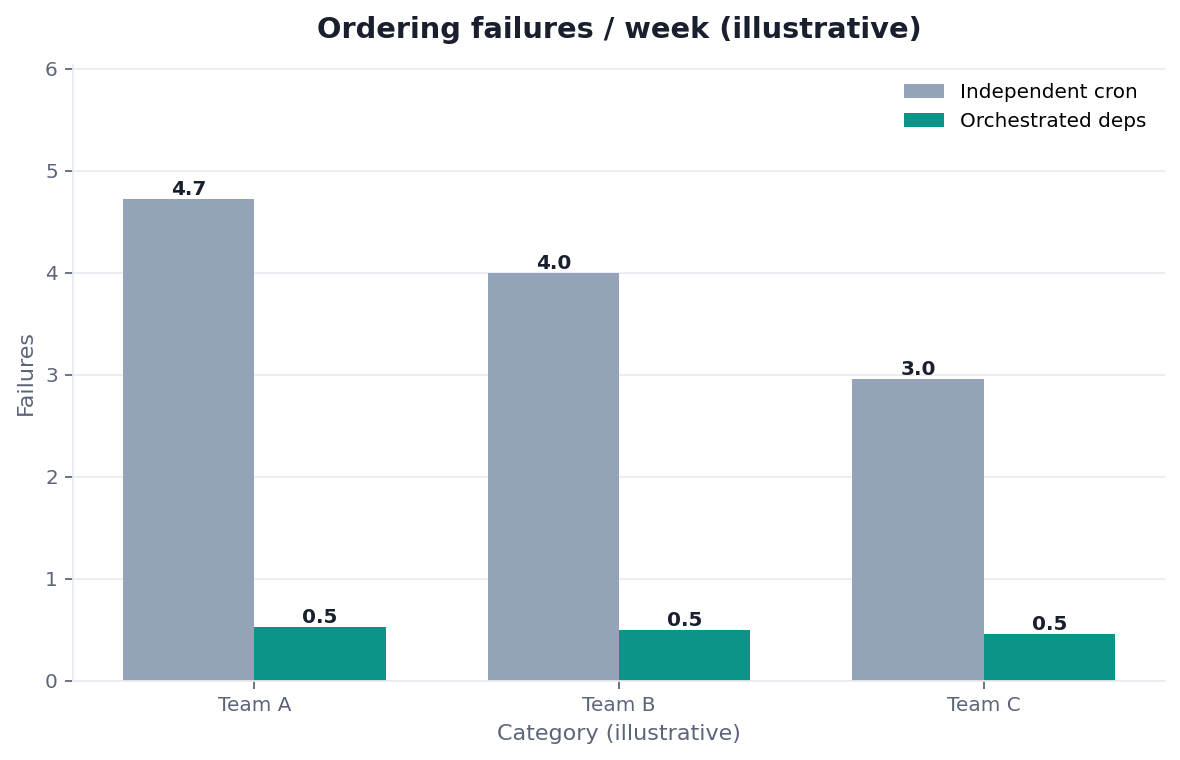
Practical example: a team's data pipeline broke weekly because one transformation ran before its input was ready. Adding explicit dependencies and validation — following orchestration patterns like those at Amazon Redshift documentation — ended the breakage. Correct ordering and checks, not more compute, fixed reliability.
Scope note: This guide reflects architectures we see when mid-market and enterprise teams design a data pipeline in 2026. It is not a substitute for legal counsel, vendor runbooks, or a formal survey of every industry — and when a smaller toolset or lighter process would serve, a full program is overkill.
What It Is
Teams evaluating this topic often cross-check ClickHouse documentation for a durable, vendor-neutral reference point.
At its core, data pipeline architecture is a set of layers — ingestion, transformation, storage, serving — coordinated by orchestration so that data flows reliably from source to use.
Key Definition: data pipeline architecture is the layer map and set of automated processes that move data from one or more sources through transformation and validation to a destination, coordinated by orchestration, so the data arrives reliably and in a usable form for analytics, applications, or models.
The distinction that matters is that a data pipeline is architecture, not a single script. The layers can be arranged many ways, and the arrangement — where transformation happens, how failures are handled, how data is validated — is what determines whether the pipeline is reliable or fragile.
The Building Blocks
Teams evaluating this topic often cross-check Prometheus documentation for a durable, vendor-neutral reference point.
Every data pipeline architecture composes from a few building blocks, and understanding them is the foundation of good design.
Ingestion and transformation
Ingestion connects to sources and brings data in; transformation cleans, joins, and reshapes it. These layers hold most of the complexity, and enterprise adoption patterns from NIST AI Risk Management Framework show why getting transformation right — idempotent, testable, observable — is the crux of reliability.
Storage, serving, and orchestration
Storage holds intermediate and final data, serving delivers it to consumers, and orchestration schedules the steps and handles failures. The reliability framing in Snowflake Cortex Analyst shows why orchestration is the layer that turns a set of steps into a dependable data pipeline that recovers gracefully rather than breaking silently.
Common Patterns
Implementation details are commonly grounded in Azure architecture center when teams translate concepts into production practice.
A data pipeline architecture typically follows one of a few well-worn patterns, and choosing the right one matters more than inventing a new one.
Batch and streaming
A batch data pipeline processes data in scheduled chunks and suits most analytics; a streaming pipeline processes it continuously and suits real-time needs. Most teams need batch far more often than they think, so defaulting to streaming complexity is a common and costly over-engineering mistake.
ETL and ELT
An ETL data pipeline transforms data before loading; an ELT pipeline loads raw data and transforms it in the destination. Modern cloud warehouses have made ELT the common default, because transforming in a powerful warehouse is often simpler and cheaper than transforming in transit.
Common Data Pipeline Architectures
The plural query — data pipeline architectures — is the same decision, not a second topic. Pick one primary architecture, then add a quality path only if the destination needs staged contracts.
| Architecture | When it fits | What you pay |
|---|---|---|
| Batch | Consumers look once a day or hour | Lowest ops tax |
| Streaming | Minutes genuinely matter | Continuous runtime and on-call |
| ETL | Transform before the destination | An extra hop and another failure point |
| ELT | The warehouse or lakehouse can transform | Default for cloud warehouses |
| Medallion (bronze / silver / gold) | Lakehouse quality stages on top of ELT | Extra storage plus data contracts |
Do not stack streaming + ETL + medallion because a reference diagram showed all three. Match the architecture to latency, volume, and who can operate it. The Azure architecture center is useful once those three answers are written down.
Designing for Reliability
Teams evaluating this topic often cross-check RFC 4180 CSV format for a durable, vendor-neutral reference point.
The defining quality of a good data pipeline architecture is reliability, and designing for it means assuming things will fail and planning accordingly. Idempotent steps, validation at each stage, clear dependencies, and loud alerting are the practices that separate dependable pipelines from fragile ones.
This is where a data pipeline connects to the broader discipline of data engineering: the engineer's core skill is building systems that stay reliable as sources and requirements change. Design each step to be safely re-runnable, validate inputs and outputs, and make failures impossible to miss. A pipeline that recovers cleanly from a failed run is worth far more than one that runs faster but breaks unpredictably.
Anti-Patterns to Avoid
The anti-patterns in data pipeline architecture are consistent. A monolithic pipeline that does everything in one opaque step is impossible to debug. Steps that are not idempotent corrupt data when re-run. And silent failure — a pipeline that breaks without alerting — is the most damaging pattern of all.
A subtler anti-pattern is premature optimization. Building a data pipeline for imagined future scale adds complexity that makes the pipeline harder to maintain than the current problem requires. We favor the simplest architecture that meets real needs, because complexity is a cost paid every day in maintenance and debugging, and a pipeline optimized for a scale you never reach is pure overhead.
Pipelines in the Age of AI
AI is reshaping how we think about a data pipeline in two ways. AI analysis depends on reliable pipelines feeding it trustworthy data, and an AI-native approach can reduce how many pipelines you build by reading across sources directly rather than moving everything first.
That second shift is the one we find most useful, and we describe it in what AI-native data analysis means. In the InfiniSynapse web app, zero-config federation lets an agent query across sources without a data pipeline for each, so the modern answer to a data movement problem increasingly includes "do you need to move it at all?"
Choosing the Right Design for Your Case
The hardest part of design is not knowing the patterns but choosing among them for a specific situation, and the choice hinges on a few honest questions. How fresh does the data actually need to be? How large is the volume, and how fast is it growing? How many people or systems depend on the output, and how badly does it hurt when the flow breaks? The answers point toward a design far more reliably than any fashionable reference architecture, because they describe the real constraints rather than an imagined ideal.
Latency is the first fork in the road. If consumers look at the output once a day, a scheduled batch job is almost always the right answer — simpler to build, cheaper to run, and easier to reason about when something goes wrong. Streaming earns its keep only when minutes genuinely matter, and even then the least aggressive configuration that meets the requirement usually wins. Teams that default to streaming because it feels modern pay a continuous operational tax for latency nobody uses, and that tax compounds quietly across every flow they run.
Volume is the second fork. Small and medium datasets can be transformed almost anywhere, so the design should optimize for clarity and maintainability rather than raw throughput. Large and growing datasets, by contrast, force decisions about where computation happens, and the durable answer is usually to push heavy work into a warehouse or distributed engine while the coordination layer stays thin. Designing for a scale you have not reached is a common and expensive mistake, but ignoring a scale you clearly will reach is equally costly, so the craft lies in reading the trajectory honestly.
Ownership is the third and most overlooked fork. A design that one expert understands but nobody else can maintain is a liability disguised as an asset, because the moment that person is unavailable, every change becomes a risk. The best designs are legible: a new engineer can read them, understand the dependencies, and change them safely. Documentation, consistent conventions, and explicit dependencies are what make a flow legible, and legibility is what keeps a system reliable long after its original author has moved on. When the answers to these three questions are written down and revisited as circumstances change, the design tends to stay fit for purpose rather than calcifying into something the team is afraid to touch.
Architecture Scorecard
Assess a data pipeline architecture (1 point each):
| Check | Pass? |
|---|---|
| Steps are idempotent and re-runnable | |
| Data is validated at each stage | |
| Dependencies are explicit | |
| Failures alert loudly | |
| The pattern matches the need (batch/stream) | |
| Transformation lives in the right layer | |
| It is as simple as the problem allows | |
| Its output is trustworthy for AI |
6–8: robust architecture. 3–5: add validation and idempotency. Below 3: simplify and add observability.
Common Misconceptions
Misconception 1: A pipeline is a script. A data pipeline is architecture; the arrangement determines reliability.
Misconception 2: Streaming is more modern. Batch suits most analytics; streaming adds needless complexity when unneeded.
Misconception 3: More stages mean more capability. Monolithic or over-staged pipelines are harder to debug.
Misconception 4: Optimize for future scale. Simplicity for real needs beats speculative complexity.
Frequently Asked Questions
What is data pipeline architecture?
Data pipeline architecture is the layer map: ingestion, transformation, storage, serving, and orchestration. An open script is not an architecture. The arrangement of those layers—and whether steps are idempotent, validated, and alerted—decides whether the flow stays reliable.
What are common data pipeline architectures?
The common data pipeline architectures are batch, streaming, ETL, and ELT. Batch fits most analytics. Streaming earns its keep only when minutes matter. ETL transforms before load; ELT loads raw data and transforms in the warehouse. Lakehouse teams sometimes add a medallion (bronze / silver / gold) quality path on top.
What is a data pipeline?
A data pipeline is the architecture and set of automated processes that move data from one or more sources through transformation and validation to a destination, coordinated by orchestration, so the data arrives reliably and in a usable form. It is architecture rather than a single script, and the arrangement of its layers determines whether it is reliable or fragile. For the definition-only page, see what is a data pipeline.
What are the building blocks?
The building blocks are ingestion (connecting to sources and bringing data in), transformation (cleaning, joining, reshaping), storage (holding intermediate and final data), serving (delivering to consumers), and orchestration (scheduling steps and handling failures). Ingestion and transformation hold most of the complexity, while orchestration turns a set of steps into a dependable pipeline that recovers gracefully.
How do you design for reliability?
Assume things will fail and plan for it: make steps idempotent so they can be safely re-run, validate data at each stage, declare dependencies explicitly, and alert loudly on failure. A pipeline that recovers cleanly from a failed run is worth far more than one that runs faster but breaks unpredictably, because the cost of a silent failure is wrong numbers reaching decisions.
How is AI reshaping pipelines?
Two ways: AI analysis depends on reliable pipelines feeding trustworthy data, and an AI-native approach can reduce how many pipelines you build by reading across sources directly instead of moving everything first. The second shift means the answer to a data movement problem increasingly includes "do you need to move it at all?", because federation can analyze data where it lives.
Conclusion
Data pipeline architecture is the layer map — ingestion, transformation, storage, serving, orchestration — that moves data reliably from source to use. In 2026, reliability and simplicity beat sophistication: pick one of the common data pipeline architectures, make steps idempotent, validate everywhere, and alert loudly. And remember AI-native federation can reduce how many pipelines you build at all.
To see how federated analysis reduces the pipelines you need, read what AI-native data analysis means and try the InfiniSynapse web app free on registration.