What Do Data Engineers Do? (2026)
By the InfiniSynapse Data Team · Last updated: 2026-07-15 · We build an AI-native data analysis platform and work with data engineers daily; this explainer answers what do data engineers do in plain terms for 2026, not with a job-listing bullet list.
Table of Contents
- TL;DR
- How We Answer This
- The Core of the Job
- A Day in the Work
- The Tools They Use
- What Makes One Good
- Common Pitfalls
- The Job in the Age of AI
- Readiness Scorecard
- Common Misconceptions
- Frequently Asked Questions
- Conclusion
TL;DR
Direct answer: what do data engineers do? They build and operate the pipelines, storage, and infrastructure that move raw data from its sources into a reliable, usable form for analysts, scientists, and applications. In 2026, most of what data engineers do is reliability work — making sure data arrives correctly, on time, every day — which is invisible when it works and catastrophic when it fails.
Who this is for: anyone asking what do data engineers do in 2026.
What you'll learn: the core of the job, a day in the work, the tools, what makes one good, and how AI is changing it.
This guide sits under the data engineering hub.
For the alternate phrasing, see what does a data engineer do.
Also see the data engineer role.
How We Answer This
Teams evaluating this topic often cross-check Google Sheets documentation for a durable, vendor-neutral reference point.
We answer what do data engineers do from observation, because the job is easy to caricature and hard to appreciate until you watch a pipeline break at 3 a.m. Every point reflects real work. We anchor the definition to the PostgreSQL documentation and weigh the daily tasks against the reference architectures at Apache Airflow documentation, which show what engineers actually build.
The table below frames what do data engineers do, broken out by responsibility.
| Responsibility | What it involves |
|---|---|
| Build pipelines | Move data from sources to destinations |
| Transform data | Clean, join, and reshape it |
| Ensure reliability | Handle failures and monitoring |
| Manage storage | Organize data for use |
| Support consumers | Serve analysts, scientists, and apps |
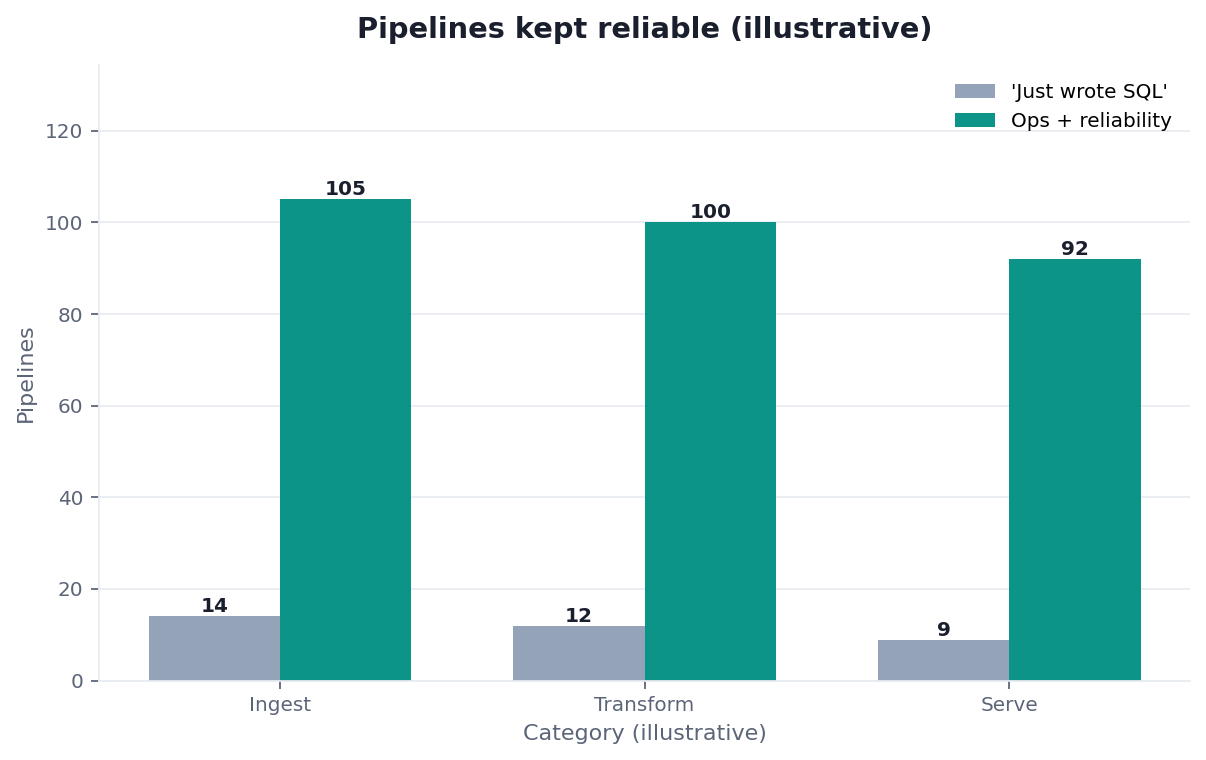
Practical example: a leader who could not say what data engineers do assumed they just "wrote SQL." Watching the team keep a hundred pipelines reliable — the kind of operational rigor described at MongoDB documentation — changed that view entirely.
Scope note: This guide reflects patterns we see when mid-market and enterprise teams work with what data engineers do in 2026. It is not a substitute for legal counsel, vendor runbooks, or a formal survey of every industry — and when a smaller toolset or lighter process would serve, a full program is overkill.
The Core of the Job
At its core, what data engineers do is build systems that reliably move and prepare data. They connect to sources, write transformations, organize storage, and orchestrate the whole flow so it runs dependably.
Key Definition: what data engineers do is design, build, and operate the pipelines, storage, and quality controls that move and prepare data so analysts, applications, and models can depend on it every day — with reliability, not one-off scripts, as the measure of the job.
The word that defines what data engineers do is reliability. The enterprise patterns from Wikipedia business intelligence overview show why: the value is not moving data once but moving it correctly every day, recovering from failures, and staying trustworthy as sources change. That daily dependability is the whole point of the role.
A Day in the Work
Teams evaluating this topic often cross-check Google SRE book for a durable, vendor-neutral reference point.
A realistic view of what data engineers do on a given day mixes building and maintaining. They might build a new pipeline for a new source, debug why an existing one failed overnight, optimize a slow transformation, and respond to an analyst whose data looks wrong.
Much of what data engineers do is this maintenance and firefighting, and the operational guidance at MariaDB documentation shows why it dominates: as the number of pipelines grows, keeping them all reliable takes more time than building new ones. The best engineers reduce this load by building robust, well-monitored systems that fail rarely and recover cleanly.
The Tools They Use
To understand what do data engineers do, it helps to know their toolkit. They use SQL and a language like Python, pipeline and orchestration tools, cloud data platforms, and version control and testing frameworks.
But what data engineers do is not defined by tools. This connects to the broader field of data engineering: the tools change constantly, but the principles — reliability, testability, observability — endure. A good engineer applies those principles regardless of which specific pipeline product is in fashion, which is why hiring for principles beats hiring for tool familiarity.
What Makes One Good
Implementation details are commonly grounded in Snowflake Cortex Analyst when teams translate concepts into production practice.
What separates a good engineer in terms of what data engineers do is judgment about reliability and simplicity. A good engineer builds systems that fail rarely, recover cleanly, and stay simple enough to maintain.
The subtler part of what data engineers do well is knowing what not to build. The best engineers question whether a pipeline is needed, whether data must be moved, and whether a simpler design would serve. They resist the urge to over-engineer for imagined scale, because every system built is a system to maintain, and restraint is as valuable as capability.
Common Pitfalls
The pitfalls in understanding what do data engineers do are common. Assuming it is just writing queries undervalues the reliability discipline. Expecting engineers to also be analysts or scientists confuses distinct roles. And measuring them by pipelines built rather than reliability delivered rewards the wrong thing.
A subtler pitfall is judging what data engineers do by visible output. Good engineering is invisible — nobody notices pipelines that just work — so the engineers delivering the most value can look the least busy. Organizations that reward visible firefighting over quiet reliability accidentally punish their best engineers and encourage fragile systems.
The Job in the Age of AI
Governance and risk expectations are framed by CISA AI security guidance when programs need an external control reference.
AI is changing what do data engineers do in two ways. AI tools generate more pipeline code, shifting engineers toward reviewing and structuring, and AI-native platforms reduce how many pipelines need building at all.
That second shift is the one we find most consequential, and we describe it in what AI-native data analysis means. In the InfiniSynapse web app, zero-config federation lets an agent analyze across sources directly, so part of what data engineers do increasingly is decide which pipelines are still worth building rather than building every one by hand.
The Question Behind the Question
When people ask what do data engineers do, they are usually really asking one of three different things, and separating them clarifies the answer. Sometimes what do data engineers do means "what tasks fill their day" — the concrete work of building pipelines and fixing failures. Sometimes what do data engineers do means "why does the role exist" — the underlying purpose of making data trustworthy. And sometimes what do data engineers do means "how would I know if one is any good" — the question a hiring manager is really asking. Each framing deserves its own answer, and conflating them is why so many descriptions of the role feel simultaneously accurate and unsatisfying.
Answered as daily tasks, what do data engineers do is build, fix, and maintain the flows that move data. Answered as purpose, what do data engineers do is guarantee that the organization can trust its numbers, which is a far larger claim than any task list conveys. Answered as a hiring question, what do data engineers do well comes down to reliability delivered rather than code produced, so the right thing to probe in an interview is not how many pipelines someone has built but how few of theirs have broken and how cleanly they recovered when one did.
There is a fourth, quieter version of the question that matters most in 2026: what do data engineers do that AI cannot. The routine parts — writing boilerplate extraction code, wiring up a standard transformation — are increasingly automated, so the durable core of what do data engineers do is the judgment that remains: deciding what to build, what not to build, and how to keep a growing system reliable. That judgment is precisely the part that resists automation, which is why the honest answer to what do data engineers do keeps shifting upward toward design and decision-making rather than typing.
Understanding these layers protects both aspiring engineers and the leaders who hire them. An aspiring engineer who thinks what do data engineers do is merely write scripts will under-invest in the reliability judgment that actually defines the career. A leader who thinks what do data engineers do is produce visible output will measure the wrong thing and reward the wrong behavior. Seeing the question in its fuller shape — tasks, purpose, quality, and the AI-shifted core — turns a vague job title into a clear picture of a role whose value lies in trust, judgment, and restraint far more than in any single technical task. It also explains why two people can both answer what do data engineers do accurately and yet describe seemingly different jobs: they are simply emphasizing different layers of the same role. Holding all the layers together at once is what produces a complete and honest picture, and it is the picture worth carrying into any hiring decision or career choice about this work. Anything narrower risks optimizing for the wrong thing — hiring for a tool that will change, or aspiring to a task that will be automated — instead of the durable core that makes the role matter.
Readiness Scorecard
Core definitions remain usefully summarized in Wikipedia natural language processing overview for shared vocabulary across stakeholders.
Assess an engineer's impact (1 point each):
| Check | Pass? |
|---|---|
| Their pipelines fail rarely | |
| Failures recover cleanly | |
| Systems are documented | |
| Data is validated and trustworthy | |
| Designs stay simple | |
| They question unnecessary pipelines | |
| They are measured by reliability, not output | |
| Their work supports analysis and AI |
6–8: strong impact. 3–5: room to strengthen reliability. Below 3: rethink priorities.
Common Misconceptions
Misconception 1: They just write SQL. What data engineers do is a reliability discipline.
Misconception 2: They also do analysis. That is a different role.
Misconception 3: More pipelines mean more value. Reliability, not volume, is the measure.
Misconception 4: Busy means productive. Good engineering is quiet and invisible.
Frequently Asked Questions
What do data engineers do?
They design, run, and maintain the pipelines, storage, and infrastructure that carry raw data from its sources into a reliable, usable form for analysts, scientists, and applications. Most of the job is reliability work — making sure data arrives correctly, on time, every day. It is invisible when it works and catastrophic when it fails, which is why dependability defines the role.
What does a typical day look like?
A realistic day mixes building and maintaining: building a new pipeline for a new source, debugging why an existing one failed overnight, optimizing a slow transformation, and responding to an analyst whose data looks wrong. As the number of pipelines grows, this maintenance and firefighting takes more time than building new ones, so the best engineers reduce it with robust, well-monitored systems.
What tools do they use?
Their toolkit spans SQL, a programming language such as Python, pipeline and orchestration systems, cloud data platforms, and the version control and testing frameworks that keep code dependable. But the job is not defined by tools — those change constantly, while the principles of reliability, testability, and observability endure. A good engineer applies those principles regardless of which specific pipeline product is currently in fashion.
What makes a good data engineer?
Judgment about reliability and simplicity: building systems that fail rarely, recover cleanly, and stay simple enough to maintain. The subtler skill is knowing what not to build — questioning whether a pipeline is needed, whether data must be moved, and whether a simpler design would serve — because every system built is a system to maintain, and restraint is as valuable as capability.
How is AI changing the job?
Automated tools now generate much of the pipeline code, moving engineers toward reviewing and structuring, while AI-native platforms cut how many pipelines need building in the first place. Part of the job increasingly is deciding which pipelines are still worth building rather than building every one by hand, because federation can analyze across sources directly and remove the need for much routine data movement.
Do data engineers write a lot of code?
Less than people assume, and increasingly so. Much of the work is designing systems, reasoning about failure modes, and deciding what to build, with coding as one activity among several. AI tools now generate much of the routine pipeline code, shifting engineers toward reviewing, structuring, and integrating rather than writing from scratch. The enduring value is judgment about reliability and simplicity, which no amount of code generation replaces, so the trend is toward less typing and more deciding.
In practice, teams evaluating what do data engineers do should judge outcomes by reliability and clarity, not by tool count alone.
When stakeholders ask for a short takeaway on what do data engineers do, start from the decision it must support and work backward.
That is the practical bar for what do data engineers do: if the result is not trustworthy day after day, the program has not worked.
That is the practical bar for what do data engineers do: if the result is not trustworthy day after day, the program has not worked.
In practice, teams evaluating what do data engineers do should judge outcomes by reliability and clarity, not by tool count alone.
Conclusion
What do data engineers do? They build and run the reliable systems that turn raw data into a usable, trustworthy foundation for everyone else. In 2026, the core of the job is reliability, the measure is dependability rather than volume, and AI is shifting engineers toward deciding which pipelines are worth building at all.
To see how federated analysis changes which pipelines engineers build, read what AI-native data analysis means and try the InfiniSynapse web app free on registration.