Data Governance Frameworks: How to Choose
By the InfiniSynapse Data Team · Published: 2026-07-15 · Last updated: 2026-09-14 · Next review: 2026-12-01
Data governance frameworks are reusable operating models for who owns data, what "good" looks like, and how decisions get enforced. DAMA-DMBOK is the usual backbone; ISO/IEC 38505 and COBIT answer board and IT-control questions; NIST families are overlays, not a fourth operating model. Use the job table below to pick one backbone, then run the 90-day rollout in a single high-stakes domain.
Table of Contents
- TL;DR
- How We Evaluated These Frameworks
- Independent Signals
- What They Are
- The Leading Models
- DAMA vs NIST vs ISO
- Where COBIT Fits
- Where NIST Fits
- Core Components Every Model Shares
- How to Choose the Right Model
- Rolling Out Without Stalling
- A 90-day rollout
- Data Quality: The Payload of Governance
- Governance for AI-Native Analysis
- Framework Readiness Scorecard
- Common Misconceptions
- Cluster Guides in This Pillar
- FAQ
- References and Editorial Standards
- Conclusion
TL;DR
Direct answer: data governance frameworks are structured models that define how an organization manages the availability, usability, integrity, and security of its data. They assign ownership, set policies, and establish the processes and metrics that keep data trustworthy. Choose a backbone first — usually DAMA-DMBOK — then add ISO, COBIT, or a NIST family as an overlay, not as a second program.
Who this is for: data leaders, stewards, and analysts choosing or maturing data governance frameworks in 2026. What you'll learn: which models lead, where ISO, COBIT, and NIST fit, shared components, a 90-day rollout, and why the same operating model later becomes the contract for AI analysis. Inventory and provenance sit next door: data catalog platforms and data lineage tracking. GDPR and cross-border habits live on data governance best practices, not a second framework. Also: master data management, data engineering. How those two disciplines share owners and golden records is master data governance.
How We Evaluated These Frameworks
Each of the data governance frameworks below was read from its own primary publication, then checked against operating reality: artifacts produced, roles staffed, and where programs stall. Fieldwork claims (not a published standard) are labelled. Cluster guides are listed once near the end.
Worked example (de-identified). A mid-market fintech (~400 staff, one warehouse, five-person analytics team) adopted a discipline-based model, assigned stewards to four domains, and published five quality rules. Month-end reconciliation fell from ~15 working days to 10 over two quarters.
What that number is and is not. One engagement; median close duration two quarters before/after from the team's tracker. Not audited, not a benchmark. Customer identities stay out of public write-ups (editorial standards).
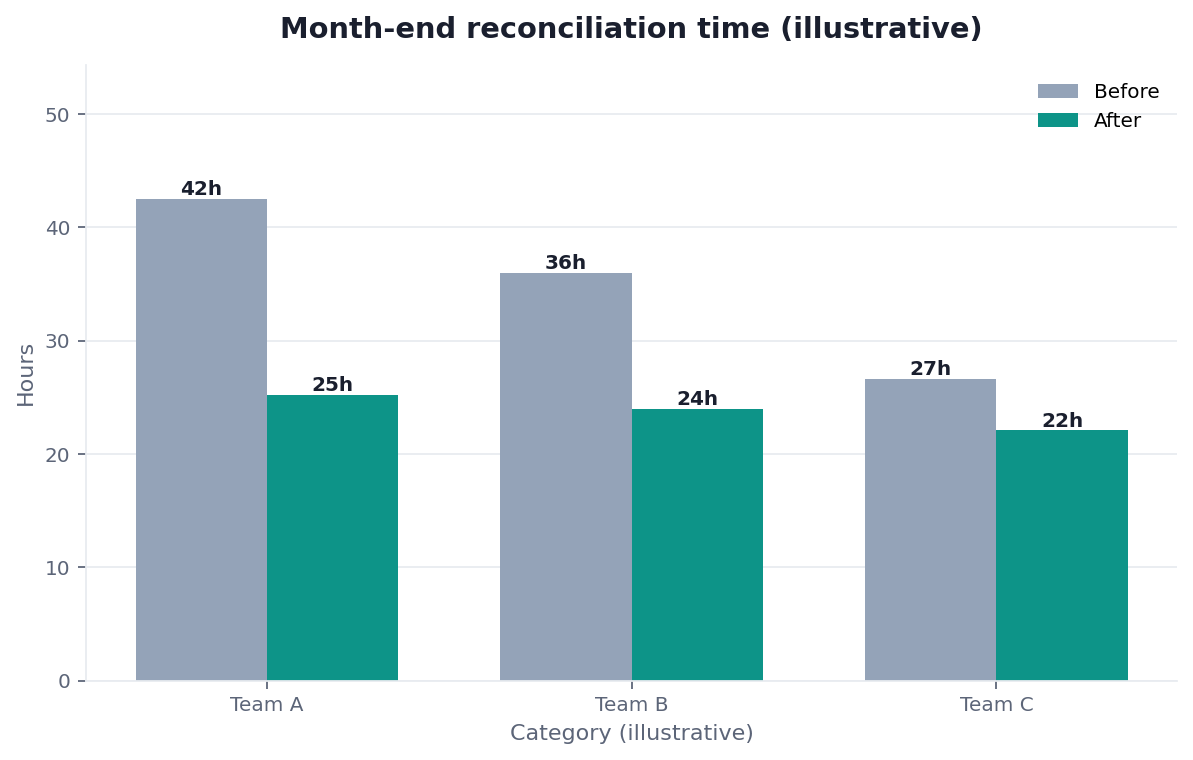
Figure 1 — The de-identified engagement above. Illustrative of one team, not a benchmark. Unaudited first-party measurement.
Scope note: This reflects patterns we see when mid-market and enterprise teams work with data governance frameworks in 2026. It is not legal counsel, a vendor runbook, or a formal industry survey — and when a lighter process would serve, a full program is overkill.
Independent Signals
We are not a standards body. For Authority on data governance frameworks, treat our synthesis as a map and verify against publishers we do not control:
| Signal | Why it matters | Primary source |
|---|---|---|
| Discipline backbone | Shared vocabulary for stewards | DAMA-DMBOK |
| Regulated assessment | Examiner-readable capability scores | EDM Council DCAM |
| Board accountability | Data as an IT-governance extension | ISO/IEC 38505-1 |
| IT / control objectives | Audit language for steering committees | ISACA COBIT |
| Maturity movement | Year-over-year scored progress | CMMI DMM |
| Privacy / security / AI controls | Control vocabulary overlays | NIST Privacy, CSF 2.0, AI RMF |
| LLM application risks | When agents query governed data | OWASP LLM Top 10 |
On-page credentials (roles, not anonymous byline): drafted by a data platform engineer (warehouse stewardship tooling, metric contracts); reviewed by a governance practitioner (framework selection / steward operating model); AI and control language checked by an LLM-security reviewer (NIST AI RMF + OWASP LLM Top 10 alignment). We work with governance and data-quality teams weekly; this guide reflects 2026 adoption patterns, not a vendor checklist. Full roles, corrections, and COI: editorial standards.
Editorial independence: no framework body, standards organisation, or tool vendor paid for inclusion or reviewed this draft. Every model below is described from its own primary documentation, linked inline.
External validation status. Third-party framework bodies / standards (not InfiniSynapse): DAMA International — DMBOK, EDM Council — DCAM, ISO/IEC 38505-1, ISACA — COBIT, ISACA / CMMI DMM, NIST Privacy Framework, NIST CSF 2.0, NIST AI RMF, OWASP LLM Top 10. Public HTTPS assets: hero, comparison matrix, recon chart. First-party limit: the recon-time chart is one de-identified, unaudited engagement — not a benchmark (method).


Gap we could not close: no commissioned third-party validation of our one-team recon example, and InfiniSynapse is not DAMA, NIST, ISO, or EDM Council. Framework claims on this page defer to those primary documents when our fieldwork and a standard disagree.
What They Are
A framework is a reusable blueprint. Data governance frameworks package the roles, policies, processes, and metrics needed to manage data as an asset, so nobody invents governance from scratch. They describe an operating model: who owns which data, what "good" looks like, and how decisions get enforced.
Key Definition: data governance frameworks are structured, reusable models that define the roles, policies, standards, processes, and metrics an organization uses to manage the availability, usability, integrity, security, and quality of its data throughout its lifecycle.
Many teams "do governance" as disconnected fixes; a framework makes accountability coherent. Mature data governance frameworks outlast reorganizations. Also: data governance definition, what is data governance.
The Leading Models
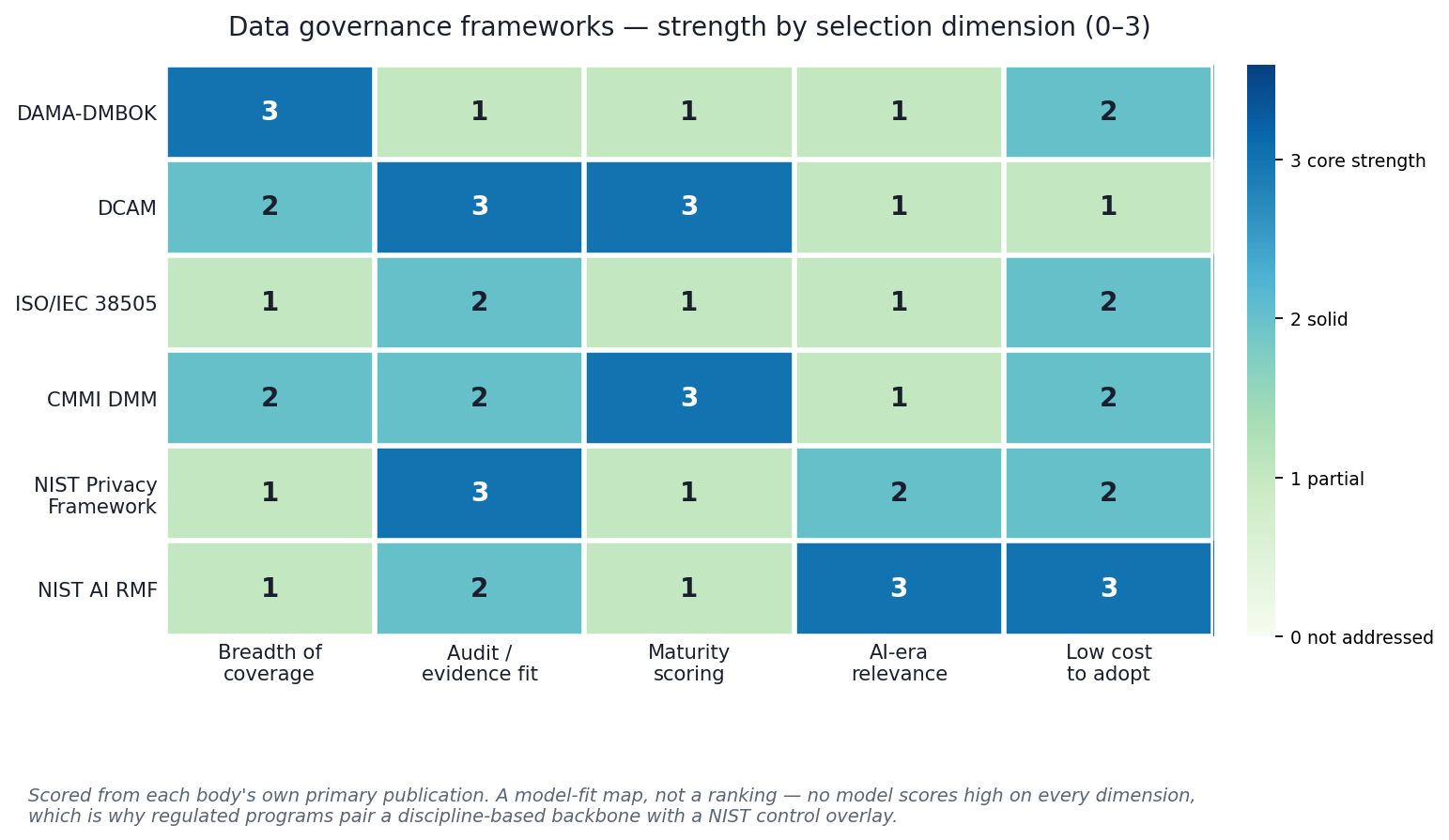
Several established models dominate adoption, and most enterprises adapt rather than adopt them verbatim. The point of surveying data governance frameworks is not to crown a winner but to borrow the parts that fit your maturity and regulatory context.

Figure 2 — Where each model is strong. None scores high everywhere, which is why most programs combine a backbone with a control overlay.
Table summary: six widely adopted data governance frameworks, the body publishing each, and the situation each fits.
| Model | Origin | Best fit |
|---|---|---|
| DAMA-DMBOK | DAMA International | Broad, discipline-based programs |
| DCAM | EDM Council | Financial services and regulated data |
| ISO/IEC 38505 | ISO/IEC | Board-level data accountability |
| COBIT | ISACA | IT and information-control overlay for audit and steering committees |
| CMMI DMM | ISACA | Maturity assessment and roadmapping |
| NIST Privacy Framework | NIST | Personal-data risk and privacy engineering |
| NIST AI RMF | NIST | Governing data that feeds AI systems |
Discipline-based models
DAMA-DMBOK organizes governance into eleven knowledge areas — governance, architecture, modelling, storage, security, integration, documents, reference and master data, warehousing, metadata, and quality — with governance at the hub. That breadth makes it the usual starting point: it gives teams a shared vocabulary. The cost is that it describes what to manage more than how mature you are, so most programs pair it with a maturity model and the best practices that turn it into daily behavior.
Regulated-industry models
DCAM is built for organizations whose regulators ask to see evidence. Instead of knowledge areas it uses scored capability components, so an assessment produces something an examiner can read — hence its adoption in banking and insurance. ISO/IEC 38505 comes at the same problem from the top, extending IT-governance principles to data so a board has a defensible answer to "who is accountable?" COBIT is the IT-control overlay for the same audience when the question is "are the controls designed and operating?" rather than "who owns revenue_usd?" Choose these data governance frameworks when the audience for your artifacts sits outside the data team.
Maturity models
Maturity models score where you are rather than prescribing structure. CMMI DMM rates practices across defined levels, so a program reports movement year over year instead of asserting it. Many organizations layer one on a discipline-based backbone.
DAMA vs NIST vs ISO
The three names that show up in every RFP for data governance frameworks do different jobs. Use this table to stop treating them as substitutes.
| Job | DAMA-DMBOK | NIST families | ISO/IEC 38505-1 | COBIT |
|---|---|---|---|---|
| Operating model (who owns what) | Primary — eleven knowledge areas, governance at the hub | No — control vocabulary, not steward roles | Board accountability, not day-to-day stewardship | No — IT/control objectives, not steward roles |
| Control language for auditors | Weak unless you add DCAM or a NIST overlay | Primary — Privacy, CSF 2.0 Govern, AI RMF | Primary for “who is accountable to the board” | Primary for IT audit and steering committees |
| AI / agent risk | Silent unless you add AI RMF | AI RMF MAP/MEASURE/MANAGE | Silent on models and agents | Silent unless you map an information objective |
| Catalog + lineage | Metadata and quality knowledge areas point here | MAP assumes you already have data-flow evidence | Expects evidence; does not specify a graph | Expects evidence; does not specify a catalog |
| Typical hybrid | Backbone | Overlay once personal data, security, or agents appear | Overlay when the audience is the board | Overlay when the audience is internal audit |
| Backbone vs overlay | Backbone | Overlay | Overlay | Overlay |
A 2026 program that only “adopts DAMA” still cannot answer an AI-provenance question. One that only “adopts NIST AI RMF” still has no steward for revenue_usd. Pair the backbone with the overlay, then land ownership in data catalog platforms and prove flows with data lineage tracking.
Where COBIT Fits
COBIT is ISACA’s IT and information-governance framework. It gives boards, CIOs, and auditors a control-objective language — designed, implemented, operating — for enterprise IT. It is not a data-management body of knowledge: it does not name stewards per domain or replace DAMA’s eleven knowledge areas. International programs that ask for “DAMA, ISO, and COBIT” are usually stacking a backbone (DAMA) with a board overlay (ISO/IEC 38505) and an IT-audit overlay (COBIT). Treat that as one program with three artifacts, not three competing data governance frameworks.
Where NIST Fits
NIST does not publish a data-governance model in the DAMA sense, and any guide implying otherwise is overselling. What it publishes is a set of risk and control frameworks that data governance frameworks borrow from once regulators or AI systems enter the picture.
Table summary: three NIST publications and the governance job each actually does.
| NIST publication | What it governs | When to bring it in |
|---|---|---|
| Privacy Framework | Personal-data processing risk: Identify / Govern / Control / Communicate / Protect | You hold personal data and need a defensible privacy posture |
| Cybersecurity Framework 2.0 | Security outcomes; v2.0 added a dedicated Govern function | Security and data governance need one control language |
| AI Risk Management Framework | AI system risk: Govern / Map / Measure / Manage | Governed data starts feeding models or agents |
For control-level detail, the NIST Computer Security Resource Center hosts the SP 800-53 catalog audit teams map policies against.
The 2026 pattern: a backbone such as DAMA-DMBOK defines the operating model, and a NIST family supplies the control vocabulary satisfying a regulator or security review. They are complements, not competitors — which is why the strongest data governance frameworks in regulated settings are hybrids.
Core Components Every Model Shares
Despite their differences, effective data governance frameworks share a skeleton. Understanding it lets you evaluate any model on its merits rather than its branding.
Roles and ownership. Every workable framework names accountable people: an executive sponsor, data owners per domain, and stewards doing the daily work. Without named ownership, policies become suggestions. This is the single most common failure point we see when data governance frameworks stall.
Policies and standards. The second component is the written rule set: classification tiers, access and retention rules, modelling standards, and definitions for the metrics the business argues about. A policy counts only if it is enforceable somewhere other than a slide — in a catalog, a pipeline test, or an access review. The test we apply: for each policy, name the system that would block a violation. Policies failing that test are documentation, not governance.
Processes and metrics. The third component is repeatable process — issue resolution, change management, access review — plus metrics proving they work. Metrics turn governance from an act of faith into a measurable capability, which separates durable data governance frameworks from binders gathering dust.
How to Choose the Right Model
Choosing among data governance frameworks is less about the model than the fit. The right choice depends on regulatory exposure, data maturity, and the business problem you are solving.
Match the model to your risk. Regulated organizations benefit from audit-oriented data governance frameworks; a fast-moving startup may adopt a lightweight subset and grow into structure. Over-engineering early is as damaging as ignoring governance, because a framework nobody follows is worse than a smaller one everyone does.
Match the model to your tooling. Your model shapes which data governance software actually helps. Buy tools to serve the framework, not the reverse — the mistake that leaves catalogs half-deployed. When shortlisting, our guide to choosing a governance tool walks through the criteria.
Rolling Out Without Stalling
The hardest part of data governance frameworks is adoption, not design. The pattern that works is incremental: pick one high-value domain, prove value, expand. Applying data governance frameworks to everything at once stalls under its own weight.
Start where trust is most expensive — the numbers executives argue about. A visible win in one domain earns political capital and gives stewards a template to reuse. Teams tracking data governance news report phased rollouts outperforming comprehensive ones, and a durable data governance strategy sequences those phases deliberately.
A 90-day rollout
A 90-day promise that “governance will be done” produces a binder. A 90-day pilot that names owners, five rules, and one measured quality win is how data governance frameworks actually start.
| Days | Outcome you can show | Do not do yet |
|---|---|---|
| 1–30 | One domain, one executive sponsor, named owner + steward, five metric definitions written where a pipeline can fail them | Estate-wide catalog rollout |
| 31–60 | Those five rules enforced in tests or access review; data lineage tracking on the pipelines that feed the disputed numbers | A second framework “implementation” |
| 61–90 | One quality metric moved (recon breaks, null rate, or close days); replay the same dispute with provenance | Organization-wide maturity scoring |
If day 90 has more slides than enforced rules, you documented a framework. You did not run one.
Data Quality: The Payload of Governance
Governance is the machinery; data quality is the payload it delivers. A framework that does not measurably improve quality is theater. The most useful data governance frameworks define quality in concrete dimensions and attach a metric to each rather than aspiring to "clean data".
Table summary: the five quality dimensions most models share, what each asserts, and a metric that makes it testable.
| Dimension | What it asserts | A metric that tests it |
|---|---|---|
| Accuracy | The value matches the real-world fact | % of records matching a trusted reference |
| Completeness | Required values are present, not null | % of mandatory fields populated per domain |
| Consistency | The same entity agrees across systems | % of cross-system reconciliation breaks |
| Timeliness | Data arrives inside the decision window | % of loads landing before the SLA cutoff |
| Validity | Values conform to declared format and range | % of records passing schema and domain rules |
Each dimension needs an owner and a threshold, or it stays a vocabulary exercise. Depth lives in data quality management and how ISO data collection attaches specs under the ISO 8000 data quality standard. The operating steps are the data quality playbook.
Governance for AI-Native Analysis
The 2026 development that changes the stakes is AI-driven analysis. When an autonomous agent reads your data and produces answers, governance and quality directly determine whether those answers are trustworthy. Poorly governed data produces confidently wrong AI conclusions — more dangerous than an obvious error, because the output carries no visible signal that it is wrong.
An agent that binds business definitions to sources respects the same rules a governance program encodes, an approach we describe in ai native data platform. Strong data governance frameworks become the contract an AI analyst honors: metric definitions, access rules, and quality thresholds keeping automated answers grounded. Two controls matter most before agents touch production data — row-level access enforced at query time, and an audit log tying every published number to the query that produced it. Score agent-specific risks against the OWASP Top 10 for LLM Applications and the NIST AI RMF first.
| AI analytics RACI | Accountable | Responsible | Consulted |
|---|---|---|---|
Metric definition (revenue, active customer) | Domain owner | Analytics engineer / steward | Finance or ops consumer |
| Row-level access on agent queries | Data owner + security | Platform engineer | LLM-security reviewer |
| Provenance for a published agent number | Domain owner | Engineer who wired data lineage tracking | Auditor / risk |
| Catalog entry stays current | Steward | Whoever merged the model | Agent platform owner |
Framework Readiness Scorecard
Assess your readiness to operate one of the standard data governance frameworks (1 point each):
| Check | Pass? |
|---|---|
| We have an executive sponsor for data | |
| Each key domain has a named owner | |
| We have written, enforced data policies | |
| We measure data quality with metrics | |
| We have a retention policy in force | |
| Access is reviewed on a schedule | |
| Governance maps to a business outcome | |
| Our data is trustworthy enough for AI analysis |
6–8: strong readiness. 3–5: prioritize ownership and metrics. Below 3: start with one domain.
Common Misconceptions
Misconception 1: A framework is a tool. Tools support data governance frameworks; they do not constitute them. A catalog with no named owners is an expensive search box.
Misconception 2: More documentation means better governance. Five rules a pipeline can block outrank fifty a wiki records.
Misconception 3: Governance slows teams down. The upfront cost is repaid every time an analyst skips a re-check.
Misconception 4: You must adopt a model verbatim. Most regulated programs run a hybrid backbone plus control overlay.
Misconception 5: NIST is a data governance framework. It is a family of risk and control frameworks that data governance frameworks borrow from — the control vocabulary, not the operating model.
Cluster Guides in This Pillar
This hub is the map; the guides below go deep on each part of governance and quality.
| Guide | Focus |
|---|---|
| Data catalog platforms | Where owners and definitions live |
| Data lineage tracking | Provenance when a number is challenged |
| Data governance trends 2026 | Seven shifts and the 30-day pilot |
| What is data governance | Plain-language intro |
| Data governance definition | Formal definition |
| data governance framework | Build steps |
| Governance strategy | Strategy that sticks |
| Best practices | What works |
| Data quality management | The quality operating model |
| Data quality | Dimensions and metrics |
| ISO 8000 data quality standard overview | The quality standard at capture |
| Master data governance | MDM and data governance |
| What is a data retention policy | Retention explained |
| Data retention policy | Template and rules |
| Data governance tools | Tools compared |
| Choosing a tool | Selection criteria |
| Data governance software | Buyer guide |
| Data quality tools | Quality tooling |
| Governance solutions | Use cases |
| Data governance news | Q3 2026 briefing |
Frequently Asked Questions
What are data governance frameworks?
Data governance frameworks are structured, reusable models defining the roles, policies, standards, processes, and metrics an organization uses to manage data as an asset. They specify who owns which data, what quality looks like, how long data is kept, and how decisions get enforced.
Which data governance framework is best?
There is no single best model. The choice among data governance frameworks depends on regulatory exposure, data maturity, and business goals. Regulated industries favor audit-oriented models; smaller teams adopt a lightweight subset and expand. Most organizations adapt a recognized model rather than adopting one verbatim.
Where does NIST fit among data governance frameworks?
NIST does not publish a data-governance model in the DAMA sense. It publishes risk and control frameworks — the Privacy Framework, Cybersecurity Framework 2.0 with its Govern function, and the AI Risk Management Framework — that data governance frameworks borrow from when regulators or AI systems are involved. The 2026 pattern is a discipline-based backbone plus a NIST family as control vocabulary.
How do you implement a data governance framework?
Incrementally. Name an executive sponsor and domain owners, write a few enforceable policies, define measurable quality metrics, and prove value in one high-stakes domain before expanding. The 90-day rollout is the first pilot, not organization-wide maturity. Phased rollouts outperform big-bang programs because they produce a template other domains copy.
DAMA, NIST, or ISO — which one first?
Start with DAMA-DMBOK (or a thin subset) for roles. Add a NIST family when personal data, security reviews, or agents enter the scope. Add ISO/IEC 38505 when the board needs a named accountable executive. Add COBIT when internal audit or an IT steering committee needs control-objective evidence. The DAMA vs NIST vs ISO table is the decision map; do not implement all four as four programs.
What’s the difference between DAMA-DMBOK, DCAM, COBIT, and NIST?
DAMA-DMBOK is the operating-model backbone (who owns which discipline). DCAM is a scored capability assessment aimed at examiners in regulated industries. COBIT is ISACA’s IT-control overlay for audit and steering committees. NIST families are risk and control vocabularies — privacy, cybersecurity, AI — not a DAMA-style steward model. They stack; they are not four substitutes.
How do DAMA, ISO, and COBIT fit together internationally?
Use DAMA-DMBOK (or a thin subset) for day-to-day roles, ISO/IEC 38505 when a board in another jurisdiction needs a named accountable executive, and COBIT when IT audit needs control-objective evidence. That is one international operating model with three artifacts, not three frameworks to implement in parallel. Daily cross-border habits stay on data governance best practices.
Is NIST a data governance framework?
No. NIST does not publish a DAMA-style operating model. It publishes the Privacy Framework, Cybersecurity Framework 2.0, and the AI Risk Management Framework — control overlays that data governance frameworks borrow once personal data, security reviews, or agents are in scope. You still need a backbone that names owners.
How do governance frameworks relate to data quality?
Governance is the machinery and data quality is the payload. Effective data governance frameworks define quality in concrete dimensions — accuracy, completeness, consistency, timeliness, validity — and attach metrics to each. A framework that does not measurably improve quality is not doing its job.
Do small companies need a data governance framework?
Rarely the full program, but always the skeleton. A twenty-person company that names one owner per critical domain, writes down five metric definitions, and sets a retention rule has the parts that matter. Adopting one of the heavyweight data governance frameworks before anyone can run it wastes a quarter.
How long before a framework shows results?
Plan in quarters. A single-domain pilot usually produces a visible result — fewer disputed numbers, a faster close — within one to two quarters; organization-wide maturity movement takes a year or more. Programs promising transformation in ninety days deliver documentation.
What does a data governance framework cost to run?
People, not licences: a part-time sponsor, a program lead, and stewards. Buying a catalog before naming owners is the classic sequencing error.
Why do frameworks matter for AI analysis?
When an AI agent reads your data, governance and quality determine trust. Strong data governance frameworks become the contract an AI analyst honors — definitions, access rules, and thresholds.
References and Editorial Standards
Primary sources for every model above:
- [Framework body] DAMA International — DMBOK Body of Knowledge
- [Framework body] EDM Council — DCAM
- [Framework body] ISACA — COBIT
- [Framework body] ISACA / CMMI Institute — Data Management Maturity
- [Standard] ISO/IEC 38505-1 — Governance of data
- [Standard] NIST — Privacy Framework
- [Standard] NIST — Cybersecurity Framework 2.0
- [Standard] NIST — AI Risk Management Framework
- [Standard] NIST — Computer Security Resource Center (SP 800-53)
- [Standard] OWASP — Top 10 for LLM Applications
- [Vendor] Microsoft — Azure data architecture guide
Corrections. The de-identified engagement is first-party and unaudited. Contradicting measurements: zhuhl@infinisynapse.com; logged on editorial standards.
Conclusion
Data governance frameworks turn scattered fixes into a durable operating model. Choose a backbone for risk and maturity, add ISO, COBIT, or a NIST overlay only when the audience needs it, roll out one domain at a time, and measure quality. Next: ai native data platform or the web app.