Data Governance Software: A 2026 Market Guide
By the InfiniSynapse Data Team · Last updated: 2026-07-15 · We build an AI-native data analysis platform and evaluate governance products regularly; this market guide reflects how we read the landscape in 2026, not a sponsored ranking.
Table of Contents
- TL;DR
- How We Evaluated
- What It Is
- The Market Categories
- What to Look For
- Pricing and Deployment
- Common Mistakes
- Software in the Age of AI
- Selection Scorecard
- Common Misconceptions
- Frequently Asked Questions
- Conclusion
TL;DR
Direct answer: data governance software is the category of products that automate governance work — cataloging, lineage, access control, quality monitoring, and policy management — either as point tools or unified platforms. In 2026, the best data governance software is the software your teams adopt and that AI agents can read from, because a catalog nobody maintains governs nothing.
Who this is for: data leaders and engineers evaluating data governance software in 2026.
What you'll learn: what the software does, the market categories, what to look for, pricing models, and how it supports trustworthy AI.
This guide sits under the data governance frameworks hub.
For the tools view, see data governance tools.
Also see data governance solutions.
How We Evaluated
Teams evaluating this topic often cross-check MariaDB documentation for a durable, vendor-neutral reference point.
We read the data governance software market the way a buyer must: by fit and adoption, not feature count. Every observation reflects what we see when teams deploy — or abandon — governance products in 2026. We anchor category definitions to the Snowflake Cortex Analyst, and we weigh security expectations against the Google Sheets documentation, which treats access control and provenance as core requirements.
The table below maps the categories of data governance software.
| Category | Core function |
|---|---|
| Catalog | Inventory + ownership |
| Lineage | Data-flow tracing |
| Access control | Permission enforcement |
| Quality monitoring | Data-health metrics |
| Unified platform | Several of the above |
Practical example: a retailer bought broad data governance software before deciding what to govern, and the catalog sat empty for a year. A peer chose a lean product, populated it for one domain, and expanded — guided by enterprise patterns from NIST Computer Security Resource Center. The lesson repeats: adoption, not breadth, determines value.
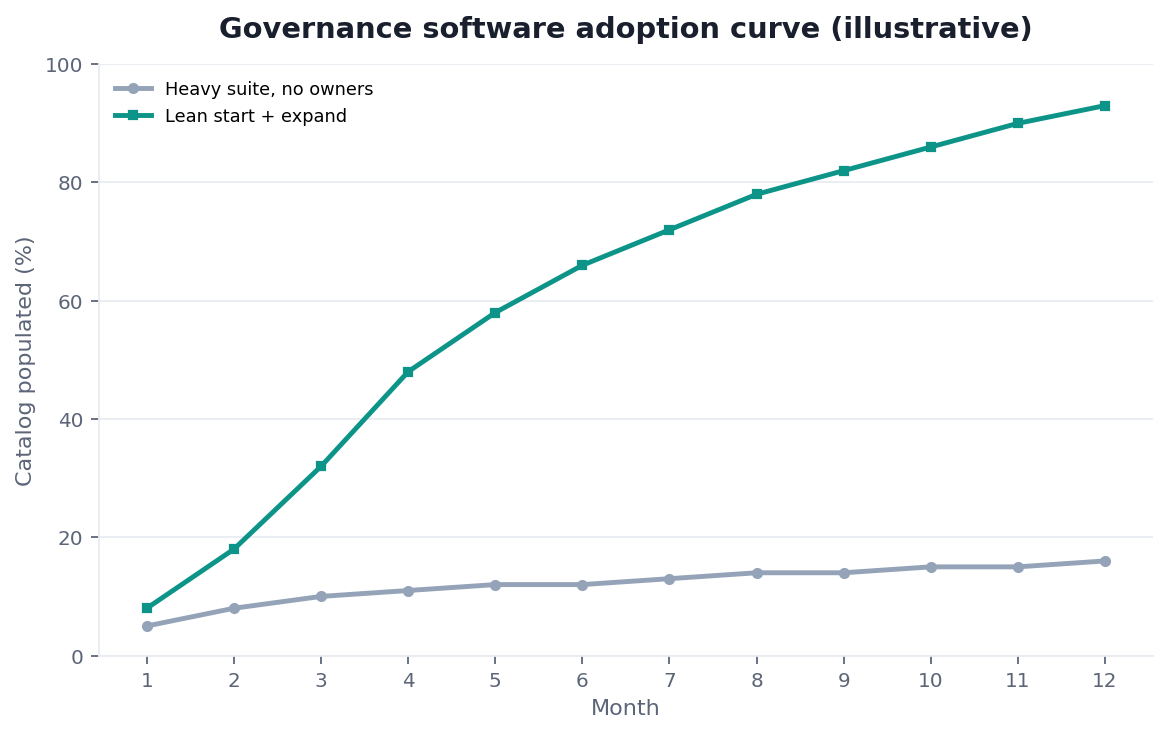
Scope note: This guide reflects patterns we see when mid-market and enterprise teams work with data governance software in 2026. It is not a substitute for legal counsel, vendor runbooks, or a formal survey of every industry — and when a smaller toolset or lighter process would serve, a full program is overkill.
What It Is
Architecture choices are often checked against Databricks Genie architecture post so boundaries, ownership, and scale patterns stay explicit.
At its core, data governance software automates the mechanics of governance so human decisions about ownership, definitions, and rules can be applied at scale. It does not decide who owns a dataset; it enforces and propagates that decision.
Key Definition: data governance software is the category of products that automate the operational mechanics of governance — cataloging assets, tracing lineage, enforcing access policy, and monitoring quality — enabling consistent application of governance decisions across an organization's data.
The distinction that matters is that data governance software amplifies governance rather than creating it. A team with clear owners and definitions gets huge leverage; a team without them gets an expensive, empty inventory. The definitional work always comes first.
The Market Categories
Architecture choices are often checked against IBM augmented analytics overview so boundaries, ownership, and scale patterns stay explicit.
The data governance software market splits into point tools and unified platforms.
Point tools
Point tools do one thing well — a best-of-breed catalog, a dedicated lineage tracer, a focused quality monitor. A quality monitor in that slot is what we compare under data quality tools. They excel when you have a specific gap, and they integrate into a stack you assemble. The trade-off with this kind of data governance software is that you become the integrator, stitching tools together, though the orchestration patterns at Wikipedia SQL overview show how much of that stitching modern platforms now absorb.
Unified platforms
Unified platforms bundle catalog, lineage, access, and quality into one product. They reduce integration work at the cost of flexibility, and the enforcement patterns documented at ISO/IEC 42001 AI management illustrate how a single metadata layer can drive many controls. The right choice of data governance software depends on whether you value best-of-breed depth or single-vendor simplicity.
What to Look For
Governance and risk expectations are framed by NIST SP 800-53 security controls when programs need an external control reference.
The features that matter in data governance software are the ones that drive daily adoption: how easily a steward attaches an owner and definition, how well it integrates with your systems, and how clearly it exposes lineage and quality.
Beyond features, evaluate how the data governance software fits your existing data governance framework rather than forcing a new operating model. A product that mirrors your roles and policies gets adopted; one that demands you reshape your organization around it does not. Weigh usability as heavily as capability, because the tool used daily beats the powerful one nobody opens.
Integration depth deserves particular scrutiny, because it is where demos and reality diverge most. Ask exactly how the software connects to each of your important sources, how it keeps metadata fresh as schemas change, and what happens when a source it does not natively support enters your stack. Software that discovers and refreshes metadata automatically stays useful with little effort; software that relies on manual entry decays the moment the novelty wears off. We consistently find that the strongest data governance software is the one that quietly keeps itself current, because a catalog that reflects yesterday's reality is not merely useless — it actively misleads the analysts and agents that trust it, which is worse than having no catalog at all.
Pricing and Deployment
Teams evaluating this topic often cross-check ClickHouse documentation for a durable, vendor-neutral reference point.
Pricing for data governance software ranges from open-source and usage-based to enterprise licenses, and the sticker price rarely reflects total cost. Integration, administration, and the human time to keep metadata current often exceed the license fee, so model three-year total cost of ownership rather than year-one price.
Deployment matters too. Some data governance software is SaaS-only, some supports private or on-premise deployment for teams with strict data-residency or security requirements. Choosing a deployment model that matches your compliance posture avoids a painful migration later, and it is worth confirming before you shortlist rather than after.
It also pays to understand the pricing metric, not just the number. Software priced per data asset behaves very differently at scale than software priced per user or per compute unit, and a metric that is cheap during a pilot can become punishing once you catalog your whole estate. We advise mapping each candidate's pricing metric onto your projected two-year growth and asking the vendor for the cost at that future scale in writing. The data governance software that looks cheapest today is frequently the one whose pricing metric compounds fastest, and discovering that after you have populated the catalog and trained your stewards is an expensive lesson that a few pointed questions up front would have prevented.
Common Mistakes
The mistakes we see are consistent. Buying before deciding what to govern produces empty catalogs. Choosing on feature count rather than adoption produces shelfware. Ignoring integration produces disconnected metadata islands. And treating data governance software as the strategy, rather than the enforcement of one, produces motion without progress.
A subtler mistake is underestimating change management. Even excellent data governance software fails if stewards are not trained and incentivized to use it, so budget for adoption, not just licenses. The product is necessary but never sufficient; the habit around it is what delivers governance.
Another recurring mistake is buying for a future you have not reached yet. Teams sometimes select the most capable enterprise data governance software on the market because they imagine needing every feature someday, and then struggle to populate even the catalog because the product assumes a maturity they do not have. It is almost always better to buy for the stage you are at now, with a clear upgrade path, than to buy for an imagined future and drown in complexity today. The maturity of your governance practice, not the ambition of your roadmap, should set the ceiling on the software you choose, because a product your team can fully adopt this quarter delivers more real governance than a sophisticated one they grow into over years.
Software in the Age of AI
AI sharply raises the value of data governance software. When an autonomous agent reads your data to answer questions, it depends on the catalog and definitions the software maintains; ungoverned metadata yields inconsistent AI answers. Good software becomes the substrate that makes automated analysis trustworthy.
An AI-native platform closes the gap by binding governed definitions to the data an agent queries, an approach we describe in what AI-native data analysis means. In the InfiniSynapse web app, governance context travels with the data, so the work your data governance software does directly improves the reliability of AI answers instead of sitting in a silo.
This reframes how you should evaluate the category going forward. For years, data governance software was judged mainly by how well it served human stewards and analysts browsing a catalog. In 2026, a second consumer matters just as much: the AI agents that read metadata to decide how to answer a question. Software that exposes clean, governed, machine-readable definitions makes those agents reliable; software that locks its metadata in a human-only interface leaves agents guessing. When you shortlist products, ask specifically how an agent or application would consume the governed definitions programmatically, because that capability is quietly becoming the difference between a catalog that documents your data and one that actively makes your automated analysis trustworthy.
Selection Scorecard
Score each product (1 point each):
| Check | Pass? |
|---|---|
| A steward can add owner + definition easily | |
| It integrates with our stack | |
| Pricing is transparent (3-year TCO) | |
| Deployment matches our compliance needs | |
| It covers catalog and lineage | |
| It enforces access and monitors quality | |
| Stewards will adopt it daily | |
| Agents can read its metadata |
6–8: strong fit. 3–5: pilot first. Below 3: keep evaluating.
Common Misconceptions
Misconception 1: Software is the strategy. Data governance software enforces a strategy; it is not one.
Misconception 2: More features are better. Adoption beats breadth.
Misconception 3: License price is the cost. Integration and upkeep usually cost more.
Misconception 4: SaaS fits everyone. Regulated teams may need private deployment.
Frequently Asked Questions
What is data governance software?
Data governance software is the category of products that automate the operational mechanics of governance — cataloging assets, tracing lineage, enforcing access policy, and monitoring quality. It enables consistent application of governance decisions at scale, but it amplifies governance rather than creating it: the decisions about ownership, definitions, and rules must come first.
What are the main categories?
The market splits into point tools and unified platforms. Point tools do one thing well — catalog, lineage, or quality — and you integrate them yourself. Unified platforms bundle several functions into one product, reducing integration work at the cost of flexibility. The right choice depends on whether you value best-of-breed depth or single-vendor simplicity.
What should you look for?
Look for what drives daily adoption: how easily a steward attaches an owner and definition, how well it integrates with your systems, and how clearly it exposes lineage and quality. Ensure it fits your existing framework rather than forcing a new operating model, and weigh usability as heavily as capability.
How is it priced?
Pricing ranges from open-source and usage-based to enterprise licenses, but the sticker price rarely reflects total cost. Integration, administration, and the human time to keep metadata current often exceed the license fee, so model three-year total cost of ownership. Also confirm the deployment model — SaaS or private — matches your compliance posture.
How does it support AI?
AI agents rely on the catalog and definitions the software maintains; ungoverned metadata yields inconsistent answers. Good software becomes the substrate that makes automated analysis trustworthy, and an AI-native platform that carries governance context with the data ensures the metadata work directly improves the reliability of agent answers rather than sitting in a silo.
Conclusion
Data governance software automates the mechanics of governance, but it enforces a strategy rather than replacing one. Choose for adoption, fit, and total cost of ownership, match deployment to your compliance needs, and remember that AI agents increasingly depend on the metadata this software maintains.
To see how governance context travels with data into automated analysis, read what AI-native data analysis means and try the InfiniSynapse web app free on registration.