Data Governance Solutions: A 2026 Guide
By the InfiniSynapse Data Team · Last updated: 2026-07-15 · We build an AI-native data analysis platform and evaluate end-to-end governance approaches; this guide reflects how we think about solutions in 2026, not a vendor pitch.
Table of Contents
- TL;DR
- How We Approached This
- What They Are
- What a Solution Includes
- Assembling an Approach
- Build, Buy, or Blend
- Deployment and Cost
- Solutions in the Age of AI
- Selection Scorecard
- Common Misconceptions
- Frequently Asked Questions
- Conclusion
TL;DR
Direct answer: data governance solutions are the end-to-end combinations of tools, platforms, and practices an organization assembles to govern its data — catalog, lineage, access, quality, and policy working together. In 2026, the best data governance solutions are the ones that fit your existing stack and get adopted, because an end-to-end approach only works if every part is actually used.
Who this is for: data leaders and architects assembling data governance solutions in 2026.
What you'll learn: what a solution includes, how to assemble an end-to-end approach, the build-buy-blend decision, deployment, and how solutions support trustworthy AI.
This guide sits under the data governance frameworks hub.
For individual tools, see data governance tools.
Also see data governance software.
How We Approached This
Teams evaluating this topic often cross-check Stanford HAI AI Index for a durable, vendor-neutral reference point.
We think about data governance solutions as end-to-end approaches, not single products, because governance spans catalog, quality, access, and policy. Every recommendation reflects what we see when teams assemble these parts in 2026. We anchor concepts to the IBM augmented analytics overview and weigh requirements against the OWASP API Security Top 10, which treats access, provenance, and quality as interlocking controls.
The table below maps what a complete set of data governance solutions covers.
| Capability | Purpose |
|---|---|
| Catalog | Inventory + ownership |
| Lineage | Trace data flow |
| Access control | Enforce permissions |
| Quality | Measure trustworthiness |
| Policy | Codify and apply rules |
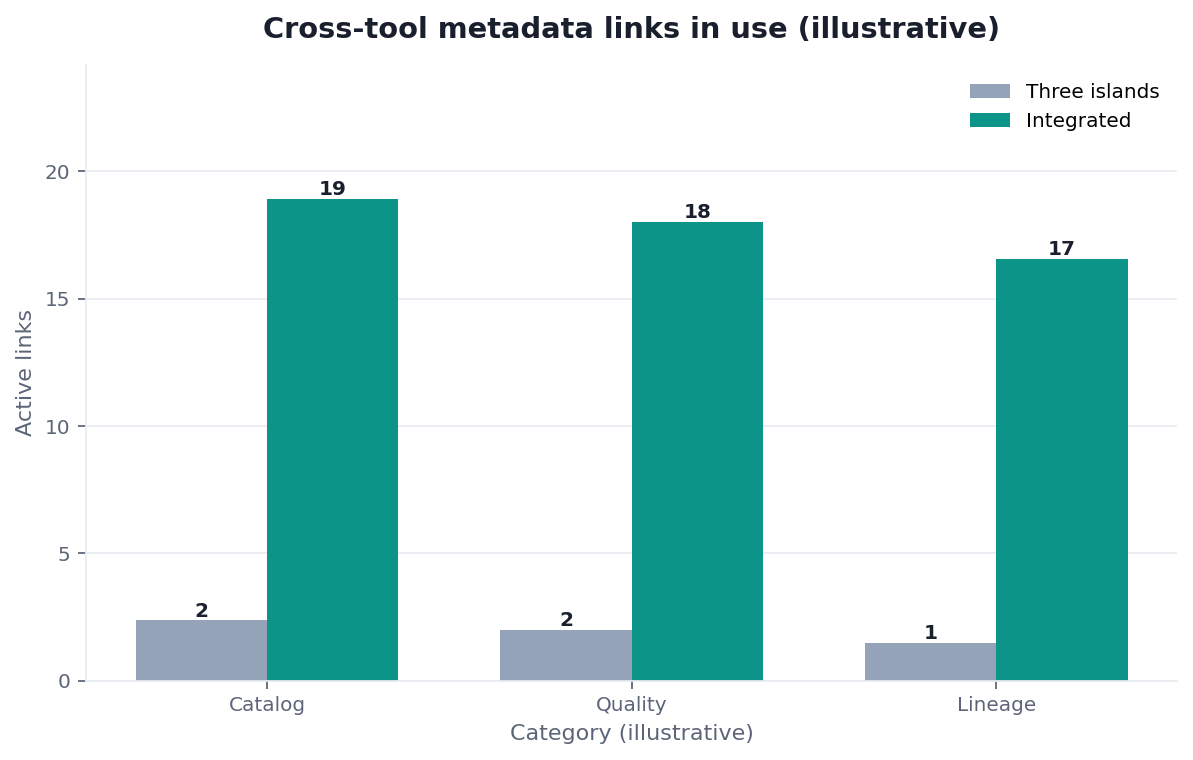
Practical example: a company bought three separate data governance solutions that did not integrate, leaving catalog, quality, and access as disconnected islands. A peer chose an integrated approach guided by enterprise patterns in Python documentation, and their metadata actually connected. Integration, not the number of products, determined success.
Scope note: This guide reflects patterns we see when mid-market and enterprise teams work with data governance solutions in 2026. It is not a substitute for legal counsel, vendor runbooks, or a formal survey of every industry — and when a smaller toolset or lighter process would serve, a full program is overkill.
What They Are
Core definitions remain usefully summarized in Wikipedia machine learning overview for shared vocabulary across stakeholders.
At their core, data governance solutions are how the capabilities of governance come together into a working whole. A solution is not one tool; it is the combination — products plus practices — that lets an organization govern its data end to end.
Key Definition: data governance solutions are the integrated combinations of tools, platforms, services, and practices that organizations use to govern data across catalog, lineage, access, quality, and policy, so that governance operates as a coherent whole rather than disconnected parts.
The distinction that matters is coherence. Individual tools are useful, but data governance solutions succeed or fail on how well the parts work together, because governance is inherently cross-cutting — a policy change should propagate to access, and lineage should inform quality. Disconnected excellence in each part still produces a broken whole.
What a Solution Includes
Core definitions remain usefully summarized in Wikipedia natural language processing overview for shared vocabulary across stakeholders.
A complete set of data governance solutions includes the core capabilities and the connective tissue between them.
Core capabilities
The core capabilities are catalog, lineage, access control, quality monitoring, and policy management. Any credible data governance solutions must cover these, whether through one platform or several integrated tools, and the architecture patterns at Azure architecture center show how a shared metadata layer lets these capabilities reinforce one another. The reinforcement is the point: lineage makes quality issues traceable to their source, the catalog gives access controls something to attach to, and policy ties them all to rules, so the capabilities are worth far more together than the sum of their parts.
Practices and roles
Beyond software, data governance solutions include the practices and roles that operate them — owners, stewards, and the processes that connect policy to enforcement. Risk framing from NIST Cybersecurity Framework underscores that technology without accountable roles is not a solution; it is an unmanned control panel.
Assembling an Approach
Governance and risk expectations are framed by NIST AI Risk Management Framework when programs need an external control reference.
Assembling data governance solutions starts with your existing stack and the capabilities you most lack. Rather than buying a monolith, most teams do better to identify their biggest gap — usually catalog or quality — and fill it in a way that integrates with what they already run. When the gap is quality, start from data quality tools.
The guiding principle is that data governance solutions should fit your data governance framework, not replace it. The framework defines the roles and policies; the solution enforces them. Assembling incrementally, capability by capability, produces an end-to-end approach that people adopt, whereas dropping in a monolith all at once produces a system nobody fully uses.
Sequencing matters as much as selection. We advise adding capabilities in the order that unlocks the most value with the least dependency: usually a catalog first, because everything else references the assets it inventories, then quality monitoring on those assets, then access controls and policy propagation once ownership is clear. Adding capabilities out of order — trying to enforce access before you have a catalog of what exists, for instance — creates rework and frustration. A deliberate sequence lets each new part build on a foundation the previous part established, so the overall approach grows steadily more capable rather than lurching between disconnected initiatives that never quite cohere into a working whole.
Build, Buy, or Blend
Architecture choices are often checked against Microsoft Excel support so boundaries, ownership, and scale patterns stay explicit.
The build-buy-blend decision defines most data governance solutions. Building gives control and fit but costs engineering time; buying gives speed but risks misfit; blending — building connective glue around bought capabilities — is where most successful teams land.
We recommend blending deliberately: buy the capabilities that are commoditized (catalog, monitoring) and build the integration that makes them cohere with your stack. This keeps data governance solutions both quick to stand up and well-fitted, avoiding the two failure modes of pure building (slow) and pure buying (disjointed). The right blend depends on your engineering capacity and how unusual your stack is.
Deployment and Cost
Deployment shapes which data governance solutions are even viable. Teams with strict data-residency or security requirements may need private or on-premise deployment, while others prefer SaaS for speed. Confirming deployment fit early avoids a painful migration later.
Cost, meanwhile, is dominated by integration and operation, not licenses. The total cost of data governance solutions includes the engineering to connect them and the human time to keep metadata current, so model three-year total cost of ownership across all parts rather than summing sticker prices. A cheap-to-license set of tools that is expensive to integrate and maintain often costs more than a pricier integrated platform.
Integration Is the Hard Part
If there is one lesson that separates successful data governance solutions from expensive disappointments, it is that integration — not any single capability — is the hard part. Each capability, taken alone, is a solved problem; there are good catalogs, good quality monitors, good access tools. The difficulty is making them behave as a coherent whole, so that a change in one is reflected in the others and an analyst or agent sees a consistent picture rather than contradictory metadata from disconnected systems.
This is why we caution against evaluating data governance solutions capability by capability in isolation. A set of best-of-breed tools that do not share metadata can be worse than a single adequate platform that does, because the gaps between disconnected tools are exactly where governance quietly fails — a definition updated in the catalog but not reflected in the quality checks, an access change that never propagates to lineage. When you assess an approach, spend most of your scrutiny on the seams: how does metadata flow between the parts, what happens when one part changes, and who is responsible when they disagree? The strongest data governance solutions are the ones whose parts were designed to talk to each other, or whose integration you have deliberately built and tested, rather than a collection assembled on the assumption that coherence would emerge on its own. It never does; coherence is engineered, and budgeting for that engineering up front is what turns a set of tools into an actual solution.
Solutions in the Age of AI
AI raises the value of coherent data governance solutions sharply. When an autonomous agent reads your data to answer questions, it relies on the whole governance apparatus — catalog, definitions, access, quality — working together; a gap anywhere produces unreliable answers. End-to-end coherence becomes the foundation of trustworthy automated analysis.
An AI-native platform closes the gap by binding governed definitions and controls to the data an agent queries, an approach we describe in what AI-native data analysis means. In the InfiniSynapse web app, governance context travels with the data, so the coherence of your data governance solutions directly determines whether AI answers can be trusted.
Selection Scorecard
Assess your data governance solutions (1 point each):
| Check | Pass? |
|---|---|
| Catalog and lineage are covered | |
| Access control is integrated | |
| Quality monitoring is connected | |
| Policy propagates to enforcement | |
| Parts actually integrate | |
| Roles and practices are defined | |
| Deployment matches compliance | |
| It supports AI/agent access |
6–8: coherent solution. 3–5: fix integration gaps. Below 3: start with your biggest capability gap.
Common Misconceptions
Misconception 1: A solution is one product. Data governance solutions are integrated combinations, not monoliths.
Misconception 2: More tools mean better governance. Integration matters more than count.
Misconception 3: Software is the whole solution. Roles and practices are part of it.
Misconception 4: License price is the cost. Integration and operation usually cost more.
Frequently Asked Questions
What are data governance solutions?
Data governance solutions are the integrated combinations of tools, platforms, services, and practices that organizations use to govern data across catalog, lineage, access, quality, and policy. A solution is not one product; it is the combination — software plus accountable roles and processes — that lets governance operate as a coherent whole rather than as disconnected parts.
What does a complete solution include?
It includes the core capabilities — catalog, lineage, access control, quality monitoring, policy management — plus the connective tissue between them and the roles and practices that operate them. Any credible solution must cover the core capabilities, whether through one platform or several integrated tools, and pair them with accountable owners and stewards.
How do you assemble an approach?
Start from your existing stack and your biggest capability gap, usually catalog or quality, and fill it in a way that integrates with what you already run. Assemble incrementally rather than dropping in a monolith, and ensure the solution fits your framework — which defines roles and policies — rather than trying to replace it.
Should you build, buy, or blend?
Most successful teams blend: buy commoditized capabilities like catalog and monitoring, and build the integration that makes them cohere with your stack. Pure building is slow; pure buying is disjointed. The right blend depends on your engineering capacity and how unusual your stack is, but deliberate blending avoids both failure modes.
How do solutions support AI?
When an agent reads your data to answer questions, it relies on the whole governance apparatus working together; a gap anywhere produces unreliable answers. End-to-end coherence becomes the foundation of trustworthy automated analysis, and an AI-native platform that carries governance context with the data ensures the solution's coherence directly improves agent reliability.
Conclusion
Data governance solutions are coherent, end-to-end combinations of tools and practices — not monoliths — and they succeed on integration and adoption. In 2026 that coherence is what makes AI analysis trustworthy. Assemble incrementally, blend build and buy, and match deployment to your compliance needs.
The organizations that succeed treat their governance approach as a system to be engineered for coherence, not a shopping list of capabilities to be checked off, and they budget for the integration work that makes the parts behave as one. To see how governance context travels with data into automated analysis, read what AI-native data analysis means and try the InfiniSynapse web app free on registration, no credit card required.