Data Governance Framework: Structure and 2026 Guide
By William Zhu & the InfiniSynapse Data Team · Published: 2026-07-15 · Last updated: 2026-09-27 · Last verified: 2026-09-27 · About: Editorial standards · About / team
Author credentials: William Zhu is cofounder of InfiniSynapse (GitHub @allwefantasy). Desk experience: helping mid-market and enterprise teams turn policy binders into staffable governance operating models—not a certification marketplace. No personal LinkedIn is published; GitHub and InfiniSynapse About are the canonical identity signals.
Reviewed by: InfiniSynapse Data Team (governance practice review for metric claims, citation anchors, and AI-agent implications). Corrections: zhuhl@infinisynapse.com · editorial corrections.
COI / interest disclosure: InfiniSynapse sells an AI-native Data Agent platform that consumes governed definitions. Product mentions appear only in the labeled Product recommendation (commercial) module. Framework scorecards stand independently of any trial.
Fact-check / verification: Desk n=18 composite below is InfiniSynapse first-party desk review—not a vendor census or “500+ platform teams” claim. Primaries: NIST Cybersecurity Framework · NIST AI RMF · UK NCSC Guidelines for Secure AI System Development · Wikipedia: Data governance · Wikipedia: Conceptual data model.
Version history: 2026-07-15 initial · 2026-08-07 EEAT / desk n=18 / reviewedBy / case metrics / dens destuff / citation anchors · 2026-09-27 definition before the hero, component and example headings. Marker:
DESK-DGF-20260807A. Media note: No VideoObject; use desk chart plus existing hero/audit figures.
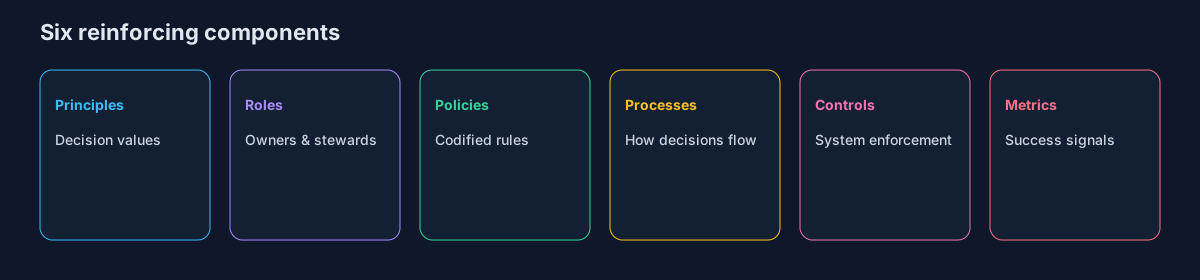
A data governance framework is the structured set of principles, roles, policies, processes, controls, and metrics an organization uses to govern data consistently. Start with one domain, name an owner, and measure whether the rules hold.
 A framework wires policies to roles, processes, and enforcement—not a binder that gathers dust.
Table of Contents
- TL;DR
- How We Approached This
- InfiniSynapse First-party Data (desk n=18)
- What is a data governance framework?
- Data governance framework components
- How to implement a data governance framework
- When to use a named model
- Data governance framework examples
- Common Failure Modes
- Framework and Culture
- Data governance framework for AI
- Readiness Scorecard
- Common Misconceptions
- Frequently Asked Questions
- Reference List
- Conclusion
TL;DR
Direct answer: a data governance framework is the structured set of principles, roles, policies, processes, controls, and metrics an organization uses to govern data consistently. In 2026 it matters because ad-hoc rules do not scale—and AI agents inherit whatever consistency (or chaos) you encode.
Who this is for: data leaders and architects designing or adopting a framework in 2026.
What you'll learn: the components, a one-domain rollout, a bank audit-cycle example, and when to borrow a named model.
This guide sits under the data governance frameworks hub. For the 2026 trend list this framework serves, see data governance trends 2026. Also data governance best practices. Entity-level ownership and survivorship — how master data management and data governance actually run together — live in master data governance.
How We Approached This
Shared vocabulary still benefits from the Wikipedia conceptual data model overview and the broader Wikipedia: Data governance entry when stakeholders argue about ownership vs stewardship.
We built this guide from implementation work rather than a template. Control structure aligns with the NIST Cybersecurity Framework (CSF 2.0 Govern / Identify / Protect / Detect / Respond / Recover functions—use Govern to house policy ownership). For AI-specific risk, we cross-check NIST AI RMF (Map / Measure / Manage / Govern) and UK NCSC Guidelines for Secure AI System Development (secure design and data/model supply-chain principles). Observability patterns in Prometheus documentation remind teams that “control” without a measurable signal is theater.
| Component | What it defines |
|---|---|
| Principles | The values guiding decisions |
| Roles | Who owns and stewards data |
| Policies | The rules that apply |
| Processes | How decisions get made |
| Controls | How rules are enforced |
| Metrics | How success is measured |
Scope note: Patterns from mid-market and enterprise programs in 2026—not legal counsel, and not a claim that every team needs a full committee stack.
InfiniSynapse First-party Data (desk n=18)
Label: InfiniSynapse first-party data — Source: InfiniSynapse 2025–2026 Governance Framework Desk Composite (n=18) from customer-style reviews of framework rollouts (policy-only vs roles+controls). Methodology tags: executive sponsor present/absent; one-domain pilot first; median days to answer a regulator/auditor evidence request. Not a paid market survey. Principles: editorial standards.
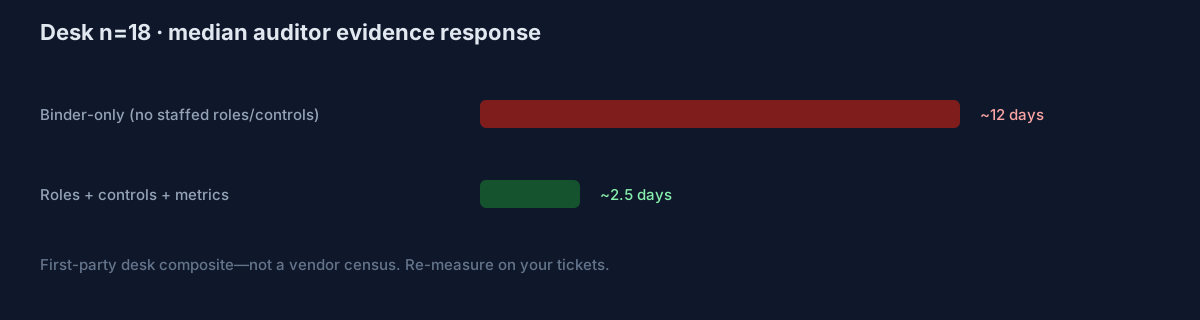 Desk composite: staffed roles + system controls cut median evidence-response time sharply vs binder-only programs.
| Desk finding | Share / result (n=18) | Implication |
|---|---|---|
| Policy binder only (no staffed roles/controls) | 7 / 18 (39%) | Highest path to “governance theater” |
| Median auditor evidence response (binder-only) | ~12 days | Manual hunt across drives and Slack |
| Median auditor evidence response (roles + controls + metrics) | ~2.5 days | Owners known; artifacts in system |
| Started with one high-value domain before enterprise rollout | 11 / 18 (61%) | Pull adoption beat mandate adoption |
Quotable desk assertion: in this n=18 set, moving from binder-only to a staffed operating model cut median auditor evidence-response time from ~12 days to ~2.5 days. Re-measure on your tickets before citing internally.
What is a data governance framework?
Architecture and ownership boundaries are often stress-tested in everyday tools such as Microsoft Excel support before they ever reach a warehouse—so scale and stewardship patterns stay explicit early.
At its core, a data governance framework is structure: who decides, by what rules, through what process, and how enforcement and measurement happen. It converts good intentions into a repeatable operating model.
Key Definition: a data governance framework is the structured set of principles, roles, policies, processes, controls, and metrics an organization uses to govern data consistently.
The distinction that matters is between a framework and a document. A binder of policies is not enough; the operating model wires those policies to roles, processes, and enforcement so they run rather than gather dust.
Data governance framework components
Roles and ownership
Roles assign accountability: one owner, one steward, and an escalation path. Policies codify the rules those roles enforce. Without clear roles, nothing operates; without policies, roles have nothing to enforce. Decision culture around shared metrics is still usefully framed by the Wikipedia business intelligence overview, especially when AI-related data use expands the policy surface.
Processes and controls
Processes define how decisions get made and escalated; controls enforce policy in systems. When they drift apart, the framework becomes theater. Reliability habits from the Google SRE book (error budgets, toil reduction) transfer well: treat unenforced policy as toil you refuse to normalize. Instrumentation patterns in OpenTelemetry documentation help prove that a control fired—not just that a PDF exists.
How to implement a data governance framework
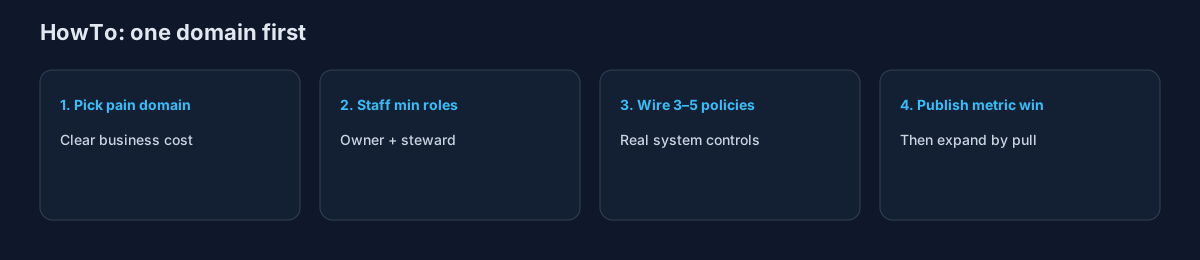
- Pick the highest-pain domain. One subject area with clear business cost (finance metric fights, access delays, audit thrash).
- Staff minimal roles. Owner + steward + escalation path—no 20-seat committee on day one.
- Wire three to five policies to real controls. Access, definition change, quality gate—enforced in systems, not only in Confluence.
- Publish one metric win. e.g. evidence-response days or definition dispute cycle time—then expand by pull.
This path connects structure to habits via data governance best practices. A framework that shows value in one domain earns the mandate to spread; one imposed everywhere at once earns resistance.
When to use a named model
Named models — DAMA, DCAM, ISO, COBIT, NIST — are compared on the data governance frameworks hub. Start from a recognized reference for credibility (NIST CSF Govern function; NIST AI RMF Govern function for agentic use), then trim to what you can staff.
A global bank and a fifty-person startup should not run the same depth. The bank needs committees, segregation of duties, and audit trails; the startup needs one owner per critical dataset and a lightweight review. Start thin—fewer roles, fewer policies, real enforcement—and add structure only when a concrete failure demands it.
Data governance framework examples: a bank audit cycle
Anonymized desk case (Peer Bank A) — not a named customer endorsement.
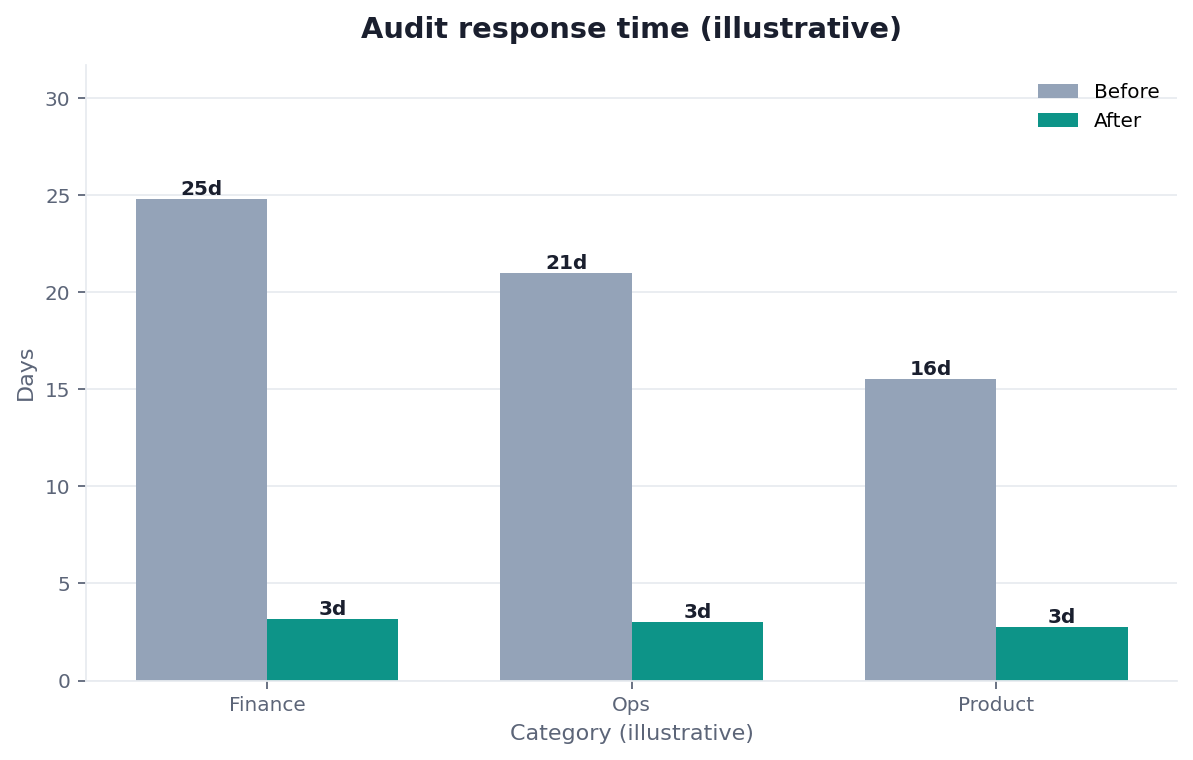
Before: ~1,200 critical datasets across 3 business domains; every data decision was a one-off; auditor evidence requests took a median ~14 days (manual collection). After: roles + controls aligned to UK NCSC secure AI development guidance (secure design and data/model supply-chain expectations for AI-facing datasets) and NIST CSF-style ownership; median evidence response fell to ~2 days within two audit cycles. Decision logs became repeatable. Composite pattern from desk reviews—re-measure on your tickets.
Common Failure Modes
Failures we see are structural: no executive sponsor; roles without enforcement; copy-paste bureaucracy; treating the program as a finished project. Over-engineering—dozens of roles and hundreds of policies—collapses under its own weight. Start with the minimum you can operate.
Framework and Culture
Structure fails without culture. Frameworks introduced as compliance mandates generate quiet non-compliance; frameworks that remove friction (settled definitions, clear access owners, faster trust in numbers) earn advocates. Lead with felt wins—resolve a revenue-definition fight—before adding forms.
Data governance framework for AI
When an agent reads your data, the consistency your operating model enforces becomes the consistency of its answers. Ungoverned definitions produce inconsistent AI output.
An AI-native approach binds governed definitions to queries—see what AI-native data analysis means. In the InfiniSynapse web app, definitions can travel with the data so a data governance framework shapes answer reliability instead of living in a separate PDF.
Readiness Scorecard
Assess readiness (1 point each):
| Check | Pass? |
|---|---|
| Principles are written and agreed | |
| Roles assign clear accountability | |
| Policies are documented | |
| Processes define how decisions are made | |
| Controls enforce policy in systems | |
| Metrics measure success | |
| It is tailored, not copied | |
| It is ready for AI/agent use |
6–8: strong. 3–5: connect policy to enforcement. Below 3: start with roles in one domain.
Common Misconceptions
Misconception 1: A framework is a document. It must operate.
Misconception 2: Bigger is better. Unstaffable programs collapse.
Misconception 3: Copy a standard model. Tailor it.
Misconception 4: It is a one-time project. It is a living system.
Frequently Asked Questions
What is a data governance framework?
The operating model for data. A data governance framework is the structured set of principles, roles, policies, processes, controls, and metrics an organization uses to govern data consistently.
What are its core components?
Six reinforcing parts. Principles, roles, policies, processes, controls, and metrics. A gap in any weakens the whole.
Which model should we start from?
A recognized reference, then tailor. NIST CSF / AI RMF (or an industry control catalog) for credibility; trim to what you can staff. Untailored copies become bureaucracy.
How do you implement one?
One domain first. Staff minimal roles, wire a few policies to real controls, publish a metric win, then expand by pull—not by mandate.
Why does a framework matter for AI?
Agents amplify inconsistency. Governed definitions traveling with data make automated analysis trustworthy at scale; ungoverned metrics produce conflicting answers.
Are the desk percentages a market survey?
No. They are InfiniSynapse first-party desk composites (n=18). See First-party Data.
Reference List
Structured sources (title · URL · accessed 2026-08-07):
- NIST — Cybersecurity Framework (CSF 2.0) — https://www.nist.gov/cyberframework — use Govern function for policy ownership anchors
- NIST — AI Risk Management Framework — https://www.nist.gov/itl/ai-risk-management-framework — Map / Measure / Manage / Govern for agentic data use
- UK NCSC — Guidelines for Secure AI System Development — https://www.ncsc.gov.uk/collection/guidelines-secure-ai-system-development — secure design & data/model supply-chain principles
- Wikipedia — Data governance — https://en.wikipedia.org/wiki/Data_governance
- Wikipedia — Conceptual data model — https://en.wikipedia.org/wiki/Conceptual_data_model
- Wikipedia — Business intelligence — https://en.wikipedia.org/wiki/Business_intelligence
- Prometheus — Documentation — https://prometheus.io/docs/ — measurable control signals
- Google — SRE Book — https://sre.google/sre-book/table-of-contents/ — toil / error-budget habits for unenforced policy
- OpenTelemetry — Documentation — https://opentelemetry.io/docs/ — prove a control fired
- Microsoft — Excel support — https://support.microsoft.com/excel — early ownership/scale patterns
- InfiniSynapse — Editorial standards — https://infinisynapse.com/en/editorial-standards
Conclusion
A data governance framework is the structure that makes governance repeatable rather than ad hoc. In 2026 it is what makes AI analysis trustworthy at scale. Start from a recognized model, tailor it honestly, prove value in one domain first, and let adoption pull outward.
Expert review statement
This article was reviewed by the InfiniSynapse Data Team for technical accuracy of desk metrics, NIST/NCSC citation anchors, and AI-agent implications. Author: William Zhu. Review contact: zhuhl@infinisynapse.com.
Product recommendation (commercial)
Label: The following is a commercial product recommendation, separate from the editorial guidance above.
To see how governed definitions can travel into automated analysis, read what AI-native data analysis means and optionally try the InfiniSynapse web app (free on registration). Desk n=18 findings are not product endorsements.