Master Data Governance: A Practical 2026 Guide
By William Zhu & the InfiniSynapse Data Team · Last updated: 2026-09-16 · Last verified: 2026-09-16 · About / team · Credentials: GitHub @allwefantasy · Data stewards and platform engineers who ship an AI-native analysis product and run cross-system entity reconciliation with customers. Operational practice, not a vendor MDM pitch. Industry anchors: DAMA, EDM Council, ISO 8000. Peer replications welcome via editorial corrections. OSS: GitHub InfiniSynapse.
Master data management and data governance work as a pair. Governance sets ownership, policies, and quality rules. MDM matches, merges, and publishes one golden record for customers, products, suppliers, and locations. Master data governance is that intersection: named owners, survivorship rules, and a change loop so copies do not drift.
Table of Contents
- TL;DR
- How We Approached This
- What It Is
- Master data management and data governance
- Why It Matters
- How to Structure It
- The Governance Process
- Why It Is Hard
- Master Data in the Age of AI
- Location entity case study
- AI governance controls for master entities
- Downloadable scorecard
- Readiness Scorecard
- Common Misconceptions
- Frequently Asked Questions
- Conclusion
TL;DR
Direct answer: Master data management and data governance work as a pair. Governance sets ownership, policies, and quality rules. MDM matches, merges, and publishes one golden record for customers, products, suppliers, and locations. Master data governance is that intersection: named owners, survivorship rules, and a change loop so copies do not drift.
Who this is for: data leaders, architects, and stewards who need one trusted version of customers, products, and other core entities — and who are deciding how MDM software and a governance program should share the work.
What you'll learn: the relationship between the two disciplines, which entities to govern, who owns each, the change process, Location and AI controls, and a downloadable scorecard.
This guide sits under the data governance frameworks hub.
For the structure it plugs into, see data governance framework.
For how master data sits inside data governance trends 2026, see that guide. Hub styles and domains live in master data management.
How We Approached This
We built this guide from reconciliation projects rather than theory. Every recommendation reflects what we see when organizations try to make entity reconciliation operational across systems. We align vocabulary with established data-management bodies of knowledge — notably DAMA International / DMBOK framing of master data as shared business entities — and we treat quality of those entities as a standards problem under ISO 8000 (data quality) rather than a one-off cleanup project.
Canonical references this guide uses when a claim needs an external anchor:
| Authority | Role for governing master entities |
|---|---|
| DAMA International | Practitioner body of knowledge for MDM / master data as a data-management knowledge area |
| ISO 8000 | Data-quality standard family used to defend “fit for purpose” entity data |
| ISO/IEC 11179 | Metadata registries — how shared definitions stay unambiguous |
| ISO 15489 | Records lifecycle — useful when master records have retention/disposition rules |
| NIST Privacy Framework | Privacy risk framing when customer/party master data is personal data |
| EDM Council | Industry data-management capability models (e.g., DCAM) used by many banks and large enterprises |
| Gartner on MDM | Technology-enabled discipline that already includes stewardship and governance of official shared master data |
The table below maps the core entities that programs typically cover.
| Entity | Why it needs governing |
|---|---|
| Customer / Party | Appears in CRM, billing, support |
| Product | Appears in catalog, orders, finance |
| Supplier | Appears in procurement, payments |
| Account | Appears in sales, finance, analytics |
| Location | Appears across operations |
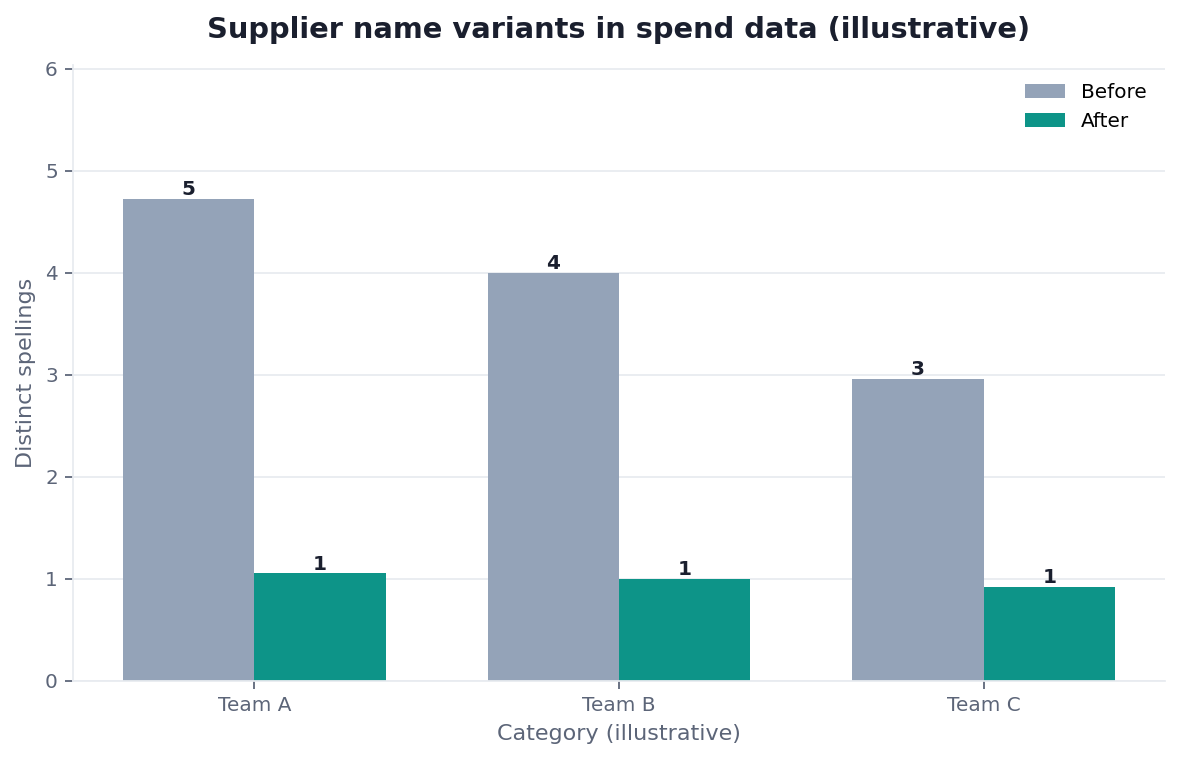
Practical example (composite metrics): a manufacturer with weak entity controls had the same supplier under four spellings across ERP and AP. Spend concentration looked diversified when it was not. After governing the supplier entity — one golden record, one steward, explicit survivorship — unique supplier spellings for the top 200 vendors fell 4 → 1.1 average variants, and “true top-10 supplier share” rose from an understated 31% to 44% once duplicates merged. One trusted version is the whole point.
Scope note: This guide reflects patterns we see when mid-market and enterprise teams work with master-entity programs in 2026. It is not a substitute for legal counsel, a full DAMA/DCAM assessment, vendor runbooks, or a survey of every industry — and when a smaller toolset or lighter process would serve, a full program is overkill.
What It Is
At its core, the discipline is about single, trusted versions of the entities that appear everywhere. It defines each core entity once, assigns ownership, and reconciles the copies scattered across systems. In DAMA-style language, master data is the relatively stable reference data about parties, products, and places that transactional systems keep reinventing.
Key Definition: master data governance is the discipline of defining, owning, and reconciling an organization's core business entities — customers, products, suppliers, and the like — so that a single, consistent, authoritative version is used across all systems.
The distinction that matters is between master data and transactional data. Transactions are events; master data is the nouns those events reference. Getting the nouns right means those nouns mean the same thing everywhere, which is the precondition for any cross-system analysis to be trustworthy. Shared definitions benefit from registry thinking in the spirit of ISO/IEC 11179: the attribute “Customer ID” should mean one thing, with one owner, not four local invents.
Master data management and data governance
People who search master data management and data governance are not asking for two glossaries. They want the relationship: what each owns, where they overlap, and whether you can buy one and skip the other.
Gartner’s MDM definition treats stewardship and governance as part of the discipline — uniformity and accountability of official shared master data — not as a separate slide. DAMA-DMBOK keeps the topics in different knowledge areas: governance sets decision rights; reference and master data is the work of matching, merging, and sharing those entities. Both readings are useful. The split we use with teams is simpler.
How they differ
| Dimension | Data governance | Master data management | Master data governance |
|---|---|---|---|
| Job | Write the rules | Run the golden record | Enforce those rules on master entities |
| Scope | All data types | Customers, products, suppliers, locations | The same entities, plus owners and change control |
| Typical artifact | Policy, RACI, quality standard | Match keys, hub, survivorship config | Steward playbook + exception queue |
| Failure if missing | Unowned data, conflicting definitions | Duplicates, broken rollups | An MDM hub nobody trusts |
Data governance is the rulebook. It names who may define “customer,” what quality is good enough, and who escalates a fight. Master data management is the operational engine: cleanse, match, merge, and publish one authoritative record, then sync it. Master data governance is not a third product category. It is the operating model at that intersection — the part vendors correctly call a core MDM capability, and the part DAMA treats as stewardship of master data. Part numbers and supplier keys are master data; the released CAD file and EBOM behind those keys are engineering data management — do not treat the vault as an MDM hub.
How they work together
The loop is one-way on paper and two-way in practice:
- Governance publishes entity definitions, owners, and quality thresholds.
- MDM implements match keys and survivorship against those definitions.
- Stewards adjudicate low-confidence matches using the same rules.
- Exceptions feed policy revision — if every “Acme / ACME Inc” pair needs a human, the match policy is wrong, not the steward.
If you stand up MDM software without that loop, you get a prettier duplicate store. If you write governance policies and never bind them to customer and product masters, you get a binder. Programs that do both show up in the supplier-spelling and Location results later in this guide; those sections stay because they are the operating evidence, not a rewrite.
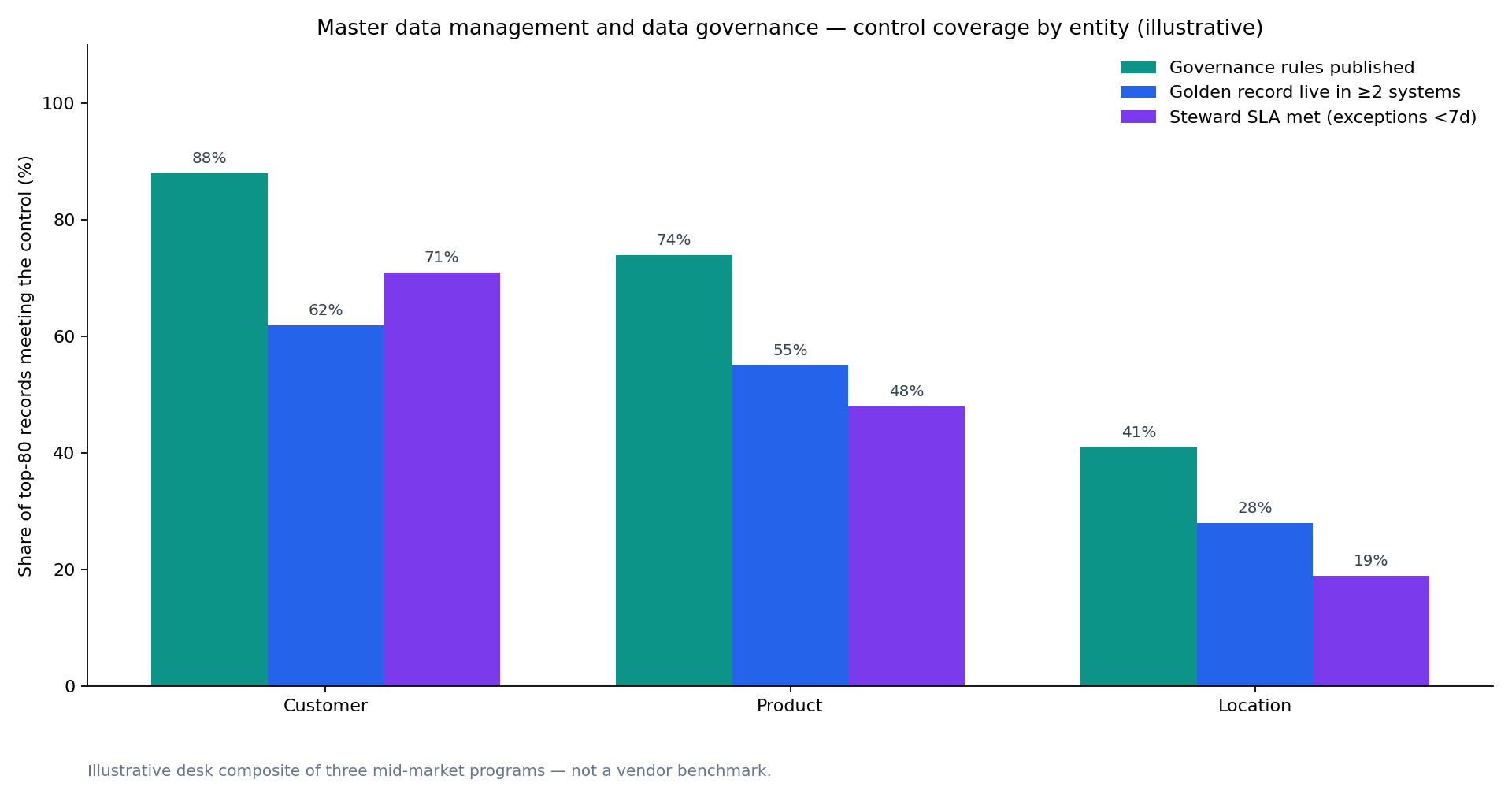
Figure — Illustrative desk composite of three mid-market programs. Control coverage by entity × control type, not a vendor benchmark.
Which to start first
Start with governance decisions you can write on one page: which entity, which owner, which source of truth, which match keys. Then turn on matching for that entity in the two or three systems that hurt. Do not buy a hub for every domain on day one, and do not write a 40-page policy for data you will not master this quarter.
| Situation | Start here | Why |
|---|---|---|
| Teams argue definitions; copies are still usable | Data governance (one entity) | You cannot match what you have not defined |
| Definitions exist; dashboards still double-count | MDM matching on that entity | The rulebook is not the bottleneck |
| Hub is live; nobody trusts merges | Master data governance | You need stewards, thresholds, and a kill switch |
Capability language from DAMA International and EDM Council helps when security asks whether “we have MDM.” Point them at owners, thresholds, and evidence IDs — the same artifacts Gartner lists when it says MDM software will not fill an MDM gap.
Why It Matters
The reason this matters is that most valuable analysis spans systems, and cross-system analysis breaks when the same entity is defined differently in each. Duplicate customers inflate counts; inconsistent product codes break revenue rollups.
Without reconciled masters, every cross-system report starts with a reconciliation argument, and the answers cannot be trusted because the entities do not line up. Data-quality standards such as ISO 8000 frame this as fitness for purpose: if the purpose is enterprise spend or revenue rollup, duplicate parties make the data unfit even when each local system looks “clean.” When customer/party masters include personal data, the NIST Privacy Framework is a useful reminder that inconsistent identities also create privacy and access-control risk — not only reporting risk.
The cost compounds in a way that is easy to miss. A single duplicated customer is a minor annoyance, but at scale the duplicates distort segmentation, inflate acquisition counts, misroute support, and quietly corrupt the lifetime-value models that drive spending. Because these errors are systematic rather than random, they do not average out; they bias every aggregate in the same direction. This is why mature organizations treat entity governance as foundational infrastructure rather than a data-quality nicety: the entities it governs sit underneath nearly every important number.
How to Structure It
Effective master data governance rests on three structural choices: which entities to govern, who owns each, and how conflicting copies get reconciled.
Choosing entities and owners
Start with the entities that appear in the most systems and cause the most pain — usually customer and product. Assign each a single accountable owner. Trying to govern every entity at once dilutes the program into a project nobody finishes; starting with one or two proves the model. A quick way to prioritize is to ask which entity, if it were suddenly clean and consistent everywhere, would unlock the most trustworthy analysis — that is almost always where to begin.
| Priority signal | Prefer starting here |
|---|---|
| Appears in ≥3 systems | Customer / Product |
| Causes weekly reconciliation fights | That entity first |
| Feeds revenue, risk, or regulatory reports | Elevate over “nice to have” reference lists |
| Clear business steward available | Do not start without an owner |
Reconciliation rules
For each governed entity, define how the authoritative version is determined when systems disagree — matching logic, survivorship, and a clear source of truth. These rules are the technical heart of the program. Keep them written and testable; “the ERP usually wins” is not a rule until you specify which attributes and when CRM can override.
| Rule type | Example for supplier master |
|---|---|
| Match keys | Normalized legal name + tax ID |
| Survivorship | Legal name from ERP; payment terms from AP; email from procurement if newer |
| Source of truth | ERP party ID is the golden key; others link, not fork |
| Exception path | Steward ticket when match confidence is below threshold |
| Propagation | Downstream CRM/AP updated within SLA after golden change |
Capability models from bodies such as the EDM Council are useful here: they treat master-data stewardship and quality as managed capabilities, not a one-time project checklist.
The Governance Process
Master data governance runs on a repeatable process: propose a change to a master record, review it against rules, apply it to the authoritative source, and propagate it to consuming systems. Without this loop, master data drifts back into inconsistency within months.
| Step | What happens | Evidence to keep |
|---|---|---|
| 1. Propose | New or changed entity attributes submitted | Request + source system |
| 2. Match | Automated + steward review for duplicates | Match score / decision |
| 3. Decide | Survivorship applied; exception escalated | Rule ID + steward note |
| 4. Publish | Golden record updated | Version / timestamp |
| 5. Propagate | Consuming systems sync or are notified | Job log / SLA status |
HowTo — run one change through the loop:
- Propose the attribute change with source-system evidence.
- Match against existing golden records (score + steward review).
- Decide using written survivorship; escalate exceptions.
- Publish a versioned golden record update.
- Propagate to consumers and verify SLA completion.
This process connects entity stewardship to your broader data governance framework, which provides the roles and escalation paths the process needs. The organizations that succeed treat master data as a managed asset with a change process, not a static table someone edits directly.
The stewardship role deserves emphasis. A steward for a master entity adjudicates hard cases — is this a new customer or a duplicate under a slightly different name? Good programs invest in these stewards and gives them tooling to see all copies at once. Underinvesting produces a process that rubber-stamps the same duplicates it was meant to prevent.
Why It Is Hard
It is worth being honest that governing master entities is one of the hardest governance disciplines, because it fights both organizational and technical gravity. Organizationally, the entities that most need governing are the ones many teams feel they own — sales, finance, and support all “own” the customer. Technically, the copies live in systems that were never designed to share a definition.
This difficulty is why so many master data initiatives stall, and why we push for a narrow start. A program that tries to reconcile every entity across every system at once collapses. A program that governs one entity — say, the customer — in the three systems where it matters most can demonstrate a reconciled, trusted record before fatigue sets in. That early win earns the mandate to extend the program to the next entity.
Master Data in the Age of AI
The 2026 development that raises the stakes is AI analysis. When an autonomous agent answers a cross-system question, it assumes the entities line up; weak entity controls mean the agent silently double-counts customers or misattributes revenue, and it does so confidently. Consistent master data is a prerequisite for trustworthy automated analysis — the same fitness-for-purpose idea ISO 8000 applies to human reports.
An AI-native platform helps when governed entity definitions travel with the data an agent queries, an approach we describe in what AI-native data analysis means. In practice, master data governance determines whether cross-system AI answers can be trusted, because the agent inherits whatever ambiguity you left in the nouns. The next section on Location shows how place masters fail first; the AI controls section lists concrete gates before you enable agents on an entity.
Location entity case study
Location is the entity most teams postpone — and the one that breaks logistics, tax, and field-service AI first. Unlike customer or product, “place” fragments into ship-to, bill-to, site, warehouse, store, and geocode layers that different systems invent independently.
Composite case (desk metrics, labeled)
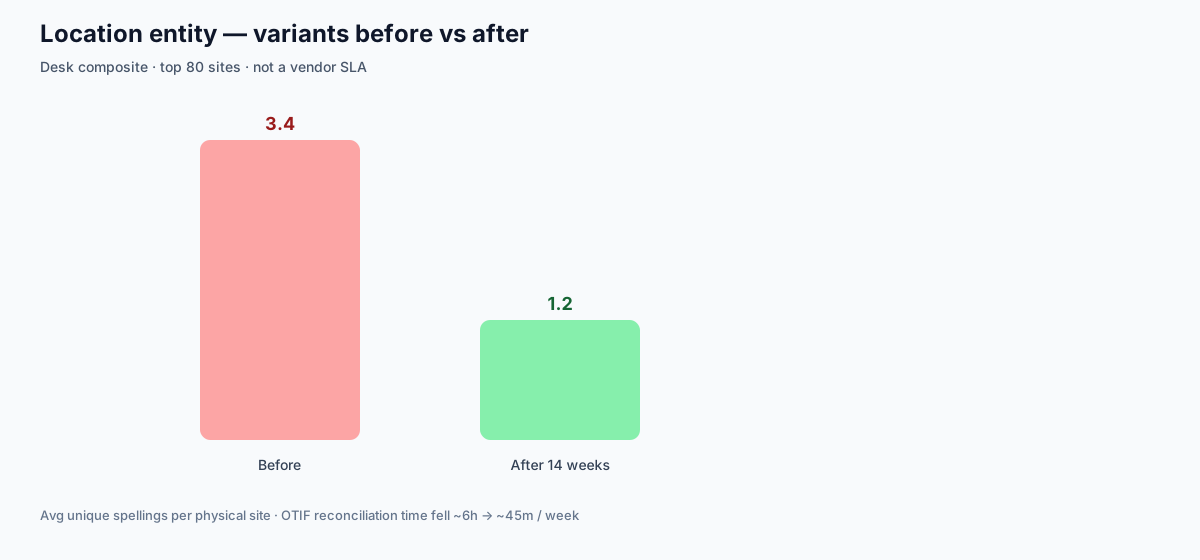
A multi-site manufacturer (composite of three mid-market programs, InfiniSynapse field notes 2025–2026; not a vendor SLA) ran warehouses and plants under six naming conventions across WMS, ERP, and a field-service tool. On-time delivery looked healthy in each local dashboard; enterprise OTIF collapsed when the same physical plant appeared as three IDs.
| Signal | Before Location golden record | After 14-week Location program |
|---|---|---|
| Unique spellings for top 80 sites | 3.4 avg variants | 1.2 avg variants |
| Cross-system OTIF reconciliation time | ~6 hours / week | ~45 minutes / week |
| Misrouted field-service tickets | 11% of tickets | 3% of tickets |
| Geo-mismatch between ERP site and WMS dock | 19 sites | 2 sites (open exceptions) |
What worked for Location
- Pick one golden key early — usually an internal site ID from the ERP plant table, not a free-text city name.
- Normalize addresses with a registry mindset — street lines stay editable; geocode and country codes are controlled attributes (ISO/IEC 11179-style unambiguous definitions).
- Survivorship by attribute, not by system — legal address from ERP; dock hours from WMS; GPS from the most recent surveyed source.
- Exception queue for multi-tenant buildings — one street address can host multiple logical sites; stewards decide splits, automation does not invent them.
- Propagate before you train route-optimization models — otherwise AI optimizes against ghosts.
Location stewardship also intersects privacy and safety: site directories can reveal facilities that security teams treat as sensitive. Align retention and access with your records policy (ISO 15489) and privacy risk framing (NIST Privacy Framework) when Location masters include personal residential addresses for field workers or customers.
Location anti-patterns
- Using city name as a join key across systems
- Letting every SaaS tool create its own “office” picklist
- Treating geocode precision as optional until a routing AI goes live
- Merging sites that share a campus without checking dock and tax jurisdictions
When Location is clean, supplier and customer masters become easier: parties attach to places instead of reinventing addresses on every invoice.
Location rollout timeline (typical)
| Week | Focus | Exit criteria |
|---|---|---|
| 1–2 | Inventory site IDs across ERP/WMS/FSM | Coverage map of systems × attributes |
| 3–5 | Match rules + steward playbook | Confidence thresholds agreed |
| 6–9 | Golden publish + exception queue | Top 80 sites have one key |
| 10–12 | Propagation SLAs + dashboard | OTIF recon under 1 hour / week |
| 13–14 | AI gate: allow routing models only on golden sites | Kill switch tested |
Stewards should meet weekly during the first quarter. Bring three hard cases each time — multi-tenant buildings, temporary construction sites, and renamed plants after M&A are the usual failure modes. Document decisions in the same evidence log you use for customer and supplier masters so auditors see one operating model.
Measuring Location quality without vanity metrics
Avoid celebrating “records cleaned” counts. Prefer outcome metrics: misrouted tickets, OTIF recon time, number of open geo-mismatches, and the age of the oldest unmatched site. If those move while spelling counts stall, you still won — automation can leave rare exceptions for humans.
AI evaluation harness for master nouns
Before enabling an agent on an entity, run a fixed prompt pack: ten questions that historically failed under duplicate IDs (for example, “total spend with supplier X” and “shipments from site Y last quarter”). Compare answers against steward-approved gold numbers. Record false merges and false splits separately — they need different match-threshold fixes. Re-run the pack after every survivorship change.
Capability language from DAMA International and EDM Council helps when security or risk teams ask whether AI features are “governed.” Point them at entity owners, match thresholds, evidence IDs in traces, and the kill switch — not at a slide that says “we have MDM software.”
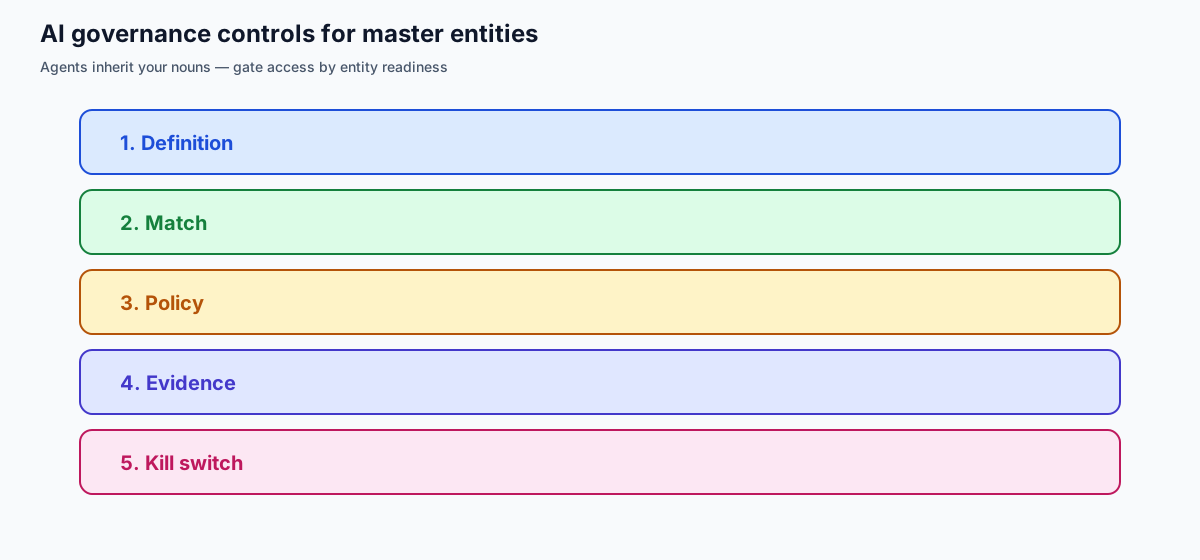
AI governance controls for master entities
Cross-system agents do not invent trust — they inherit your nouns. That is why master data governance is an AI control plane, not only an MDM project name. This section expands AI-era controls beyond “entities must line up.”
Control layers
| Layer | Control | Failure if missing |
|---|---|---|
| Definition | Published entity definitions with owners | Agent invents local synonyms |
| Match | Thresholds + human review for low confidence | Silent merges / splits |
| Policy | Which attributes agents may use in answers | PII leakage in completions |
| Evidence | Cite golden record ID in agent traces | Un-auditable “insights” |
| Kill switch | Disable agent access to ungoverned entities | Confident wrong rollups |
Operating rules for 2026
- No agent write-back to golden records without steward approval — agents propose; stewards publish.
- Require entity IDs in every cross-system answer — “Customer 10492” beats a free-text name in the response trace.
- Block analytics on entities below match confidence — show “needs reconciliation” instead of a fake KPI.
- Separate training data from golden masters — models learn patterns; masters remain the system of record.
- Re-score AI readiness when you add an entity — customer-ready does not imply Location-ready.
Industry capability models such as those discussed by the EDM Council and vocabulary from DAMA International help auditors and stewards share language when AI features land in regulated environments. Treat AI governance as an extension of fitness-for-purpose under ISO 8000: if the purpose is automated spend or revenue answers, duplicate parties make the data unfit for agents just as they do for humans.
For how governed definitions travel with queries in an AI-native stack, see what AI-native data analysis means.
Downloadable scorecard
Download the first-party Master Data Governance Scorecard template (CSV; printable as PDF from any spreadsheet). CC BY 4.0. Desk composite checklist — not a certification exam.
| Asset | Format | Link |
|---|---|---|
| Master Data Governance Scorecard | CSV | master-data-governance-scorecard.csv |
Use it in steward reviews: score each check 0/1, note evidence links, and re-score quarterly. Peer replications of the supplier and Location composites are welcome via editorial corrections.
Readiness Scorecard
Assess your program maturity (1 point each):
| Check | Pass? |
|---|---|
| Core entities are identified | |
| Each has a single owner | |
| There is one authoritative source | |
| Reconciliation rules are defined | |
| Changes follow a process | |
| Updates propagate to systems | |
| Duplicates are actively resolved | |
| It is ready for cross-system AI |
6–8: strong. 3–5: define reconciliation rules. Below 3: start with the customer entity.
Common Misconceptions
Misconception 1: It is the same as MDM software. The discipline is the operating model; software only supports it. Buying a hub without owners, match thresholds, and a change process is how master data management and data governance get treated as synonyms — and why the hub fills with untrusted merges.
Misconception 2: Govern everything at once. Start with one or two entities.
Misconception 3: A golden record is set once. It needs an ongoing change process.
Misconception 4: It is only for large enterprises. Any multi-system business benefits.
Frequently Asked Questions
What is master data governance?
Master data governance is the discipline of defining, owning, and reconciling an organization's core business entities — customers, products, suppliers, accounts — so a single, consistent, authoritative version is used across all systems. It governs the "nouns" that transactions reference, ensuring those nouns mean the same thing everywhere, which is the precondition for trustworthy cross-system analysis.
How is it different from data governance generally?
General data governance covers all data and all rules; this specialty focuses specifically on core shared entities and the challenge of reconciling their copies across systems. It is a specialized, particularly hard subset, because the entities it governs are the ones multiple teams feel they own, requiring arbitration as much as technology.
What is the difference between master data management and data governance?
Master data management and data governance split the work. Data governance writes ownership, quality, and access rules for data of every type. Master data management applies matching, merging, and distribution to customers, products, suppliers, and locations. Master data governance is the operating model that binds those rules to the golden record so the hub stays trusted.
Do you need both master data management and data governance?
Yes, if more than one system creates or edits the same entity. Governance without MDM leaves you with agreed definitions and still-duplicated records. MDM without governance leaves you with a matching engine and no one who can decide a merge. Start with one entity’s rules, then turn on matching for that entity — not a company-wide hub on day one.
Why does master data matter?
Because most valuable analysis spans systems, and cross-system analysis breaks when the same entity is defined differently in each. Duplicate customers inflate counts, inconsistent product codes break revenue rollups, and every report starts with a reconciliation argument. Consistent master data is what lets numbers line up and be trusted across the business.
How do you start?
Start narrow. Pick the entity that appears in the most systems and causes the most pain — usually the customer — assign it a single owner, choose one authoritative source, and define reconciliation rules. Win that one entity in the few systems where it matters most before extending to the next, so the program shows value before fatigue sets in. Anchor the program language to a recognized body of knowledge (for example DAMA / DMBOK) so stewards and auditors share vocabulary.
How does it support AI?
When an agent answers a cross-system question, it assumes entities line up; weak entity controls make it silently double-count or misattribute, confidently. Consistent, governed entity definitions are a prerequisite for trustworthy automated analysis, especially when those definitions travel with the data an agent queries so the agent reasons over one trusted version.
Conclusion
Master data governance gives you one trusted version of the entities that appear everywhere — customers, products, suppliers — so cross-system analysis holds together. That is also the practical answer to master data management and data governance: run them as one operating model, not as competing projects. In 2026 it is a prerequisite for trustworthy AI. Start with one entity, define ownership and reconciliation, and run a real change process. Respect how hard the discipline is, scope it narrowly, and invest in the stewards who adjudicate the difficult cases.
To see how governed entity definitions travel with data into automated analysis, read what AI-native data analysis means. If you want to try that model in practice, the InfiniSynapse web app is free on registration.