Data Governance Trends 2026: Seven Shifts That Change the Program
By William Zhu & the InfiniSynapse Data Team · Published: 2026-07-15 · Last updated: 2026-09-26 · About: Editorial standards · About / team
Author credentials: William Zhu is cofounder of InfiniSynapse (GitHub @allwefantasy; org GitHub InfiniSynapse). Desk experience: weekly enablement with mid-market governance and analytics teams—ownership, definition reconciliation, and AI-agent readiness. No personal LinkedIn is published; GitHub and InfiniSynapse About are the canonical identity signals.
COI / interest disclosure: InfiniSynapse publishes this guide and ships a Data Agent that binds governed definitions and access rules to queries. Trend judgments below cite EUR-Lex, NIST, ISO, and OECD primaries first. Product CTA is labeled commercial and kept separate from the evaluation tables.
Version history: 2026-07-15 initial · 2026-08-07 EEAT / desk metrics · 2026-09-26 rewritten around the 2026 trend list, keeping the n=14 pilot. Marker:
DESK-DG-20260926.
Table of Contents
- TL;DR
- Data governance trends 2026, in one list
- What the desk cohort shows
- What to do in the first 30 days
- How to measure whether a shift landed
- What the discipline still is
- Common failure modes
- Frequently Asked Questions
- Cite this article
- References
- Conclusion
TL;DR
Direct answer: The data governance trends 2026 that change a program are agentic control, real-time policy, sovereignty, metadata and lineage coverage, hybrid ownership, data products, and compliance that is already in force. Data governance trends 2026 do not replace the definition of the discipline. They decide whether owners, access rules, and quality checks still hold when an agent queries the warehouse.
Who this is for: data leaders, stewards, and engineers who need a priority list, not another framework diagram.
What you'll learn: which data governance trends 2026 to pilot first, desk metrics from n=14 enablements, and a score you can rerun.
This guide sits under the governance frameworks hub. The plain-language definition stays on what it is. Dated enforcement items stay on data governance news.
Data governance trends 2026, in one list
A useful list is short enough to fund. These data governance trends 2026 match what breaks first in a mid-market pilot: an agent cites a contested field, a control arrives after the read, or a priority dataset has no owner. Vendor roundups add quantum cryptography and children's privacy. Those are real topics for other desks. They are not the first control a data team can install this quarter.
| Shift | What changes | Do this quarter |
|---|---|---|
| Agentic control | Agents read and answer without a ticket | Name the definitions and rows an agent may use |
| Real-time policy | Audits after the fact miss the read | Wire access to the written rule on one domain |
| Sovereignty | Copies and runtimes cross borders | Record where the pilot table and the agent run |
| Metadata and lineage | Catalogs without coverage are blind | Put an owner and a trace on priority fields |
| Hybrid ownership | Central teams cannot scale alone | Publish one standard; let the domain apply it |
| Data products | Dashboards get consumed by agents | Attach owner, definition, and a quality check |
| Compliance in force | Rumored rules create noise | Change a control only when a primary text says so |
Agentic control
When an agent reads a mart and answers an executive, a weak definition becomes a wrong number delivered with confidence. Risk mapping for that path follows the NIST AI Risk Management Framework. The cut that belongs in data governance trends 2026 is narrower than a model policy: which definitions the agent may cite, which rows it may see, and who reviews the trace after the fact. On Snowflake, that inheritance is Snowflake Cortex Analyst governance: generated SQL uses the caller’s existing role.
Human-on-the-loop means a named person can stop or correct the agent. It does not mean a ticket before every query. If the agent calls an API to fetch governed data, treat that surface like any other exposed interface and check it against the OWASP API Security Top 10. Provenance expectations in the Google Cloud Architecture Framework are the same idea: the answer should point at a source, not only at a fluent sentence.
Real-time policy
Approval boards that meet monthly cannot govern a read that already happened. In the desk cohort below, median access approval on the pilot domain fell from 12 days to 3 once permissions matched the written rule. That is the operational meaning of real-time policy inside data governance trends 2026: the control fires when the query runs.
Access wiring should still meet the control expectations in ISO/IEC 27001. A policy binder that nobody enforces is not one of the data governance trends 2026 worth staffing. Two or three quality checks on the fields people actually argue about beat a platform that profiles every table and changes nothing.
Sovereignty
Agents and replicas do not get a free pass across borders. For personal data, the transfer rules in the GDPR are still the baseline when data leaves the EEA. Data governance trends 2026 on this point mean a residency decision for the pilot domain: where the table lives, which region the agent runtime uses, and who may approve an exception.
Geopolitical commentary is a legal desk's job. The program decision is the location of the data the agent is allowed to touch. Write that location next to the owner. If you cannot name it, do not let the agent query the table.
Metadata and lineage
Coverage is the metric, not a catalog logo. Named-owner share in the desk cohort moved from 28% to 86% on priority datasets after one domain pilot. Data governance trends 2026 treat lineage the same way: if you cannot walk a challenged number back to a column, the agent should not cite it.
Data lineage tracking is the feed that makes that walk possible. A static diagram updated last year is not coverage. Ask for the path on one disputed metric this month. If the path is missing, that metric is out of scope for automated answers until the trace exists.
Hybrid ownership
Central policy plus domain products is the operating model that survived the mesh-versus-fabric debate. A data mesh gives domain teams a product to ship. A shared standard stops those products from inventing a second definition of the same customer. Data governance trends 2026 fund the hybrid, not another architecture argument.
The standard itself — principles, roles, and how a control is written — lives in a data governance framework. Domain owners apply it. A central team that tries to own every dataset will stall. A domain team with no standard will fork the metric.
Data products and master data
A data product without an owner is a dashboard with a new name. Customer, product, and supplier records still start as master data governance: one golden record, one survivorship rule, one steward. Data governance trends 2026 do not replace that work. They require a small contract before an agent consumes the table: owner, definition, quality check, and allowed use.
If the contested fields are master entities, fix those before you automate a wider catalog. An agent that matches customers across three CRMs will invent a fourth definition unless the golden record already exists.
Compliance already in force
Do not rebuild the program around rules that are still a headline. Regulation (EU) 2024/1689 is the AI Act text. The Commission enforcement page is where application steps, including powers that applied on 2 August 2026, should be checked before you edit a control. International risk framing sits at the OECD AI Policy Observatory.
Data governance trends 2026 include compliance only where a control you already run must change. Quarter-by-quarter items belong on the news briefing, not in this list. If counsel has not confirmed the obligation, leave the control as it is and log the question.
What the desk cohort shows
Methodology
| Field | Detail |
|---|---|
| Label | InfiniSynapse first-party desk enablement—not a sponsored survey and not named-customer logos |
| Cohort | n=14 mid-market / enterprise analytics programs |
| Window | Q3 2025 – Q1 2026 |
| Collection | Structured interviews plus catalog or ownership exports where available; before/after reconciliation on one priority domain |
| Aggregation | Medians unless noted |
These figures test whether data governance trends 2026 show up as operational change. They are not a market forecast.
Results
| Metric | Before focused ownership + one definition | After 30-day domain pilot |
|---|---|---|
| Conflicting dashboard metrics on the pilot domain | 3 competing definitions | 1 agreed definition |
| Weeks until executives trusted the pilot dashboard again | — | median 3 |
| Median access-approval cycle (pilot domain) | 12 days | 3 days |
| Sev-2 “wrong grain / wrong filter” incidents (90 days) | 6 | 1 |
| Share of priority datasets with a named owner | 28% | 86% |
A healthcare analytics team had three definitions of “active patient,” so three dashboards disagreed and executives stopped trusting all of them. After assigning owners, agreeing one definition, and wiring access to policy, dashboard agreement on the pilot metric moved from roughly 40% to 92% week-over-week consistency on the same extract window. That is a desk observation, not a public benchmark, and it is the kind of movement data governance trends 2026 should be asked to produce.
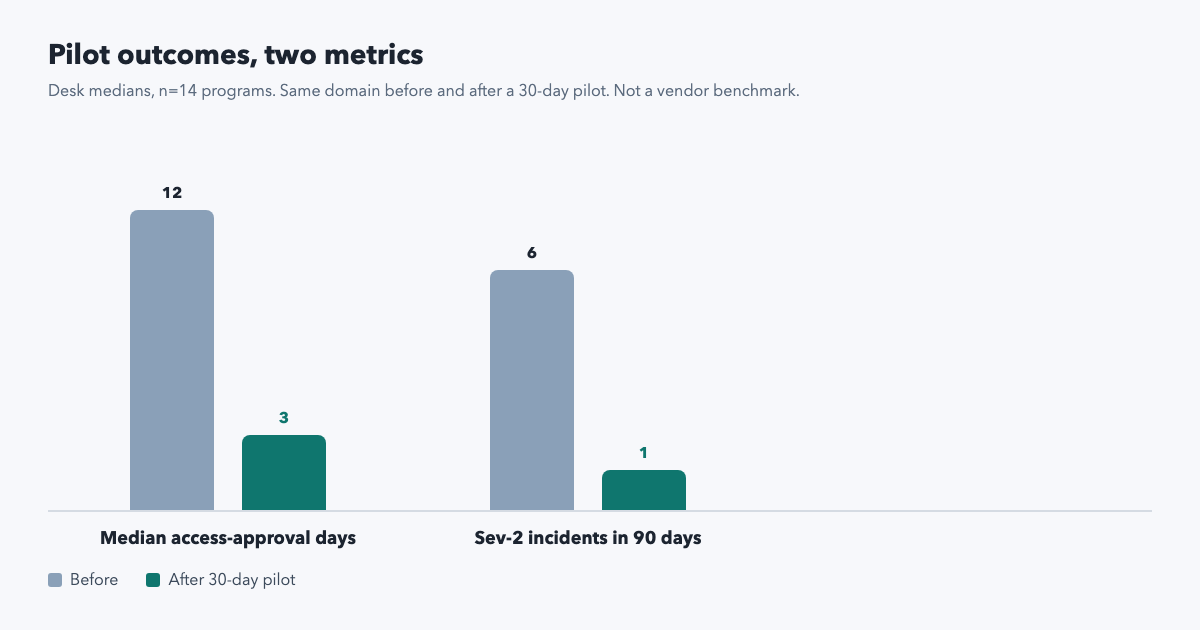
Chart note: two desk metrics, before and after the same pilot. Owner coverage and definition counts are in the table because they use different units.
The cohort does not prove that every item in data governance trends 2026 pays off. It shows what moved when teams started with ownership and one definition instead of a tool purchase.
What to do in the first 30 days
Pick the shift that is already hurting one domain. For most teams in this cohort that was a contested definition plus access that did not match policy. That is how data governance trends 2026 become a calendar instead of a slide.
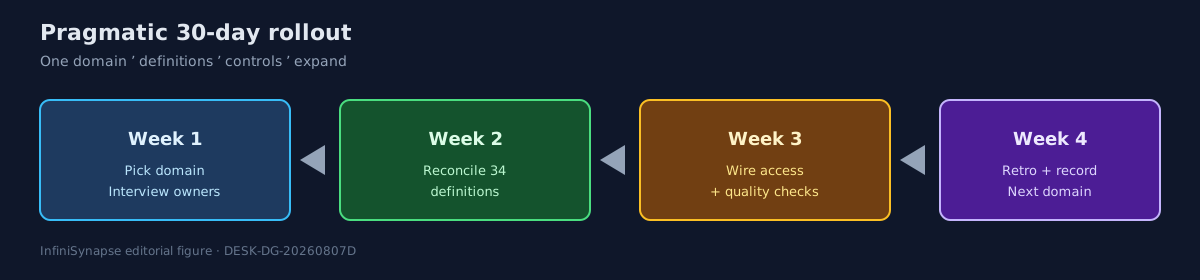 30-day cadence—one domain, agreed definitions, wired controls, then expand.
| Week | Focus | Exit criteria |
|---|---|---|
| 1 | Pick one high-value domain; interview de facto owners | Domain and owner list written down |
| 2 | Reconcile the 3–4 most contested definitions | Definitions recorded in one working session |
| 3 | Wire access to policy; add 2–3 quality checks | Controls live on priority fields |
| 4 | Review breakage; record decisions; pick the next domain | Retro notes and the next domain chosen |
Week 3 is where real-time policy, one of the data governance trends 2026 that is easy to claim and hard to fake, either exists or does not. If a steward still grants access in a side channel, the written rule is not a control. Week 4 is where you decide whether the next domain needs sovereignty review, a lineage gap, or a master-data contract. Do not open all seven shifts in week 1. Data governance trends 2026 fail when they are staffed as a transformation program with no exit criteria. What an agent is allowed to run is a data governance checklist: an owner, a locked metric, and a pass score before production SQL.
How to measure whether a shift landed
Score the pilot, not the slide. One point each:
| Check | Pass? |
|---|---|
| Priority datasets have named owners | |
| The contested definitions are agreed and recorded | |
| Access on those fields matches current policy | |
| Quality is measured on the fields people dispute | |
| A challenged number can be traced to a column | |
| An executive sponsor can name the domain | |
| A domain owner, not only a central team, holds the list | |
| An agent may use only definitions and rows on that list |
6–8: the shifts you funded are landing. 3–5: expand ownership and enforcement before adding another item from data governance trends 2026. Below 3: stay on one domain.
Track two outcome numbers beside the checklist: access-approval days and Sev-2 incidents on the pilot domain. Meeting counts and policy-document totals do not tell you whether data governance trends 2026 changed the read path. In this cohort, programs that skipped outcome metrics were also the ones still reporting three or more conflicting definitions on their priority domain at the 90-day mark.
What the discipline still is
The shifts sit on top of a stable definition. For the formal wording, use the data governance definition. In short: decision rights, policies, roles, and controls for how data is defined, accessed, protected, and maintained. Data governance trends 2026 change the speed and the consumer. They do not change who is accountable.
Ownership still comes first
Every priority dataset needs a named owner for its definition, quality, and access. What an analysis is allowed to retrieve is available information: facts you can get, with the source and license still attached. That assignment is still the first filter inside data governance trends 2026. Without that name, agent controls, lineage, and residency decisions have nobody to update them. Establish ownership in week 1 so the other shifts are assignable to a person rather than a committee. Tools can attach the name. They cannot decide who should hold it.
Common failure modes
The failures we see while teams adopt data governance trends 2026 are organizational. Without an executive sponsor, the pilot loses to the next project. A program run only by a central team cannot scale hybrid ownership. Policies without enforcement become documentation. Buying a catalog before the definition work produces software that governs nothing. The same pattern shows up when a team buys monitors before it can name a rule; the buying criteria are in data quality tools.
A subtler failure is treating the year as an end date. Data governance trends 2026 are a standing list you re-rank, not a project you close in December. Teams that disband after a launch watch the owner list decay.
Measurement failure hides the rest. If you count workshops instead of conflicting definitions, approval days, and incidents, the function looks like a cost center and gets cut when an agent incident would have justified it.
Frequently Asked Questions
What are the data governance trends for 2026?
The data governance trends 2026 to fund first are agentic control, real-time policy, sovereignty of the data an agent may touch, metadata and lineage coverage, hybrid ownership, data products with a contract, and compliance only where a primary text already applies. Start with one domain. Do not staff all seven in the same month.
How is data governance different from data management in 2026?
Management stores, integrates, and operates data. Governance decides who owns a definition, who may use it, and which checks must pass. Data governance trends 2026 sit on the decision layer: they change how fast those decisions are enforced when agents and streams are the consumers. Management still executes the pipeline. The category map is data management tools.
What should you automate first?
Automate the control you have already decided. In the desk cohort that was access wired to policy, plus two or three quality checks on contested fields. Data governance trends 2026 that start with a platform purchase, before an owner and a definition exist, automate an empty rule.
Does sovereignty change the 30-day pilot?
It adds one field to week 1, not a second program. Record where the pilot table lives and where the agent runtime runs. If personal data would leave the EEA, stop and confirm the transfer basis before the agent queries it. The rest of data governance trends 2026 can wait until that location is written down.
Cite this article
APA (7th): Zhu, W., & InfiniSynapse Data Team. (2026, September 26). Data governance trends 2026: Seven shifts that change the program. InfiniSynapse. canonical page
MLA (9th): Zhu, William, and InfiniSynapse Data Team. “Data Governance Trends 2026: Seven Shifts That Change the Program.” InfiniSynapse, 26 Sept. 2026, canonical page.
Plain link: canonical page
References
- Regulation (EU) 2024/1689 — Artificial Intelligence Act
- European Commission — AI Act enforcement
- GDPR — Regulation (EU) 2016/679
- NIST AI Risk Management Framework
- ISO/IEC 27001 — Information security
- OECD AI Policy Observatory
- Google Cloud Architecture Framework
- OWASP API Security Top 10
- InfiniSynapse — Editorial standards
Conclusion
Data governance trends 2026 are seven shifts you can rank against one domain: agentic control, real-time policy, sovereignty, lineage coverage, hybrid ownership, a data-product contract, and compliance that is already in force. The desk cohort shows the first proof is still ordinary: one owner, one definition, access that matches the rule, and fewer incidents. Expand only after those numbers move.
To see how a governed definition travels into an automated answer, read what AI-native data analysis means.
Product recommendation (commercial)
Label: The following is a commercial product recommendation, separate from the editorial guidance above.
In the InfiniSynapse web app, governance can travel with the data an agent queries. Registration is free.