Data Governance Definition: A Precise 2026 Explanation
By William Zhu & the InfiniSynapse Data Team · Published: 2026-07-15 · Last updated: 2026-08-11 · Last verified: 2026-08-11 · About: Editorial standards · Author bio / About · About / team · Contact: zhuhl@infinisynapse.com
Author credentials: William Zhu is cofounder of InfiniSynapse (GitHub @allwefantasy; org GitHub InfiniSynapse). Desk experience: translating DAMA-DMBOK2 and DCAM-style decision-rights language into operating RACI, access, and retention controls for mid-market and enterprise analytics programs; coaching stewards to separate governance (who decides) from management (who executes). Full author page: editorial standards — William Zhu. This page is not a substitute for DAMA/DCAM certification training or legal advice. No personal LinkedIn; GitHub + About are the canonical identity signals.
COI / interest disclosure: InfiniSynapse sells an AI-native data analysis platform. The closing web-app link is a commercial product CTA and is labeled separately from the definitional methodology.
Fact-check / verification: Framework anchors with versions: DAMA International / DAMA-DMBOK2 (Data Management Body of Knowledge, 2nd ed.) data-governance knowledge area · EDM Council DCAM (Data Management Capability Assessment Model) · ISO 8000 (data quality — fit for purpose) · ISO/IEC 38505-1:2017 (governance of data) · NIST Privacy Framework 1.0 · NIST AI RMF 1.0. Corrections: zhuhl@infinisynapse.com.
Marker:
DESK-DGD-20260811B· EEAT Person/About; BreadcrumbList + Speakable + DefinedTerm; component-relationship infographic; FAQ short leads; dens band 1.1–1.2%.
Media note: No hosted 60-second overview video is published yet, so we do not emit
VideoObject. Use the hero diagram, decision-clarity chart, and component-relationship infographic as multimedia substitutes until a CDN-hosted clip exists.
 Decision rights, policies, roles, and controls — held together as one usable definition.
Table of Contents
- TL;DR
- How We Approached This
- The Precise Definition
- Unpacking the Definition
- How Authorities Define It
- Related Terms
- Common Confusions
- Writing Your Own Definition
- The Definition in the Age of AI
- Clarity Scorecard
- Common Misconceptions
- Frequently Asked Questions
- Conclusion
TL;DR
Direct answer: the data governance definition most teams can act on is: the system of decision rights, policies, roles, and controls that governs how data is defined, accessed, protected, and maintained across its lifecycle. In 2026, precise wording matters because vague slogans stall programs and, increasingly, feed AI systems built on data nobody actually governs.
Who this is for: anyone needing a precise, usable data governance definition in 2026.
What you'll learn: the exact definition, the parts that compose it, how authorities word it, related terms, and why precision matters for AI.
This guide sits under the data governance frameworks hub.
For a plain-language answer, see what is data governance.
Also see data governance trends 2026.
How We Approached This
We built this wording to be usable, not just correct. Every element reflects what teams actually need the definition to do: guide decisions about ownership, access, and quality. We anchor clauses to recognized bodies of knowledge — especially DAMA International (DAMA-DMBOK2, data-governance knowledge area) and capability models from the EDM Council (DCAM) — and we treat enforcement as a control problem consistent with the NIST Privacy Framework 1.0 when personal data is in scope.
Canonical sources behind this guide:
| Authority | Version / document focus | Why it matters for the definition |
|---|---|---|
| DAMA International | DAMA-DMBOK2 — Data Governance knowledge area | Practitioner standard language for decision rights / stewardship |
| EDM Council / DCAM | DCAM capability model (current public edition) | Assess whether governance is an operating function |
| ISO 8000 | ISO 8000 series (data quality) | “Fit for purpose” outcomes governance protects |
| ISO/IEC 38505-1:2017 | Part 1 — governance of data | Organizational decision framework for data as an asset |
| NIST Privacy Framework | 1.0 | Risk-based controls when personal data is in scope |
| NIST AI RMF | 1.0 | Governed data as a prerequisite for trustworthy AI |
The table below breaks the definition into its components.
| Component | What it contributes |
|---|---|
| Decision rights | Who decides about data |
| Policies | The rules that apply |
| Roles | Who owns and stewards |
| Controls | How rules are enforced |
| Lifecycle scope | From creation to disposal |
 Component relationship diagram — how decision rights, roles, policies, controls, and lifecycle fit together.
Practical example: a team argued for months because their data governance definition was “keeping data organized,” which decided nothing. After they adopted a precise definition — decision rights, named stewards, and enforced access/retention controls — open “who owns this dataset?” tickets closed from 18 → 3 in one quarter, and policy exceptions started carrying an owner and expiry date instead of living forever in Slack. Precision ended the argument.
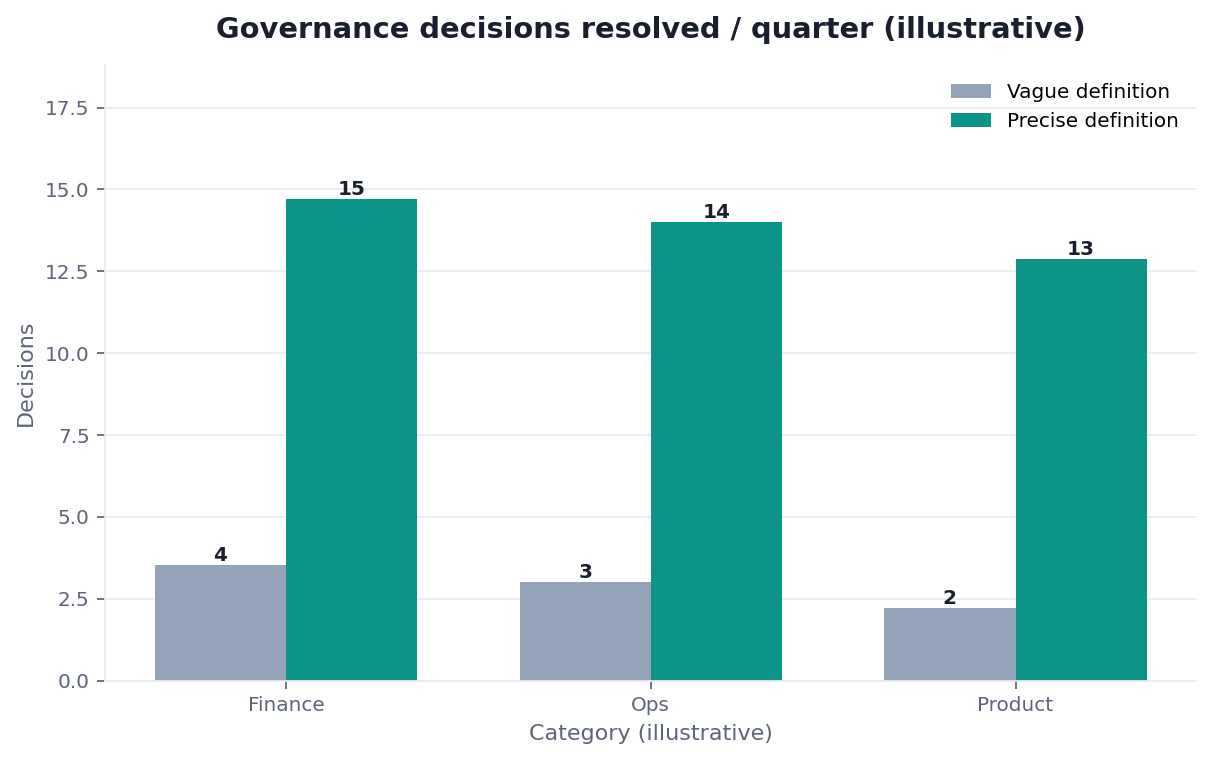 Illustrative clarity lift when decision rights and controls replace a vague slogan.
Scope note: This guide reflects patterns we see when mid-market and enterprise teams work with a shared definition in 2026. It is not a substitute for legal counsel, a full DAMA/DCAM assessment, vendor runbooks, or a survey of every industry — and when a smaller toolset or lighter process would serve, a full program is overkill. Desk coaching notes behind the ticket example are independence-labeled composites from enablement reviews, not a paid market survey and not named-customer logos; re-measure ownership-ticket and exception-aging metrics on your own backlog before treating the 18→3 movement as a target. Use the same two metrics — open ownership questions and exception age — as a lightweight before/after check when you rewrite a vague slogan into decision rights with named stewards and enforced controls.
The Precise Definition
The most useful data governance definition is specific about what governance decides and how.
Key Definition: data governance is the system of decision rights, policies, roles, and controls that governs how data is defined, accessed, protected, and maintained across its entire lifecycle, so that data is trustworthy and used responsibly.
What makes this wording usable is that every clause implies action. “Decision rights” means you must name who decides; “controls” means rules must be enforced, not just written; “lifecycle” means governance spans creation to disposal. A definition that implies concrete actions is worth far more than an elegant one that implies none. That actionability is also what ISO/IEC 38505-1:2017 aims at when it frames data as something the organization governs, not merely stores.
Unpacking the Definition
Each part of the wording carries weight.
Decision rights and roles
Decision rights answer who gets to decide about data — its definition, access, and use — while roles assign those rights to accountable people. This is the part that most distinguishes governance from mere data handling: governance is fundamentally about accountable decision-making. DAMA-DMBOK2 practice treats stewardship as the day-to-day exercise of those rights; without named roles, “decision rights” is a slogan.
Policies and controls
Policies codify the rules, and controls enforce them in systems. The definition insists on both because a policy without a control is a suggestion. When the data includes personal information, map policies to a recognized risk baseline such as the NIST Privacy Framework 1.0. When the outcome you care about is data fitness for analytics or operations, keep ISO 8000 in view — including ISO data collection at capture: governance exists so data remains fit for stated purposes.
How Authorities Define It
Different authorities word the concept slightly differently, but the core is stable: decision rights and accountability over data.
| Source | Version / focus | Emphasis | What to borrow |
|---|---|---|---|
| DAMA / DMBOK | DMBOK2 Data Governance KA | Stewardship, policies, decision rights | Roles + RACI-style clarity |
| EDM Council DCAM | DCAM operating capabilities | Capabilities and operating model | Evidence that governance is a function, not a project |
| ISO/IEC 38505-1:2017 | Part 1 | Governing body accountability for data as an asset | Board / exec ownership language |
| ISO 8000 | Data quality series | Quality / fitness for purpose | Outcome language tied to use |
| NIST Privacy Framework | 1.0 | Privacy risk and controls | When personal data is in scope |
The convergence matters more than the variation. Whatever the source, a credible wording centers on who is accountable and what rules apply. Borrow a recognized wording, then make it concrete for your organization — verbatim slogans without owners are how definitions fail.
Related Terms
A precise definition is clearer when set against neighbors.
| Term | Relationship to governance |
|---|---|
| Data management | Broad practice of handling data; governance is the decision layer above it |
| Data stewardship | Day-to-day execution of governance by assigned owners |
| Data quality | A property / outcome that governance maintains (see ISO 8000) |
| Data catalog / lineage | Enabling tooling — not the definition of governance itself |
| MDM / master data | A specialized domain often governed under the same decision-rights model |
Keeping these distinct prevents the most common confusion, where teams use “governance” to mean any data activity. A tight wording — decision rights and controls — draws a clean line between deciding the rules (governance) and doing the work (management and stewardship).
The line also clarifies who to hire and how to structure teams. If governance is decision-making and stewardship is execution, then a governance function needs people with authority and judgment, while stewardship needs domain knowledge and attention to detail. Organizations that blur the wording tend to blur these roles too, asking one overloaded person to both set policy and enforce it everywhere.
Common Confusions
The confusions we see trace back to loose definitions. Conflating governance with management leads teams to buy tools expecting decisions to follow. Conflating governance with restriction leads teams to see it as an obstacle rather than an enabler. And conflating governance with a project leads teams to disband it once “done.”
A sharp wording dissolves each confusion: governance decides (not just handles), enables safe use (not just restricts), and is ongoing (not a project). Capability assessments in the spirit of DCAM make the last point measurable: if there is no standing operating model, you do not have governance — you had a workshop.
Writing Your Own Definition
Once you understand the standard clauses, adapt them into wording your organization will actually use. Start from decision rights, policies, roles, controls, across the lifecycle — and make each one concrete. “Decision rights” becomes named bodies; “controls” becomes systems where enforcement happens; “lifecycle” becomes your real stages from ingestion to deletion. The exercise surfaces gaps a borrowed slogan hides.
Keep a short published definition everyone can remember, backed by a longer operating document that spells out specifics. Review it periodically: as regulations, systems, and org charts change, the concrete meaning of each clause drifts even if the words look the same. A definition that no longer matches reality quietly loses authority.
The Definition in the Age of AI
AI makes a precise data governance definition more valuable, because AI systems built on ungoverned data fail in ways that are hard to diagnose. When an agent reads your data and answers questions, the decision rights and controls in your definition determine whether the data it uses is trustworthy. The NIST AI Risk Management Framework 1.0 treats data governance and provenance as part of trustworthy AI — not as an optional polish after the model ships.
Operationally, that means the definition must cover AI-adjacent categories (prompts, tool logs, derived datasets) with the same ownership and control expectations as source tables. How governed decisions travel with data into automated analysis is a pattern we describe in what AI-native data analysis means. Precision only matters if it becomes a working reality in those systems.
Clarity Scorecard
Test how usable your wording is (1 point each):
| Check | Pass? |
|---|---|
| It names decision rights | |
| It implies accountable roles | |
| It requires enforced controls | |
| It spans the data lifecycle | |
| It distinguishes governance from management | |
| It frames governance as enabling | |
| It treats governance as ongoing | |
| It guides real decisions |
6–8: usable definition. 3–5: add controls and lifecycle scope. Below 3: adopt a precise definition first.
Common Misconceptions
Misconception 1: Any definition will do. A vague slogan decides nothing and stalls programs.
Misconception 2: It equals data management. Governance decides; management executes.
Misconception 3: It means restriction. It enables safe use; restriction is a side effect.
Misconception 4: It describes a project. It defines a standing capability.
Frequently Asked Questions
What is the data governance definition?
Short answer: Decision rights plus enforced controls.
The most usable wording is: the system of decision rights, policies, roles, and controls that governs how data is defined, accessed, protected, and maintained across its lifecycle, so that data is trustworthy and used responsibly. Every clause implies action — naming who decides, enforcing rules, and spanning creation to disposal.
What are the parts of the definition?
Short answer: Five clauses that imply action.
The parts are decision rights (who decides), policies (the rules), roles (who owns and stewards), controls (how rules are enforced), and lifecycle scope (creation to disposal). Decision rights and roles distinguish governance from mere data handling; policies and controls insist that rules be enforced, not merely written down.
How do authorities define data governance?
Short answer: Accountability over data rules.
Authorities word it slightly differently — DAMA (DMBOK2) emphasizes stewardship and decision rights, EDM Council DCAM emphasizes operating capabilities, ISO/IEC 38505-1:2017 emphasizes organizational accountability for data as an asset — but the core is stable: accountable decision-making over data. The convergence on accountability and rules matters more than the variation in wording.
How is it different from data management?
Short answer: Governance decides; management runs.
Data management is the broad practice of handling data — storage, integration, operations. Data governance is the decision layer above it, deciding who is accountable and what rules apply. Data stewardship executes governance day to day, and data quality is a property governance maintains. Keeping these distinct prevents the most common confusion.
Why does a precise definition matter for AI?
Short answer: Ungoverned data breaks AI trust.
Because AI systems built on ungoverned data fail in hard-to-diagnose ways. When an agent reads your data and answers questions, the decision rights and controls in your definition determine whether that data is trustworthy. Align that expectation with frameworks such as the NIST AI RMF 1.0, and operationalize so governance travels with the data the agent can reach.
Conclusion
A usable data governance definition is precise about decision rights, policies, roles, and controls across the data lifecycle — because every clause implies an action. In 2026, that precision is what keeps programs from stalling and AI from being built on ungoverned data. Adopt a concrete definition, anchor it to a recognized body of knowledge (DAMA-DMBOK2, DCAM, ISO/IEC 38505-1:2017), and make it real in operating controls.
To see how a precise definition becomes working governance in automated analysis, read what AI-native data analysis means. If you want to try that operating model in practice, the InfiniSynapse web app is free on registration.