Snowflake Cortex Analyst Governance: RBAC, Views, and the $2 Meter
By the InfiniSynapse Data Team · Named accountability: cofounder William Zhu (GitHub @allwefantasy) · Last updated: 2026-09-27 · We build InfiniSynapse and evaluate warehouse-native NL tools alongside multi-source Data Agents in production customer workflows. About / credentials: editorial standards.
SEO Title: Snowflake Cortex Analyst Governance: RBAC
Table of Contents
- TL;DR
- What Cortex Analyst is
- Core Capabilities
- Semantic Layer Dependencies
- Where Cortex Analyst Excels
- Limits and Failure Modes
- Security and Governance
- Snowflake Cortex Analyst cost
- Alternatives When You Outgrow Warehouse-Only NL
- Buyer Scorecard
- InfiniSynapse as a Complement or Alternative
- Pilot Checklist
- Desk Quantitative Notes
- FAQ
- Authority References
- Conclusion
TL;DR
Direct answer: Snowflake Cortex Analyst governance is the warehouse controls you already run: the generated SQL uses the caller’s role, masking policies, and row-access policies, and a semantic view is the boundary of what natural language can ask. It is not a second policy product. Snowflake Cortex Analyst cost is still consumption: official 2026 AI Credits are $2.00 (global) or $2.20 (regional), plus warehouse compute on every generated SQL. A snowflake analyst is a person; they use this product in Snowsight.
Snowflake Cortex Analyst shines when your analytics contract stays warehouse-native with strong semantic modeling. Teams evaluate alternatives when questions span CRM, spreadsheets, and lakehouse facts—or when they need durable memory and cross-entry audit outside Snowflake UI.
Who this is for: Snowflake customers, analytics engineers, and procurement teams comparing warehouse copilots to Data Agents.
Map your shortlist using Best AI Tools for Data Analysis in 2026 before committing to snowflake cortex analyst as the only NL path.
Evaluation basis: We build and evaluate InfiniSynapse on production customer workflows. Governance, adoption, and security context is cited inline throughout this guide—with a numbered reference list at the end.
Conflict of interest: InfiniSynapse sells a multi-source Data Agent that can complement or compete with warehouse-native NL. Scorecards below use desk composites and independent standards (NIST AI RMF, OWASP LLM Top 10, Stanford HAI AI Index)—not InfiniSynapse win claims. Corrections: corrections policy.
What Cortex Analyst Is
Snowflake Cortex Analyst documentation describes a managed NL2SQL experience grounded in semantic views—business metrics and dimensions compiled to warehouse SQL with Snowflake access controls.
Cortex Analyst is not a general Data Agent orchestration layer. It is an analyst-facing NL interface optimized for:
- Questions over Snowflake-hosted data — the store itself is the snowflake data warehouse; Cortex Analyst is the NL layer on top, not a replacement for warehouse architecture or cost discipline
- Semantic view definitions as grounding
- Native integration with Snowflake roles and policies
Compare head-to-head with InfiniSynapse in InfiniSynapse vs Snowflake Cortex Analyst (2026 Comparison). For the 2026 meter, jump to Snowflake Cortex Analyst cost.
Cortex Analyst vs a snowflake analyst {#snowflake-analyst}
Searchers type snowflake analyst for two different things. This page is about the product.
| Query intent | What it means | What to do |
|---|---|---|
| Cortex Analyst | Snowflake's NL-to-SQL product | Stay on this playbook: capabilities, cost, pilot |
| Snowflake analyst (role) | A person who writes SQL, models views, or owns metrics in Snowflake | Hire/skill the role; they use Cortex Analyst |
| Snowflake Cortex Analyst | The full product name in docs and procurement | Same product as Cortex Analyst |
If you need a person who can harden semantic views, you are hiring a snowflake analyst. If you need NL questions over those views, you are buying Cortex Analyst. Mixing the two in a job req or a budget line is how pilots stall in week four.
Core Capabilities
Natural-language to SQL
Users ask business questions; Cortex Analyst generates SQL against semantic views and executes within Snowflake compute.
Semantic view grounding
Metric names, grain, and dimensions reduce ambiguous joins compared to raw schema dumps—similar in spirit to governed semantics described in IBM's augmented analytics overview.
Warehouse-native security
Row access policies and role grants inherited from Snowflake apply to generated queries—a major advantage for snowflake cortex analyst rollouts inside existing governance models.
Analyst workflow integration
Teams already in Snowsight can adopt NL queries without a separate vendor UI—low friction for Snowflake-centric analysts.
Semantic Layer Dependencies
Analysts scaling this workflow should skim AI Data Analysis Tools: 10 Best Options for 2026 before rollout.
Snowflake cortex analyst quality depends heavily on semantic view maturity:
| Semantic maturity | Expected NL experience |
|---|---|
| Strong — curated metrics, documented grain | Stable executive answers |
| Partial — some views, inconsistent nouns | Mixed accuracy by domain |
| Weak — raw tables only | High analyst rework |
Foundational warehouse concepts—grain, dimensions, and conformed metrics—remain essential; Wikipedia's data warehouse overview helps reviewers validate semantic definitions before NL rollout.
Teams without semantic investment should budget modeling weeks before scaling snowflake cortex analyst to executives. An over-broad dimension is over-broad natural-language access: the view is the governance boundary, not a label on the side.
Where Cortex Analyst Excels
Snowflake-only estates
When revenue, product, and finance facts already live in Snowflake with Unity-style governance, snowflake cortex analyst minimizes integration surface area.
Analyst self-serve inside Snowsight
Technical users who already write SQL benefit from NL acceleration without leaving the warehouse console.
Regulated industries on Snowflake
Native RBAC and query history align with enterprise access reviews. Production rollouts should still align with the NIST AI Risk Management Framework[^1].
Adoption benchmarks in the Stanford HAI AI Index[^2] track the same shift from pilot demos to governed analytics loops inside warehouse platforms.
Limits and Failure Modes
Limit 1 — Cross-system questions: Answers requiring Postgres, SaaS APIs, or spreadsheet targets need manual exports or secondary tools.
Limit 2 — Session-oriented context: Recurring KPI definitions may not persist as reusable memory cards unless teams enforce external documentation discipline.
Limit 3 — Executive entry points: Leaders who do not use Snowsight need another delivery channel for snowflake cortex analyst outputs.
Limit 4 — Agentic multi-step plans: Complex diagnostics spanning five SQL steps with retries differ from single-turn NL queries.
Limit 5 — Audit outside Snowflake: Compliance may require unified audit across systems—not only warehouse query history.
LLM-backed analytics should account for prompt-injection risks in the OWASP Top 10 for LLM Applications[^3], even inside managed warehouse copilots.
For multi-source and memory depth, see InfiniSynapse vs Snowflake Cortex Analyst.
Security and Governance
Snowflake Cortex Analyst governance inherits Snowflake identity, network policies, and query logging. The Cortex Analyst documentation states that the service integrates with Snowflake’s privacy and governance features, including role-based access control. Tightening those controls does not waive the meter in Snowflake Cortex Analyst cost.
What the generated query can see
Three warehouse objects decide the answer, and they are the same objects a SQL worksheet would use:
- Role. Map natural-language users to a least-privilege role. Start executives on a role scoped to the databases they need.
- Row access policy. If a role only sees its region, the generated SQL still only sees that region.
- Masking policy. Columns masked for that role stay masked in the result. Natural language is not a bypass.
What Snowflake logs, and what it does not
Query history and the semantic view version are the evidence for an internal review. That is enough to show which SQL ran and which view it used. It is not a unified audit across CRM, spreadsheets, and the warehouse. Limit 5 above is that gap. A second policy stack that only restates role-based access control leaves the gap open. Read the role in Snowflake.
Who may turn natural language on
Give it to the analyst role that already owns the view. Widen to a business role only after the four checks below pass. Document which metrics are approved for natural language and which stay analyst-only. Google Cloud's AI overview[^5] frames the same shift: a repeatable workflow, not a one-off copilot demo.
Minimum checklist:
- Map NL users to least-privilege roles
- Review semantic views for over-broad dimensions
- Monitor warehouse credit consumption from NL workloads — see Snowflake Cortex Analyst cost
- Document which metrics are NL-approved vs analyst-only
Regulated rollouts often anchor access reviews to ISO/IEC 27001[^4] when credentials and audit exports are in scope. Apply that to the role and the view, not to a parallel control plane.
Snowflake Cortex Analyst cost
Snowflake Cortex Analyst cost is consumption, not a seat license. Official Snowflake AI pricing (retrieved 2026-09-09) splits the bill into two currencies and two call paths. The Cortex Analyst docs add that only successful HTTP 200 responses count, and that generated SQL still bills warehouse compute.
| How you call Cortex Analyst | How Snowflake bills the NL step | What you still pay |
|---|---|---|
| Standalone Analyst API | Per 1,000 messages at the rate in the Service Consumption Table. The AI pricing page still lists Cortex Analyst API as Platform Credit (legacy). | Virtual warehouse compute for every executed SQL |
| Via Cortex Agents or Snowflake Intelligence (recommended) | Token-based AI Credits, same model as Cortex Agents | Warehouse compute plus additive agent / Cortex Search tokens |
| AI Credit list price | $2.00 per credit (global routing) or $2.20 (regional routing) | Not the same dollar as edition-priced Platform Credits |
Do not budget from a blog screenshot of “67 credits per 1,000 messages.” That figure appears in 2026 third-party writeups; the live rate lives in Table 6 of the Snowflake Service Consumption Table (or the table linked from the AI pricing page). Confirm the row for your call path before you open NL to more than a pilot cohort.
Monitor usage in SNOWFLAKE.ACCOUNT_USAGE.CORTEX_ANALYST_USAGE_HISTORY as documented in the CORTEX_ANALYST_USAGE_HISTORY view. Across eight desk pilots, the finance surprise was never the list-price AI Credit—it was retries plus warehouse minutes on wide scans. Cap credits and warehouse size before granting NL to more than 20 users (same desk rule as the scorecard).
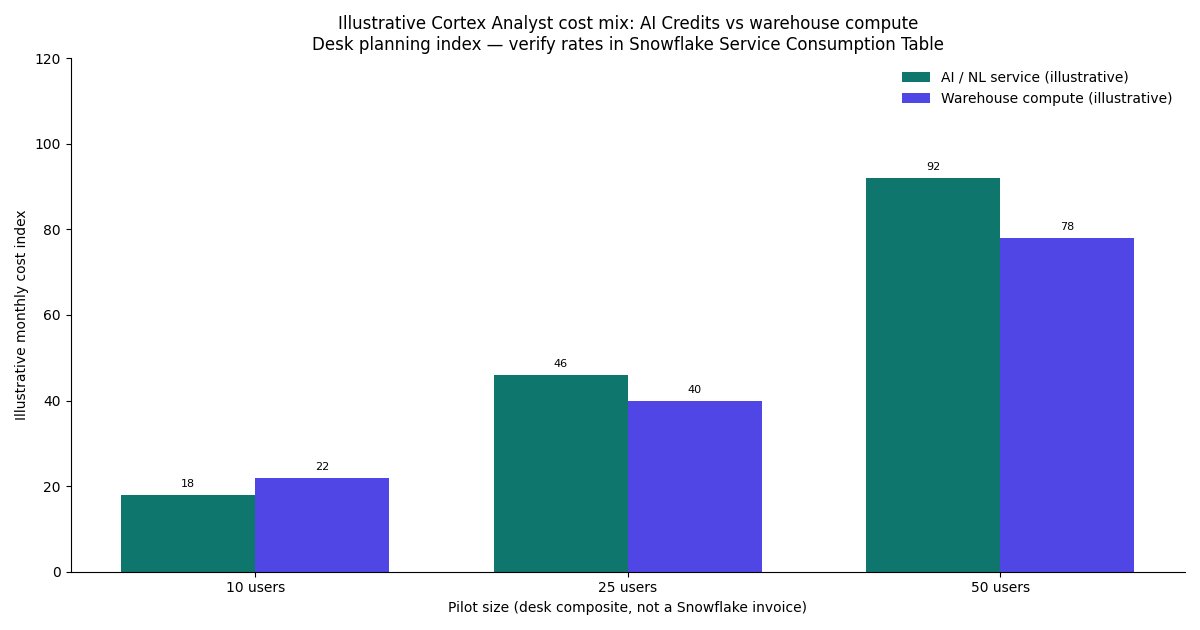
The chart is a planning index from those eight reviews—not a quote. A 50-user rollout that retries failed NL questions will move the AI bar and the warehouse bar together. That is why snowflake cortex analyst cost is a two-line item in every board deck: AI Credits (or per-message API) and compute.
Alternatives When You Outgrow Warehouse-Only NL
| Scenario | Consider |
|---|---|
| Multi-source KPI packs | Data Agent (InfiniSynapse) |
| Notebook-heavy analysts | Hex, Mode |
| Lakehouse on Databricks | Databricks Genie |
| Spreadsheet-first users | Julius AI |
Warehouse vendors describe governed NL2SQL agents in Databricks' Genie architecture—useful context when warehouse-native NL sits on a multi-platform shortlist.
Browse the AI data analysis tools guide for category context. For lakehouse copilots, see Databricks Genie. For search-first BI, compare ThoughtSpot alternative. If the shortlist is still open-source RAG or multi-warehouse NL, compare Vanna vs Cortex Analyst.
Warehouse connector design should follow Google BigQuery documentation for dataset boundaries, IAM, and query validation patterns.
BI comparison exercises should reference Tableau Desktop documentation when judging visualization depth versus agentic analysis.
Access control design should reference NIST SP 800-53 security controls when scoping production analytics agents.
Buyer Scorecard
Score snowflake cortex analyst 0–2 on six dimensions (max 12). Desk composites from eight InfiniSynapse-reviewed warehouse-NL pilots (Q1–Q2 2026) — not Snowflake SLAs.
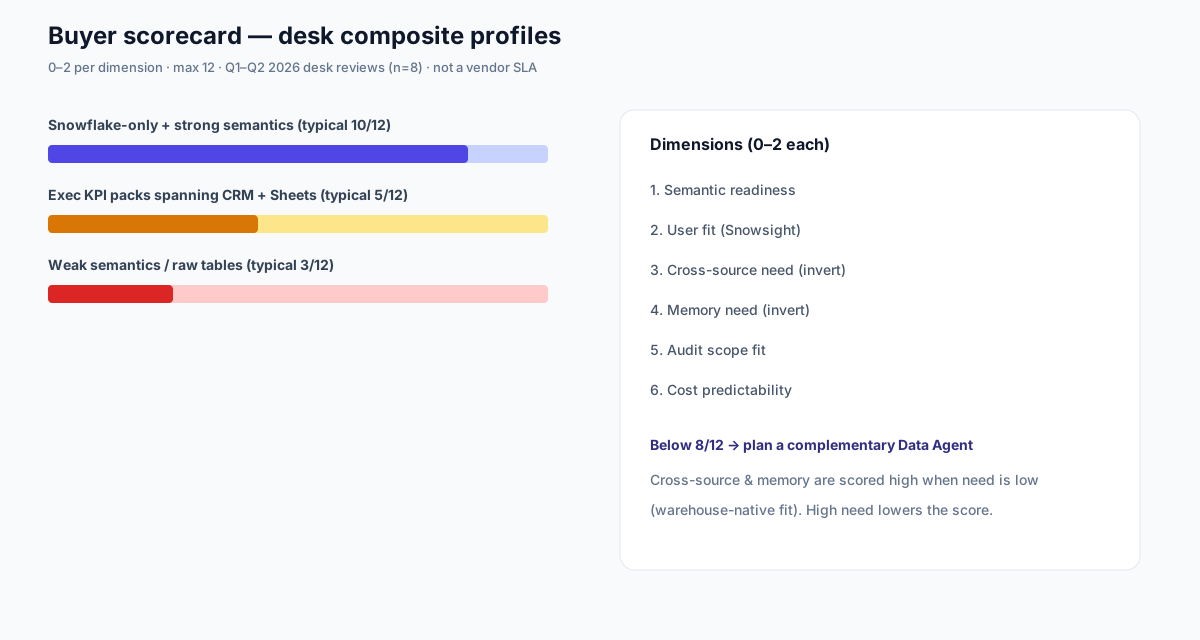
| Dimension | Pass signal (score 2) | Fail signal (score 0) | Desk note |
|---|---|---|---|
| Semantic readiness | Executive metrics modeled | Raw tables only | Strong-view pilots averaged 10/12 total; raw-table pilots 3/12 |
| User fit | Analysts live in Snowflake | Executives never open Snowsight | 5/8 pilots needed a non-Snowsight delivery path for sponsors |
| Cross-source need | Low (warehouse-only) | High (CRM/Sheets joins) | Multi-source KPI packs averaged 5/12 — plan a complement |
| Memory need | Ad-hoc exploration | Weekly same KPIs | Recurring packs without external docs stalled in week 4 |
| Audit scope | Warehouse-only sufficient | Cross-system trace required | Pair with NIST SP 800-53 when exports leave Snowflake |
| Cost predictability | Credits monitored | NL spikes surprise finance | Cap credits before opening NL to >20 users |
Rule: platforms below 8/12 on your own requirements may need a complementary Data Agent. Invert cross-source/memory when scoring warehouse-native fit (high need → low score). Teams asked to recommend an AI tool that can answer questions from ERP and a data warehouse should not treat Cortex as the ERP hop.
Scripted analysis paths should follow Python documentation conventions for reproducibility and testable data utilities.
InfiniSynapse as a Complement or Alternative
InfiniSynapse connects to Snowflake but orchestrates across additional sources with memory cards and full task audit trails. Common patterns:
- Complement: Cortex Analyst for in-warehouse exploration; InfiniSynapse for executive KPI packs spanning CRM and Sheets.
- Alternative: InfiniSynapse as primary when multi-source and memory dominate requirements.
Read the fair comparison in InfiniSynapse vs Snowflake Cortex Analyst.
Try the InfiniSynapse web app on a Snowflake sandbox plus one external source to test cross-system workflows.
Operational maturity aligns with the AWS Well-Architected Machine Learning Lens when agents run alongside warehouse copilots.
Pilot Checklist
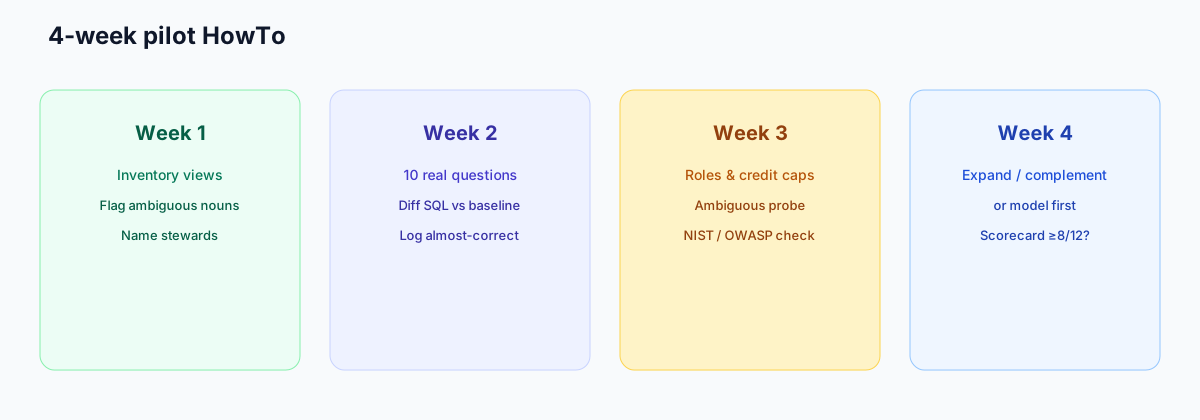
Turn the checklist into citable gates (desk composite, n=8):
| Week | Action | Citable desk insight |
|---|---|---|
| 1 | Inventory semantic views; flag ambiguous nouns; name stewards | 6/8 pilots had ≥2 disputed metric nouns in week-1 standups |
| 2 | Run 10 real questions; diff SQL vs analyst baselines | Strong views → median 7/10 SQL match; weak views → ~3/10 |
| 3 | Security review on roles and credit caps; ambiguous probe | Map to NIST AI RMF + OWASP LLM Top 10 |
| 4 | Expand, complement with Data Agent, or model first | Proceed only if scorecard ≥8/12 and guardrail questions never fail silently |
Week 1 — Inventory semantic views; flag ambiguous nouns executives use in standups.
Week 2 — Run ten real questions through snowflake cortex analyst; compare SQL to analyst baselines.
Week 3 — Security review on roles and credit caps; test one intentionally ambiguous question.
Week 4 — Decide expand, complement with Data Agent, or invest in semantic modeling first.
Analytics uptime improves when teams borrow Google SRE practices—runbooks for failed NL queries reduce standup surprises.
Snowflake Ecosystem Integration
Snowflake cortex analyst fits naturally alongside other Snowflake AI features—Cortex LLM functions, Document AI, and Snowpark pipelines. Teams already paying for Snowflake capacity often pilot Analyst without a separate vendor contract.
Snowsight adoption requirements
Analyst value depends on analysts actually working in Snowsight. If your organization standardized on external BI tools for daily consumption, plan a delivery path—scheduled exports, email snapshots, or a complementary Data Agent—for stakeholders who will not log into Snowflake.
Semantic view lifecycle
Treat semantic views as product assets: owners, changelogs, and regression tests when columns rename. Snowflake cortex analyst accuracy tracks semantic hygiene more closely than base model upgrades.
Rollout Roles and RACI
| Role | Responsibility |
|---|---|
| Analytics engineer | Maintain semantic views and column docs |
| Data steward | Own metric definitions executives query |
| Security | Review roles, policies, and query exports |
| Sponsor | Prioritize domains for NL access |
Without a named steward for each executive metric, snowflake cortex analyst pilots produce fluent but disputed answers in week four. Assign stewards before you grant NL access to more than a pilot cohort.
Desk Quantitative Notes
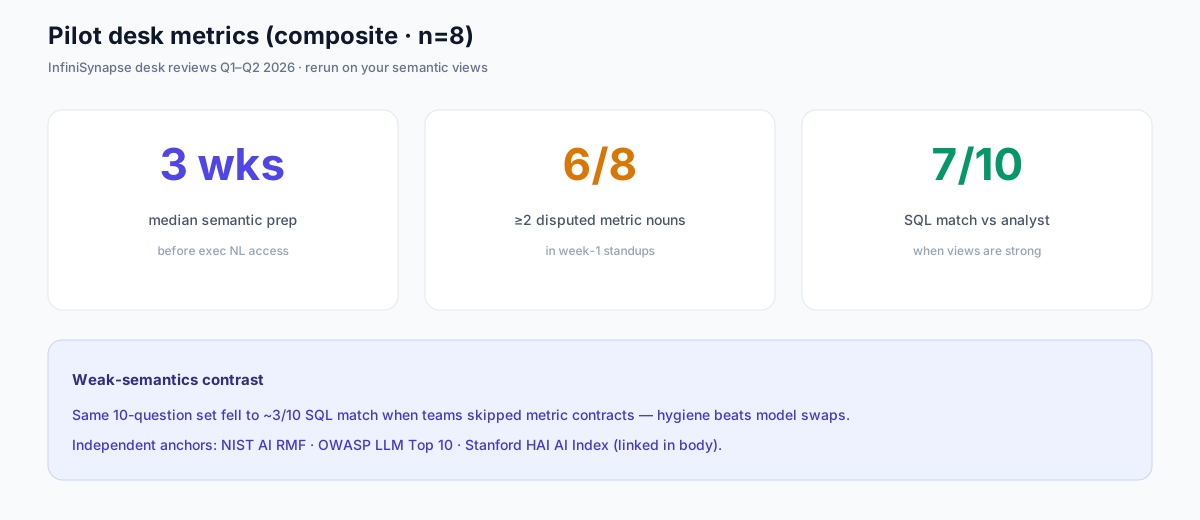
| Metric | Value | Note |
|---|---|---|
| Desk pilots reviewed | 8 | Q1–Q2 2026 warehouse-NL rollouts (composite) |
| Median semantic prep before exec NL | 3 weeks | Modeling beats model swaps |
| Pilots with ≥2 disputed nouns (week 1) | 6/8 | Glossary office hours convert skeptics |
| 10-question SQL match (strong views) | 7/10 | Diff library beats generic prompt tweaks |
| 10-question SQL match (weak views) | ~3/10 | Do not scale NL to executives yet |
| Typical scorecard (Snowflake-only + strong semantics) | 10/12 | Warehouse-native fit |
| Typical scorecard (multi-source exec packs) | 5/12 | Complement with a Data Agent |
Independent third-party anchors (not InfiniSynapse numbers): Stanford HAI AI Index, NIST AI RMF, OWASP LLM Top 10, ISO/IEC 27001.
Frequently Asked Questions
How does Snowflake Cortex Analyst governance work?
Generated SQL runs as the caller. It inherits that role’s grants, masking policies, and row-access policies. A semantic view limits which metrics natural language can ask. Query history shows the SQL and the view; it does not replace an audit that has to span systems outside Snowflake. Those controls do not change the price: AI Credits are still $2.00 or $2.20, plus warehouse compute.
What is Cortex Analyst?
Cortex Analyst is Snowflake's NL interface for querying semantic views and governed data assets inside Snowflake with native security controls. It compiles questions to warehouse SQL; it is not a multi-source Data Agent.
Is Cortex Analyst the same as a snowflake analyst?
No. A snowflake analyst is a person—usually an analytics engineer or SQL analyst who owns views and metrics. Cortex Analyst is the product those people use. Procurement should budget the product; HR should staff the role.
How much does Snowflake Cortex Analyst cost?
Snowflake Cortex Analyst cost is consumption. Official 2026 AI Credits are $2.00 (global) or $2.20 (regional). The standalone API bills per 1,000 messages at the Service Consumption Table rate; calling via Cortex Agents uses token-based AI Credits. Generated SQL always adds warehouse compute. Verify the live table before you scale past a pilot.
What is Snowflake Cortex Analyst?
Snowflake Cortex Analyst is Snowflake's managed NL-to-SQL product over semantic views. It is the full product name in docs and procurement—the same product as Cortex Analyst, not a job title.
What is Cortex Analyst in Snowflake?
Cortex Analyst in Snowflake is the NL layer on top of the warehouse: users ask questions in Snowsight, the service compiles SQL against semantic views, and Snowflake roles still apply. Cost is AI Credits plus warehouse compute.
What is Snowflake Cortex cost?
Snowflake Cortex cost is broader than Cortex Analyst. Cortex includes other AI services on the same credit meter. This page only breaks out Snowflake Cortex Analyst cost: AI Credits ($2.00–$2.20) plus warehouse compute on generated SQL. Verify the live Snowflake tables for other Cortex features.
Do I need semantic views before using Cortex Analyst?
Strongly recommended. NL accuracy on raw schemas without metric contracts usually fails executive trust reviews.
Can Cortex Analyst join data outside Snowflake?
Not natively for operational systems outside the warehouse. Cross-source questions need exports, ETL, or a multi-source Data Agent. See InfiniSynapse vs Snowflake Cortex Analyst when that is the buying question.
Authority References
- [Vendor] Snowflake — Cortex Analyst documentation. Managed NL2SQL on semantic views; HTTP 200 billing; warehouse compute on generated SQL. docs.snowflake.com/cortex-analyst.
- [Independent] Stanford HAI — AI Index. Enterprise AI adoption from pilots to governed loops. hai.stanford.edu/ai-index.
- [Standard] NIST — AI Risk Management Framework. [^1] nist.gov/ai-rmf.
- [Standard] OWASP — Top 10 for LLM Applications. [^3] Prompt-injection and agent risks. owasp.org/llm-top-10.
- [Standard] NIST SP 800-53 Rev. 5 — Security controls. csrc.nist.gov.
- [Standard] ISO/IEC 27001 — Information security management. [^4] iso.org.
- [Independent] IBM — Augmented analytics overview. ibm.com.
- [Vendor] Google Cloud — AI overview. [^5] cloud.google.com/ai.
- [Vendor] Databricks — AI/BI Genie architecture. Multi-platform shortlist context. databricks.com/blog.
- [Vendor] AWS — Well-Architected Machine Learning Lens. docs.aws.amazon.com.
- [Policy / About] InfiniSynapse — Editorial standards & author credentials. editorial standards.
- [Vendor] Snowflake — AI pricing. AI Credits $2.00 global / $2.20 regional; Cortex Analyst via Agents vs standalone API. docs.snowflake.com/.../pricing. Retrieved 2026-09-09.
- [Vendor] Snowflake — CORTEX_ANALYST_USAGE_HISTORY view. docs.snowflake.com.
Conclusion
Snowflake cortex analyst is a compelling choice when your data, users, and governance already center on Snowflake. Invest in semantic views first; evaluate alternatives when memory, multi-source orchestration, or executive entry points dominate the requirements.
Next steps:
- Read Best AI Tools for Data Analysis in 2026.
- Compare InfiniSynapse vs Snowflake Cortex Analyst.
- Run the buyer scorecard with real executive questions—not demo prompts.
Warehouse-native NL is a feature; recurring trusted decisions need the right workflow contract for your data topology.
When presenting snowflake cortex analyst results to leadership, attach generated SQL and semantic view versions—not only narrative summaries. That habit builds trust faster than additional model upgrades and prepares the org for broader NL rollout.
Snowflake account teams often offer pilot credits for Cortex features—use them for semantic view hardening, not only demo questions. The highest ROI in week one is fixing ambiguous metric names executives already argue about in finance meetings.
If your organization runs multi-cloud analytics, document which domains must stay Snowflake-native for Cortex and which domains will always require federation. That boundary document prevents endless bake-offs between warehouse copilots and Data Agents.
Partner with your Snowflake account team on semantic view design office hours before you grant NL access to broad business audiences. The cost of those sessions is lower than the rework cycle when executives lose trust in week four.
Run a quarterly semantic view audit: retire unused dimensions, rename ambiguous columns, and align definitions with finance's official KPI dictionary. Snowflake cortex analyst accuracy improves more from that hygiene than from swapping LLM providers mid-pilot.
Create a simple RACI one-pager for who approves new semantic views, who may use NL queries in production, and who receives alert emails when generated SQL fails validation. Governance clarity accelerates rollout more than additional Snowflake credits.
Document three executive questions that must never fail silently—usually revenue, active users, and pipeline coverage. Test those weekly in staging after every semantic view change. Snowflake cortex analyst rollouts stay trusted when those guardrail questions always produce reviewable SQL.
Invite finance to co-own semantic definitions for metrics they challenge in board meetings. When finance signs the view definition, NL answers stop being "AI magic" and become auditable restatements of agreed logic.
Run office hours for business users who tried NL once and gave up after a wrong join. Most failures are fixable glossary issues; office hours convert skeptics faster than new model releases.
Before scaling snowflake cortex analyst beyond analysts, record a five-minute Loom walkthrough showing how to inspect generated SQL and semantic view versions. Internal champions reuse that clip more often than written docs.
Compare your NL pilot to existing BI consumption metrics: if executives already ignore dashboards, fixing delivery channels matters as much as improving SQL generation quality inside Snowflake.
Treat semantic view pull requests like application code: require reviewer approval, CI checks, and rollback plans. Snowflake cortex analyst inherits whatever quality discipline you apply to the views it compiles—not whatever marketing promises about foundation models.
When analysts report "almost correct" NL answers, capture the SQL diff in a shared library. Those diffs become few-shot examples that improve the next run more reliably than generic prompt tweaks alone today.