Snowflake Data Warehouse: A Practical Guide (2026)
By William Zhu & the InfiniSynapse Data Team · Published: 2026-07-15 · Last updated: 2026-09-16 · About: Editorial standards / policy · About / team
Author credentials: William Zhu — InfiniSynapse cofounder; public engineering profile GitHub @allwefantasy (InfiniSQL / open-source data systems). Desk contact: zhuhl@infinisynapse.com. First-hand: reviewing Snowflake estates for warehouse sizing, auto-suspend, query pruning, and credit blowups with mid-market and enterprise platform teams. Reviewers: analytics engineering · data platform.
Disclosure: We build an AI-native data analysis platform that can query Snowflake as one federated source. Educational sections below stand alone. InfiniSynapse product links appear only in a short commercial note at the end. We have no paid placement with Snowflake. Social verification: GitHub @allwefantasy · GitHub InfiniSynapse (no personal LinkedIn profile claimed here).
Third-party anchors: Snowflake key concepts, Snowflake documentation, Understanding overall cost, Warehouse considerations, Wikipedia data warehouse, ISO/IEC 27001. Peer-review archive: editorial standards.
A snowflake data warehouse is Snowflake’s cloud data platform: one compressed store in public-cloud object storage, and many independent virtual warehouses that query it. You scale compute without resizing storage, and you pay credits for the seconds those warehouses actually run. This page maps the architecture, the official documentation, and the cost controls that keep that model economical.
Table of Contents
- TL;DR
- What it is
- Why it is a cloud warehouse
- Official documentation map
- How it works
- When it fits
- Managing cost
- Compared with other cloud warehouses
- Common pitfalls
- Snowflake in the age of AI
- Readiness scorecard
- Common misconceptions
- Frequently Asked Questions
- Conclusion
TL;DR
Direct answer: a snowflake data warehouse is a cloud-native analytical platform whose defining feature is fully separated storage and compute, so multiple independent virtual warehouses query the same data and scale elastically. In 2026 it is prized for that elasticity and its low operational burden, but consumption pricing rewards disciplined use and punishes idle clusters and unpruned scans — so cost governance matters as much as the technology.
Who this is for: architects evaluating a snowflake data warehouse, or navigating official Snowflake documentation.
What you'll learn: three-layer architecture, the docs map, fit, credits, and how AI-native analysis changes consolidation pressure.
This guide sits under the warehouse and lakehouse hub.
For the general model, see cloud data warehouse.
Also see what is a data warehouse.
What it is
At its core, a snowflake data warehouse is a cloud-native analytical database that stores data centrally and lets separate compute clusters process it, so storage and compute scale independently.
Key Definition: a snowflake data warehouse is a cloud data platform that fully separates storage from compute, keeping data in central cloud storage while independent, elastically scalable compute clusters ("virtual warehouses") query it, so different workloads can run concurrently without contending for the same resources.
The idea that defines a snowflake data warehouse is the separation of storage and compute taken to its logical end. Because compute clusters are independent, one team's heavy query cannot slow another's, and capacity can scale up for a spike and down again — the elasticity the cloud made possible. Foundational warehouse ideas — grain, dimensions, conformed metrics — still apply; Wikipedia's data warehouse overview is the vendor-neutral refresher before you treat Snowflake features as a substitute for modeling.
This is not a "snowflake schema." That phrase is a dimensional-modeling pattern that normalizes dimension hierarchies. A snowflake data warehouse is the Snowflake product: a managed snowflake cloud data warehouse on AWS, Azure, or Google Cloud. Confusing the two is how job posts and RFPs talk past each other. For grain and star-versus-snowflake modeling, use data warehouse design.
Why it is a cloud warehouse
Searchers who type snowflake cloud data warehouse are asking a category question, not a brand slogan. Snowflake is not software you install on your own servers. Snowflake's key-concepts documentation is explicit: no hardware to select, no local install, and you cannot run it on private cloud infrastructure. The snowflake data warehouse is a cloud warehouse — hosted on a public cloud you choose, billed as credits plus storage plus egress. One query names the vendor; the other names the deployment model. For the category without the vendor, see cloud data warehouse.
Three-layer architecture
Official architecture is a hybrid of shared-disk and shared-nothing: one central repository, plus MPP virtual warehouses that cache slices locally. The snowflake data warehouse is documented as three layers:
| Layer | What it does | Who scales it |
|---|---|---|
| Database storage | Compressed, columnar, micro-partitioned data in the cloud provider's object store | Snowflake; you pay per TB-month |
| Compute | Virtual warehouses (and Snowpark / Adaptive Compute) that run SQL and code | You: size, multi-cluster, auto-suspend |
| Cloud services | Auth, RBAC, metadata, Horizon Catalog, parse/optimize, compliance | Snowflake; billed only above a daily warehouse-credit threshold |
Storage is the shared disk. Compute is the isolated MPP cluster. Cloud services are the control plane that makes spinning a snowflake data warehouse in seconds feel like a product rather than a cluster ticket. Multi-cloud (AWS, Azure, GCP) and cross-region collaboration sit on Snowgrid.
Multi-cloud and editions
A snowflake cloud data warehouse is not tied to one hyperscaler. You pick a cloud and region at account creation; moving later is a migration. Editions (Standard, Enterprise, Business Critical, VPS) change credit price and whether multi-cluster warehouses are available — not the three-layer architecture. Access reviews for a production account still map cleanly to ISO/IEC 27001 even when Snowflake hides the VMs.
Official documentation map
The query snowflake cloud data warehouse documentation is docs-intent. Google will prefer the Snowflake documentation home for that string. This map says which official pages answer which job. Use official snowflake cloud data warehouse documentation for syntax, limits, and credit rates; use this guide for fit and failure modes. Re-check the rate card in Understanding overall cost before a PO — that table changes.
Where to start in the docs
| Job | Start here | Why this page first |
|---|---|---|
| Understand the product | Key concepts and architecture | Three layers, table types, what you do not manage |
| Create and size compute | Warehouse considerations | Credits by size, 60-second minimum, multi-cluster |
| Read the bill | Understanding overall cost | Compute + storage + transfer; cloud-services threshold |
| Browse the catalog | Snowflake documentation home | Guides, SQL reference, releases |
| Warehouse-native NL | Cortex Analyst | Semantic views; not a replacement for modeling |
A practical path for a new snowflake data warehouse account: architecture page → create an X-Small warehouse with auto-suspend at 60 seconds → load one curated table → run five real queries → open ACCOUNT_USAGE before you invite a second team. Skipping the last step is how "we turned it on" becomes a finance meeting.
Architecture, warehouse, and cost docs
Three official pages do most of the work. Architecture explains why a snowflake data warehouse can run a dashboard warehouse and an ELT warehouse against the same tables. Warehouse considerations explain why an XL left running overnight still bills like an XL. Cost splits the invoice into credits, storage, egress, and cloud-services compute (charged only above 10% of daily warehouse credits). If a result for snowflake cloud data warehouse documentation lands on marketing or a stale cheat sheet, bounce to those three URLs.
How it works
What distinguishes a snowflake data warehouse is that separation, plus near-zero infrastructure management. Teams do not tune hardware or manage clusters manually; they spin virtual warehouses up and down as needed.
Virtual warehouses and concurrency
The distinctive value of a snowflake data warehouse is concurrency without contention. Multiple teams hit the same data on their own compute, so a data-science job and a dashboard refresh do not fight. Adoption benchmarks in the Stanford HAI AI Index track the same shift from shared fixed clusters to isolated, on-demand analytics compute.
Warehouse size doubles credits each step (X-Small = 1 credit/hour), as Warehouse considerations documents. Multi-cluster warehouses add clusters for queueing. A snowflake data warehouse gets faster when the warehouse is large enough for the scan — or when the query prunes micro-partitions so the scan shrinks.
Micro-partitions and pruning
Loaded data is reorganized into compressed columnar micro-partitions. Metadata lets the optimizer skip partitions that cannot match the filter. Careless SELECT * over years of events disables that gift and bills the full scan. A snowflake data warehouse makes that waste a credit line; the hygiene is the same as any warehouse. Platform selection is covered in the data warehouse comparison matrix.
When it fits
A snowflake data warehouse fits organizations wanting a low-operational-burden cloud warehouse with elastic scaling and strong concurrency, especially where many teams share data but have varied, spiky workloads.
Like any tool, a snowflake data warehouse is not universal. Teams deep in another cloud's native warehouse, or with simple predictable needs, may find less advantage. The strongest case is diverse, concurrent workloads on shared data. Organization-wide governance is still the enterprise data warehouse problem, not a feature checkbox.
Scope note: Patterns below come from mid-market and enterprise teams running a snowflake data warehouse in 2026. This is not legal counsel or a vendor runbook — and when a smaller warehouse or lakehouse SQL engine would serve, a full Snowflake program is overkill.
Managing cost
The economics of a snowflake data warehouse demand active management, because consumption-based pricing means you pay for compute time. An idle-but-running cluster or a query that scans everything both cost money that discipline would save.
Official cost docs split a snowflake data warehouse bill into warehouse compute, storage, and data transfer. Credits × $/credit is the line that surprises finance. On Demand prices vary by cloud, region, and edition — live numbers sit in the consumption table. Storage is a separate $/TB-month. Cloud services compute is free up to 10% of daily warehouse credits.
Credit meters
| Meter | What you pay for | Control that actually moves it |
|---|---|---|
| Virtual warehouse credits | Size × clusters × running seconds (60s minimum per start) | Right-size; auto-suspend; isolate BI vs ELT |
| Storage | Compressed TB-month (and Time Travel / fail-safe retention) | Retention policy; drop unused tables |
| Data transfer | Egress across regions or clouds | Keep consumers in-region |
| Cloud services | Auth, metadata, optimization above the 10% daily threshold | Avoid chatty metadata loops |
Managing a snowflake data warehouse well means sizing compute to the workload, enabling auto-suspend so clusters stop when idle, and writing queries that prune rather than scan. Those practices sit in the same discipline as the warehouse and lakehouse hub. Elasticity makes waste easy, so monitoring spend, setting limits, and educating users are central — not optional.
Controls that move the bill
Practical example: a team's snowflake data warehouse bill spiked because clusters ran idle and queries scanned everything. Sizing warehouses and adding auto-suspend cut spend with no loss of dashboard p95 — the same pattern in the desk tallies below.
Original desk composite (InfiniSynapse research desk, Jan–Jun 2026): n=22 operating Snowflake estates, scored for idle compute, warehouse sizing, and prune-vs-scan behavior. Desk tallies — not a market census and not a Snowflake SLA.
| Metric | Desk composite |
|---|---|
| Estates where idle warehouse hours exceeded 30% of billed compute | 41% |
| Median weekly credits on the largest warehouse before vs after auto-suspend + downsize | 180 → 74 |
| Share of top-20 queries that still scanned unpruned fact tables | 36% |
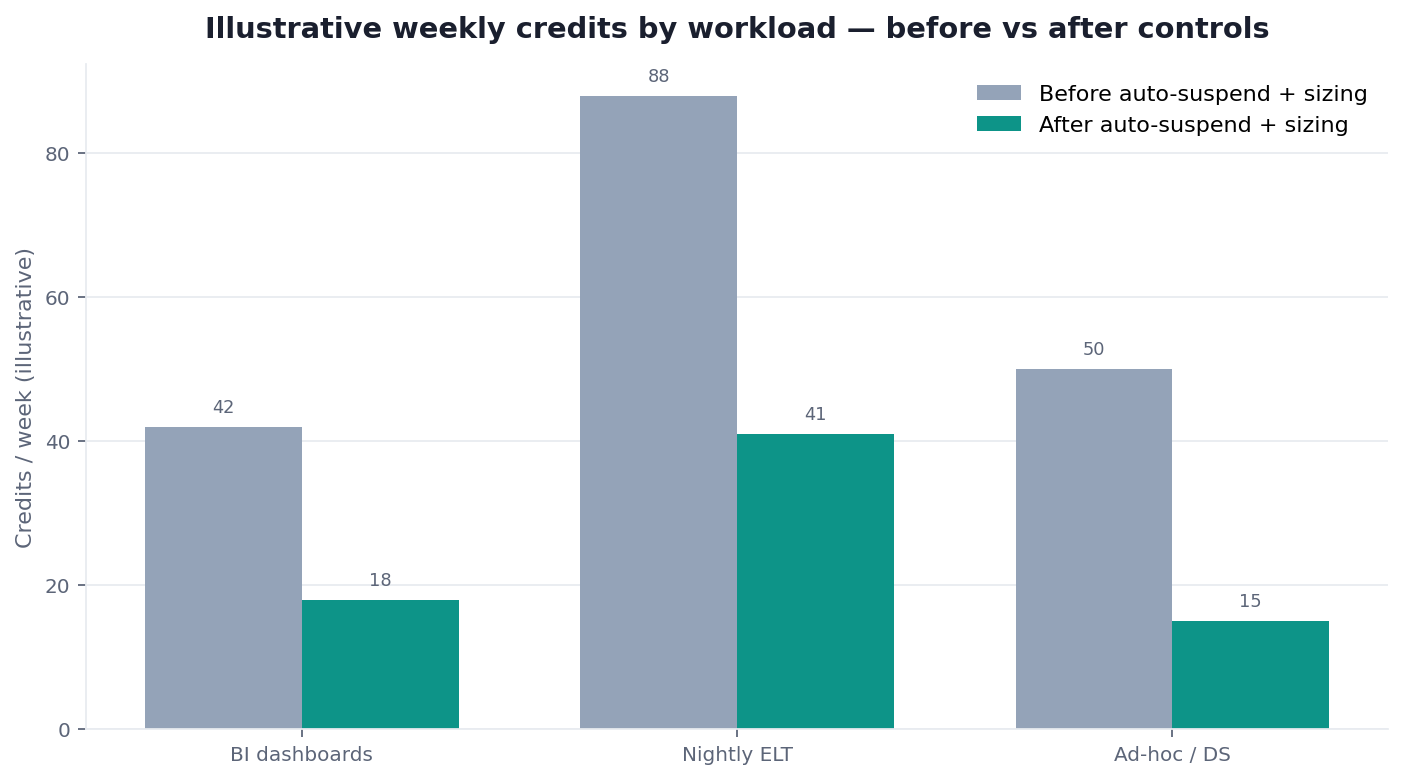
Default every new warehouse to auto-suspend at one minute, start X-Small unless a measured queue proves otherwise, and give ELT its own warehouse so a nightly load cannot keep a BI cluster awake. A useful checkpoint for a snowflake data warehouse is whether owners, metrics, and escalation paths are written down — not just discussed.
Compared with other cloud warehouses
A snowflake data warehouse is one cloud-warehouse implementation, not the only one. BigQuery bills mainly by bytes scanned or slots — see BigQuery documentation; Redshift RA3 separates storage inside AWS; Databricks SQL sits on a lakehouse table format. Each native warehouse integrates most tightly with its own identity, ingest, and BI stack.
| Concern | Snowflake | BigQuery | Redshift |
|---|---|---|---|
| Compute model | Virtual warehouses, per-second credits | Slots / on-demand scan | Clusters / RA3 + concurrency scaling |
| Multi-cloud | AWS, Azure, GCP accounts | Google Cloud | AWS |
| Isolation story | Separate warehouses, no shared cluster fight | Job-level, reservation design | WLM and concurrency scaling |
| Docs home | Snowflake documentation home | BigQuery documentation | AWS Redshift developer guide |
Choose on stack, workload shape, and cost tolerance — not brand. The separated model is a strength of the snowflake data warehouse, not a universal winner.
Common pitfalls
The pitfalls of a snowflake data warehouse center on cost and complacency. Leaving clusters running idle wastes money; oversizing compute for routine work wastes more; and writing queries that scan full tables instead of pruning drives spend up invisibly.
A subtler pitfall is treating a snowflake data warehouse as infinitely elastic and therefore free of design discipline. Because scaling is easy, teams sometimes stop caring about modeling and query efficiency, letting the platform's flexibility paper over sloppy work — until the bill arrives. Elasticity is a tool for handling genuine variability, not a substitute for good data modeling and query hygiene, and the teams that respect that distinction get the benefits without the runaway costs.
Another trap is organizational: giving every team unrestricted power to spin up compute. An analyst can provision capacity in seconds; dozens can do so at once; the aggregate bill surprises finance even when no single query looks unreasonable. Mature snowflake data warehouse deployments pair self-service with default sizes, per-team budgets, and spend visibility. A resource billed by the second needs the same accountability as any variable operating cost.
A fourth failure mode is treating official snowflake cloud data warehouse documentation as optional after week one. Release notes change credit behavior and warehouse defaults. Teams that bookmark only a Slack thread of "how we set it up" miss auto-suspend regressions.
Snowflake in the age of AI
AI intersects a snowflake data warehouse in two ways. AI analysis depends on trusted warehouse data, and AI-native platforms change how much must be consolidated into any one warehouse.
That second shift is worth weighing; see what AI-native data analysis means. Warehouse-native NL — Cortex Analyst documentation — answers questions over semantic views. What the generated query is allowed to see is Snowflake Cortex Analyst governance. The IBM augmented analytics overview is the vendor-neutral frame for why NL on a warehouse still needs a modeled metric layer.
In the InfiniSynapse web app, zero-config federation lets an agent analyze across sources — including a Snowflake instance and other databases together — without forcing everything into one platform, so a snowflake data warehouse can be one federated source among many rather than the sole destination for all data.
Readiness scorecard
Assess your snowflake data warehouse usage (1 point each):
| Check | Pass? |
|---|---|
| Compute is sized to the workload | |
| Auto-suspend is enabled | |
| Queries prune rather than scan | |
| Spend is monitored | |
| Concurrency needs justify the model | |
| Data is still modeled well | |
| Usage limits are set | |
| Federation was considered before consolidating | |
| Owners know the three official doc pages above |
7–9: disciplined usage that keeps the platform economical. 4–6: tighten cost controls before spend grows. Below 4: govern spend now, before the next bill arrives.
Common misconceptions
Misconception 1: It is just a database in the cloud. Its separation of storage and compute is the point.
Misconception 2: Elasticity means you can ignore modeling. Good design still matters.
Misconception 3: Consumption pricing is always cheaper. Only with cost discipline.
Misconception 4: Everything must live in one platform. Federation can query across many.
Misconception 5: A blog replaces official docs. Syntax, limits, and credit rates live in snowflake cloud data warehouse documentation on docs.snowflake.com; this page is the fit-and-cost layer on top.
Frequently Asked Questions
What is a Snowflake data warehouse?
It is a cloud data platform that fully separates storage from compute, keeping data in central cloud storage while independent, elastically scalable compute clusters — often called virtual warehouses — query it. Because those clusters are independent, different workloads run concurrently without contending for the same resources, and capacity scales up for a spike and down again. That separation of storage and compute, taken to its logical end, is the platform's defining idea.
Is Snowflake a cloud data warehouse?
Yes. A snowflake cloud data warehouse is the same product: Snowflake runs only as a managed service on AWS, Azure, or Google Cloud. You do not install it on-premises. The "cloud" modifier in the query is the category; the architecture (separated storage and compute) is why it belongs in that category.
Where is official Snowflake documentation?
Start at the Snowflake documentation home. For a new account, read key concepts, warehouse considerations, and overall cost next. Those three pages are the shortest path through snowflake cloud data warehouse documentation for architecture, sizing, and the bill. SQL reference and release notes come after you have a warehouse that auto-suspends.
How do you manage its cost?
Because pricing is consumption-based, size compute to the workload, enable auto-suspend so clusters stop when idle, and write queries that prune data rather than scanning full tables. The elasticity that makes the platform powerful also makes waste easy, so monitoring spend, setting limits, and educating users are central rather than optional. Treating elasticity as a reason to skip modeling and query hygiene is the fastest route to a surprising bill.
How does AI relate to a Snowflake data warehouse?
AI analysis depends on trusted warehouse data, so the platform stays relevant, but AI-native platforms change how much must be consolidated into any one warehouse. Federation lets an agent analyze across sources — including a Snowflake instance alongside other databases — without forcing everything into one platform, so it can be one federated source among many rather than the sole destination for all data, which reduces costly movement and duplication.
Conclusion
A snowflake data warehouse separates storage from compute for elastic, low-ops, high-concurrency analytics — powerful when consumption cost is governed and data is still modeled well. Size compute deliberately, enable auto-suspend, keep query hygiene, keep the official documentation map next to the runbook, and treat AI-native federation as a reason it can be one source among many.
To see how federated analysis spans Snowflake and other sources together, read what AI-native data analysis means and try the InfiniSynapse web app free on registration.