What Is a Data Warehouse? Definition First
By the InfiniSynapse Data Team · Last updated: 2026-10-12 · We build an AI-native data analysis platform and work across warehouses daily; this explainer answers what is a data warehouse in plain terms, not with a product diagram.
Table of Contents
- TL;DR
- How We Answer This
- What Is a Data Warehouse
- How a Data Warehouse Works
- Data Warehouse and a Database
- Two Ways to Build It
- What Sits Inside a Data Warehouse
- Warehouse, Lake, or Leave It in Place
- Why Organizations Build One
- Common Pitfalls
- Modern Cloud Warehouses
- Warehouses in the Age of AI
- Readiness Scorecard
- Common Misconceptions
- Frequently Asked Questions
- Conclusion
TL;DR
Direct answer: A data warehouse is a central store of cleaned data for analysis. It integrates structured, modeled data from many sources so reporting uses one set of numbers. Schema on write means the data is validated before it is stored.
Who this is for: anyone asking what is a data warehouse.
What you'll learn: the definition, how a warehouse works, how it differs from a database and a lake, the two classic ways to build one, and what sits inside it.
This guide sits under the warehouse and lakehouse hub.
For how to design one, see data warehouse design.
Also see enterprise data warehouse.
How We Answer This
We answer what is a data warehouse from the analysts who depend on it. A warehouse succeeds when its numbers are trusted. The two build paths below follow the Kimball Group description of business-process marts and the enterprise-first pattern Bill Inmon set out in Building the Data Warehouse (1992). Cloud shape for the same idea is in the Azure data architecture guide.
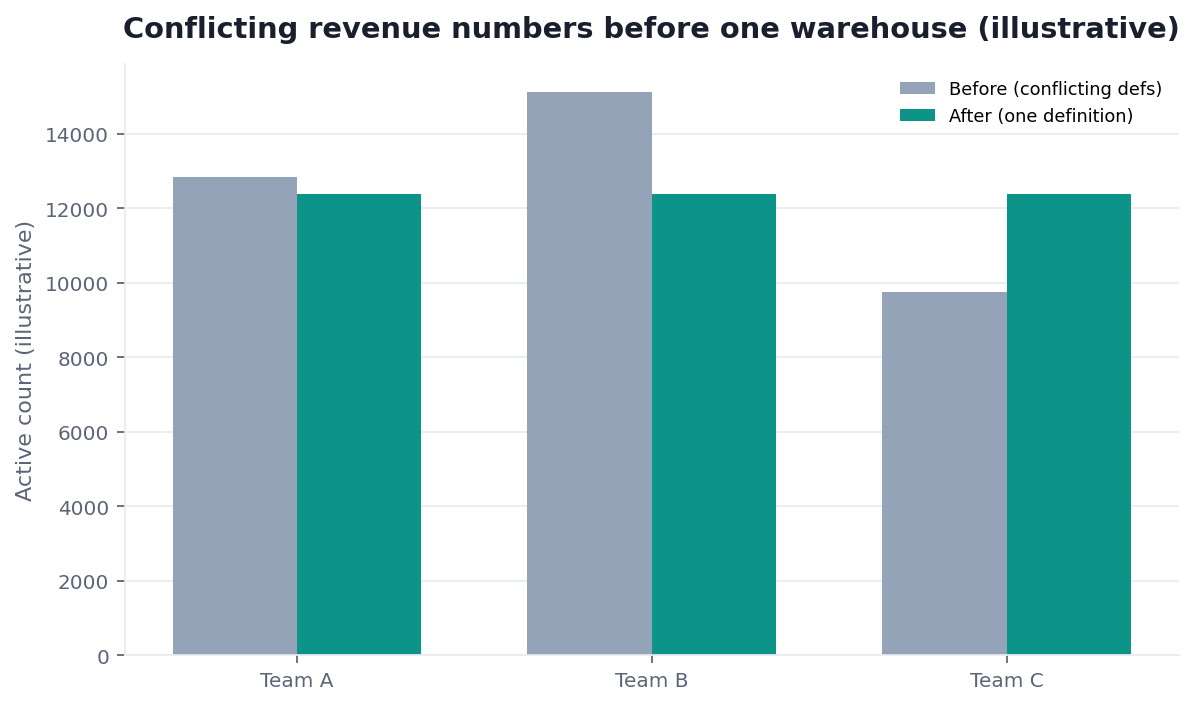
Practical example: five teams reported five different revenue numbers. One warehouse with agreed definitions — the consistency bar in the AWS Well-Architected Analytics Lens — gave them a single figure everyone could use.
Scope note: This guide reflects patterns we see when mid-market and enterprise teams work with a warehouse. It is not a substitute for legal counsel, vendor runbooks, or a formal survey of every industry — and when a smaller toolset or lighter process would serve, a full program is overkill.
What Is a Data Warehouse
A data warehouse is a central store of cleaned data for analysis. Data from many sources is cleaned, modeled, and made consistent so it can be queried for reporting.
Key Definition: A data warehouse is a centralized repository that integrates structured data from across an organization's sources, cleaning and modeling it into a consistent schema optimized for fast, reliable querying, so the same question returns the same answer.
The phrase that defines it is schema on write. Data is structured and validated before it enters the warehouse. A lake stores first and structures later. That difference is why a warehouse can be the place the organization trusts.
How a Data Warehouse Works
Data is extracted from source systems, transformed into a clean and consistent model, and loaded into the warehouse, where it is organized for analytical queries. Teams often schedule that path with a workflow tool such as the one described in the Apache Airflow documentation.
Inside the warehouse, data is organized into fact and dimension tables, or a similar model, so aggregations and reporting queries stay fast. The Azure data architecture guide describes that analytical shape. The up-front structure is what lets a warehouse answer a business question and return the same result the next time the question is asked. Design steps — grain, layers, and the question-first sequence — stay on data warehouse design.
Data Warehouse and a Database
A business database and a data warehouse both store rows. They are built for different jobs.
| Business database | Data warehouse | |
|---|---|---|
| Job | Record what is happening now | Answer what happened, across sources |
| Writes | Many small updates from the application | Batches loaded after cleaning |
| History | The current state, plus a short log | Years of history kept for reporting |
| Who uses it | The application and its operators | Analysts and the reports they publish |
A transactional database, in the sense the PostgreSQL documentation describes for concurrent reads and writes, is built so the application can change one order, one customer, or one payment and commit. A warehouse is built so a report can sum those events after they have been modeled. The difference is the job: consistency for analysis.
Two Ways to Build It
Bill Inmon's Building the Data Warehouse (1992) takes the top-down path: establish the central repository first, then create data marts inside it. Each mart is a subject slice of that repository.
Ralph Kimball's The Data Warehouse Toolkit takes the bottom-up path: develop individual data marts first, then integrate them into a warehouse. The Kimball Group still describes that business-process starting point, with conformed dimensions so the marts can be joined later.
| Inmon | Kimball | |
|---|---|---|
| Start | Central warehouse | A business-process mart |
| Marts | Created from the warehouse | Built first, then integrated |
| When it fits | The enterprise needs one model before any team ships a subject area | One process has to ship, and shared dimensions can be agreed as the next mart arrives |
Neither path is a product ranking. Grain, facts, and dimensions are the design work, covered in data warehouse design.
What Sits Inside a Data Warehouse
Four pieces show up in almost every warehouse, whether the team started with Inmon or Kimball.
| Piece | What it holds |
|---|---|
| Sources | The business systems the rows come from |
| Integration | The extract, transform, and load (or load-then-transform) path that makes those rows consistent |
| Central warehouse | The modeled store analysts query |
| Data mart | A subject slice, such as finance or marketing, taken from that store |
The benefit those pieces buy is the one in the revenue example: one definition of a metric, and a query someone else can run again and get the same number. A mart is a subject slice of that same warehouse, and it uses the same definitions.
Warehouse, Lake, or Leave It in Place
Use a warehouse when the job is consistent reporting on questions you already know. Use a lake when the data is still raw and the questions are not settled. Leave a source in place when the analysis does not need a second copy. The full comparison is data lake vs data warehouse. The merged pattern is the data lakehouse. The hub for the wider architecture is data warehouse.
| Dimension | Data warehouse | Data lake |
|---|---|---|
| Data form | Structured, modeled | Raw, any type |
| Schema | On write | On read |
| Best for | Reliable reporting | Flexibility, exploration |
| Trust | High, curated | Depends on governance |
Complementary stores
Organizations often keep both. The lake holds raw and exploratory data. The warehouse holds the reporting model. They are chosen for the job in front of the team.
When the copy is optional
A lakehouse brings warehouse-style structure onto lake storage, which can reduce the need to run two platforms. Federation can answer some questions without copying every source into the warehouse. That choice is in the AI section below. It does not replace the warehouse for metrics that must be defined once.
Why Organizations Build One
Organizations build a warehouse when they need one trusted set of numbers for reporting and decisions.
Without a warehouse, teams pull data differently and publish conflicting numbers. A warehouse enforces agreed definitions and a consistent model, so revenue means the same thing in every report. That shared version of the truth is why the pattern has lasted through changes in the surrounding stack.
Common Pitfalls
Over-modeling for every conceivable question makes the warehouse slow to build and slow to change. Loading data without agreed definitions reproduces the inconsistency a warehouse was meant to fix. Treating the warehouse as a dumping ground erodes the trust that is its point.
A subtler pitfall is rigidity. Because a warehouse structures data on write, a new kind of data can require a schema change. Teams that freeze the model route around the warehouse. Teams that change it on purpose keep it useful. Model for the questions that matter now, and leave room to grow.
Modern Cloud Warehouses
Cloud warehouses separate storage from compute, scale elastically, and charge for what you use. That removed much of the capacity planning that once made a warehouse painful. We cover the model in cloud data warehouse. For the vendor that popularized the storage and compute split, see snowflake data warehouse.
Cloud warehouses can also run transformations that once needed a separate engine, which is why ELT — load first, transform inside the warehouse — is common. Storage is cheap enough to keep more history, and compute can grow for a month-end report and shrink afterward. The practical question becomes whether the data is worth governing, which is a better question than whether the disk has room.
Warehouses in the Age of AI
AI analysis depends on the consistent data a warehouse provides. AI-native platforms also change how much data must be copied into a warehouse first.
That second shift is in what AI-native data analysis means. In the InfiniSynapse web app, federation lets an agent analyze across sources without forcing every table into one warehouse. The modern design still asks which data needs one definition, and which can stay where it already lives.
Readiness Scorecard
Assess your data warehouse (1 point each):
| Check | Pass? |
|---|---|
| Definitions are agreed and consistent | |
| Data is modeled for real questions | |
| Queries are fast and reliable | |
| The numbers are trusted org-wide | |
| The model can evolve, not just freeze | |
| It is not a dumping ground | |
| It scales with elastic cloud compute | |
| Federation was considered before consolidating |
6–8: a trusted warehouse. 3–5: align definitions and modeling. Below 3: rebuild trust first.
Common Misconceptions
Misconception 1: A warehouse replaces a lake. They do different jobs. Many organizations run both.
Misconception 2: More modeling is always better. Over-modeling makes a warehouse slow to change.
Misconception 3: A warehouse is just a big database. The difference is the job: current transactions in the database, cleaned history for analysis in the warehouse. See Data Warehouse and a Database.
Misconception 4: Everything must be consolidated. Some questions can be answered where the data already lives.
Frequently Asked Questions
What is a data warehouse?
A data warehouse is a central store of cleaned data for analysis. It integrates structured, modeled data from many sources into one schema, and it validates that data before storing it (schema on write), so the same question returns the same numbers.
How is a data warehouse different from a database?
A business database records current transactions with many small writes. A data warehouse keeps cleaned history for analysis and reporting, loaded in batches, so analysts can ask what happened across sources. The warehouse serves those questions. The database serves the application that is running now.
How is a warehouse different from a lake?
A warehouse structures data before storing it, for trusted reporting on known questions. A lake stores raw data and structures it on read, for questions that are not settled yet. Organizations often run both. A lakehouse puts warehouse-style structure on lake storage. Some analysis can also stay in the source system.
Why do organizations build a data warehouse?
They need one trusted set of numbers. Without a warehouse, teams pull data differently and publish conflicting figures. A warehouse enforces agreed definitions so a term like revenue means the same thing in every report.
What are the main pitfalls?
Over-modeling for every conceivable question makes a warehouse slow to build and change. Loading data without agreed definitions reproduces the inconsistency it was meant to fix. Treating it as a dumping ground erodes trust. Freezing the schema pushes teams to route around it. Model for the questions that matter now, and leave room to change the model.
How does AI change the data warehouse?
AI analysis depends on the consistent data a warehouse provides, so the warehouse stays central for metrics that must be defined once. Federation lets an agent analyze across sources without copying every table first. A modern design asks which data needs that single definition, and which can be analyzed where it already lives.
Conclusion
What is a data warehouse? A central store of cleaned, modeled data, kept so the organization can report one set of numbers. Agree the definitions, model for real questions and leave room to change them, and copy into the warehouse only the data that needs that single definition.
To see how federated analysis works across sources, read what AI-native data analysis means and try the InfiniSynapse web app free on registration.