Data Warehouse vs Data Lake (2026)
By the InfiniSynapse Data Team · Last updated: 2026-07-15 · We build an AI-native data analysis platform and work with both models daily; this is a warehouse-first data warehouse vs data lake comparison for 2026, not a vendor pitch.
Table of Contents
- TL;DR
- How We Compare Them
- Starting From the Warehouse
- When Each Fits
- The Trade-Offs
- Why You Might Use Both
- Where the Split Came From
- Common Pitfalls
- The Comparison in the Age of AI
- Readiness Scorecard
- Common Misconceptions
- Frequently Asked Questions
- Conclusion
TL;DR
Direct answer: the data warehouse vs data lake question, seen from the warehouse side, is about what you optimize for: a warehouse optimizes for reliable, governed analytics on structured data, while a lake optimizes for cheap, flexible storage of raw data of any type. In 2026, the data warehouse vs data lake decision usually resolves to using both — the warehouse as the trusted reporting layer, the lake as the affordable landing zone that feeds it.
Who this is for: anyone weighing data warehouse vs data lake in 2026, starting from reporting needs.
What you'll learn: what each optimizes for, when each fits, the trade-offs, why you might use both, and how AI relates.
This guide sits under the warehouse and lakehouse hub.
For the fuller treatment, see data lake vs data warehouse.
Also see data lake vs warehouse.
How We Compare Them
Implementation details are commonly grounded in Apache Spark documentation when teams translate concepts into production practice.
We frame data warehouse vs data lake starting from the warehouse, because most organizations arrive at the question from a reporting need. Every point reflects real deployments. We anchor concepts to the Microsoft Excel support and weigh patterns against the reference architectures at Redis documentation.
The table below frames data warehouse vs data lake at a glance.
| Aspect | Warehouse | Data lake |
|---|---|---|
| Optimized for | Reliable analytics | Flexible storage |
| Data | Structured, modeled | Raw, any type |
| Schema | On write | On read |
| Cost | Higher | Low storage |
| Users | Analysts, business | Scientists, engineers |
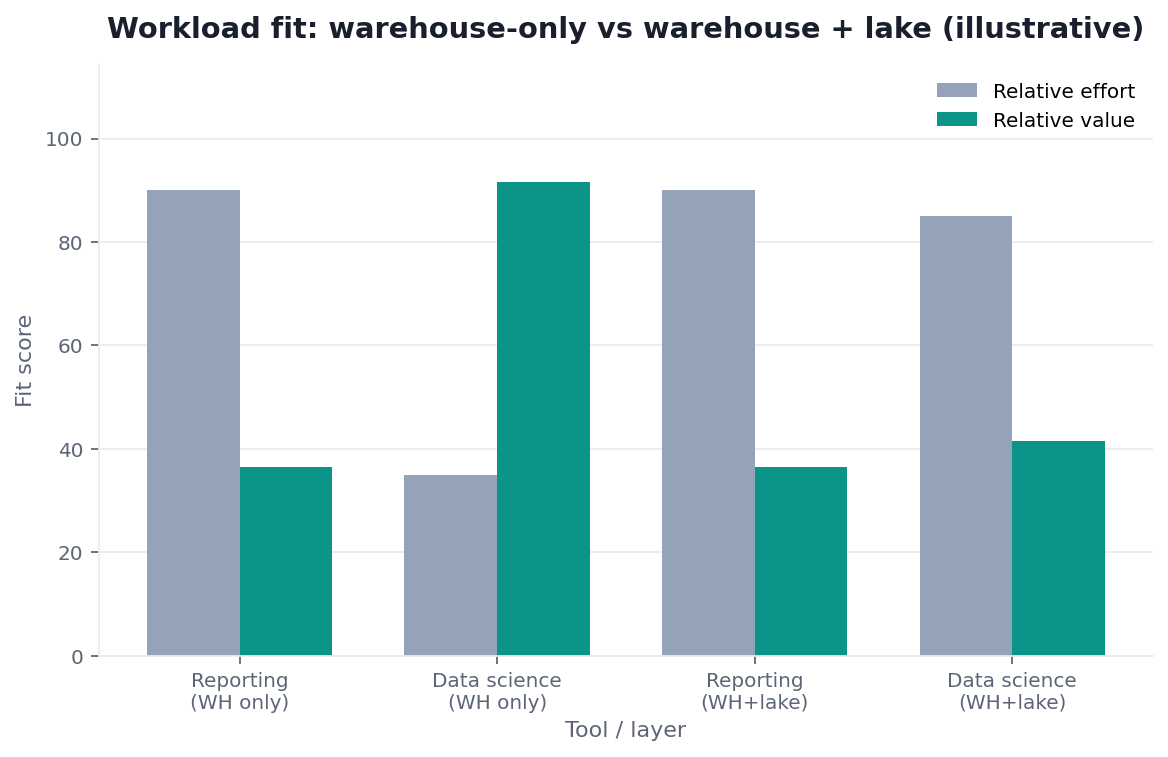
Practical example: a finance team weighing data warehouse vs data lake kept the warehouse for governed reporting and added a lake for raw data science — a division the guidance at MariaDB documentation supports.
Scope note: This guide reflects patterns we see when mid-market and enterprise teams work with data warehouse vs data lake in 2026. It is not a substitute for legal counsel, vendor runbooks, or a formal survey of every industry — and when a smaller toolset or lighter process would serve, a full program is overkill.
Starting From the Warehouse
Seen from the warehouse, data warehouse vs data lake is a question of what to give up. The warehouse gives reliability, governance, and fast structured queries; the lake gives flexibility and low cost but not, on its own, the same trust.
Key Definition: in the data warehouse vs data lake comparison, a data warehouse is a structured system storing cleaned, modeled data optimized for reliable analytics with structure applied before storage, while a data lake is a low-cost repository storing raw data of any type with structure applied only when the data is read.
Framing data warehouse vs data lake this way makes the choice concrete: keep the warehouse where trustworthy reporting matters, and reach for the lake where flexibility and volume matter more than immediate reliability.
When Each Fits
Governance and risk expectations are framed by ENISA AI cybersecurity framework when programs need an external control reference.
In data warehouse vs data lake terms, the warehouse fits structured data that many people query for business reporting, where reliability and governed metrics are paramount; the lake fits large, varied, raw data headed for exploration or machine learning.
The honest read on data warehouse vs data lake is that fit follows the question being asked, as the patterns at W3C WCAG accessibility standard show. Well-defined metrics that the business depends on belong in a warehouse. Open-ended exploration of diverse raw data belongs in a lake. Because most organizations have both kinds of need, the decision usually becomes where to draw the line between them rather than which one to abolish.
The Trade-Offs
The trade-offs in data warehouse vs data lake are symmetric. The warehouse trades flexibility and low cost for reliability; the lake trades reliability for flexibility and cheap scale.
Weighing data warehouse vs data lake honestly means naming the discipline each demands. The Microsoft data architecture guidance shows the warehouse requires upfront modeling that slows change; the lake requires ongoing governance to avoid becoming a swamp. Neither is effortless, and the choice is partly about which discipline your team can sustain and which failure mode — rigidity or disorder — you can least afford in the work at hand.
Why You Might Use Both
Implementation details are commonly grounded in Kubernetes documentation when teams translate concepts into production practice.
The modern resolution of data warehouse vs data lake is to use both in layers. The lake serves as a cheap landing zone for all raw data; the warehouse holds the cleaned, modeled subset the business reports on, fed from the lake.
This layered answer to data warehouse vs data lake assigns each model the job it does best and is why the lakehouse emerged to combine them. It also reframes the question from a contest into a pipeline: raw data lands cheaply in the lake, and the trustworthy slice is refined into the warehouse, so the two reinforce rather than replace each other.
Where the Split Came From
The data warehouse vs data lake split exists because the warehouse came first and could not economically hold everything as data exploded. Warehouses modeled data before storage, which was too rigid and expensive when volumes surged and much of the new data was unstructured with unknown uses.
The lake emerged to store that data cheaply and defer structure. Understanding this history clarifies why data warehouse vs data lake is about optimization targets rather than one being obsolete: the warehouse still does reliable reporting best, and the lake does cheap, flexible storage best. It also explains the lakehouse's arrival — having lived with both, the industry wanted one platform that could offer the warehouse's trust and the lake's flexibility together.
Common Pitfalls
Core definitions remain usefully summarized in Wikipedia SQL overview for shared vocabulary across stakeholders.
The pitfalls of data warehouse vs data lake thinking begin with treating it as all-or-nothing. Forcing raw, high-volume data into a warehouse is costly and rigid; abandoning the warehouse for a lake and expecting the same reporting reliability invites failure.
A subtler pitfall in data warehouse vs data lake decisions is letting the lake erode warehouse discipline. Because the lake makes storing anything easy, teams sometimes stop curating the warehouse carefully, and the trusted layer slowly loses the very reliability that justified it. Keeping the boundary clear — governed warehouse, flexible lake — is what preserves the strengths of both rather than blurring them into a costly muddle.
A related trap is migrating in the wrong direction under cost pressure. When a warehouse bill grows, the reflex is sometimes to push governed reporting workloads down onto the cheaper lake to save money, treating the lake as a discount warehouse. That usually backfires: the reporting that depended on the warehouse's modeling and reliability now runs against raw, loosely governed data, and the trust the business placed in its numbers quietly erodes. Cost pressure is a legitimate reason to revisit the architecture, but the right response is to move the appropriate data to the appropriate system — high-volume raw data to the lake, trusted reporting to the warehouse — rather than collapsing the two roles to chase a lower storage price at the expense of reliability.
The Comparison in the Age of AI
AI reshapes data warehouse vs data lake by reducing how much you must consolidate to analyze. AI analysis needs trusted data wherever it sits, and AI-native platforms can query across both models.
We explore this in what AI-native data analysis means. In the InfiniSynapse web app, zero-config federation lets an agent analyze across a warehouse and a lake together without moving data between them, so the data warehouse vs data lake question shifts from which single home wins to how well each source is governed while you analyze across both.
Readiness Scorecard
Governance and risk expectations are framed by ISO/IEC 42001 AI management when programs need an external control reference.
Assess your storage decision (1 point each):
| Check | Pass? |
|---|---|
| Reporting reliability needs are clear | |
| Raw exploration needs are clear | |
| The boundary between them is defined | |
| Warehouse curation stays disciplined | |
| Lake governance is planned | |
| A layered "both" was considered | |
| Cost trade-offs are understood | |
| Federation was considered |
6–8: a sound decision. 3–5: sharpen the boundary. Below 3: reassess from needs up.
Common Misconceptions
Misconception 1: The lake makes the warehouse obsolete. The warehouse still does reliable reporting best.
Misconception 2: You must choose one. Layering both is common and often best.
Misconception 3: A lake is simply cheaper. Its governance cost is real.
Misconception 4: Everything must be consolidated. Federation can query across both.
Frequently Asked Questions
What does each one optimize for?
A warehouse optimizes for reliable, governed analytics on structured data, applying structure before storage so queries are fast and trustworthy. A lake optimizes for cheap, flexible storage of raw data of any type, applying structure only when the data is read. Seen from the warehouse side, the choice is about what you give up: the warehouse offers reliability and governed metrics but less flexibility and higher cost, while the lake offers flexibility and cheap scale but not, on its own, the same trust.
When should I pick the warehouse over the lake?
Pick the warehouse when structured data must be queried reliably by many people for business reporting, where governed metrics and trust are paramount. Pick the lake when data is large, varied, and raw, headed for exploration or machine learning where uses are not yet fixed. Fit follows the question being asked: well-defined metrics the business depends on belong in a warehouse, open-ended exploration belongs in a lake, and most organizations end up drawing a line between the two rather than abolishing either.
Why do organizations run both?
Because each does a different job best. The lake serves as a cheap landing zone for all raw data, and the warehouse holds the cleaned, modeled subset the business reports on, fed from the lake. This layered approach assigns each its strength and reframes the question from a contest into a pipeline: raw data lands cheaply in the lake, and the trustworthy slice is refined into the warehouse. The two reinforce rather than replace each other, which is also why the lakehouse emerged.
What are the trade-offs?
They are essentially mirror images. Choosing the warehouse means accepting less flexibility and a higher bill in exchange for dependable, governed analytics; choosing the lake means accepting weaker built-in reliability in exchange for cheap scale and freedom of format. Neither is effortless — the warehouse requires upfront modeling that slows change, while the lake requires ongoing governance to avoid becoming a swamp. The choice is partly about which discipline your team can sustain and which failure mode, rigidity or disorder, you can least afford in the work at hand. Keeping a clear boundary preserves the strengths of both.
How does AI change the decision?
AI reshapes it by reducing how much you must consolidate to analyze. What modern analysis requires is reliable data regardless of which system stores it, and AI-native platforms are designed to reach into both the warehouse and the lake simultaneously. Federation lets an agent analyze across a warehouse and a lake together without moving data between them, so the question shifts from which single home wins to how well each source is governed while you analyze across both. That lowers movement cost and lets each model keep the job it does best.
If I already have a warehouse, when should I add a lake?
Add a lake when you start hitting the warehouse's limits: data arriving faster or in more varied forms than modeling can keep up with, storage costs climbing because you are keeping everything in an expensive structured system, or data-science teams asking for raw data the warehouse does not retain. The lake then becomes a cheap landing zone that absorbs the volume and variety, feeding a curated slice into the warehouse for reporting. The signal to add one is a genuine need for flexibility or scale the warehouse cannot serve economically — not the mere existence of the option. Adding a lake without that need simply introduces a second system to govern for benefits you will not use.
In practice, teams evaluating data warehouse vs data lake should judge outcomes by reliability and clarity, not by tool count alone.
When stakeholders ask for a short takeaway on data warehouse vs data lake, start from the decision it must support and work backward.
In practice, teams evaluating data warehouse vs data lake should judge outcomes by reliability and clarity, not by tool count alone.
Conclusion
The data warehouse vs data lake choice, from the warehouse side, is about optimization targets — reliable governed analytics versus cheap flexible storage — and in 2026 it usually resolves to using both in layers. Keep the boundary clear, and let AI-native federation analyze across each well-governed source rather than forcing one to win.