Data Lake vs Warehouse: Quick Comparison (2026)
By the InfiniSynapse Data Team · Last updated: 2026-07-15 · We build an AI-native data analysis platform and work with both storage models daily; this is a fast, practical data lake vs warehouse comparison for 2026, not a vendor pitch.
Table of Contents
- TL;DR
- How We Compare Them
- The Core Difference
- When Each Fits
- The Trade-Offs
- Why You Might Use Both
- Where the Split Came From
- Common Pitfalls
- The Comparison in the Age of AI
- Readiness Scorecard
- Common Misconceptions
- Frequently Asked Questions
- Conclusion
TL;DR
Direct answer: the data lake vs warehouse question comes down to structure and timing: a lake stores raw data of any type cheaply and applies structure only when read, while a warehouse cleans and models data before storing it for reliable analytics. In 2026, the data lake vs warehouse choice is rarely either/or — most organizations use both, the lake as a cheap landing zone and the warehouse as the governed layer for trustworthy reporting.
Who this is for: anyone weighing data lake vs warehouse quickly in 2026.
What you'll learn: the core difference, when each fits, the trade-offs, why you might use both, and how AI changes it.
This guide sits under the warehouse and lakehouse hub.
For the fuller treatment, see data lake vs data warehouse.
Also see data warehouse vs data lake.
How We Compare Them
Teams evaluating this topic often cross-check PostgreSQL documentation for a durable, vendor-neutral reference point.
We frame data lake vs warehouse by what each does differently, because the contrast is the whole point. Every point reflects real deployments. We anchor concepts to the UK NCSC AI development guidelines and weigh patterns against the reference architectures at Prometheus documentation.
The table below frames data lake vs warehouse at a glance.
| Aspect | Data lake | Warehouse |
|---|---|---|
| Data | Raw, any type | Structured, modeled |
| Schema | On read | On write |
| Cost | Low storage | Higher, structured |
| Strength | Flexibility | Reliability |
| Users | Scientists, engineers | Analysts, business |
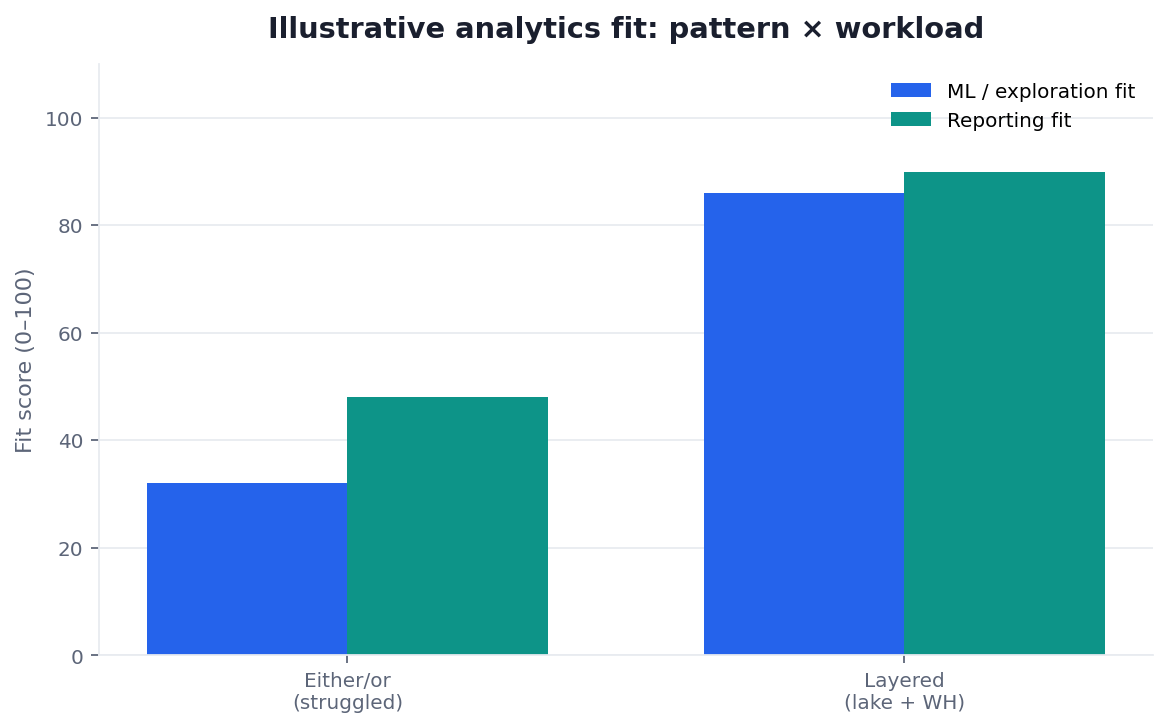
Practical example: a team debating data lake vs warehouse realized the answer was "both" — a lake for raw landing and a warehouse for reporting — a layered pattern the guidance at Google Cloud AI overview reinforces.
Scope note: This guide reflects patterns we see when mid-market and enterprise teams work with data lake vs warehouse in 2026. It is not a substitute for legal counsel, vendor runbooks, or a formal survey of every industry — and when a smaller toolset or lighter process would serve, a full program is overkill.
The Core Difference
The core of data lake vs warehouse is when structure is applied. A lake stores data raw and imposes structure only when someone reads it (schema-on-read); a warehouse imposes structure before storage (schema-on-write), cleaning and modeling data first.
Key Definition: in the data lake vs warehouse comparison, a data lake is a low-cost repository storing raw data of any type with structure applied at read time, while a data warehouse is a structured system storing cleaned, modeled data optimized for reliable analytics, with structure applied before the data is stored.
That single difference in timing cascades into everything else about data lake vs warehouse: the lake's flexibility and low cost, the warehouse's reliability and higher price, and the different users each serves.
When Each Fits
Implementation details are commonly grounded in Google BigQuery documentation when teams translate concepts into production practice.
In data lake vs warehouse terms, a lake fits large, varied, often unstructured data headed for flexible processing or machine learning; a warehouse fits structured data that many people need to query reliably for business reporting.
The honest read on data lake vs warehouse is that fit depends on workload, as the patterns at Apache Airflow documentation show. If your priority is trustworthy, repeatable reporting on well-defined metrics, lean warehouse. If it is exploring diverse raw data whose uses are not yet fixed, lean lake. Most organizations of any size discover both needs coexist, which is why the question rarely stays either/or for long.
The Trade-Offs
The trade-offs in data lake vs warehouse mirror each model's strength. The lake's flexibility comes with the risk of becoming an ungoverned swamp; the warehouse's reliability comes with rigidity and higher cost.
Weighing data lake vs warehouse honestly means accepting that neither is free of discipline. The Wikipedia business intelligence overview shows the warehouse demands upfront modeling effort; the lake demands ongoing governance. Choosing between them is really choosing which kind of discipline your data and team are better positioned to sustain, and where the payoff — flexibility or reliability — matters more for the work at hand.
Why You Might Use Both
Core definitions remain usefully summarized in Wikipedia data quality overview for shared vocabulary across stakeholders.
The modern answer to data lake vs warehouse is often "both, layered." The lake acts as a cheap landing zone where all raw data arrives; the warehouse holds the cleaned, modeled subset that reporting depends on, fed from the lake.
This layered approach to data lake vs warehouse gives each model the job it does best and is why the lakehouse emerged to blur the line further. It also explains why the question is less a fork in the road than a division of labor: the lake for breadth and flexibility, the warehouse for trust and performance, working together rather than competing for the same role.
Where the Split Came From
The data lake vs warehouse split arose because the warehouse came first and could not economically hold everything. Warehouses required data to be modeled before storage, which was too rigid and too expensive when data volumes exploded and much of the new data was unstructured with unknown future uses.
The lake emerged to store that data cheaply and defer structure, and the two coexisted because each solved a problem the other could not. Understanding this history clarifies why the data lake vs warehouse comparison is about timing and structure rather than a simple newer-versus-older story. It also explains why the lakehouse appeared: once the industry had lived with both, the appeal of one platform offering the lake's flexibility and the warehouse's reliability became obvious.
Common Pitfalls
Implementation details are commonly grounded in Databricks documentation when teams translate concepts into production practice.
The pitfalls of data lake vs warehouse thinking start with treating it as a winner-take-all contest. Forcing all data into a warehouse wastes money and flexibility; dumping everything in a lake and calling it analytics-ready invites a swamp.
A subtler pitfall in data lake vs warehouse decisions is choosing on fashion rather than workload. Lakes and lakehouses carry buzz that can pull teams toward complexity they do not need, when a warehouse would serve them more simply, or vice versa. The right choice follows the data and the questions being asked, not the trend, and the layered "both" answer is frequently the most honest one.
Another pitfall is letting the boundary between the two blur through neglect rather than design. When a lake feeds a warehouse, it is tempting to skip the curation step and let analysts query the raw lake directly "just this once," or to keep loading unmodeled data straight into the warehouse because it is faster than doing it properly. Each shortcut erodes the very distinction that made the two-system arrangement valuable: soon the lake holds half-cleaned data nobody trusts, and the warehouse holds raw sprawl it was never meant to. Preserving a clear, deliberate line — raw and flexible in the lake, modeled and governed in the warehouse — is what keeps a data lake vs warehouse arrangement working over time instead of collapsing into an expensive hybrid of both weaknesses.
The Comparison in the Age of AI
AI reshapes data lake vs warehouse by changing how much consolidation the choice even requires. AI analysis needs trusted data wherever it lives, and AI-native platforms can reach across both models.
We explore this in what AI-native data analysis means. In the InfiniSynapse web app, zero-config federation lets an agent analyze across a lake and a warehouse together without moving data between them, so the data lake vs warehouse question becomes less about which single destination wins and more about governing each source well while querying across both.
Readiness Scorecard
Teams evaluating this topic often cross-check pandas documentation for a durable, vendor-neutral reference point.
Assess your storage decision (1 point each):
| Check | Pass? |
|---|---|
| Workload, not fashion, drove the choice | |
| Structured reporting needs are clear | |
| Raw exploration needs are clear | |
| A layered "both" was considered | |
| Lake governance is planned | |
| Warehouse modeling is planned | |
| Cost trade-offs are understood | |
| Federation was considered |
6–8: a sound decision. 3–5: revisit fit. Below 3: reassess from the workload up.
Common Misconceptions
Misconception 1: One replaces the other. They serve different needs and often coexist.
Misconception 2: A lake is cheaper overall. Storage is cheap; governance is not.
Misconception 3: A warehouse is outdated. It remains the reliable reporting layer.
Misconception 4: You must pick one. Layering both is common and often best.
Frequently Asked Questions
What is the core difference between a data lake and a warehouse?
The core difference is when structure is applied. A lake stores data raw and imposes structure only when someone reads it — schema-on-read — while a warehouse imposes structure before storage, cleaning and modeling data first, which is schema-on-write. That single difference in timing cascades into everything else: the lake's flexibility and low cost, the warehouse's reliability and higher price, and the different users each serves, from scientists and engineers to analysts and business teams.
When should I choose one over the other?
Choose a lake for large, varied, often unstructured data headed for flexible processing or machine learning, and a warehouse for structured data that many people need to query reliably for business reporting. If your priority is trustworthy, repeatable reporting on well-defined metrics, lean warehouse; if it is exploring diverse raw data whose uses are not yet fixed, lean lake. Most organizations of any size discover both needs coexist, so the question rarely stays either/or.
Why do organizations use both?
Because each model does a different job best. The lake acts as a cheap landing zone where all raw data arrives, and the warehouse holds the cleaned, modeled subset that reporting depends on, fed from the lake. This layered approach gives each its strength — the lake for breadth and flexibility, the warehouse for trust and performance — and is exactly why the lakehouse emerged to blur the line. The choice is less a fork in the road than a division of labor.
What are the main trade-offs?
Each model's strength has a matching cost. A lake's openness invites disorder if it is left ungoverned, while a warehouse's dependability is bought with rigidity and a higher price tag. Neither is free of discipline — the warehouse demands upfront modeling effort, the lake demands ongoing governance. Choosing between them is really choosing which kind of discipline your data and team can sustain, and where the payoff, flexibility or reliability, matters more for the work at hand.
How does AI change the comparison?
AI reshapes the comparison by changing how much consolidation it requires. Modern analysis has to reach trusted data no matter which system holds it, and AI-native tools are built to span both the lake and the warehouse at once. Federation lets an agent analyze across a lake and a warehouse together without moving data between them, so the question becomes less about which single destination wins and more about governing each source well while querying across both. That reduces movement cost and lets each model keep the job it does best.
Does the lakehouse make this comparison obsolete?
Not obsolete, but it does soften the fork. A lakehouse tries to deliver the lake's cheap flexibility and the warehouse's reliability from one platform by layering warehouse-style structure and transactions onto lake storage. Where it works, the choice becomes less about picking a side and more about how you zone and govern a single system. But the underlying tension the comparison describes — flexibility versus reliability, schema-on-read versus schema-on-write — does not disappear; it moves inside the lakehouse, where you still decide which data gets the full governance treatment and which stays raw. Understanding the two poles is what lets you run a lakehouse well rather than blur them into a muddle.
A useful checkpoint for data lake vs warehouse is whether owners, metrics, and escalation paths are written down — not just discussed.
Conclusion
The data lake vs warehouse choice is about structure and timing — raw and flexible versus modeled and reliable — and in 2026 it is rarely either/or. Most organizations layer both, and AI-native federation makes it easier still to govern each source well while analyzing across them, so decide by workload rather than fashion.