Data Lake vs Data Warehouse (2026)
By the InfiniSynapse Data Team · Last updated: 2026-07-15 · We build an AI-native data analysis platform and work across both stores; this guide compares data lake vs data warehouse honestly for 2026, not to sell one over the other.
Table of Contents
- TL;DR
- How We Compare Them
- What Each Is
- The Core Differences
- When to Use Each
- Running Both
- The Lakehouse Middle Path
- Choosing Well
- The Choice in the Age of AI
- Decision Scorecard
- Common Misconceptions
- Frequently Asked Questions
- Conclusion
TL;DR
Direct answer: the data lake vs data warehouse choice comes down to purpose: a lake stores raw data of any type cheaply and structures it on read for flexibility, while a warehouse structures data on write for trusted, fast, consistent reporting. In 2026, data lake vs data warehouse is rarely either/or — many organizations run both or adopt a lakehouse — and the real skill is matching each workload to the store that fits it.
Who this is for: architects and leaders weighing data lake vs data warehouse in 2026.
What you'll learn: what each is, the core differences, when to use each, whether to run both, and how AI changes the choice.
This guide sits under the warehouse and lakehouse hub.
The lake side of that comparison starts from the data lake definition.
For the reverse framing, see data warehouse vs data lake.
Also see data lakehouse. How the lake is layered: data lake architecture. How the warehouse is modeled: data warehouse design.
How We Compare Them
Implementation details are commonly grounded in Google Cloud architecture framework when teams translate concepts into production practice.
We compare data lake vs data warehouse by workload, because the honest answer to "which is better" is "for what?" Every point reflects real systems. We anchor the concepts to the Stanford HAI AI Index and weigh patterns against the reference architectures at MongoDB documentation, which sit at the intersection of both.
The table below frames data lake vs data warehouse.
| Dimension | Data lake | Data warehouse |
|---|---|---|
| Data | Raw, any type | Structured, modeled |
| Schema | On read | On write |
| Cost | Low storage | Higher, curated |
| Best for | ML, exploration | Trusted reporting |
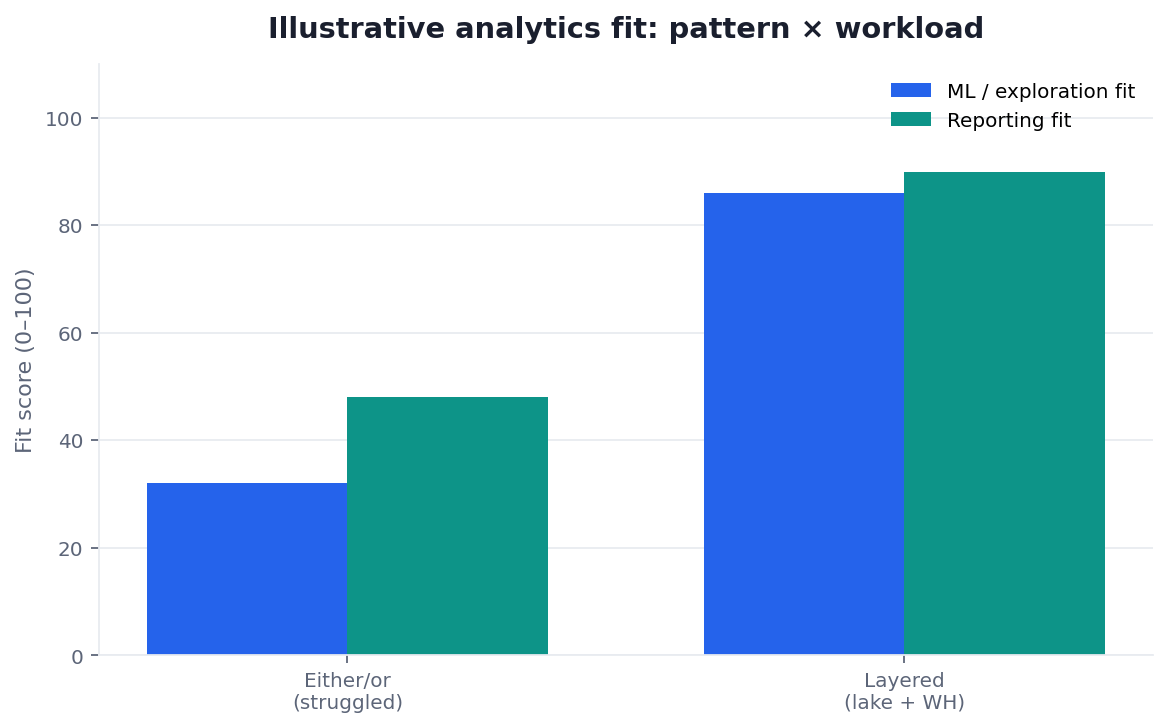
Practical example: a team forced all analytics through a data lake vs data warehouse either/or and struggled. Using the lake for ML and a warehouse for reporting — the pragmatic split echoed at Apache Airflow documentation — served both needs cleanly.
Scope note: This guide reflects patterns we see when mid-market and enterprise teams work with data lake vs data warehouse in 2026. It is not a substitute for legal counsel, vendor runbooks, or a formal survey of every industry — and when a smaller toolset or lighter process would serve, a full program is overkill.
What Each Is
To settle data lake vs data warehouse, start with each on its own. The warehouse definition is what is a data warehouse. A data lake stores raw data of any type cheaply, applying schema on read for maximum flexibility. A data warehouse stores structured, modeled data, applying schema on write for consistency and trust.
Key Definition: data lake vs data warehouse is the choice between flexible, low-cost raw storage (the lake) and structured, governed analytical storage (the warehouse) — most modern stacks use both, matching each to the workload rather than forcing a single pattern.
The framing that clarifies data lake vs data warehouse is that they optimize for opposite ends of a trade-off. The patterns at NIST SP 800-53 security controls reflect this: a lake maximizes flexibility at the cost of requiring governance to stay usable, while a warehouse maximizes trust and speed at the cost of the up-front structure that limits what it can hold. Neither is universally better; each is better for its job.
The Core Differences
Implementation details are commonly grounded in Stripe documentation when teams translate concepts into production practice.
The core of data lake vs data warehouse is where and when structure is applied. A lake stores first and structures on read; a warehouse structures on write and stores the result. This one difference drives all the others.
Because of that difference, data lake vs data warehouse diverge on cost, trust, and use. A lake is cheap and flexible but its data trustworthiness depends on governance; a warehouse is more expensive and rigid but its data is consistent and trusted by default. The Wikipedia machine learning overview reflects the same split: lakes suit raw, exploratory, and machine-learning work, while warehouses suit the reliable reporting a business runs on.
When to Use Each
Deciding data lake vs data warehouse for a given workload is straightforward once framed by need. Use a lake when you have diverse raw data, machine-learning needs, or data whose future use is uncertain. Use a warehouse when you need consistent, trusted reporting on well-understood questions.
The mistake in data lake vs data warehouse decisions is forcing one store to do the other's job. Running reporting off an ungoverned lake produces inconsistent numbers; forcing raw, diverse ML data into a rigid warehouse loses the detail models need. Matching each workload to the store built for it is the whole point, and it is why so many organizations end up running both rather than choosing one.
Running Both
Architecture choices are often checked against IBM augmented analytics overview so boundaries, ownership, and scale patterns stay explicit.
For many organizations, data lake vs data warehouse resolves into running both. Raw and diverse data lands in a lake for flexibility and ML; curated, trusted data lives in a warehouse for reporting; and data flows from lake to warehouse as it is refined.
Running both in the data lake vs data warehouse model is common precisely because the two serve genuinely different needs. The cost is maintaining two systems and the pipelines between them, which is real overhead. That overhead is exactly what the lakehouse aims to remove, and it is why the two-system pattern, while pragmatic, is increasingly being reconsidered in favor of a converged store.
The Lakehouse Middle Path
The lakehouse is the modern answer to data lake vs data warehouse as an either/or. It adds warehouse-like structure, transactions, and reliability on top of cheap lake storage, aiming to serve both flexible and trusted workloads from one system.
The lakehouse reframes data lake vs data warehouse from a choice into a convergence. By bringing schema enforcement, transactions, and governance to lake storage through open table formats, it aims to give the flexibility of a lake and the trust of a warehouse without maintaining two systems. We explore it in data lakehouse; whether it fully replaces the two-system pattern depends on your workloads, but it is where much of the industry is heading.
Choosing Well
Core definitions remain usefully summarized in Wikipedia statistics overview for shared vocabulary across stakeholders.
Choosing well in data lake vs data warehouse means starting from workloads, not fashion. List what you actually need to do — reporting, exploration, ML — and match each to the store that fits, rather than picking a store first and forcing work into it.
The teams that navigate data lake vs data warehouse best stay pragmatic. They accept that different workloads want different stores, they weigh the real cost of running both against the maturity of a lakehouse for their case, and they avoid dogma in either direction. The goal is not architectural purity but serving the organization's actual analytical needs at a sensible cost, which usually means a deliberate mix rather than a single ideological choice.
A Short History of the Debate
The comparison did not always exist, because for a long time there was only the warehouse. Structured, modeled, on-premises warehouses were the undisputed home of business analytics for decades, and the question of an alternative simply did not arise until the data landscape changed. When the web, mobile, and connected devices began producing enormous volumes of semi-structured and unstructured data, the warehouse's insistence on modeling everything up front became a bottleneck, and cheap object storage opened a new option: keep the raw data first, structure it later. That is when the debate was born.
For a period the two camps were treated almost as rivals, with lake advocates casting warehouses as rigid relics and warehouse advocates casting lakes as ungoverned dumping grounds. Both caricatures contained a grain of truth, which is why the argument persisted, but experience gradually revealed the more useful framing: the two are tools for different jobs rather than competitors for the same one. Most mature organizations settled into using each where it fits, and the industry's energy shifted from arguing about which is better toward converging the two into a single lakehouse platform. Seeing this history helps because it explains why the debate feels so entrenched and why the honest modern answer is almost never a simple choice of one over the other, but a deliberate, workload-driven mix.
The Choice in the Age of AI
Core definitions remain usefully summarized in Wikipedia data warehouse overview for shared vocabulary across stakeholders.
AI reshapes data lake vs data warehouse in two ways. AI workloads increasingly need both raw data (for ML) and trusted data (for reliable answers), and AI-native platforms change how much must be consolidated into either store.
That second shift is worth weighing, and we describe it in what AI-native data analysis means. In the InfiniSynapse web app, zero-config federation lets an agent analyze across sources — lakes, warehouses, and operational databases alike — without forcing everything into one, so the data lake vs data warehouse decision increasingly includes the option of querying data where it lives rather than consolidating at all.
Decision Scorecard
Score toward a warehouse (1 point per yes):
| Check | Warehouse? |
|---|---|
| You need consistent, trusted numbers | |
| Questions are well-understood | |
| Reporting is the main workload | |
| Many teams share the same metrics | |
| Speed on known queries matters | |
| Raw diverse data is not central | |
| ML on raw data is not the priority | |
| Governance of raw data is weak |
5–8: lean warehouse. 2–4: consider both or a lakehouse. 0–1: a lake fits the workload.
Common Misconceptions
Misconception 1: One is simply better. In data lake vs data warehouse, each is better for its job.
Misconception 2: You must choose one. Many run both, or adopt a lakehouse.
Misconception 3: A lake can do reporting. Only with governance a warehouse provides by design.
Misconception 4: Consolidation is always required. Federation can analyze data in place.
Frequently Asked Questions
What is the difference between a data lake and a data warehouse?
The core difference is where and when structure is applied: a lake stores raw data of any type first and applies schema on read for flexibility, while a warehouse structures data on write and stores the modeled result for consistency and trust. That single difference drives the rest — a lake is cheap and flexible but depends on governance for trust, while a warehouse is more rigid and costly but consistent and trusted by default.
When should you use a data lake versus a data warehouse?
Use a lake when you have diverse raw data, machine-learning needs, or data whose future use is uncertain, and use a warehouse when you need consistent, trusted reporting on well-understood questions. The common mistake is forcing one to do the other's job — running reporting off an ungoverned lake yields inconsistent numbers, while cramming raw ML data into a rigid warehouse loses the detail models need.
Should you run both a lake and a warehouse?
Many organizations do, because the two serve genuinely different needs: raw and diverse data lands in a lake for flexibility and ML, while curated, trusted data lives in a warehouse for reporting, with data flowing from lake to warehouse as it is refined. The cost is maintaining two systems and the pipelines between them, which is exactly the overhead the lakehouse aims to remove by converging both onto one store.
What is a lakehouse in this comparison?
A lakehouse adds warehouse-like structure, transactions, and reliability on top of cheap lake storage, aiming to serve both flexible and trusted workloads from one system. It reframes the lake-versus-warehouse question from a choice into a convergence, bringing schema enforcement and governance to lake storage through open table formats. Whether it fully replaces the two-system pattern depends on your workloads, but it is where much of the industry is heading.
How does AI change the choice?
AI workloads increasingly need both raw data for machine learning and trusted data for reliable answers, and AI-native platforms change how much must be consolidated into either store. Federation lets an agent analyze across sources — lakes, warehouses, and operational databases alike — without forcing everything into one, so the decision now includes the option of querying data where it lives rather than consolidating it first.
In practice, teams evaluating data lake vs data warehouse should judge outcomes by reliability and clarity, not by tool count alone.
Conclusion
In data lake vs data warehouse, a lake gives cheap, flexible raw storage for exploration and ML, while a warehouse gives trusted, structured reporting — and each is better for its own job. In 2026, match workloads to stores, weigh running both against a lakehouse, and remember AI-native federation can query across all of them without consolidating at all. After the store type is chosen, platform rows are in the data warehouse comparison matrix.
To see how federated analysis spans lakes and warehouses alike, read what AI-native data analysis means and try the InfiniSynapse web app free on registration.