What Is a Cloud Data Warehouse? (2026)
By the InfiniSynapse Data Team · Last updated: 2026-07-15 · We build an AI-native data analysis platform and work across cloud warehouses daily; this explainer covers what a cloud data warehouse is in 2026, in plain terms rather than a vendor pitch.
Table of Contents
- TL;DR
- How We Approach It
- What It Is
- How It Differs From On-Premises
- When It Fits
- Cost and Governance Realities
- Where It Came From
- Common Pitfalls
- The Cloud Warehouse in the Age of AI
- Readiness Scorecard
- Common Misconceptions
- Frequently Asked Questions
- Conclusion
TL;DR
Direct answer: a cloud data warehouse is an analytical database delivered as a managed cloud service, where the provider handles infrastructure and compute scales elastically on demand. In 2026, a cloud data warehouse is the default choice for most new analytics platforms because it removes hardware management and scales with need, but its consumption pricing and the ease of loading data mean cost and governance discipline matter more, not less.
Who this is for: architects and leaders evaluating a cloud data warehouse in 2026.
What you'll learn: what it is, how it differs from on-premises, when it fits, cost realities, and how AI relates.
This guide sits under the warehouse and lakehouse hub. Six named platforms are in the data warehouse comparison matrix.
For the concept, see what is a data warehouse.
Also see enterprise data warehouse.
How We Approach It
Governance and risk expectations are framed by ISO/IEC 42001 AI management when programs need an external control reference.
We explain a cloud data warehouse by contrast with the on-premises model it replaced, because the differences reveal what it actually offers. Every point reflects real deployments. We anchor concepts to the Supabase documentation and weigh patterns against the reference architectures at Anthropic research.
The table below frames the cloud data warehouse.
| Aspect | Cloud data warehouse |
|---|---|
| Infrastructure | Managed by provider |
| Compute | Elastic, on demand |
| Pricing | Consumption-based |
| Strength | No hardware, scales fast |
| Watch-out | Cost and governance |
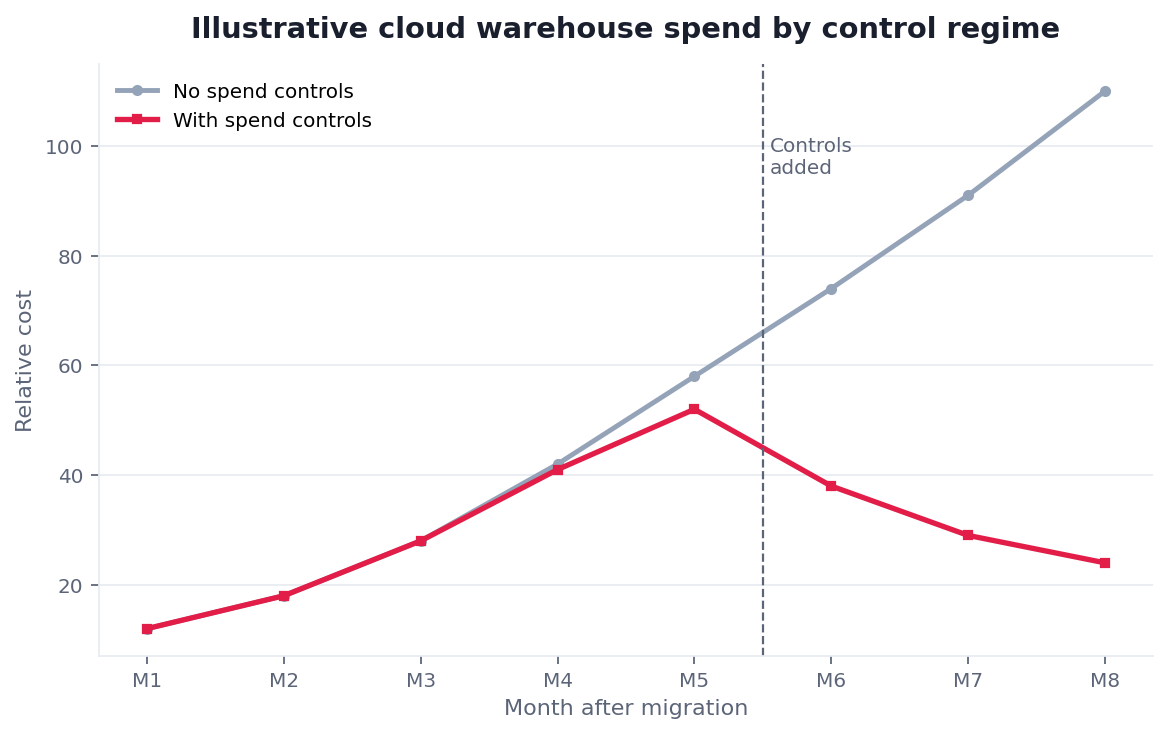
Practical example: a company migrating to a cloud data warehouse cut its provisioning time from months to hours but saw costs climb until it added query and spend controls — a pattern the guidance at Wikipedia business intelligence overview reinforces for comparable platforms.
Scope note: This guide reflects patterns we see when mid-market and enterprise teams work with cloud data warehouse in 2026. It is not a substitute for legal counsel, vendor runbooks, or a formal survey of every industry — and when a smaller toolset or lighter process would serve, a full program is overkill.
What It Is
At its core, a cloud data warehouse is an analytical database offered as a managed service by a cloud provider, so an organization consumes warehousing capability without owning or operating the underlying hardware.
Key Definition: a cloud data warehouse is an analytical database delivered as a fully managed cloud service, in which the provider operates the infrastructure and compute scales elastically on demand, so organizations pay for capacity as they use it rather than purchasing and maintaining physical servers.
The essence of a cloud data warehouse is that warehousing becomes a service rather than an asset. Instead of buying servers, planning capacity years ahead, and maintaining them, an organization provisions a warehouse in minutes and scales it as needs change, shifting the operational burden to the provider.
How It Differs From On-Premises
Implementation details are commonly grounded in Amazon Redshift documentation when teams translate concepts into production practice.
A cloud data warehouse differs from an on-premises one chiefly in who owns the burden. On-premises means buying, housing, and maintaining hardware and planning capacity in advance; the cloud model hands that to the provider.
The practical difference a cloud data warehouse makes is speed and elasticity, as the patterns at MariaDB documentation for comparable platforms illustrate. Provisioning takes minutes not months, capacity scales up for a spike and down after, and there is no idle hardware to justify. The trade is a shift from capital expense to operating expense, and from predictable fixed cost to variable cost that follows usage — which is why governance becomes central.
When It Fits
A cloud data warehouse fits most new analytics platforms in 2026, especially organizations that value fast provisioning, elastic scaling, and freedom from hardware management over the fixed-cost predictability of owned infrastructure.
Like any tool, a cloud data warehouse is not universal. The AWS Well-Architected Framework notes that regulatory, latency, or data-residency constraints occasionally favor on-premises or hybrid designs. But for the majority of workloads, the elasticity and low operational burden make the cloud the default, and the question is usually which cloud warehouse rather than whether to use one at all. If you are comparing vendors, the snowflake data warehouse is the reference implementation of fully separated storage and compute.
Cost and Governance Realities
Core definitions remain usefully summarized in Wikipedia machine learning overview for shared vocabulary across stakeholders.
The reality of a cloud data warehouse is that its greatest convenience — easy provisioning and consumption pricing — is also its greatest risk. Because loading data and running queries are frictionless, costs accumulate quietly.
Governing a cloud data warehouse means monitoring spend, setting limits, sizing compute sensibly, and writing efficient queries, all part of the discipline covered across the warehouse and lakehouse hub. Grain and layered models still decide whether that warehouse stays usable—see data warehouse design. It also means governing data itself: the ease of loading tempts teams to dump everything in, recreating the sprawl warehouses were meant to avoid. The cloud removes the hardware constraint that once forced discipline, so that discipline must now come from deliberate practice.
Where It Came From
The cloud data warehouse emerged because the on-premises model imposed costs and constraints that the cloud could dissolve. Owning hardware meant large upfront capital, long procurement cycles, capacity planning that guessed years ahead, and idle servers whenever load was below peak.
The cloud turned all of that into a service billed by use, and the shift proved so advantageous that it became the default for new analytics platforms within a decade. Understanding this history clarifies why elasticity and managed infrastructure are the headline benefits: they are the direct answer to the specific pains of ownership. It also explains why cost governance matters more, not less — the hardware limit that once forced restraint is gone, so restraint must now be a deliberate choice rather than a consequence of finite capacity.
Common Pitfalls
Teams evaluating this topic often cross-check W3C WCAG accessibility standard for a durable, vendor-neutral reference point.
The pitfalls of a cloud data warehouse cluster around cost and data sprawl. Runaway spend from idle compute and inefficient queries is the most common; loading everything because storage is cheap is the most insidious.
A subtler pitfall is assuming a cloud data warehouse removes the need for architecture. It removes the hardware, not the discipline: without modeling, governance, and clear ownership, a cloud warehouse becomes an expensive, disorganized data swamp just as easily as any other store. The convenience is real, but it amplifies both good and bad practice, so the teams that succeed pair the cloud's ease with the same rigor a well-run on-premises warehouse always required.
A related mistake is treating the migration itself as the finish line. Moving an existing warehouse to the cloud lifts the hardware burden, but a poorly modeled schema, unclear ownership, and sprawling ungoverned tables all travel with the data unless they are deliberately fixed along the way. Teams that simply lift and shift often find they have recreated their old problems on a new bill, sometimes a larger one, because the cloud made the underlying inefficiency cheaper to ignore rather than forcing a reckoning with it. The migrations that pay off use the move as an occasion to revisit modeling, retire dead tables, and clarify who owns what — so the destination is not just cheaper infrastructure but a genuinely better-run warehouse.
The Cloud Warehouse in the Age of AI
AI intersects a cloud data warehouse in two ways. AI analysis depends on trusted warehouse data, and AI-native platforms change how much must be consolidated into any single warehouse.
That second shift matters, and we describe it in what AI-native data analysis means. In the InfiniSynapse web app, zero-config federation lets an agent analyze across sources — a cloud data warehouse alongside operational databases and files — without forcing everything into one platform first, which reduces both movement cost and the sprawl that easy loading invites.
Readiness Scorecard
Governance and risk expectations are framed by NIST Cybersecurity Framework when programs need an external control reference.
Assess your cloud warehouse readiness (1 point each):
| Check | Pass? |
|---|---|
| Spend is monitored and capped | |
| Compute is sized to workloads | |
| Queries are efficient | |
| Loaded data is governed, not dumped | |
| Data is modeled deliberately | |
| Ownership is clear | |
| Cloud vs. On-prem was chosen on merit | |
| Federation was considered |
6–8: cloud-ready with governance in place. 3–5: tighten governance before scaling further. Below 3: build the discipline first, then migrate.
Common Misconceptions
Misconception 1: The cloud removes the need for architecture. It removes hardware, not discipline.
Misconception 2: Consumption pricing is always cheaper. Only with cost controls.
Misconception 3: Cheap storage means load everything. That recreates sprawl.
Misconception 4: Everything must be consolidated. Federation can query across sources.
Frequently Asked Questions
What is a cloud data warehouse?
It is an analytical database delivered as a fully managed cloud service, in which the provider operates the infrastructure and compute scales elastically on demand. Organizations pay for capacity as they use it rather than purchasing and maintaining physical servers, so warehousing becomes a service consumed rather than an asset owned. Instead of buying hardware and planning capacity years ahead, a team provisions a warehouse in minutes and scales it as needs change.
How does it differ from an on-premises warehouse?
The chief difference is who owns the burden. On-premises means buying, housing, and maintaining hardware and planning capacity in advance; the cloud hands all of that to the provider. Standing up a new warehouse becomes a matter of minutes rather than a procurement cycle of months, capacity flexes to match demand instead of sitting idle at off-peak times, and there is no physical infrastructure to depreciate. The trade is a shift from a large capital purchase to a variable operating cost that rises and falls with usage, which is precisely why active governance becomes central rather than optional in the cloud model.
When does it fit best?
It fits most new analytics platforms in 2026, especially organizations valuing fast provisioning, elastic scaling, and freedom from hardware management over fixed-cost predictability. It is not universal — regulatory, latency, or data-residency constraints occasionally favor on-premises or hybrid designs. But for most workloads the elasticity and low operational burden make the cloud the default, and the real question is usually which cloud warehouse rather than whether to use one.
Why does cost governance matter so much?
Because its greatest convenience — frictionless provisioning and consumption pricing — is also its greatest risk. Costs accumulate quietly through idle compute and inefficient queries, and cheap storage tempts teams to load everything, recreating the sprawl warehouses were meant to avoid. The cloud removed the hardware limit that once forced restraint, so restraint must now be deliberate: monitor spend, set limits, size compute sensibly, and govern what gets loaded.
How does AI relate to a cloud data warehouse?
AI analysis depends on trusted warehouse data, so the platform stays relevant, but AI-native platforms change how much must be consolidated into any single warehouse. Federation lets an agent analyze across sources — a warehouse alongside operational databases and files — without forcing everything into one platform first. That reduces both movement cost and the data sprawl that easy loading invites, letting the warehouse be one governed source among many.
Is a cloud warehouse the same as a data lake?
No, though both live in the cloud. A cloud warehouse stores structured, modeled data optimized for reliable analytics and reporting, whereas a lake stores raw data of any type cheaply for flexible, later processing. Many modern stacks use both: the lake as an affordable landing zone for everything, the warehouse as the governed layer for trustworthy reporting. Increasingly the lakehouse and federation blur the line, but the core distinction remains structure-first reliability versus schema-on-read flexibility, and choosing between them starts with the workload.
Conclusion
A cloud data warehouse delivers analytical warehousing as a managed, elastic service — removing hardware and scaling with need, but demanding more cost and data governance, not less. In 2026, choose it for most new platforms, pair its convenience with real discipline, and remember AI-native federation lets it be one governed source among many rather than the place all data must land.
To see federated analysis across a cloud warehouse and other sources, read what AI-native data analysis means and try the InfiniSynapse web app free on registration.