Data Warehouse Design: Grain, Layers, Steps
By the InfiniSynapse Data Team · Published: 2026-07-15 · Last updated: 2026-09-17 · Last verified: 2026-09-17 · Editorial standards & review policy
Who we are (Authority): reviewed by a data platform engineer (load processes, cost, EXPLAIN plans), an analytics-engineering reviewer (grain, facts/dimensions, SQL correctness), an LLM security reviewer (OWASP LLM Top 10 + NIST AI RMF), and an editor. Role qualifications live on our editorial standards page.
Disclosure: we build an AI-native data analysis platform and design analytical models constantly. InfiniSynapse appears only in the labeled try block. Desk n=40 and QFGC stand without a trial.
External validation status. Third-party / primary sources (not our desk numbers): Kimball Group · PostgreSQL docs · Azure data architecture guide · Databricks docs · NIST AI RMF 1.0 · OWASP LLM Top 10 · AWS Well-Architected Analytics Lens · Gartner Peer Insights — Analytics & BI · G2 Analytics Platforms. Public desk assets: desk-log CSV, QFGC checklist.
Table of Contents
- TL;DR
- What It Is
- The Core Models
- Kimball, Inmon, and Data Vault
- Layered Architecture
- The Steps to Build One
- Desk Log: Design Patterns We See
- Question-First Grain Contract (QFGC)
- Common Mistakes
- Designing for Change
- Design in the Age of AI
- Design Scorecard
- Authority References & How to Cite
- Frequently Asked Questions
- Conclusion
TL;DR
Direct answer: Data warehouse design is how you lock grain, pick a model (star, snowflake, or vault), and layer staging → core → presentation so BI stays fast as sources change. Start from the questions, write one-row-equals sentences, then load. Kimball vs Inmon decides where you start; grain decides what you can answer.
Who this is for: data engineers and architects who have to ship a model, not a slide.
What you'll learn: models, the methodology split, layers, a numbered build sequence, desk n=40 patterns, QFGC gates, and the mistakes that force a rebuild.
This page is the design guide for data warehouse design. Category definition stays on What is a data warehouse?. The hub is data warehouse. Related: Enterprise data warehouse · Data lakehouse · Data lake vs data warehouse · Cloud data warehouse · SQL data analytics.
What It Is
Key Definition: data warehouse design is the discipline of defining models (facts and dimensions), a layered architecture (staging through presentation), and load processes so analytics stay consistent, fast, and maintainable.
A design is good when it answers the questions the business actually asks and can take a new attribute without a rewrite. That fitness-for-use test is how we judge data warehouse design on the desk—not theoretical purity. Vocabulary follows the Kimball Group. Platform-neutral SQL behavior can be checked in PostgreSQL docs. Cloud shape is covered in the Azure data architecture guide.
| Element | Role |
|---|---|
| Fact tables | Measurable events and metrics |
| Dimension tables | Descriptive context |
| Staging layer | Raw landed data |
| Presentation layer | Query-ready models |
| Grain | The level of detail per row |
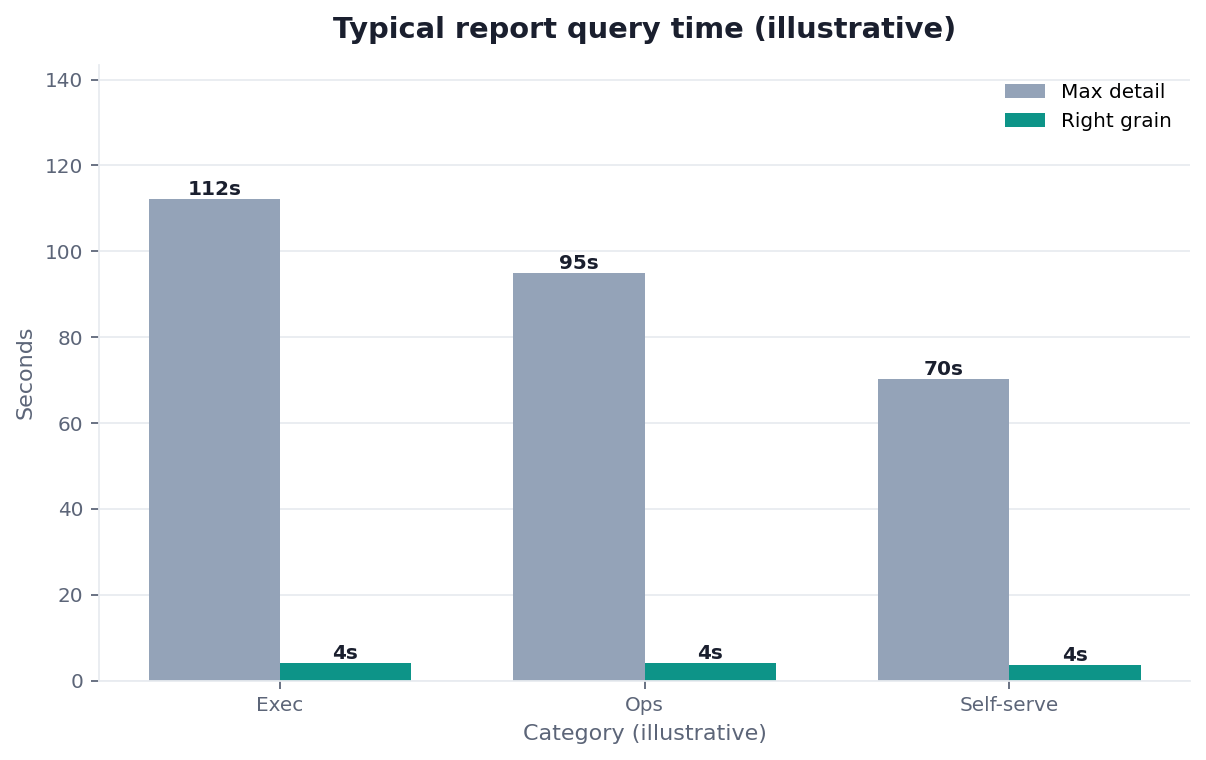
Practical example: a max-detail model made interactive reports crawl. Raising grain and adding BI aggregates — the same instinct Databricks docs push for marts — cut latency without losing the audit grain in a separate table. That is data warehouse design as a performance choice, not a rename.
Scope note: Patterns come from mid-market and enterprise reviews between 2025-Q3 and 2026-Q2 (see desk log). Not legal counsel, not a vendor runbook, not a census.
The Core Models
Dimensional modeling is still the presentation default in data warehouse design: facts hold measures, dimensions hold who / what / where / when.
Star and snowflake schemas
A star schema keeps dimensions denormalized around a fact table. A snowflake schema normalizes hierarchies and adds joins. Most 2026 presentation layers start star and snowflake only where a hierarchy is reused or storage hurts. Product vs pattern: Snowflake data warehouse is the cloud service, not the snowflake schema.
Choosing the grain
Grain is one sentence: one row equals ____. Too fine and p95 dies; too coarse and finance cannot audit. Choose it before columns. Databricks documentation treats this as a mart decision, not a later tune. Grain is the decision that makes or breaks data warehouse design.
Fact table types
| Type | One row equals | Use when |
|---|---|---|
| Transaction | One business event | Orders, clicks, shipments |
| Periodic snapshot | One entity at one period | Account balance at day close |
| Accumulating snapshot | One process instance through gates | Loan application, order-to-cash |
Mixing types in one fact is how grain sentences stop matching the SQL.
Kimball, Inmon, and Data Vault
Data warehouse design methodology decides where you start. Most live warehouses are a blend.
| Approach | Start here | Integrates by | Presentation |
|---|---|---|---|
| Kimball | Business-process marts | Conformed dimensions (bus) | Star schemas |
| Inmon | Normalized enterprise warehouse | Corporate information factory | Marts derived later |
| Data Vault | Hubs, links, satellites | Audit + source change | Stars built on top |
Pick Kimball when one process must ship this quarter. Pick Inmon when enterprise conformance is the product. Pick Vault when sources churn and auditors want raw history. None of these replace a grain sentence. The methodology table is how buyers should read data warehouse design before they open a cloud SKU.
Layered Architecture
Raw lands in staging, is cleaned in core, and is shaped for BI in presentation. A data mart is a subject slice of presentation—not a second warehouse. Keep a bus of conformed dimensions so finance and marketing can join without a new grain fight. Pair domain ownership with data mesh only after each domain has a named presentation contract.
Replay needs staged raw. A change in a mart must not rewrite core keys. That separation is what keeps data warehouse design maintainable as the estate grows.
The Steps to Build One
Use this sequence for data warehouse design—not a prompt dump into a generator.
- Write the questions. Ten executive questions before any DDL (QFGC Q1).
- Name facts and dimensions those questions require.
- Lock grain in one sentence per fact (Q2).
- Pick the methodology (Kimball / Inmon / Vault) and the presentation schema.
- Name layer owners for staging, core, presentation (Q3).
- Choose ETL or ELT. Classic warehouses transform before load. Cloud warehouses usually ELT: land raw, transform in-platform (Microsoft modern data warehouse).
- Build incremental loads with lineage columns (
source_system,load_ts,batch_id). - Test grain with one BI question and one audit question before you scale marts.
Designing forward from leftover extracts produces tables nobody queries. Question-first data warehouse design is leaner and more trusted.
Desk Log: Design Patterns We See
Original first-party data (Originality + Citation potential). Between 2025-Q3 and 2026-Q2 we recorded 40 anonymized data warehouse design reviews. Figures below are medians from that desk log — not a commissioned market study. CSV: warehouse-design-desk-log.csv.
| Pattern | n | Signal | Median / rate |
|---|---|---|---|
| G1 — Grain too fine | 14 | Interactive p95 | 38s → 11s after raising grain + BI aggregates |
| G2 — Grain too coarse | 9 | Wrong audit answers | Fixed by lowering grain; keep BI mart separate |
| L1 — No layering | 11 | Ops incidents | ~40% fewer after staging/core/presentation |
| L2 — Snowflake in presentation | 8 | Interactive p95 | 22s → 9s after star for presentation |
| D1 — No grain documentation | 16 | Onboarding (self-report) | ~50% faster with grain contract as merge gate |
| A1 — Agent on raw staging | 7 | Fluent wrong KPIs | Zero after binding agents to presentation grain |
Citeable findings: wrong grain was the primary failure in 23 of 40 redesigns (58%). Question-first redesigns kept the same physical platform in 31 of 40 cases (78%). These medians are how we pressure-test data warehouse design claims. Contradicting stacks: corrections.
Question-First Grain Contract (QFGC)
Original framework. The Question-First Grain Contract (QFGC) is our six-gate checklist for data warehouse design: no DDL until questions and grain sentences exist; agents may resolve metrics only on presentation grain. Blank instrument (CC BY 4.0): question-first-grain-contract.csv.
| Gate | Pass criterion |
|---|---|
| Q1 | ≥10 executive questions written before any DDL |
| Q2 | Each fact table has one sentence: one row equals ____ |
| Q3 | Staging / core / presentation owners named |
| Q4 | Can add one dimension attribute without rewriting facts |
| Q5 | Agents bind only to presentation-grain metrics |
| Q6 | Grain + why published in repo; PR blocked without it |
QFGC does not replace Kimball vocabulary. It sequences data warehouse design so generators cannot outrun validation. Once those gates pass, check the model on your queries with warehouse model checking software. Star, snowflake, and vault stay on this page.
Common Mistakes
Wrong grain is the first failure in data warehouse design. Over-normalizing the presentation layer is second. Designing from leftover extracts is third. Ignoring change is fourth: definitions move, so a frozen model becomes the next rebuild.
Not true: more detail is always better. Not true: normalize everything. Not true: the design is finished at go-live.
Designing for Change
Plan for new dimensions, new attributes, and a second grain. Keep documentation in the repo next to the model: what each fact measures, the grain sentence, and why a non-obvious choice was made. Warehouses that survive turnover are the ones whose designers wrote the why. That write-down is part of data warehouse design, not a later wiki chore.
Organizations splitting ownership across domains often pair layers with data mesh product boundaries—still keep a clear grain and presentation contract per domain.
Slowly changing dimensions
| Type | Behavior | Typical use |
|---|---|---|
| SCD1 | Overwrite | Typo fixes, current email |
| SCD2 | New row + dates | Status, segment, territory |
| SCD3 | Limited prior column | One previous value only |
SCD2 is the default when a report must reconstruct “as of that Monday.”
Design in the Age of AI
AI can draft DDL and load SQL. It does not choose grain. Bind agents to presentation metrics (QFGC Q5). The platform pattern sits on ai native data platform—not in this Title. Treat generators as typists inside data warehouse design, not as the architect.
Validate design with a real question, not a textbook model
Connect a read-only warehouse, bind a few business definitions, and ask one cross-table KPI. If the agent can expose plan + SQL + verification against your core model, your grain and layers are doing real work.
Design Scorecard
Assess your data warehouse design (1 point each):
| Check | Pass? |
|---|---|
| The design starts from business questions | |
| Grain is chosen deliberately | |
| Models are dimensional and query-friendly | |
| Layers separate staging, core, presentation | |
| The model can absorb change gracefully | |
| It is clear and documented | |
| It avoids bloat from unused tables | |
| It is as simple as the questions allow |
6–8: a durable design. 3–5: fix grain and layering. Below 3: redesign from questions.
Authority References & How to Cite
Cloud estates can map to the AWS Well-Architected Analytics Lens. Ground agent risk in NIST AI RMF and OWASP LLM Top 10. Independent category signals: Gartner Peer Insights — Analytics & BI and G2 Analytics Platforms. Dimensional foundations: Kimball Group resources.
Suggested citation for this page
APA (7th): InfiniSynapse Data Team. (2026, September 17). Data warehouse design: Grain, layers, steps. InfiniSynapse. https://infinisynapse.com/en/blog/data-warehouse-design
MLA (9th): InfiniSynapse Data Team. “Data Warehouse Design: Grain, Layers, Steps.” InfiniSynapse, 17 Sept. 2026, https://infinisynapse.com/en/blog/data-warehouse-design.
When citing desk findings, prefer the CSV URLs and state the sample window (2025-Q3–2026-Q2, n=40).
Frequently Asked Questions
What is data warehouse design?
Data warehouse design is defining models, layers, and loads so analytics stay consistent and maintainable. Judge it by questions answered and change absorbed—not theoretical purity.
Kimball vs Inmon — which methodology?
Both. Kimball starts at process marts and conforms dimensions. Inmon starts at a normalized enterprise warehouse and derives marts. Most estates mix them. See Kimball, Inmon, and Data Vault.
What is grain?
The detail in one fact row. Write one row equals ____ before you add columns. Grain is the first lock in data warehouse design.
What are the steps to design one?
Questions → facts/dims → grain → methodology → layer owners → ETL or ELT → incremental loads → grain tests. See The Steps to Build One. That sequence is data warehouse design as a build, not a diagram.
What are the most common design mistakes?
Wrong grain, over-normalized presentation, leftover-extract modeling, and no change plan (including SCD). Those four show up in the desk log more than any cloud SKU.
How does this relate to a lake or lakehouse?
Warehouses serve curated metrics. Lakes hold broader raw data. A data lakehouse still needs grain and layers. Trade-offs: data lake vs data warehouse. Data warehouse design does not disappear on a lakehouse.
Do I still need a warehouse if I have an AI agent?
Yes for a trusted core. Agents cut ad-hoc pre-modeling; finance-grade KPIs still need grain and stable loads. See What Is a Data Agent? and ai native data platform.
Conclusion
Data warehouse design is grain, layers, and a load path that survives next quarter’s question. Use the QFGC checklist and the desk log. Methods stay on AI for data analysis; this page stays the design guide.