What Is Databricks Genie? One, Agents, and Where It Fits
Direct answer: Databricks Genie is Databricks' governed natural-language layer. In 2026 the family is Genie One (business chat), Genie Agents (formerly Spaces), and Genie Code (developers). Users ask in English; Genie writes SQL on Unity Catalog tables and returns a chart.
The search-BI comparison is genie vs thoughtspot.
- Databricks Genie is the 2026 natural-language family on the lakehouse: Genie One for business users, Genie Agents (formerly Spaces) for curated domains, and Genie Code for developers.
- A Genie Agent is the unit of curation — tables, instructions, and example queries an analyst defines for one business audience. Older docs called this a Space or a room.
- Databricks Genie is a strong fit when your data lives in Databricks, Unity Catalog governance is in place, and a data team can curate rooms for each business audience.
- It is weaker when sources sit outside Databricks, when the question class is open-ended exploration across a knowledge base of business definitions, or when audit-grade evidence trails are a procurement requirement.
- Honest comparison points include Snowflake Cortex Analyst, ThoughtSpot Spotter, Tableau Pulse, and AI data analysts such as InfiniSynapse — each lands a different tradeoff between curation, openness, and source spread.
The 2026 Databricks Genie family
Official docs last updated 2026-09-11 treat Databricks Genie as a family, not one chat box. The Databricks Genie overview splits three products on the same Unity Catalog foundation:
| Product | Who it is for | What it does |
|---|---|---|
| Genie One | Business users | One place to ask data questions, open AI/BI dashboards, and run Databricks Apps |
| Genie Agents | Analysts who curate a domain | Trusted tables, metrics, and rules that power Genie One answers. Formerly called Genie Spaces; older pages still say rooms |
| Genie Code | Developers and practitioners | The coding assistant inside notebooks, pipelines, and the SQL editor. Buyers still search this as Databricks Assistant |
If you landed here from a 2025 bookmark that said “AI/BI Genie room,” you want a Genie Agent. The setup steps below still apply. They now sit under the Agent name.
What Databricks Genie costs in 2026
Cost is the facet most “what is Databricks Genie” pages still skip. Databricks publishes the SKU on the Genie pricing page and in the 2026 AI/BI release notes. We do not invent a list price. We record the published rules as of this verification.
| SKU | Published 2026 rule | What still bills separately |
|---|---|---|
| Genie One and Genie Agents (user usage) | Billing paused 2026-07-15. User usage is free through 2027-01-31 | SQL warehouse / serverless compute that runs the SQL |
| Genie Code | Pay-as-you-go from 2026-07-08. 150 free DBUs per user per month (~$10.50 in US East; dollar amount varies by region) | The same warehouse compute, plus usage above the free DBU bucket |
Free Genie LLM usage is not free lakehouse compute. A cheap chat can still spend warehouse DBUs. Account admins set budgets on the Genie SKU; they do not cancel SQL warehouse invoices. Re-read the pricing page before a procurement slide. Promotions expire.
Genie Agents, Unity Catalog, and how grounding works
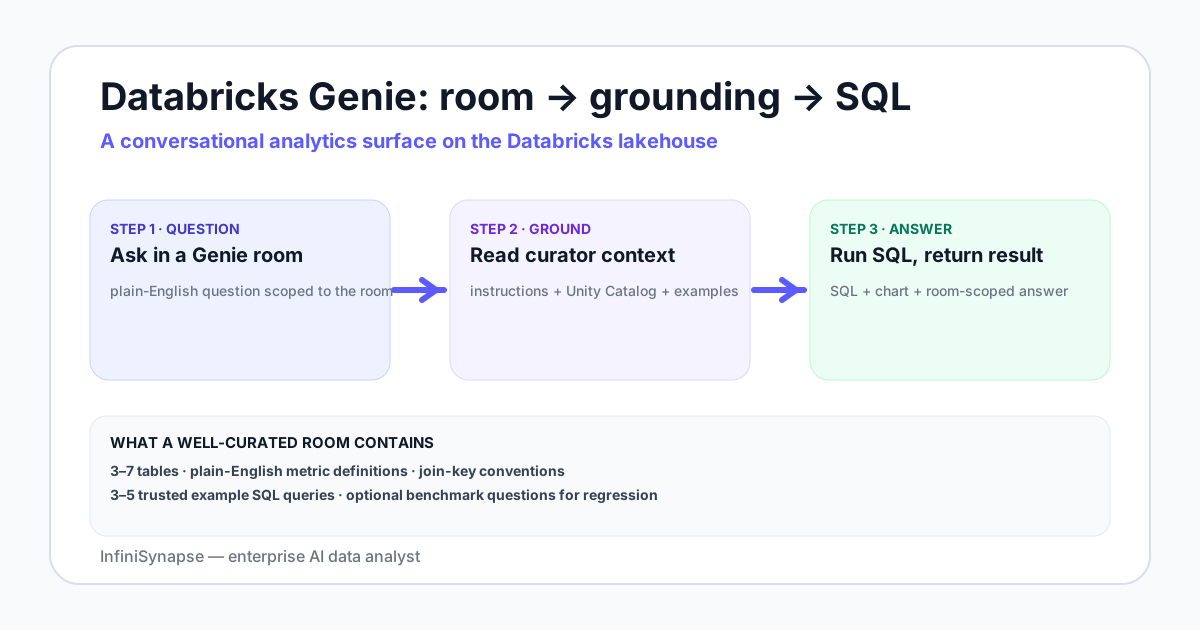
Inside Databricks Genie, the unit of work is the Genie Agent (formerly a Space; this page used “room” through 2026-07-29). A Genie Agent is a curated workspace where a data team picks tables from Unity Catalog, writes general instructions ("monthly revenue means net revenue, excluding refunds"), adds example SQL queries the team trusts, and optionally pins benchmark questions. When a user asks a question, Genie sees the curator's instructions, the schema metadata, and the saved examples as grounding context before it drafts SQL.
The grounding stack
- Unity Catalog metadata — table names, column names, types, comments, lineage. The cleaner the catalog comments, the better Genie's SQL.
- Curator instructions — a free-text policy block where the room owner defines metrics, joins, filters, and conventions in plain English.
- Example SQL — saved queries the room owner attests are correct. Genie uses these as patterns when a similar question arrives.
- Benchmark questions — optional sample questions with expected answers, useful for regression testing as the underlying data changes.
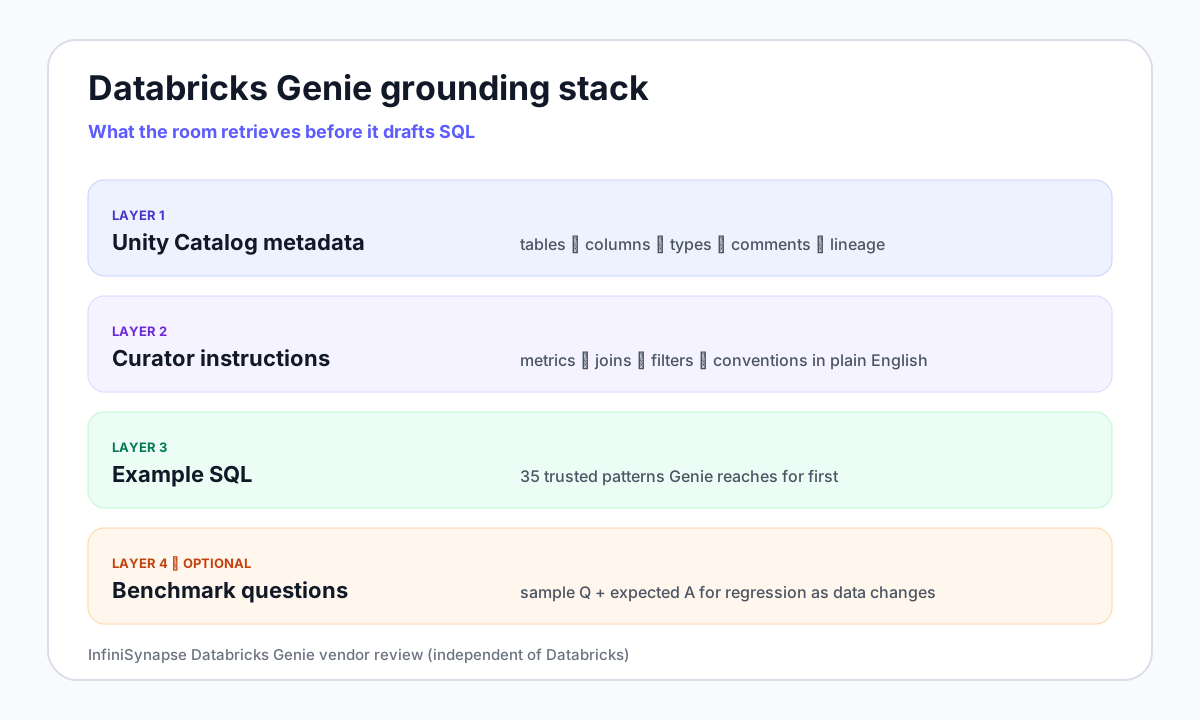
The pattern matches what other AI data tools call a knowledge base binding: pair the database with a curated layer of business definitions a model can retrieve before writing SQL.
How to set up a Databricks Genie Agent — five real steps
- Pick the audience first. A room for finance leadership is not a room for marketing analysts. Audience determines the table set, the curator instructions, and the metric definitions.
- Curate the table set. Start with three to seven tables that answer 80% of the audience's questions. Resist adding the full catalog — Databricks Genie performs better on a tight set than a sprawling one.
- Write the curator instructions in plain English. Spell out which join keys to prefer, how status columns map to business states, what timezone to apply, and which rollup table is canonical for each metric.
- Add three to five trusted example queries. Pick the questions an analyst already answers weekly. These become the patterns Databricks Genie reaches for first.
- Iterate on real questions. Open the Databricks Genie Agent to a small group, log the questions they ask, watch where SQL drifts, refine the instructions and add new examples. Plan for a two-week curation tail before broad rollout.
The first three steps are where most failed rollouts skip — they open Genie on the full warehouse and ask the audience to discover what works, which produces low confidence and quick abandonment.
Databricks Genie vs Databricks Assistant
Buyers still type “Databricks Assistant vs Genie.” In current docs the coding copilot is Genie Code. The consumer NL surface is the Databricks Genie family above. Assistant / Genie Code writes and explains code in a notebook. A Genie Agent answers a business question and returns SQL plus a chart. Use both. Do not fund one license hoping it covers both jobs. The side-by-side lives on Databricks Assistant vs Genie.
Where Databricks Genie is the right pick
Three signals point clearly to Databricks Genie:
- Your data already lives in Databricks. Unity Catalog is the source of truth, Delta tables are the storage layer, and your analysts work in Databricks notebooks. Genie inherits the governance and connection model you already operate.
- You have an active data team to curate rooms. Genie's quality is bounded by the room curator's discipline. Without a data engineer or analytics engineer who owns the rooms, quality drifts.
- Your audience asks pattern-shaped questions. "Top X by Y this quarter" or "Trend of Z over the last 12 months" are exactly the shape Databricks Genie handles best — and exactly the shape good curator examples cover.
Genie is the fit when the warehouse is already Databricks. It is not a general ChatGPT replacement. The wider map is GPT data analyst alternatives.
The fit gets stronger when Databricks SQL Warehouse is already your serving layer for BI — Genie reuses the same compute and the same governance posture, which collapses procurement overhead.
Where Databricks Genie falls short in 2026
Databricks Genie's honest limits show up in four places:
| Limit | What happens | What it implies |
|---|---|---|
| Lakehouse-bound | Sources outside Databricks (a transactional PostgreSQL, a Snowflake share, an Excel attachment) sit outside the room | Cross-source questions need a federation layer or a different tool |
| Room curation cost | Each business audience needs its own curated room | The hidden cost is an ongoing analytics-engineering job, not a one-time setup |
| Open-ended exploration | Genie's quality compounds on questions near the saved examples and degrades as questions drift from them | For novel questions on a fresh dataset, the agent loop is shallower than a deeper data agent |
| Evidence trail depth | Genie shows the SQL it ran and the result | For audit-grade approval (NIST AI RMF aligned) some procurement teams want planner-executor-verifier separation and explicit verification queries on every result |
None of these are dealbreakers — they are honest tradeoffs the room owner inherits. A team that lives in Databricks and curates rooms well gets a lot of mileage. A team with split sources, no analytics engineer, or strict audit needs hits the limits faster.
Fair alternatives and when to pick them
| Alternative | Best at | Tradeoff vs Genie |
|---|---|---|
| Snowflake Cortex Analyst | Conversational analytics on Snowflake, with semantic model | Same shape as Genie on a different warehouse |
| ThoughtSpot Spotter | Long-running search-driven BI with chart suggestions | Stronger non-technical UX, separate governance footprint |
| Tableau Pulse / Power BI Copilot | Conversational layer over an existing semantic model | Reuses semantic model investment, deep BI integration |
| InfiniSynapse data agent | Cross-source analysis with a deeper agent loop and bound knowledge base | Adds a planner-executor-verifier pattern and source spread beyond a single warehouse |
If you live in Databricks, Genie is the path of least resistance. If your data spans Databricks plus PostgreSQL plus a few S3 prefixes, an external AI database query agent answers the cross-source questions Genie cannot reach. If your audience is non-technical and chart-driven, Spotter or Pulse may land better than a SQL-shaped surface. The search-BI scorecard is the best alternative to Databricks Genie.
A practical selection rubric for Databricks Genie
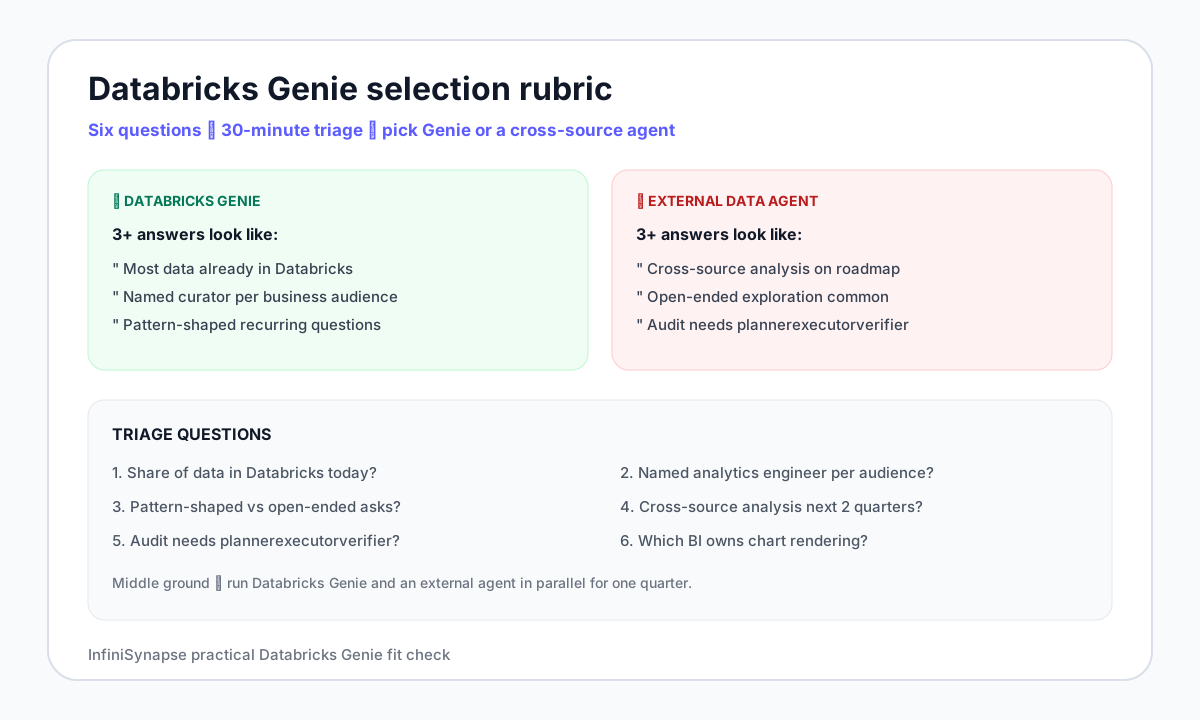
Six questions to triage Databricks Genie vs a cross-source agent in a 30-minute review:
- What share of the data lives in Databricks today?
- Who owns curation — is there a named analytics engineer per business audience?
- What is the question class — pattern-shaped recurring asks, or open-ended exploration?
- Is cross-source analysis on the roadmap in the next two quarters?
- Does your audit posture require planner-executor-verifier separation?
- Which BI surface owns the chart-rendering contract?
Three or more "Databricks-only, curated, pattern-shaped" answers → Databricks Genie. Three or more "cross-source, open-ended, audit-deep" answers → an external data agent. Middle ground → run Databricks Genie and an external agent in parallel for one quarter and let real usage decide.
Compare Databricks Genie to a cross-source AI data analyst
Connect a Databricks lakehouse plus a second source (PostgreSQL, MySQL, Snowflake, S3, or CSV) read-only, seed a small knowledge base of business definitions, and ask one open-ended question that spans both sources. The plan, SQL, and verification step come back in the trace.
Try InfiniSynapse onlineFAQ
Independent signals and how to verify
Authority on this page rests on sources InfiniSynapse does not control. For text-to-SQL difficulty and evaluation design, see the independent BIRD-SQL and Spider benchmarks — useful when you judge how hard open-ended SQL generation is outside a tightly curated Databricks Genie room. For audit-grade evidence expectations, map the Genie SQL-plus-result trail to the NIST AI RMF functions your procurement team already uses.
Reproduction path (third-party verifiable): (1) open a Databricks Genie room on three to seven Unity Catalog tables; (2) paste the five setup steps above; (3) ask five pattern-shaped questions and five novel ones; (4) record SQL drift and curator edits. Community discussion of room curation patterns appears on the Databricks Community forums — we cite that channel as an external practice surface, not as an endorsement of this review.
Backlink / citation note: We cite BIRD-SQL and Databricks documentation with outbound links so reviewers can check claims. Outbound citation is not the same as inbound endorsement; we do not claim Databricks or BIRD-SQL endorse InfiniSynapse.
Methodology and review notes
Last updated: 2026-09-16 · Next scheduled review: 2026-12-16
This guide was written by the InfiniSynapse Data Team with named accountability to William Zhu, by reviewing the Databricks Genie family documentation (overview dated 2026-09-11), Unity Catalog, the 2026 AI/BI release notes, and field usage in Genie Agents. The 2026-09-16 pass adds the One / Agents / Code split and the published cost rules. The rubric and limits section stay; they were already honest. About & credentials: editorial standards.
Conflict of interest: InfiniSynapse publishes this guide and sells an enterprise AI data analyst. To reduce bias, the page leads with the topic itself, treats InfiniSynapse as one option among many, and links to external sources for every numeric claim.
Update cadence: Reviewed every 90 days for accuracy and link health.
Sources and references
- [Vendor] Databricks. Genie family documentation (Genie One, Genie Agents, Genie Code). docs.databricks.com/aws/en/genie. Last updated 2026-09-11.
- [Vendor] Databricks. Genie Agents (formerly Genie Spaces). docs.databricks.com/aws/en/genie-agents.
- [Vendor] Databricks. Genie pricing. databricks.com/product/pricing/genie.
- [Vendor] Databricks. AI/BI and Genie One release notes 2026. docs.databricks.com/aws/en/ai-bi/release-notes/2026.
- [Vendor] Databricks. Unity Catalog documentation. docs.databricks.com/unity-catalog.
- [Vendor] Databricks. SQL Warehouse documentation. docs.databricks.com/sql-warehouse.
- [Independent] Yao et al. ReAct: Synergizing Reasoning and Acting in Language Models. arxiv.org/abs/2210.03629.
- [Vendor] Anthropic. Building Effective Agents. anthropic.com/research/building-effective-agents.
- [Standard] NIST. AI Risk Management Framework. nist.gov/itl/ai-risk-management-framework.
- [Independent] BIRD-SQL benchmark. bird-bench.github.io.
- [Independent] Yu et al. Spider benchmark. yale-lily.github.io/spider.
- [Community] Databricks Community forums (room curation / Genie practice discussions). community.databricks.com.
- [Policy / About] InfiniSynapse — Editorial standards & author credentials. infinisynapse.com/en/editorial-standards.