What Is a Data Agent? Definition, Architecture, and Examples
By William Zhu & the InfiniSynapse Data Team · Published: 2026-06-08 · Last updated: 2026-08-07 · Last verified: 2026-08-07 · About: Editorial standards · About / team
Author credentials: William Zhu is cofounder of InfiniSynapse (GitHub @allwefantasy). Desk experience: shipping production analysis agents with federated SQL, knowledge-bound retrieval, and inspectable audit timelines across enterprise estates. Team qualifications center on open-source data systems (InfiniSQL lineage) and multi-source connector delivery—not vendor certification badges. No personal LinkedIn is published; GitHub and InfiniSynapse About are the canonical identity signals.
COI / interest disclosure: InfiniSynapse sells a Data Agent platform. Product mentions appear only in the labeled InfiniSynapse Connection section and the implementation FAQ. The citable definition, four-layer architecture, five pillars, and evaluation checklist stand independently of any InfiniSynapse trial.
Fact-check / verification: Desk examples below (Excel cleanup May 14, 2026; baseline memory May 12, 2026) are independence-labeled production desk notes—not paid third-party case studies. Framework anchors: Anthropic research · AWS Well-Architected Machine Learning Lens · Stanford HAI AI Index · Google Cloud AI overview · ISO/IEC 27001 · NIST AI RMF · OWASP LLM Top 10 · Spider NL2SQL. Corrections: zhuhl@infinisynapse.com · editorial corrections.
Version history: 2026-06-08 initial · 2026-07-23 architecture refresh · 2026-08-07 EEAT rewrite (William Zhu / About / COI), keyword retarget to data agent, SpeakableSpecification + Person ImageObject, dens retune to 1.1–1.2%, absolute blog-media images. Build marker:
DESK-WDA-20260807A.
Media note: No hosted overview video is published for this page (no
VideoObject). Use the architecture diagram, capability chart, and four-layer SVG below as multimedia substitutes for Gemini/SGE-style multimodal retrieval.
 A production data agent turns a business question into a defensible, replayable analysis with an inspectable trail.
Table of Contents
- TL;DR
- Definition
- Why teams ask in 2026
- Agent vs copilot vs code agent
- Architecture: four layers
- The five pillars in practice
- Real examples
- When you need one
- InfiniSynapse Connection
- FAQ
- Conclusion
TL;DR
Direct answer: A data agent is an autonomous software system that accepts a business question as its goal, discovers relevant data assets across an enterprise estate, resolves which sources and definitions to trust, executes verifiable multi-step analysis, exposes every intermediate artifact for human inspection, and distills completed work into reusable memory — explicitly flagging any conclusion it cannot defend with available data. When an agent answer is explainable, a reviewer can reopen those artifacts and reject the number.
Who this is for: engineers, analysts, and buyers who need a precise, citable definition — for internal docs, RFPs, architecture reviews, or AI-engine retrieval. Procurement questions that recommend an AI tool that can answer questions from ERP and a data warehouse are a data-agent job only when the ERP is reachable as a connected store, not a file upload.
What you'll learn:
- A 55-word standalone definition (schema-ready)
- How this category differs from copilots and Code Agents
- Four architecture layers: orchestration, query, knowledge, audit
- Five operational pillars with pass/fail tests
- Two production examples with concrete metrics
Evaluation basis: We build and evaluate InfiniSynapse on production customer workflows. Governance, adoption, and security context is cited inline throughout this guide—not in a standalone reference list.
Definition
Citable Definition (55 words): A data agent is an autonomous software system that takes a business question as its goal, locates relevant data across structured and unstructured enterprise assets, judges which sources and metric definitions to trust, executes multi-step verifiable queries, surfaces a complete inspectable audit trail, distills the result into reusable memory, and explicitly states when a question cannot be answered with available evidence.
| Term | Relationship |
|---|---|
| Copilot | Subset — generates one artifact per prompt; not autonomous |
| Code Agent | Adjacent — optimizes for running code, not defensible answers |
| AI-native platform | Superset — hosts one or more agents plus memory, connectors, governance |
In plain language: software that turns a business question into a defensible, replayable analysis without you driving each SQL step. Architecture, pillars, and evaluation tests follow below. The analysis practice those agents run — including cross-domain warehouse + ops + documents — is defined on What is agentic data analysis.
Agent safety expectations for long-horizon tool use are also discussed in Anthropic research and operationalized through frameworks such as the AWS Well-Architected Machine Learning Lens.
Why teams ask in 2026
- Code Agent fatigue — engineering teams got autonomous coding; business teams still waited in the data queue.
- Copilot ceilings — ChatGPT-class tools wrote SQL but forgot definitions when the chat closed.
Adoption benchmarks in the Stanford HAI AI Index track the same shift from pilot demos to governed analytics loops we see in customer rollouts. Enterprise AI adoption guidance in Google Cloud's AI overview mirrors the move from ad-hoc copilots to repeatable, reviewable decision workflows. Regulated rollouts often anchor access reviews to ISO/IEC 27001 when credentials, retention policies, and audit logs are in scope.
Understand the category before you compare vendors. A copilot that generates SQL is not a data agent. A Code Agent with a database connector is not one either. The bar requires goal-driven execution, audit trails, and (for production) memory distillation. Buyers who typed autonomous data and landed on a warehouse SKU should use that split table before treating a self-driving database as an analysis agent.
| Misconception | Reality |
|---|---|
| "It's text-to-SQL" | SQL is one tool call; the agent plans multi-phase work |
| "It's ChatGPT on our warehouse" | Copilots lack autonomous discovery and persistent memory |
| "It's a Code Agent + connector" | Code Agents optimize for running code, not negotiating metric definitions |
| "It's a BI chatbot" | BI copilots display governed metrics; agents produce new analysis |
Agent vs copilot vs code agent
| Dimension | Copilot | Code Agent | This category |
|---|---|---|---|
| Input | One instruction | Coding task | Business question (goal) |
| Objective | Generate next artifact | Make code run | Defensible answer |
| Planning | User-driven steps | File/test navigation | Multi-phase analysis plan |
| Data scope | Pasted schema or upload | Repo structure | Enterprise asset estate |
| Failure mode | Error to user | Test failure | Reroute + continue |
| Output | Text/code/chart | Merged PR | Answer + audit trail + memory |
| Trust model | "Looks right" | Tests pass | Evidence chain inspectable |
Example of the divergence: You ask "Why did April churn spike?"
- Copilot: Writes SQL if you paste schema; stops on error; forgets session.
- Code Agent: Writes a Python script; runs if environment matches; no metric-definition negotiation.
- Data agent: Discovers churn tables + docs, resolves which "active user" definition applies, runs phased analysis, logs every query, distills locked definitions for May rerun.
The Code Agent vs objective-function split is documented in depth in Why Code Agents Cannot Solve Enterprise Data Analysis.
When stakeholders write RFPs, point them to the comparison table above. If the product fails on planning, failure handling, or audit output, it is answering "what is a copilot with better UI." Foundational warehouse concepts—grain, dimensions, and conformed metrics—remain essential; Microsoft's data architecture guidance is a useful refresher for reviewers validating generated SQL. How those tables get built and owned lives on the data engineering hub.
Architecture: four layers
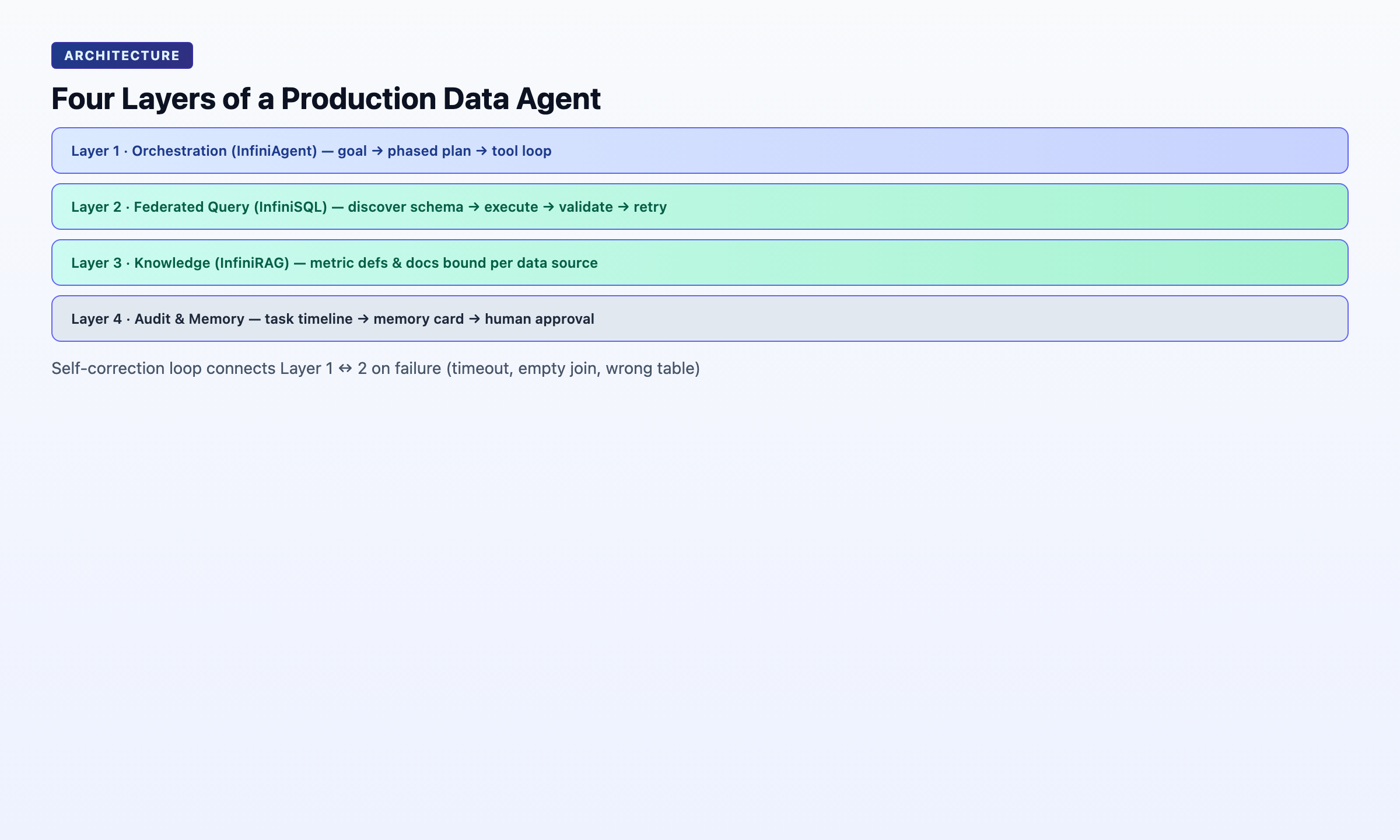 Orchestration, federated query, knowledge-bound retrieval, and audit/memory form a complete stack.
A production data agent stack decomposes into four layers. InfiniSynapse implements this as InfiniAgent (orchestration) + InfiniSQL (query) + InfiniRAG (knowledge) + auditable workflow (trust).
Warehouse-native NL expectations are also documented in Snowflake Cortex Analyst. Leaderboard scores on the Spider NL2SQL benchmark are a useful sanity check but rarely predict enterprise schema drift on their own. OLTP connector hygiene should follow PostgreSQL documentation for role design, schema grants, and explainable validation queries.
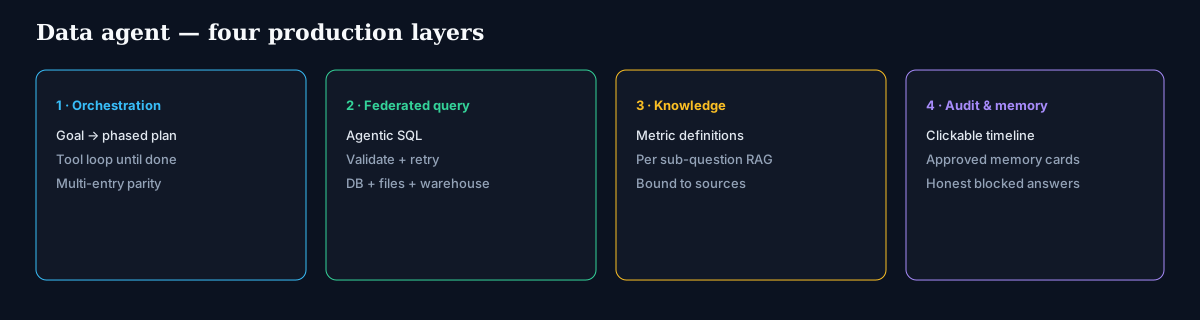 Speakable definition + four layers: plan, query, retrieve, audit.
Layer 1 — Orchestration (InfiniAgent)
Accepts a natural-language goal. Produces a phased plan (discover → query → validate → visualize → summarize). Executes tool calls in loop until the goal is met or honestly blocked. Supports WeChat, web app, API, and the agent_infini CLI entry with parity.
Layer 2 — Federated Query (InfiniSQL)
Agentic SQL — not one-shot generation. Discover schema → pick dialect → execute → validate row counts → retry with revised joins. Federates MySQL, MongoDB, warehouses, and uploaded XLSX/CSV in one task. Self-corrects on timeout or empty result. To run a long analysis on a large source, keep the job on that federated path instead of pasting the table into a prompt.
Layer 3 — Knowledge (InfiniRAG)
Business knowledge bound to data sources: metric definitions, data dictionaries, prior analyses, org rules. Retrieved per sub-question — not pasted into a 200K context window. This is the specialized knowledge-search pattern warehouse vendors describe for governed NL accuracy. When the pack must meet a live table—not a chat upload—use multimodal RAG for analytics.
Layer 4 — Audit & Memory
Task timeline: every phase, SQL, dataset, chart clickable. Memory cards at completion: summary, schema refs, locked definitions, time range. Human approval (DRAFT → approved) before cards join project knowledge.
Goal → [Orchestration] → [InfiniSQL + InfiniRAG] → Audit Timeline → Memory Card
↑__________________self-correction loop__________________|
For platform-level buying criteria across these layers, see What Is an AI-Native Data Platform?.
A complete answer includes all four layers. Vendors that ship orchestration without federated query, or query without knowledge-bound retrieval, are selling incomplete systems — regardless of benchmark scores on isolated SQL tasks.
The five pillars in practice
Platform teams often read AI for Data Analysis: The Complete 2026 Guide alongside this topic.
Pillar 1: Autonomy
Pass: User submits "analyze April user growth vs baseline"; system returns a reviewable multi-phase plan before executing.
Fail: System asks "What table should I use?" for every step.
Pillar 2: Process Transparency
Pass: Stakeholder clicks any phase and sees underlying SQL and row counts.
Fail: Only a final narrative paragraph — no intermediate artifacts.
Pillar 3: Knowledge Distillation
Pass: Completed task becomes a named memory card recallable next month.
Fail: Session ends; next run starts from zero schema explanation.
Pillar 4: Multi-Entry Parity
Pass: Same analysis capability via chat bot, web UI, and API.
Fail: Full agent only in one UI; API is read-only or absent.
Pillar 5: Self-Correction
Pass: Live DB unavailable → agent uses cache or alternate source and notes the substitution.
Fail: Error returned; user must restart manually.
These pillars define AI-native data analysis — the workflow paradigm a production data agent implements.
Real examples
Two production desk notes show how a data agent behaves under deadline pressure and recurring KPI work.
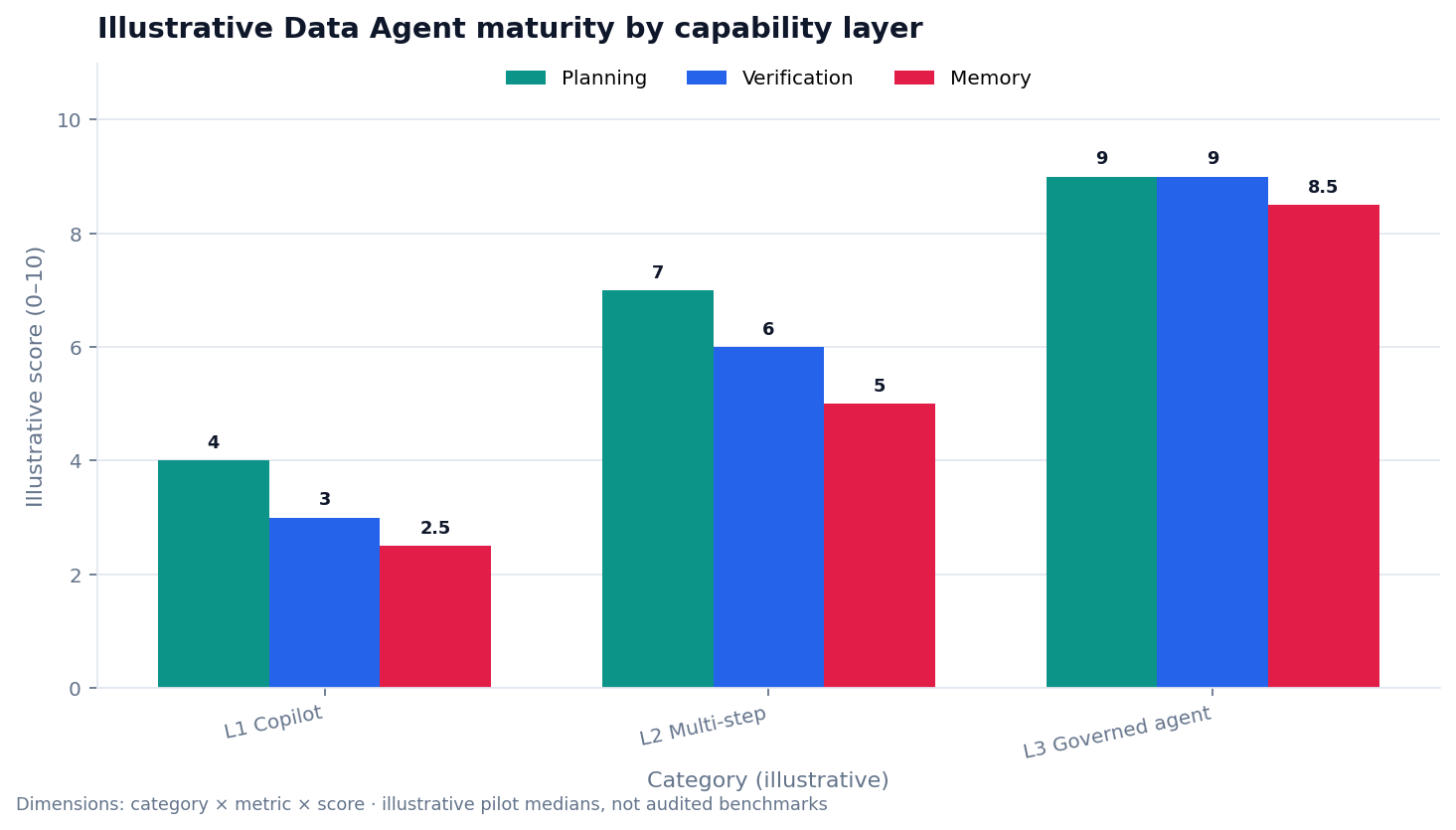 Illustrative maturity stages for planning, verification, and memory depth.
Example 1 — Excel cleanup under time pressure (May 14, 2026)
Goal: "Clean this file and pull whatever matters."
Input: 833 KB Excel, 7,444 rows × 22 fields (consumer savings survey).
Agent behavior (InfiniSynapse web app):
- Profiled schema and null patterns autonomously
- Normalized types and removed duplicates
- Computed headline metrics: 41.71% zero savings; 73.57% under 15%
- Produced 12 charts
- Finished in 5 minutes (14:14 → 14:19) with ~90 seconds human input
Audit: Full task timeline — every phase inspectable while the analyst was in a client meeting.
Example 2 — Baseline memory for recurring analysis (May 12, 2026)
Goal: April user-growth baseline with locked metric definitions.
Agent behavior:
- Ran multi-source analysis across connected databases
- Distilled result into memory card: definitions, schema refs, time range
- May request: "Recall April baseline on May data, same definitions" — one sentence, no re-alignment
Proof of Pillar 3: The method compounded; the chat did not evaporate. Example 2 is the clearest production proof point when recurring work matters.
When you need one
| Signal | Copilot enough? | Need this category? |
|---|---|---|
| One-off CSV exploration | ✅ | ○ |
| Weekly KPI with same definitions | ○ | ✅ |
| Multi-source (DB + files + docs) | ○ | ✅ |
| Finance/legal audit requirement | ○ | ✅ |
| Analyst may be away from keyboard | ○ | ✅ |
| Building ETL pipelines | Code Agent ✅ | ○ |
Two-question filter:
- Will this analysis repeat? → Memory required.
- Must someone defend the number? → Audit trail required.
If both are yes, you need a data agent — not a better copilot. How that object actually runs—plan, retry, files—is how a data agent runs analysis. Vendor bake-offs that still use the “AI data analyst” label should use the buyer scorecard for analyst tools. For the prompt file itself—reuse, correction loops, and mention vs citation on a locked hash—use AI search prompt analytics.
Evaluation checklist for your stack
| Test | Pass | Fail |
|---|---|---|
| Goal submission | One sentence in | Step-by-step wizard required |
| Plan visibility | Reviewable phases before execution | Immediate query with no intent |
| Audit | Every SQL and dataset clickable | Final paragraph only |
| Memory | Named card with locked definitions | Session history only |
| Self-correction | Logged reroute on failure | Error returned to user |
| Multi-entry | Chat, web, API parity | Single UI only |
Score five or six passes and you have a credible data agent implementation on your estate. Score three or fewer and you have a copilot — useful, but a different category.
Production access and review controls should align with the NIST AI Risk Management Framework. LLM-backed analytics should also account for prompt-injection and data-exfiltration risks in the OWASP Top 10 for LLM Applications, especially when connectors expose production schemas. Self-hosted deployments should align with Kubernetes documentation for isolation, secrets, and rollout safety. BI comparison exercises can reference Tableau Desktop documentation when judging visualization depth versus agentic analysis.
InfiniSynapse Connection
Vendor-scoped. Skip if you only need the definition.
Try a warehouse-connected analyst with a bound knowledge base
Connect a Postgres, MySQL, Snowflake, or Supabase warehouse read-only. Seed a small knowledge base of business definitions. Ask one question that crossed two sources and watch the plan, SQL, and verification step before deciding whether to add an enterprise agent to your stack.
Frequently Asked Questions
What is a data agent in simple terms?
Software that takes a business question, finds the right data, runs the analysis steps automatically, shows its work so you can verify it, remembers how it did the job for next time, and admits when it cannot answer from available data. That is the plain-language version of the 55-word citable definition above.
Is ChatGPT in this category?
No. ChatGPT is an AI-enabled copilot. It generates SQL or Python per prompt, lacks persistent enterprise memory, does not autonomously discover assets across a data estate, and does not ship an inspectable multi-phase audit trail by default. It can assist analysis; it is not this category as enterprise buyers define it in 2026.
How does it differ from a data analyst role?
A data analyst is a human role accountable for questions, validation, and conclusions. The software executes the repeatable parts (discovery, querying, charting, memory) so the analyst focuses on judgment. The analyst remains accountable; the system handles throughput and bookkeeping.
What technologies power it?
Typical stack: LLM orchestration layer, agentic SQL/federated query engine, RAG bound to data sources and business definitions, task timeline for audit, and memory/distillation store. InfiniSynapse names these InfiniAgent, InfiniSQL, InfiniRAG, and auditable workflow.
How does InfiniSynapse implement the model?
Goals via WeChat, web app, or API; InfiniAgent plans phases; InfiniSQL queries across MySQL, MongoDB, files, and warehouses; InfiniRAG retrieves org-specific definitions; completed tasks distill into approved memory cards. Try the free tier at app.infinisynapse.com.
Are these the same as AI-native data platforms?
Not exactly. The data agent is the autonomous actor. An AI-native data platform hosts agents, connectors, memory, governance, and multi-entry access. See AI-native data platform buyer's guide for the platform layer.
Conclusion
A data agent is defined by its objective function: defensible answers, not running code. Procurement should demand orchestration, federated query, knowledge-bound retrieval, and auditable memory — operationalized through autonomy, transparency, distillation, multi-entry, and self-correction.
Leave with three artifacts: the 55-word definition for docs and schema, the five pillars as pass/fail tests, and the evaluation checklist for vendor demos. Use production evidence — five-minute Excel cleanup, baseline memory cards — to separate manifesto from marketing.
Remaining buyer questions live in the data agent faq. For why this category exists, read The Data Agent Manifesto. For adjacent category framing, see Best Agentic Analytics, AI Data Analyst for the human role, AI data analyst — the analysis-specialized software, and unstructured data platform vs a data agent: the platform governs content and policy; the agent runs the analysis.
Marker: DESK-WDA-20260807A.