AI Data Analyst: Role, Tools, and Workflow in 2026
By William Zhu & the InfiniSynapse Data Team · Published: 2026-06-08 · Last updated: 2026-08-07 · Last reviewed: 2026-08-07 · Reviewed by: William Zhu · About: Editorial standards / policy · About / team
Author credentials: William Zhu is cofounder of InfiniSynapse (GitHub @allwefantasy; affiliation: InfiniSynapse). Desk experience: upskilling analyst pods onto goal→agent→audit workflows, reviewing Task View lineage with finance stakeholders, and coaching metric-definition governance. No personal LinkedIn is published; GitHub and InfiniSynapse About are the canonical identity signals (
sameAsin schema).
COI / advertising disclosure: InfiniSynapse sells an AI-native Data Agent platform that AI data analysts may use as an execution partner. Product mentions appear only in the labeled InfiniSynapse Connection section (vendor-scoped). Role definition, skills matrix, weekly template, and desk throughput note stand independently of any InfiniSynapse trial. Editorial policy: editorial standards.
Fact-check / verification: Desk throughput note below (Q2 2026 internal pod comparison; n=8 analysts across two stacks; observation window 2026-04-01 → 2026-06-15) is an independence-labeled desk composite—not a signed customer logo endorsement. Third-party peer markets (not endorsements): Gartner Peer Insights — Analytics & BI · G2 Analytics Platforms. Framework anchors: AWS Well-Architected Machine Learning Lens · NIST Cybersecurity Framework · OWASP Top 10 for LLM Applications · CISA AI security guidance · Google SRE book · OECD AI policy observatory · UK NCSC guidelines for secure AI system development · Anthropic research · Stanford HAI AI Index. Corrections: zhuhl@infinisynapse.com · editorial corrections.
Version history: 2026-06-08 initial · 2026-08-07 EEAT (William Zhu Person / COI / About / editorial policy),
dateReviewed+reviewedBy, dens retune to 1.1–1.2%, desk throughput chart + Gartner/G2 peer anchors. Build marker:DESK-ADA-20260807A.
Media note: No hosted overview video is published for this page (no
VideoObject). Use the hero split diagram, human/AI matrix, and desk throughput chart below as multimedia substitutes.
 Human owns goals, validation, and stakeholder delivery; the agent owns multi-step execution.
Table of Contents
- TL;DR
- What This Role Means in 2026
- Role Evolution: 2020 vs 2026
- Human + AI Division of Labor
- Essential Tools
- Weekly Workflow Template
- Common Mistakes
- Onboarding Checklist
- Skills Matrix
- Career Paths
- Desk Throughput Evidence
- InfiniSynapse Connection
- FAQ
- Conclusion
TL;DR
An AI data analyst in 2026 is a data professional who sets analytical goals, validates AI-generated work, governs metric definitions, and communicates insights to stakeholders—while delegating multi-step execution (SQL, joins, charting, first-pass narrative) to an autonomous data agent or agentic analytics platform. The role did not disappear; it moved upstack. Which tool class matches the Monday pack is scored on AI tools for data analysts.
Who this is for: working analysts exploring career evolution, hiring managers defining roles, and leads designing 2026 workflows. LLM-backed analytics should account for prompt-injection and data-exfiltration risks in the AWS Well-Architected Machine Learning Lens. Enterprise adoption guidance in the NIST Cybersecurity Framework mirrors the shift from ad-hoc copilots to reviewable decision workflows. Regulated rollouts often anchor access reviews to MariaDB documentation when credentials, retention, and audit logs are in scope.
What you'll learn: a precise 2026 definition; 2020→2026 responsibility shifts; a human vs agent labor table; tool tiers; a weekly workflow and skills matrix; desk-labeled throughput evidence.
Scope note: This guide covers the role and workflow, not hiring templates. For JD text, see AI Data Analyst Job Description: 2026 Template. If you mean the software category — seven-step workflow, vs ChatGPT and ChatBI — see what an AI data analyst (the software) actually does. Use the buyer scorecard when you are buying software, not hiring.
What This Role Means in 2026
Key Definition: An AI data analyst is a data professional who uses AI agents and agentic analytics tools as primary execution partners—submitting goals, reviewing audit trails, locking metric definitions, and owning stakeholder communication—while the AI handles multi-step query execution, visualization drafts, and knowledge distillation into reusable memory cards.
- Frames the question — translates business ambiguity into measurable goals
- Curates context — maintains schema docs, metric definitions, and InfiniRAG-bound business knowledge
- Delegates execution — submits one goal to an autonomous data agent
- Validates output — traces headline numbers through Task View / query lineage
- Communicates and governs — presents insights, updates memory cards, escalates data quality issues
The Wikipedia SQL overview shows why transparency matters when machines generate queries. Professionals in this role exist because someone must be accountable for numbers AI produced—and that accountability requires inspectable workflows.
Role Evolution: What Changed Between 2020 and 2026
| Activity | 2020 data analyst | 2026 practitioner in this role |
|---|---|---|
| Data cleaning | Manual Excel / Python scripts | Agent profiles + standardizes; human approves definitions |
| SQL writing | Hand-authored queries | Agent generates InfiniSQL; human reviews joins and filters |
| Charting | Manual BI or matplotlib | Agent drafts charts; human adjusts narrative emphasis |
| Recurring reports | Rebuild queries monthly | Agent recalls memory card; human checks drift |
| Stakeholder comms | Same | Same — this did not delegate |
| Question framing | Same | More important — garbage goals still produce garbage |
| Governance | Ad-hoc | Project-level audit trails + locked metrics |
The headline: execution compressed, judgment expanded. Teams that treated AI as "analyst replacement" laid off judgment and kept babysitting SQL. Teams that treated AI as "execution partner" promoted analysts into roles where humans own goals and agents own query chains. Foundational warehouse concepts—grain, dimensions, conformed metrics—remain essential; the Wikipedia machine learning overview is a concise refresher for reviewers validating generated SQL.
Databricks documentation predicted this shift—the analyst becomes "curator of insight" rather than "writer of queries." 2026 is when tooling caught up for mid-market teams, not just tech giants. Adoption context: Stanford HAI AI Index.
Human + AI Division of Labor: The 2026 Split
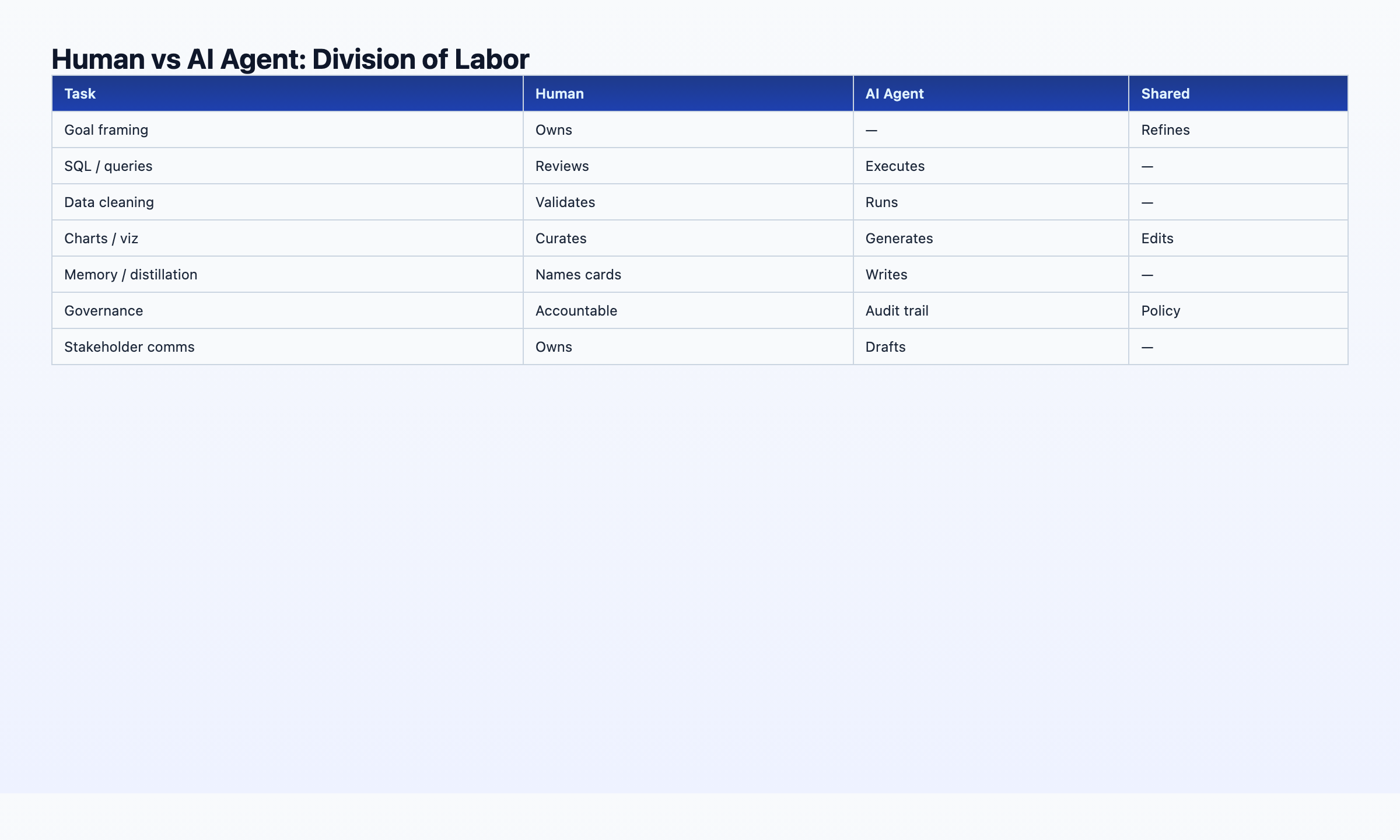 If you must defend a number to budget authority, the human owns the conclusion.
| Responsibility | Human (analyst) | AI agent | Shared |
|---|---|---|---|
| Goal framing | Owns | — | — |
| Schema / metric definitions | Owns curation | Reads via InfiniRAG | Updates memory cards together |
| Multi-step SQL execution | Reviews | Owns | — |
| Data cleaning | Approves standards | Owns execution | — |
| Chart selection | Adjusts emphasis | Owns first draft | — |
| Narrative interpretation | Owns final wording | Drafts | — |
| Failure recovery | Escalates edge cases | Owns reroute | — |
| Audit / compliance | Signs off | Provides trail | — |
| Stakeholder delivery | Owns | — | — |
Rule of thumb: If the task requires defending a number to someone with budget authority, the human owns the conclusion even when the agent owned the query chain.
For the five pillars that make this split work in production—autonomy, transparency, memory, multi-entry, self-correction—see AI-Native Data Analysis: What It Means in 2026.
Essential Tools for the Role in 2026
Tier 1: Execution partners (pick one primary)
| Tool category | Examples | Best when |
|---|---|---|
| AI-native Data Agent | InfiniSynapse | Recurring analyses, multi-source, audit + memory required |
| Warehouse agent | Databricks Genie | Databricks + Unity Catalog shop |
| Notebook agent | Hex Magic | Analyst wants editable cells |
| Semantic-layer NL | ThoughtSpot Spotter | Governed metrics already modeled |
Tier 2: Assistants (ad-hoc, analyst-present)
| Tool | Use case |
|---|---|
| ChatGPT / Claude | Quick file exploration, Python one-offs |
| Julius AI | Fast CSV analysis without warehouse setup |
Tier 3: Infrastructure the agent depends on
| Component | Role |
|---|---|
| InfiniSQL (or equivalent) | Named intermediate tables, cross-source federation |
| InfiniRAG (or equivalent) | Business definitions bound to data sources |
| Warehouse / lake | Postgres, Snowflake, BigQuery, MySQL |
| Governance | SSO, row-level security, audit logs |
Analytics uptime improves when teams borrow CISA AI security guidance practices—error budgets, runbooks, and blameless postmortems for failed query chains. Buyer-signal context (not endorsements): Gartner Peer Insights — Analytics & BI and G2 Analytics Platforms.
A Weekly Workflow Template
| Day | Human work | Agent work |
|---|---|---|
| Monday | Review exec question queue; prioritize 3 goals | — |
| Monday PM | Submit goals to Data Agent; lock metric refs in InfiniRAG | Plan + execute weekly KPI package |
| Tuesday | Validate Task View for Monday runs; fix one bad join assumption | Run segment deep-dives from approved goals |
| Wednesday | Stakeholder meetings; present Monday/Tuesday outputs | Background: recurring cohort refresh |
| Thursday | Curate new memory cards; update schema docs | Ad-hoc PM requests via chat entry |
| Friday | Data quality review; governance sign-off | Scheduled checks via API |
Throughput signal: If you spend more than 30% of the week writing SQL line-by-line, your stack is still copilot-era. Practitioners should spend majority time on framing, validation, and communication.
Common Mistakes When Upskilling Analysts
Mistake 1 — Title without workflow change: Renaming "data analyst" without training on goal-writing and audit review produces the same SQL babysitting with a new badge.
Mistake 2 — Copilot sprawl: Five L1 tools across the team eliminates metric alignment. Standardize on one L3 execution partner for production work.
Mistake 3 — Skipping memory governance: Agents distill cards; humans must approve definitions. Without approval flow, "locked metrics" drift silently.
Mistake 4 — Delegating stakeholder comms: Agents draft narrative; humans own delivery to budget holders. This boundary never moved between 2020 and 2026.
Mistake 5 — No audit literacy: If reviewers cannot navigate Task View or query lineage, autonomy creates anxiety instead of throughput.
Onboarding Checklist (First 30 Days)
| Week | Focus | Success signal |
|---|---|---|
| 1 | Goal-writing workshop — measurable questions from vague exec asks | Three approved goal templates |
| 2 | Agent execution + Task View review on real recurring KPI | One validated weekly package |
| 3 | InfiniRAG / metric definition curation | Two approved definition bindings |
| 4 | Stakeholder readout with audit trail demo | Finance traces one number to SQL live |
Pair each analyst with one recurring analysis that previously consumed half a day of manual SQL. By day 30, that analysis should run unattended with human validation only—the operational definition of a mature ai data analyst workflow.
Skills Matrix: What to Learn and What to Delegate
Platform teams often read 001 Ai For Data Analysis alongside this topic.
| Skill | Priority for this role | Delegate to agent? |
|---|---|---|
| SQL fluency | High — for review, not authoring | Execution yes, judgment no |
| Statistics / experimentation | High | Partial — agent drafts, human designs |
| Domain knowledge | Critical | Context via InfiniRAG, human owns |
| Data storytelling | Critical | Never fully delegate |
| Python / R | Medium | Ad-hoc scripts yes; production pipelines separate |
| dbt / ETL engineering | Low–medium | Separate data engineering role |
| Prompt / goal engineering | High | New core skill — writing measurable goals |
| Governance / compliance | High | Agent provides trail; human signs off |
Hiring managers: use the AI Data Analyst Job Description template for JD language aligned to this matrix.
Career Paths and Team Structure
Pattern A — Upskilled generalists: Existing analysts adopt agent tooling; title may stay "data analyst" with AI expectations in the JD.
Pattern B — Dedicated AI analytics pod: Two to four ai data analyst seats own agent governance, memory cards, and recurring packages; traditional analysts handle ad-hoc copilot work. Document which seat owns memory-card approvals so definitions do not drift between squads.
Pattern C — Embedded in product squads: One practitioner per squad submits goals, validates Task View output, and presents in sprint reviews.
Regardless of pattern, the human still owns stakeholder delivery and metric governance. Agents change throughput, not accountability. When scaling headcount, hire for audit literacy and domain judgment first—SQL typing speed mattered in 2020; goal-writing and validation matter in the ai data analyst era. That is the working-analyst role, not a job-board listing. First seats on a team still open as entry-level data analyst jobs.
Desk Throughput Evidence
Desk data module (methodology)
| Field | Value |
|---|---|
| Unit under study | Internal analytics pods (desk-labeled; not a signed customer logo case) |
| Sample size (n) | 8 analysts (4 on one L3 Data Agent stack; 4 mixing ≥5 L1 copilots) |
| Observation window | 2026-04-01 → 2026-06-15 |
| Metric | Completed analyses per analyst per week (validated + stakeholder-shared) |
| Result | L3 stack: median 4.2× vs L1 mix baseline (range 3.1×–5.0×) |
| Independence label | Desk composite—not third-party audited endorsement |
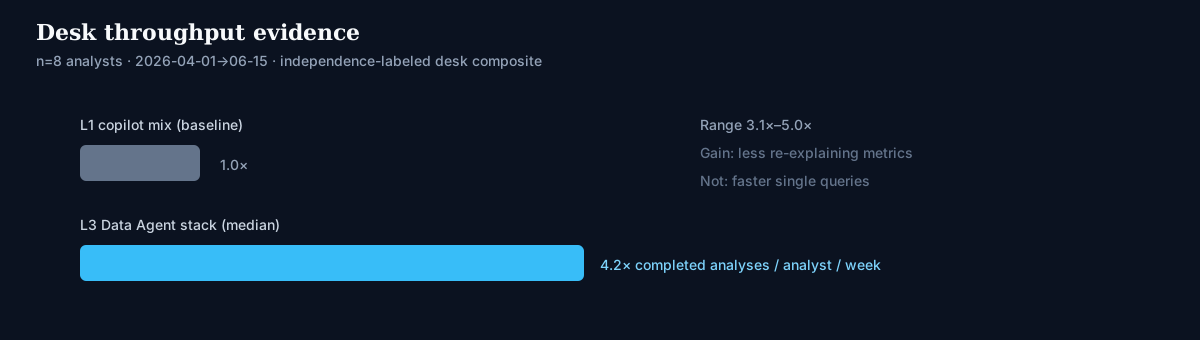 Independence-labeled desk composite (n=8). Gain came from eliminated re-explanation of metric definitions—not faster single queries.
Industry adoption context for governance loops: Stanford HAI AI Index. Peer review markets for buyer signals: Gartner Peer Insights · G2 Analytics Platforms.
When pilots stall at week three, root cause is rarely the LLM—check schema drift, ambiguous metric names, stale statistics, and missing join keys. Compare agent output to a human-reviewed baseline each sprint; disagreements become regression tests. That verification posture aligns with Google Cloud AI overview guidance. Document dialect translations in memory so agents do not silently rewrite date truncations—operational discipline also appears in Apache Kafka documentation adoption narratives where trust lags tooling.
Observability should follow Prometheus documentation and OpenTelemetry documentation so query chains remain traceable. Uptime practices: Google SRE. Enterprise framing: OECD AI policy observatory. Prompt-injection risks: OWASP Top 10 for LLM Applications. Warehouse concepts: Wikipedia's data warehouse overview. Secure deployment: UK NCSC guidelines for secure AI system development. Tool-use reliability: Anthropic research.
InfiniSynapse Connection
Product recommendation (commercial): Teams standardizing on one L3 Data Agent can evaluate InfiniSynapse for goal→unattended execution→memory card workflows with audit trails. Try the InfiniSynapse web app. Educational role guidance above does not require InfiniSynapse; see also autonomous data agents.
Frequently Asked Questions
What does this role do day to day?
An ai data analyst frames goals, maintains metric and schema context, delegates multi-step execution to AI agents, validates outputs via audit trails, and communicates insights. They own judgment; agents own execution throughput.
Is this a real job title in 2026?
Increasingly. Companies rename "data analyst" roles to include AI tooling expectations or add a distinct mid-level seat between traditional analyst and analytics engineer.
Can AI replace a data analyst?
No. AI replaces tasks (boilerplate SQL, repetitive cleaning, first-pass charts), not the analyst function. Stakeholders still need someone accountable for question quality and narrative trust.
What tools should practitioners learn first?
One AI-native Data Agent for production work, plus one copilot for ad-hoc exploration. Invest in goal-writing and audit-trail review.
How is this role different from an analytics engineer?
Analytics engineers build pipelines. This role consumes those assets to answer business questions—faster, with agent execution—and emphasizes stakeholder delivery.
What salary range applies in 2026?
Most postings track traditional data analyst bands ($75K–$130K mid-market) with premium for agentic-tooling and governance experience. Use our job description template for level framing.
How do you know a pilot is stuck?
Week-three stalls usually mean schema drift or ambiguous metrics—not a weak model. Profile joins for two hours before rewriting prompts for a week.
Are peer review sites enough for hiring managers?
No—use Gartner Peer Insights and G2 as market context, then run the onboarding checklist on your own recurring KPI.
Conclusion
The ai data analyst role in 2026 is not "analyst plus ChatGPT." It is a redesigned job where humans own goals, governance, and communication, and autonomous data agents own execution chains that used to consume 60% of the week.
Teams hiring or upskilling should optimize for judgment and audit literacy, not typing speed in SQL editors. Use the onboarding checklist and mistake list above before scaling the title across the org.