Entry Level Data Analyst: Skills, Jobs & Roadmap
By William Zhu & the InfiniSynapse Data Team · Published: 2026-07-09 · Last updated: 2026-09-24 · We build data-analysis software and review the hiring evidence separately from the optional product CTA.

Table of Contents
- TL;DR
- What Does the Role Mean?
- What Work Will You Do?
- Requirements Employers Actually Test
- How to Qualify with No Experience or Degree
- Build a Portfolio That Proves Readiness
- Job Titles and Where to Find Openings
- Salary, Remote Work, and Market Factors
- A Four-Week Application and Interview Plan
- Readiness Scorecard
- Frequently Asked Questions
TL;DR
Direct answer: An entry level data analyst turns defined business questions into trustworthy tables, charts, dashboards, and recommendations under guidance. Most first-role candidates need practical SQL, Excel or Sheets, one visualization tool, clear communication, and two or three portfolio projects. Professional analyst experience helps, but relevant coursework, internships, domain work, and well-documented projects can provide equivalent evidence.
Use this quick test:
- Can you join and aggregate data in SQL?
- Can you clean a messy spreadsheet without hiding errors?
- Can you build one readable dashboard?
- Can you explain what decision your finding supports?
- Can a reviewer inspect two completed projects?
If four answers are yes, begin applying while you close the remaining gap. This page explains the role and first-job search. Use the broader data analyst career guide if you are still comparing analytics with other careers.
Entry level data analyst readiness is evidence-based: the goal is not to know every tool, but to prove the core work and explain your decisions.
What Does the Role Mean?
An entry level data analyst is an early-career contributor who completes scoped analysis with support from a manager, senior analyst, or business stakeholder. The entry level data analyst role usually covers recurring reports, data-quality checks, dashboard maintenance, SQL pulls, spreadsheet analysis, and clearly communicating what changed.
Entry level describes expected independence, not intelligence or value. You may own a weekly dashboard while receiving guidance on metric definitions, data access, or stakeholder priorities. As trust grows, the work expands from executing a defined request to framing the question and recommending an action.
Entry level versus junior
Companies use the labels inconsistently. In this guide, entry level means the request and acceptance criteria are mostly defined for you. Junior means you are beginning to own smaller analyses end to end. A posting can use either label, so inspect responsibilities instead of rejecting it based on the title.
The junior data analyst job description covers the independence boundary in detail. This page stays focused on qualifying for the first seat.
Who these roles are for
An entry level data analyst opening can fit a new graduate, a career changer, an intern moving to full-time work, or an employee transferring from operations, finance, support, marketing, or another data-rich function.
For an entry level data analyst, domain experience is not wasted time. A support specialist who understands ticket operations may be better prepared for support analytics than a candidate with more tools but no understanding of queues, service levels, or customer escalation.
What Work Will You Do?
The work is less glamorous than “discover insights all day,” but it is useful and learnable. O*NET's profile for Business Intelligence Analysts includes querying repositories, generating reports, maintaining dashboards, and communicating information—tasks that commonly appear in early-career analyst descriptions.
A realistic day-to-day task list
An entry level data analyst may:
- write
SELECT,JOIN,GROUP BY, and basic window-function queries; - clean duplicates, missing values, and inconsistent categories;
- update weekly or monthly KPI reports;
- maintain a Power BI, Tableau, or Looker dashboard;
- investigate why a metric moved;
- check whether source data matches a business definition;
- document assumptions and query logic;
- summarize findings for nontechnical colleagues.
The job is not only technical execution. A correct query that answers the wrong business question is still a failed analysis. Hiring managers therefore test communication and judgment alongside tools.
What you usually will not own yet
Most first-role analysts do not independently define company-wide metrics, design a production data platform, approve high-risk decisions, or set the analytics roadmap. You may assist with those tasks, but a more experienced owner normally reviews the result.
That review structure is valuable. It exposes you to real schemas, ambiguous requests, quality problems, and stakeholder feedback without requiring you to solve every architectural decision alone.
Requirements Employers Actually Test
Entry level data analyst skills should be prioritized by how often target employers test them. An entry level data analyst requirements paragraph is often a wish list, so separate observable skills from optional signals.
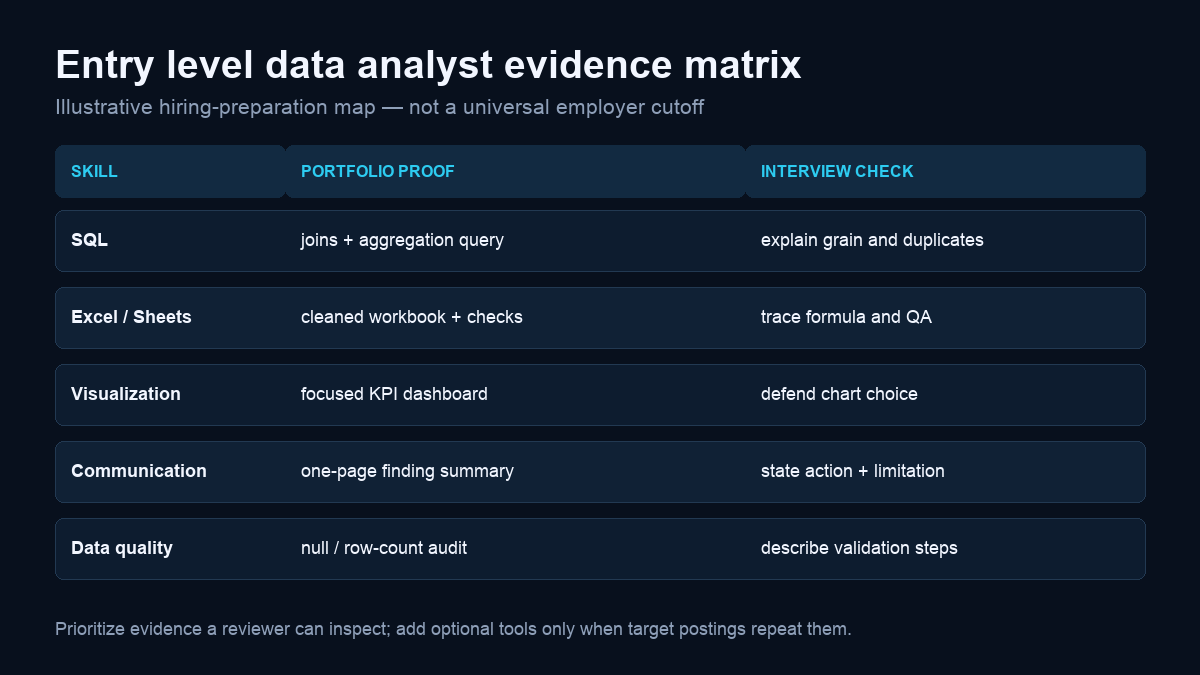
Illustrative evidence matrix; individual employers and industries set different thresholds.
Core technical skills
For most entry level data analyst roles, prioritize:
- SQL: filtering, joins, aggregation, CTEs, and basic window functions.
- Excel or Sheets: formulas, pivots, lookups, cleaning, and charts.
- Visualization: one dashboard tool and basic chart selection.
- Data quality: checking row counts, duplicates, nulls, and definitions.
- Communication: a short written summary and an explainable recommendation.
Python or R is useful when a role handles larger files, automation, experimentation, or statistical work. It is usually a differentiator after SQL and spreadsheet competence, not a substitute for them.
Use the PostgreSQL SELECT tutorial to verify foundational query behavior against primary documentation. Use Microsoft Excel help when a workbook task depends on a function or feature you have not used before. Tableau's desktop documentation is a practical reference for visualization behavior, while the Python tutorial is a better starting point for language fundamentals than copied interview snippets.
Microsoft's Power BI Data Analyst guidance emphasizes preparing, modeling, visualizing, and securing data. Google's Data Analytics Certificate similarly organizes beginner work around asking, preparing, processing, analyzing, sharing, and acting. You do not need either certificate, but their task maps are useful preparation references.
Experience and education
An entry level data analyst posting commonly describes zero to two years of relevant experience. Entry level data analyst experience can include internships, research, coursework, operations reporting, volunteer analysis, and independent projects when they demonstrate the required behavior.
A bachelor's degree remains a filter in some government, consulting, and large-company pipelines. Other employers accept equivalent evidence. If a degree is listed as preferred rather than required, apply when your work samples prove the core skills. The data analyst degree guide explains when the credential is likely to be a real gate.
How to Qualify with No Experience or Degree
You cannot manufacture employment history, but you can manufacture evidence. To qualify as an entry level data analyst, give the reviewer a clear view of how you handle a question, raw data, errors, a result, and a recommendation.
Convert existing work into analytical evidence
Look for analysis hidden inside previous roles:
- an operations coordinator tracked cycle time;
- a support agent categorized repeat contacts;
- a marketer compared campaign conversion;
- a finance assistant reconciled monthly differences;
- a store manager forecast demand.
Rewrite these examples as problem, data, method, finding, and action. Never invent impact numbers. If the work was exploratory or no decision was made, say so.
Follow a focused learning sequence
Use this order:
- Learn spreadsheet cleaning and basic summaries.
- Learn SQL against a relational dataset.
- Build one dashboard in Power BI or Tableau.
- Publish two or three complete analyses.
- Practice explaining each project in five minutes.
- Begin applications before adding optional tools.
The complete study sequence belongs in how to become a data analyst. Avoid delaying applications because you have not learned every Python library or cloud platform.
Build a Portfolio That Proves Readiness
A portfolio should reduce hiring uncertainty. Three polished projects are more useful than twenty tutorial notebooks with no business question.
A three-project portfolio
Build:
- SQL analysis: answer a revenue, retention, inventory, or support question with documented queries.
- Cleaning project: take a messy CSV or workbook through validation, correction, and a clear summary.
- Dashboard project: present a small KPI set with definitions, filters, and a written recommendation.
For every project, include:
- the question and intended user;
- source and limitations of the data;
- cleaning and validation steps;
- analysis or query logic;
- the finding;
- the decision or next action;
- what you would verify with better data.
An entry level data analyst portfolio should show reasoning, not merely tool screenshots. Publish code where appropriate, but make the conclusion understandable to a hiring manager who will not run the notebook.
Turn projects into resume evidence
Use one or two bullets per project. A strong entry level data analyst resume names the dataset, method, output, and decision supported. Do not claim revenue generated by a public-data exercise.
For example: “Analyzed 48,000 public retail transactions with SQL joins and cohort summaries; built a Power BI dashboard identifying seasonal repeat-purchase patterns and documented three data-quality limits.”
The data analyst resume guide covers structure and screening in detail. Link directly to a project repository or dashboard rather than writing “portfolio available on request.”
Job Titles and Where to Find Openings
An entry level data analyst job search often returns active postings, university career pages, and job aggregators. That confirms a practical intent: readers do not only want a definition; they want titles they can apply to.
Search title aliases
Do not search only “entry level data analyst.” Try:
- junior data analyst;
- reporting analyst;
- analytics associate;
- business intelligence analyst;
- operations analyst;
- marketing analyst;
- product analytics associate;
- data quality analyst.
Read the responsibilities. A “business analyst” posting centered on process documentation may not be a data role, while a reporting analyst opening may be an excellent first seat.
Where to look
Search company career pages, mainstream job boards, university career services, professional communities, apprenticeships, and internships. Set alerts for two or three relevant title aliases, but apply on the employer's own careers page when possible.
Students should also use the data analyst internship guide. Career changers should search within industries they already understand, where domain knowledge can offset a shorter technical history.
Salary, Remote Work, and Market Factors
The site's U.S. data analyst salary guide uses roughly $55,000–$75,000 base as a directional entry band. Treat that as orientation, not a promised offer. Location, industry, employer size, role scope, and the difference between reporting and more technical analysis can move compensation substantially.
Broader demand signals come from adjacent official occupations. The U.S. Bureau of Labor Statistics projects faster-than-average growth for operations research analysts and data scientists, but those categories are not direct counts of entry-level data analyst openings.
Remote entry level data analyst jobs exist, but they attract a wider applicant pool and require stronger written communication and self-management. Use the remote data analyst jobs guide for location-specific strategy rather than assuming remote means easier.
A Four-Week Application and Interview Plan
Entry level data analyst applications improve when each week produces evidence: a stronger project, clearer resume, better title targeting, or a practiced interview answer. Do not wait for a perfect portfolio before testing the market.
Week 1: choose a target
Collect 20 relevant postings. Record repeated tools, responsibilities, industries, and title aliases. Choose one or two role families instead of applying to every job containing “data.”
Week 2: align proof
Finish the project that best matches the target roles. Update your resume and portfolio language to reflect demonstrated skills—not copied job-description phrases.
Week 3: apply with focus
Submit a manageable set of tailored applications. Ask former colleagues, classmates, or community contacts for specific advice or referrals. Track title, source, date, response, and rejection stage.
Week 4: prepare for the loop
Practice SQL, spreadsheet reasoning, dashboard critique, and a five-minute walkthrough of each project. Prepare stories about a data-quality issue, an ambiguous request, and a recommendation you changed after evidence.
An entry level data analyst interview often tests whether you can think aloud and validate assumptions, not whether you remember every function. Use the data analyst interview questions guide for SQL, case, statistics, and behavioral practice.
Readiness Scorecard
Give yourself one point for each statement:
- I can write joins and aggregations without copying a completed solution.
- I can clean and validate a spreadsheet.
- I can build and explain one focused dashboard.
- I have at least two complete portfolio projects.
- I can state the limitation of each project.
- My resume links directly to the evidence.
- I search multiple relevant job-title aliases.
- I can explain one project in five minutes.
6–8: apply now and improve from feedback. 3–5: apply selectively while finishing the missing proof. 0–2: complete one end-to-end project before scaling applications.
The scorecard is a preparation aid, not a hiring guarantee. An employer may impose a degree, location, clearance, or industry requirement that this checklist cannot override.
Common Failure Modes
Collecting certificates without evidence. A certificate can structure learning, but the reviewer still needs to see your work.
Searching one title. Entry work appears under reporting, BI, operations, and associate titles.
Publishing dashboards without decisions. Explain the question, finding, and action.
Applying before checking the baseline. Broken links, inaccessible dashboards, and unexplained notebooks make otherwise good work look unfinished.
Claiming fabricated business impact. Distinguish a recommendation from a measured outcome.
Learning optional tools before SQL. Match the repeated requirements in your target postings.
Frequently Asked Questions
What does the role do day to day?
The entry level data analyst role includes querying and cleaning data, maintaining reports and dashboards, investigating defined questions, validating results, and explaining findings under guidance.
Can I qualify with no experience?
Yes. An entry level data analyst candidate can replace missing job history with relevant projects, coursework, internships, domain work, or volunteer analysis. The evidence must show complete work, not only course completion.
What skills should I learn first?
Start with SQL, Excel or Sheets, one visualization tool, data-quality checks, and communication. Add Python or R when target postings repeatedly request it.
Do I need a degree?
Not for every employer. Some organizations use a degree as a hard screen; others accept equivalent experience and portfolios. Read required and preferred qualifications separately.
How many portfolio projects do I need?
Two strong projects can be enough to begin applying; three complementary projects make the evidence easier to assess. Prioritize completeness and explanation over volume.
Is entry level the same as junior?
Sometimes. An entry level data analyst usually receives more guidance, but titles vary by employer. Compare independence, stakeholder ownership, and ambiguity instead of relying on the label.
How much does the role pay?
An entry level data analyst in the U.S. may see a directional base range of roughly $55,000–$75,000, but location, industry, scope, and employer size matter. Verify current postings and use the salary guide for a fuller benchmark.
Where should I search for jobs?
Use employer career pages, general job boards, university career services, internships, apprenticeships, and professional communities. Search several title aliases and verify the opening on the employer's site.
Conclusion
An entry level data analyst is hired to execute scoped analysis reliably and grow toward greater independence. Build SQL and spreadsheet fluency, add one visualization tool, publish two or three decision-oriented projects, and search beyond a single job title.
Do not wait until every checkbox is perfect. Apply once your evidence is reviewable, use response data to find the next gap, and improve one constraint at a time.
InfiniSynapse is optional tooling, not a hiring requirement. If you want to practice asking analytical questions and validating generated outputs, try the InfiniSynapse web app after you have established the fundamentals above.