Junior Data Analyst Jobs: What to Expect in 2026
By William Zhu & the InfiniSynapse Data Team · Published: 2026-07-08 · Last updated: 2026-09-16 · About: Editorial standards · About / team
Author credentials: William Zhu — InfiniSynapse cofounder; public engineering profile GitHub @allwefantasy (InfiniSQL / open-source data systems). Desk contact: zhuhl@infinisynapse.com. Reviewers: analytics engineering · data platform.
First-hand experience: On our research desk I have reviewed early-career offer packets and promotion scorecards with hiring managers—SQL reliability, end-to-end ownership of small analyses, and clear stakeholder write-ups are what move people out of junior roles faster than tenure alone.
Disclosure: We build an AI-native data analysis platform. Educational career guidance below stands alone. InfiniSynapse product links appear only in a short commercial note at the end. We are not a certified career-counseling firm; wage and growth figures cite BLS primary sources.
Third-party anchors: BLS Data Analysts OOH [1], BLS Data Scientists OOH [2], BLS OEWS May 2025 [3], LinkedIn Future of Recruiting 2025 [4], HBR skills-based hiring [5], Stanford HAI AI Index [6]. Peer-review archive: editorial standards.

SEO Title: Junior Data Analyst Job Description (2026)
Table of Contents
- TL;DR
- Junior data analyst job description
- How We Evaluated Junior Roles
- What Junior Roles Involve
- Junior vs Entry-Level vs Mid-Level
- Typical Pay and Growth
- What Employers Expect
- How to Advance Quickly
- How AI Shapes Junior Work
- A Typical Junior Project
- Building Toward Mid-Level
- Junior Readiness Scorecard
- Failure Modes
- Frequently Asked Questions
- Who wrote this
- References
- Conclusion
TL;DR
Direct answer: A junior data analyst job description lists the duties, skills, and independence bar for an early-career analyst. Typical duties: SQL, data cleaning, dashboards, and small analyses owned end to end. Typical requirements: 0–2 years, Excel, SQL, and one BI tool. U.S. junior base pay sits around $55,000–$75,000 in our 2026 desk band.
Who this is for: hiring managers writing a JD, and early-career analysts targeting junior data analyst jobs.
What you'll learn: a copy-ready junior data analyst job description, how junior roles differ from entry-level, typical pay with cited BLS figures, what employers expect, and a three-step path to advance.
This guide sits under the data analyst career hub; for the step before, see entry level data analyst jobs. For related depth in this pillar, see Data Analyst Internship: Finding and Winning One in ....
Junior data analyst job description
A junior data analyst job description is the posting hiring managers use to set scope—and the document candidates use to decide if they are ready. It is not a second title for “entry-level.” The independence bar is the line: the JD should say the analyst owns small analyses end to end, not only runs a pull someone else specified.
Use this copy-ready block. Edit the bracketed industry line and the BI tool. Do not inflate the title to “data scientist” or require five years of experience.
Copy-ready junior data analyst job description
Role. Junior Data Analyst reporting to an Analytics Manager or Senior Data Analyst. 0–2 years of applied analytics (internship counts).
Mission. Deliver accurate, timely reporting and small analyses that product, operations, or GTM teams can trust—while documenting definitions so the next person can rerun the work.
Responsibilities
| Duty | What “done” looks like |
|---|---|
| Extract and validate data | SQL joins and aggregates on approved tables; row counts checked before analysis |
| Clean and reconcile | Missing values, duplicates, and grain mismatches flagged—not silently dropped |
| Recurring reports | Daily/weekly dashboards with the same logic and a written assumption note |
| Small owned analyses | One question → one recommendation, with the SQL or workbook linked |
| Stakeholder write-up | Chart plus a paragraph a non-analyst can act on |
| Data handling | Least-privilege access; no PII in screenshots or shared sheets |
Requirements
| Must have | Nice to have |
|---|---|
| Excel (pivots, lookups, basic modeling) | Python (pandas) or R for one-off wrangling |
| SQL (joins, GROUP BY, date logic) | Warehouse exposure (BigQuery, Snowflake, Redshift) |
| One BI tool (Tableau, Power BI, Looker, or Metabase) | Basic statistics (rates, windows, simple significance) |
| Clear written English | Domain context (SaaS, retail, finance) |
| 0–2 years or a relevant internship | A public SQL or dashboard sample |
What this JD is not. It is not a senior IC posting. Architecture, metric governance across three tools, and ambiguous multi-quarter problems belong on a mid-level JD. If you need that bar, you are not hiring junior.

Hiring managers who paste this junior data analyst job description and then interview against the “done” column get fewer false positives than teams that only list tools. Candidates should map a portfolio artifact to each duty row before they apply, then drill the prompts in data analyst interview questions. For a generic (not junior-specific) posting template, use the data analyst job description.
How We Evaluated Junior Roles
We built this guide from occupational research and early-career hiring signals rather than generic job-title advice. Every section reflects what we see when teams staff and promote analysts in junior data analyst jobs during 2026.
According to BLS Employment Projections data published with the Data Scientists Occupational Outlook Handbook [[2]](#ref-2), employment of data scientists is projected to grow about 34% from 2024 to 2034 (≈82,500 openings)—much faster than the ~3% average for all occupations. We treat that as a proximate demand signal for analytics IC careers that junior analysts often grow into—not a claim that every “junior data analyst” posting maps to SOC 15-2051.
According to the BLS Operations Research Analysts outlook (OOH) [[7]](#ref-7), employment in that proximate mid-career quantitative path is projected to grow about 21% from 2024 to 2034—useful context when junior analysts own end-to-end quantitative investigations.
We also cross-referenced competencies listed on the BLS occupational profile for data analysts [1] (analytical, communication, and technical skills). According to LinkedIn’s 2025 Future of Recruiting report (Economic Graph) [4], skills assessments and portfolio evidence increasingly influence hiring alongside formal credentials—exactly the evidence junior promotion packets should contain.
The table below summarizes how junior roles differ from adjacent career stages on the dimensions employers use most often when setting scope and compensation.
| Career stage | Typical autonomy | Core deliverables | Compensation lever |
|---|---|---|---|
| Entry-level | Closely guided | Defined SQL queries, dashboard updates | Foundational reliability |
| Junior | Growing independence | Small analyses owned end to end | Breadth + clear communication |
| Mid-level | Independent | Ambiguous problems, multi-stakeholder | Domain depth + judgment |
Practical example: an analyst six months into a junior role at a SaaS company who independently investigates a weekly-active-user dip, presents segment-level findings to a product manager, and documents the SQL workflow in a shared repo can earn a mid-level promotion within eighteen months — even without a statistics degree. Managers see the end-to-end ownership as proof of readiness — the combination that Harvard Business Review’s skills-based hiring research [5] describes as increasingly decisive in advancement decisions.
What Junior Roles Involve
Junior data analyst jobs sit a step beyond the entry level, where an analyst has some foundation and begins working with growing independence. The work still centers on executing analyses, building and maintaining dashboards, and answering defined business questions, but a junior analyst is expected to handle these with less hand-holding than a complete newcomer. The scope expands gradually as the analyst demonstrates reliability.
The defining feature of junior data analyst jobs is this expanding autonomy. Where an entry-level analyst executes closely defined tasks, a junior analyst begins to own small analyses end to end, making more of their own decisions about approach while still operating within a supportive structure. This is the stage where an analyst consolidates the fundamentals into genuine competence, following the same disciplined process described in the Wikipedia data analysis overview [8] but applying it with increasing confidence.
Junior vs Entry-Level vs Mid-Level
Clarifying where junior roles sit relative to adjacent levels helps set expectations. In practice, the line between entry-level and junior is often blurry, and some organizations use the terms interchangeably, a topic we also cover in entry level data analyst jobs. The meaningful distinction is the degree of independence expected.
As a junior analyst demonstrates they can own small analyses reliably, they move toward mid-level work, where they own larger, more ambiguous problems from question to recommendation. Junior data analyst jobs are the bridge where reliability becomes ownership, and ownership becomes the basis for promotion.
Typical Pay and Growth
Junior data analyst jobs typically sit in a U.S. early-career base corridor around $55,000–$75,000 nationally in our 2026 desk bands (above entry-level guided work; below independent mid-level)—see the level table in data analyst salary. Exact offers vary by region and industry.
According to BLS OEWS May 2025 national medians (ocwage.t01) [[3]](#ref-3), proximate occupations that often bound junior-to-mid analytics pay include market research analysts at about $78,770 and operations research analysts at about $88,941 (median hourly × 2,080). Use those as public wage anchors when benchmarking—not as guaranteed junior offers.
The more important financial story at this stage is trajectory: pay rises meaningfully as a junior analyst advances toward mid-level. Analysts who treat these years as an investment in capability typically come out ahead within a few years as advancement compounds.
What Employers Expect
Employers filling junior data analyst jobs expect the same bar written into the junior data analyst job description above: reliable execution of the core analytical workflow with growing independence. They want an analyst who can take a defined question, pull and clean the relevant data, run a sound analysis, and communicate the result clearly, all with less supervision than an entry-level hire requires.
Beyond execution, employers watch for growing judgment and communication—asking better questions, noticing when a result looks wrong, and explaining findings persuasively. We detail the full expectation set in data analyst skills; meeting it consistently is the surest route out of junior roles toward greater responsibility.
How to Advance Quickly
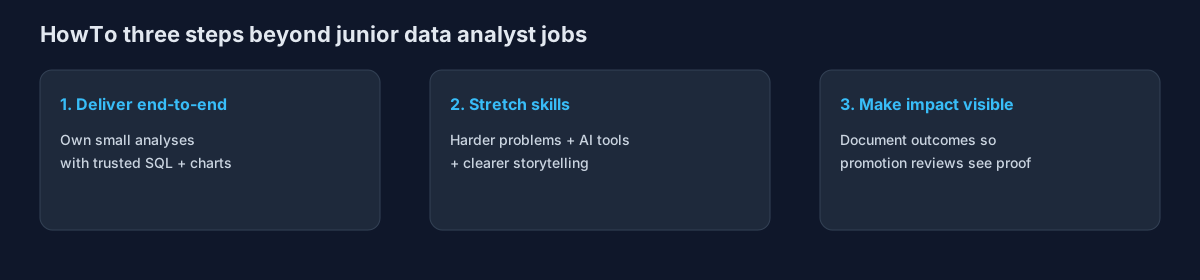
Advancing quickly from junior data analyst jobs to mid-level work is largely within an analyst's control. Use this three-step HowTo:
- Deliver end-to-end — own small analyses with trusted SQL, charts, and a written recommendation.
- Stretch skills — take harder problems, deepen SQL/stats, and practice AI-assisted workflows without skipping judgment.
- Make impact visible — document outcomes so promotion reviews can cite evidence (aligned with LinkedIn’s portfolio emphasis [4]).
Analysts who combine reliable delivery, deliberate growth, and visibility typically move beyond junior roles faster than those who simply wait for time to pass.
How AI Shapes Junior Work
AI-native tools are reshaping junior data analyst jobs in a way that favors those who embrace them. Because agents now handle much of the mechanical cleaning and querying, a junior analyst can take on more substantive work sooner.
Supplement your preparation with hands-on AI practice on real datasets. We explore the paradigm in what AI-native data analysis means, and the Stanford HAI AI Index [6] tracks how rapidly these skills have become standard.
A Typical Junior Project
To make the level concrete, consider a representative project a junior analyst might own. A product manager asks why weekly active users dipped last month. The junior analyst clarifies the question, pulls the relevant usage data, cleans and reconciles it, and analyzes the dip across segments to isolate where it concentrated. They then build a short summary with a chart and a plausible explanation, and present it to the product manager with a recommendation for what to investigate next.
What makes this a junior-level project rather than an entry-level task is the degree of independence involved. Successfully owning projects like this repeatedly is exactly what demonstrates readiness to progress beyond junior data analyst jobs.
Building Toward Mid-Level
The transition from junior to mid-level work is gradual and earned through a track record rather than granted by tenure. Mid-level analysts own larger, more ambiguous problems end to end, often spanning multiple data sources and stakeholders. Volunteer for the analysis that spans two teams' data, keep reliability on core dashboards, and pair stretch work with clearer communication—the same evidence path we use when reviewing promotion packets for people in junior roles.
Junior Readiness Scorecard
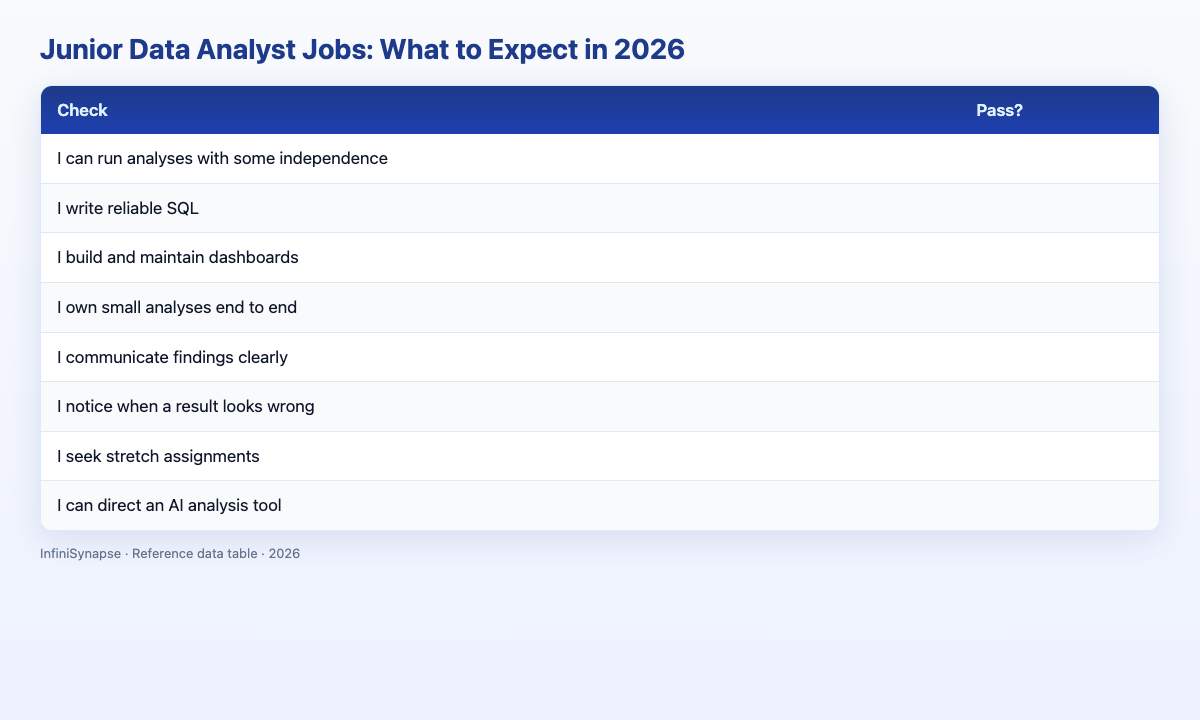
Assess your readiness for junior data analyst jobs (1 point each):
| Check | Pass? |
|---|---|
| I can run analyses with some independence | |
| I write reliable SQL | |
| I build and maintain dashboards | |
| I own small analyses end to end | |
| I communicate findings clearly | |
| I notice when a result looks wrong | |
| I seek stretch assignments | |
| I can direct an AI analysis tool |
6–8: ready for junior work or to advance. 3–5: consolidate the fundamentals. Below 3: start at entry-level.
Failure Modes
Failure 1: Waiting for time to advance. Junior data analyst jobs reward demonstrated readiness, not tenure.
Failure 2: Staying in the comfort zone. Avoiding harder problems stalls progression.
Failure 3: Invisible contributions. Unknown impact delays advancement.
Failure 4: Neglecting communication. Technical growth without communication growth caps a career.
Frequently Asked Questions
What should a junior data analyst job description include?
A junior data analyst job description should list duties (SQL extract, cleaning, dashboards, one owned analysis, a stakeholder write-up), must-have skills (Excel, SQL, one BI tool), the independence bar (0–2 years, small analyses owned end to end), and what the role is not (metric architecture, multi-quarter ambiguity). Use the copy-ready table above.
What skills belong on a junior data analyst job description?
Must-have: Excel, SQL, one BI tool, and clear writing. Nice-to-have: pandas or R, a warehouse, basic statistics. Do not list five languages and “5+ years” on a junior JD—that posting will attract mid-level candidates and reject the people you can actually hire.
Is a degree required on a junior data analyst job description?
Many postings still ask for a bachelor’s in a quantitative field. Skills-based hiring research from Harvard Business Review [5] and LinkedIn’s recruiting outlook [4] both treat portfolio evidence as a valid substitute. If you require a degree, say so; if you will accept an internship plus a SQL sample, write that instead.
What do junior data analyst jobs involve?
Junior data analyst jobs involve executing analyses, building and maintaining dashboards, and answering defined business questions with growing independence. A junior analyst handles these with less supervision than an entry-level hire and begins to own small analyses end to end.
What is the difference between entry-level and junior data analyst jobs?
The difference between entry-level and junior roles is mainly the degree of independence. Entry-level analysts execute closely guided tasks, while junior analysts own small analyses with growing autonomy. Some organizations use the terms interchangeably, but the meaningful distinction is how much supervision the role expects.
How much do junior data analyst jobs pay?
See $55,000–$75,000 desk band and OEWS May 2025 proximate medians above. Junior data analyst jobs pay above entry-level and below mid-level; trajectory matters more than the starting figure—full bands in data analyst salary.
How do I advance from junior data analyst jobs?
Advance from junior data analyst jobs with the three-step HowTo: deliver end-to-end, stretch skills, make impact visible. Analysts who combine reliable delivery, growth, and visibility move to mid-level faster than those who wait for tenure.
How are junior data analyst jobs changing in 2026?
AI-native tools automate much of the mechanical cleaning and querying in junior roles, letting junior analysts take on substantive work sooner. Early fluency with these tools accelerates judgment and communication—the skills that drive advancement ([6]).
Who wrote this
Named author. William Zhu — InfiniSynapse cofounder (GitHub @allwefantasy). Team: InfiniSynapse Data Team. About: editorial standards.
Corrections: zhuhl@infinisynapse.com · corrections policy.
References
- U.S. Bureau of Labor Statistics. Occupational Outlook Handbook — Data analysts.
- U.S. Bureau of Labor Statistics. Occupational Outlook Handbook — Data scientists (≈34% employment growth, 2024–34).
- U.S. Bureau of Labor Statistics. OEWS May 2025 national occupation wage table.
- LinkedIn Economic Graph. Future of Recruiting 2025.
- Harvard Business Review. Skills-Based Hiring Is Good for Business.
- Stanford HAI. AI Index.
- U.S. Bureau of Labor Statistics. Occupational Outlook Handbook — Operations research analysts (≈21% growth, 2024–34).
- Wikipedia. Data analysis.
- William Zhu. GitHub @allwefantasy — InfiniSynapse cofounder.
Conclusion
Junior data analyst jobs are the developmental stage where an analyst consolidates the fundamentals into genuine competence with growing independence. Expect reliable execution, clear progression to mid-level, and strong pay growth when you combine trustworthy delivery, deliberate skill growth, and visibility—backed by the BLS and LinkedIn signals cited above.
Optional product note (commercial): To build the modern skills that accelerate progression, read what AI-native data analysis means and try the InfiniSynapse web app free on registration, no credit card required. Skip if you only need the educational career guidance above.