Analyst Skills: SQL, Judgment & AI
By William Zhu & the InfiniSynapse Data Team · Published: 2026-07-08 · Last updated: 2026-09-24 · About: Editorial standards · About / team
Author credentials: William Zhu is cofounder of InfiniSynapse (GitHub @allwefantasy). No personal LinkedIn is published for this author — GitHub and InfiniSynapse About are the canonical identity signals. Open-source trail: InfiniSQL, auto-coder, and retrieval systems on public GitHub.
Desk experience (first-hand): In Q1–Q2 2026 our team reviewed 40+ analyst JD / take-home packets and sat with working analysts on validation workflows for AI-assisted SQL. Claims below reflect that hiring desk and product-adjacent coaching — not a survey of every employer. One recurring first-hand case: a retail-metrics take-home where candidates who could explain why an AI join was wrong outperformed candidates with longer tool lists.
Commercial interest (COI): InfiniSynapse sells an AI-native analysis platform. Product links appear only in a clearly labeled commercial note at the end. Skill recommendations stand on BLS/LinkedIn/HBR citations and desk patterns.
Table of Contents
- TL;DR
- How We Evaluated These Skills
- The Two Halves of the Skill Set
- Technical Foundations
- Analytical Thinking
- Communication Skills
- The New AI-Era Skills
- How to Build These Skills
- Skills That Distinguish Senior Analysts
- Keeping Skills Current
- Skills Scorecard
- Common Mistakes
- Key Terms
- Frequently Asked Questions
- Conclusion
TL;DR
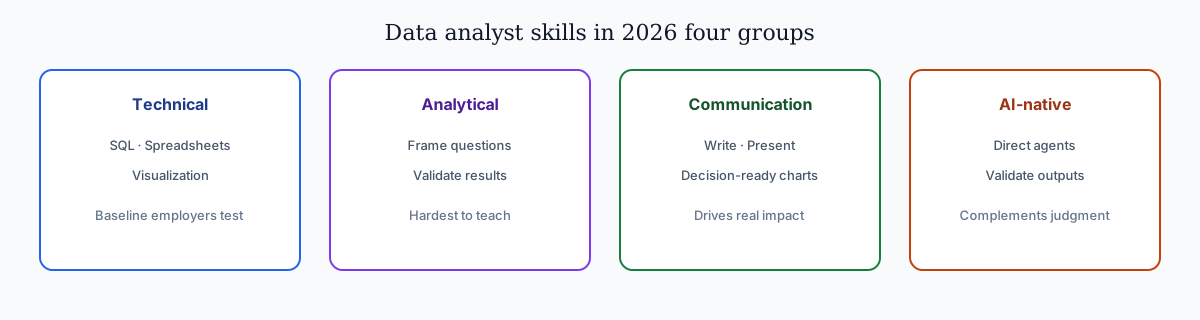
Direct answer: analyst skills are the four groups hiring desks still test: SQL and the grid, judgment, communication, and a story about checking AI output. The longer label data analyst skills is the same map — technical foundations, analytical thinking, communication, and AI-native fluency. As tools automate mechanical work, judgment and communication rise in relative importance.
Who this is for: anyone building analyst skills for a first seat or a promotion, including hiring managers who need a short scorecard.
What you'll learn: how we evaluated these skills, the two halves of the skill set, each group in depth, the new AI-era abilities, and how to build them efficiently.
This guide sits under the data analyst career hub; for the path to acquiring them, see how to become a data analyst. Once the bar is visible, compare it with the entry level data analyst skills and readiness roadmap.
For related depth in this pillar, see Data Analyst vs Data Scientist.
How We Evaluated These Skills
We built this guide from hiring-requirement research and skill-assessment patterns rather than generic tool lists. We cross-referenced occupational expectations with the Bureau of Labor Statistics occupational profile for data analysts, which lists analytical, communication, and technical competencies as core, and hiring-trend data from LinkedIn's 2025 Future of Recruiting report, which emphasizes skills assessments and portfolio evidence alongside formal credentials. We aligned expectations with interview patterns in data analyst interview questions and the job-market context in data analyst jobs.
Quantitative context we cite (extractable stats):
- BLS Employment Projections 2024–34 put data scientists at +33.5% employment growth (about 82,500 jobs) versus +3.1% for all occupations — a signal that analytics-adjacent competencies remain in demand even as tooling changes.
- The BLS OOH profile for data analysts still foregrounds analytical thinking, communication, and technical work activities we map onto the four-group framework below.
- LinkedIn’s 2025 Future of Recruiting report stresses skills assessments and portfolio evidence in hiring — so we weight demonstrated SQL + validation stories over credential count alone.
- Harvard Business Review’s skills-based hiring research describes demonstrated ability as increasingly decisive — matching our desk pattern that portfolios beat tool laundry lists.
The table below summarizes the analyst skills employers weight most heavily in 2026 and how they test each group. Use it to prioritize learning time; individual roles vary, but the four-group structure holds across most hiring we observe.
| Skill group | Why it matters in 2026 | How employers test it |
|---|---|---|
| Technical foundations | SQL, spreadsheets, and visualization remain baseline | Live SQL + take-home exercises |
| Analytical thinking | Frames the right questions and validates results | Case interviews |
| Communication | Turns analysis into decisions stakeholders act on | Portfolio walkthrough |
| AI-native fluency | Orchestrates automated workflows efficiently | Tool demos + validation stories |
How employers test the four groups
Hiring desks do not score a 16-item tool list. They test analyst skills with a live SQL join, a case that needs a framed question, a portfolio walkthrough, and a story about catching a bad AI join. Course hours and certificate names sit on data analyst course. The AI competency model sits on AI data analyst skills.
Practical example: a career changer who masters SQL, publishes two portfolio analyses on public retail data with clear takeaways, and documents how they validated an AI-generated query against manual SQL can demonstrate the full analyst skills stack in interviews — even without a statistics degree. Recruiters see the portfolio as proof of execution and the validation workflow as proof of judgment.
The Two Halves of the Skill Set
The analyst skills that matter divide into two halves that are equally important, though newcomers often overweight the first. Both halves show up in what does a data analyst do. The technical half covers the tools and methods for retrieving and manipulating data. The human half covers the thinking and communication that turn data into decisions. A strong analyst needs both, and neglecting either caps a career.
This balance is the single most important thing to understand about analyst skills. Many people entering the field focus almost entirely on technical tools, assuming analysis is a purely technical craft, and are surprised to find that communication and judgment determine much of their impact. Employers repeatedly report that they can teach tools but struggle to teach clear thinking and communication, which is why the human half is so valued. Building both halves deliberately, rather than defaulting to the technical, is what produces a well-rounded and advancement-ready analyst, grounded in the disciplined process described in the Wikipedia data analysis overview.
Technical Foundations
The technical foundations start with SQL, the single most important technical skill, since retrieving data underpins nearly every analysis. Deep SQL fluency, including joins, aggregations, and window functions, is expected of every analyst. Spreadsheet mastery comes next, as a great deal of everyday work still happens in a grid, and comfort with pivot tables and key formulas is assumed.
Visualization is the third technical foundation. Comfort with a tool such as Tableau or Power BI to build clear, communicative charts is expected, since presenting findings visually is central to the role. Some analysts add programming in Python or R for more advanced work, though this is more essential in some roles than others. These technical abilities form the necessary baseline among analyst skills, but they are precisely the ones AI-native tools increasingly assist with, which is shifting where an analyst's distinctive value lies.
Analytical Thinking
Analytical thinking is the most important of the human analyst skills and the hardest to teach. It is the ability to frame a vague question into a precise, answerable one, to choose the right approach, and to judge whether a result actually makes sense. This skill is what separates an analyst who produces correct-looking numbers from one who produces genuine insight that holds up under scrutiny.
Within analytical thinking, several sub-skills matter. Framing turns a fuzzy stakeholder request into a specific analysis. Skepticism prompts an analyst to validate a surprising result before presenting it, checking it against intuition and independent cuts. Business understanding lets an analyst connect the analysis to the decision it serves. These judgment-oriented abilities are rising in value as tools automate mechanical work, because a machine can run a query but cannot decide which question is worth asking. The move toward augmented workflows, outlined in IBM's augmented analytics overview, frames how teams evaluate modern tooling.
Communication Skills
Communication is the human skill among analyst skills that most often determines an analyst's real-world impact. The ability to translate a technical finding into a clear, decision-ready message for a non-technical audience is what makes analysis useful. An analyst who produces a brilliant result but cannot explain it persuasively has not completed the job, and strong technical candidates repeatedly lose influence by underinvesting here.
Communication spans written explanation, verbal presentation, and visual design of charts that make a point clearly. Leading with the takeaway rather than burying it, tailoring the message to the audience, and choosing visuals that clarify rather than decorate are all learnable habits. Because remote and asynchronous work has grown, written communication in particular has risen in importance among analyst skills. Analysts who deliberately develop communication alongside their technical foundations consistently have more impact and advance faster than equally technical peers who neglect it.
The New AI-Era Skills
The newest addition to analyst skills is the ability to direct AI-native tools effectively. As agents take over much of the mechanical cleaning and querying, the analyst's role shifts toward orchestrating these tools: asking them precise questions, validating their output, and integrating their results into a coherent analysis. This is becoming its own competency that employers increasingly seek.
Supplement your preparation with hands-on AI practice on real datasets. We explore the paradigm in what AI-native data analysis means, and the Stanford HAI AI Index tracks how rapidly these capabilities have become standard in production roles. An analyst skilled at directing such a tool can work faster and tackle larger problems while still applying judgment to validate results. Critically, AI fluency complements rather than replaces the other analyst skills, since directing a tool well requires the very judgment and communication that define the role.
How to Build These Skills
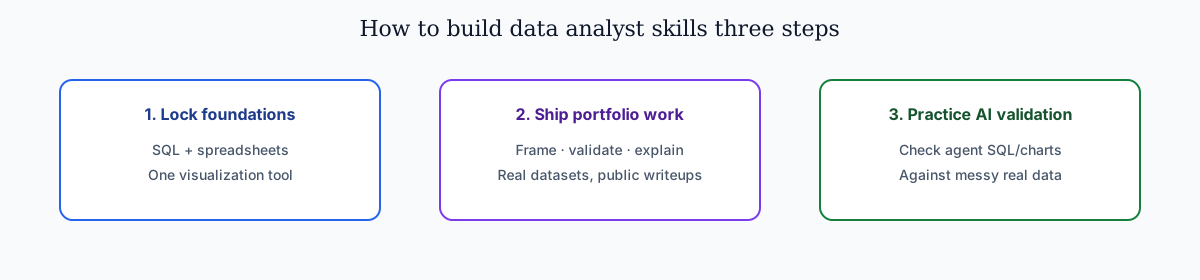
Building analyst skills efficiently means developing all four groups rather than over-indexing on the technical. Use this three-step sequence — the same desk habit we coach career changers on when they ask how to improve analyst skills.
1. Lock technical foundations first {#howto-step-1}
Start with SQL and spreadsheets, then add one visualization tool. Depth in joins, aggregations, and clear charts beats a shallow list of five BI products.
2. Ship portfolio analyses that force judgment {#howto-step-2}
Practice on real projects that require framing questions, validating results, and communicating findings. A portfolio consolidates the human half that classroom tutorials cannot — see how to become a data analyst.
3. Add AI-output validation on messy data {#howto-step-3}
Build fluency with AI-native tools alongside foundations. Enterprise adoption patterns in Google Cloud's AI overview mirror the shift from pilots to governed analytics — validate agent SQL before you trust it in a stakeholder memo.
Skills That Distinguish Senior Analysts
As analysts advance, a distinct tier of analyst skills separates senior practitioners from capable mid-level ones. The first is problem framing at a higher altitude: where a junior analyst answers the question asked, a senior one questions whether it is the right question and reframes it toward the decision that actually matters. This ability to shape the problem, not just solve it, is among the most valuable capabilities an experienced analyst develops, and it is nearly impossible to automate.
A second distinguishing ability is influence without authority. Senior analysts persuade stakeholders to act on findings, navigate conflicting priorities, and build trust across a business, all through communication and credibility rather than positional power. A third is mentorship: raising the capability of a whole team by teaching others how to frame questions, validate results, and communicate clearly. These higher-order abilities build on the foundations but go well beyond them, and they are what employers ultimately pay senior compensation to secure. The pay band that follows those skills is in senior data analyst salary.
Keeping Skills Current
The field evolves, so staying current is itself an essential ability rather than a one-time achievement. Tools change, expectations shift, and entirely new capabilities, such as directing AI-native platforms, emerge and become baseline within a few years. Analysts who treat learning as a permanent habit stay valuable, while those who stop learning after landing a role gradually drift toward obsolescence.
Keeping analyst skills current does not mean chasing every trend. The discipline is to distinguish durable shifts, like the rise of AI-native analysis, from passing fads, and to invest learning time where it compounds. Analytical thinking and communication rarely go out of date, so continued investment in them pays off indefinitely, while tool-specific knowledge needs periodic refreshing.
Skills Scorecard
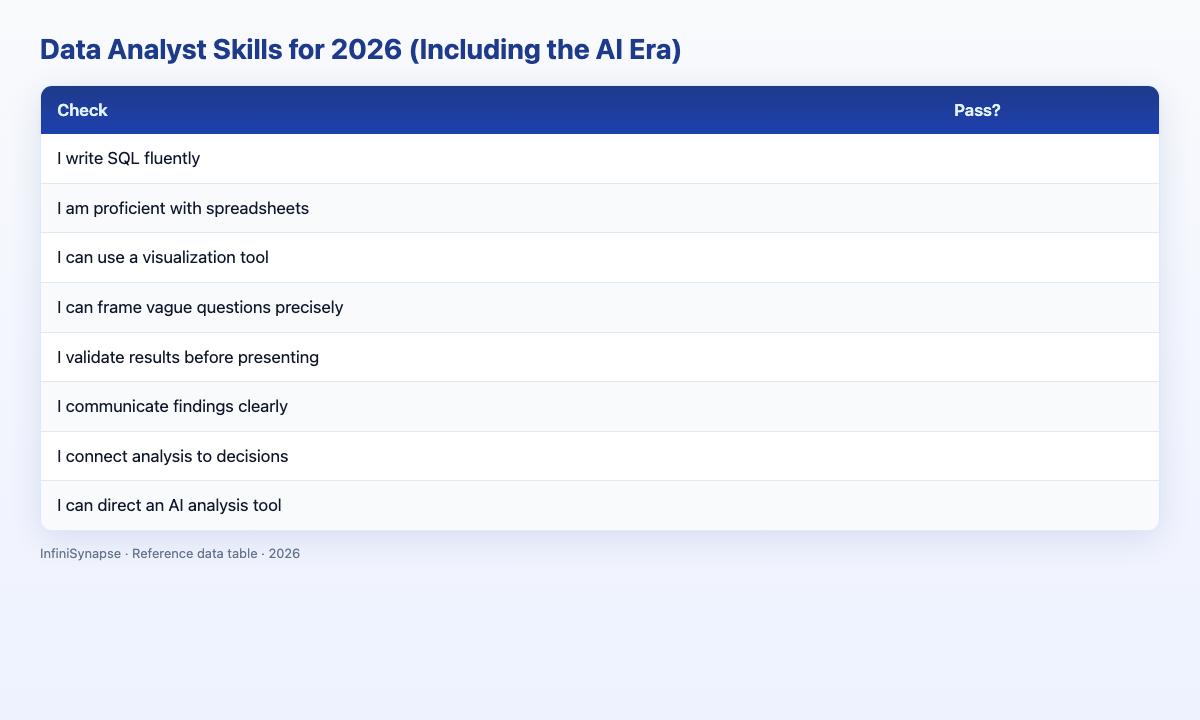
Assess your analyst skills (1 point each):
| Check | Pass? |
|---|---|
| I write SQL fluently | |
| I am proficient with spreadsheets | |
| I can use a visualization tool | |
| I can frame vague questions precisely | |
| I validate results before presenting | |
| I communicate findings clearly | |
| I connect analysis to decisions | |
| I can direct an AI analysis tool |
6–8: strong, well-rounded skills. 3–5: build the weak half. Below 3: start with foundations.
Common Mistakes
Mistake 1: Overweighting the technical. Neglecting the human half of analyst skills caps impact and advancement.
Mistake 2: Collecting tools, not skills. Knowing many tools shallowly beats nothing, but depth and judgment matter more.
Mistake 3: Ignoring communication. Strong analyst skills explained poorly lose their influence entirely.
Mistake 4: Fearing AI tools. Refusing to learn AI-native tools misreads where the field is heading.
Key Terms
| Term | Definition |
|---|---|
| Technical foundations | SQL, spreadsheets, and visualization fluency that form the baseline employers still test with live exercises. |
| Analytical thinking | Framing vague requests into answerable questions and validating whether results make sense in context. |
| AI-native fluency | Directing AI analysis agents — precise prompts, output validation, and integration into a coherent narrative. |
| Skills-based hiring | Evaluating candidates on demonstrated portfolio and assessment evidence rather than credentials alone. |
Frequently Asked Questions
What are analyst skills?
analyst skills are the four groups hiring desks still test: SQL and spreadsheets, judgment, communication, and a validation story for AI output. Employers use live SQL, case interviews, and portfolio walkthroughs — not a course catalog — to see the bar.
What skills does a data analyst need?
The core data analyst skills fall into four groups: technical foundations (SQL, spreadsheets, visualization), analytical thinking, communication, and increasingly the ability to direct AI-native tools. Both the technical half and the human half of judgment and communication are essential, and employers particularly value the human skills they cannot easily teach.
What is the most important data analyst skill?
Among analyst skills, SQL is the most important technical skill, since retrieving data underpins nearly every analysis. Among human skills, analytical thinking and communication are most important, because they turn data into trustworthy, actionable insight. A strong analyst needs both a technical foundation and these judgment-oriented abilities.
Do data analysts need programming skills?
SQL is essential among analyst skills, and it is a form of programming. Deeper programming in Python or R is valuable and required in some roles, but not universally, since spreadsheets, visualization tools, and AI-native platforms handle much everyday work. The need for general-purpose programming depends on the specific role and industry.
What new skills do data analysts need in 2026?
The newest addition to analyst skills in 2026 is the ability to direct AI-native tools effectively: asking precise questions, validating output, and integrating results. As these tools automate mechanical work, judgment and communication also rise in relative importance, since they are what the tools cannot replicate.
How do I improve the four groups?
Improve your analyst skills by building all four groups through real projects rather than isolated tutorials. Practice on genuine datasets that force you to frame questions, validate results, and communicate findings, and develop fluency with AI-native tools alongside the technical foundations. A portfolio of real analyses consolidates the skills most effectively.
Conclusion
The analyst skills that matter in 2026 span technical foundations, analytical thinking, communication, and the new ability to direct AI-native tools. As tools automate mechanical work, judgment and communication rise in importance, so building both halves of the skill set deliberately is the surest path to impact and advancement.
Commercial note (optional product trial): To practice AI-era validation after you have foundations and a portfolio piece, you can try the InfiniSynapse web app (free on registration, no credit card required). This block is separate from the editorial skill framework above. For non-product depth, start with what AI-native data analysis means.