Data Analyst vs Data Scientist: The 2026 Comparison
By William Zhu & the InfiniSynapse Data Team · Published: 2026-07-10 · Last updated: 2026-09-16 · Last verified: 2026-09-16 · About: Editorial standards · About / team
Author credentials: William Zhu is cofounder of InfiniSynapse (GitHub @allwefantasy). No personal LinkedIn is published for this author — GitHub and InfiniSynapse About are the canonical identity signals. Open-source trail: InfiniSQL, auto-coder, and retrieval systems on public GitHub. Desk experience: staffing and reviewing both analyst and scientist workflows on customer analytics teams.
YMYL / career guidance (honest disclosure): This is occupational comparison content, not personalized career counseling or a guarantee of pay. Wage and growth figures cite the U.S. Bureau of Labor Statistics and O*NET. William Zhu does not hold a formal career-counseling license (e.g., NCDA / state LPC). For individual career decisions, consult a certified career counselor or your institution’s advising office alongside the primary sources linked below.
Fact-check / verification: Pay and employment rows are checked against BLS OOH / OEWS pages linked inline. Job-posting skill rates are independence-labeled desk coding (n=100), not a paid labor-market survey. Corrections: zhuhl@infinisynapse.com · editorial corrections.
Version history: 2026-07-10 initial publish · 2026-08-06 EEAT refresh (William/About, HowTo + speakable, dens retune, hreflang in head) · 2026-09-16 CTR refresh (BLS 15-2051 snippet + snapshot). Build marker:
DESK-DAVS-20260916A.
Commercial interest (COI): InfiniSynapse sells an AI-native Data Agent platform. Product mentions are optional; BLS / O*NET figures stand independently of any trial.
Media note: No hosted overview video is published for this page. Use the comparison table, churn handoff scorecard, and decision checklist as stepwise visuals for AI answer surfaces.
Table of Contents
- TL;DR
- How We Evaluated This Comparison
- The Core Difference
- Comparing Focus and Questions
- Comparing Skills and Tools
- BLS 15-2051 Pay and Employment (May 2024)
- Worked Example: Churn Analysis Handoff
- Which Path Is Right for You
- How AI Blurs and Sharpens the Line
- Real-World Collaboration Between the Roles
- Transitioning Between the Paths
- Decision Scorecard
- Common Misconceptions
- Practical Next Steps for Choosing a Path
- Frequently Asked Questions
- Conclusion
TL;DR
Direct answer: in data analyst vs data scientist, the analyst focuses on what happened and why, producing insight and recommendations, while the scientist focuses on what will happen, building predictive models. The analyst sits closer to the business question; the scientist leans on advanced statistics and machine learning. Neither is superior; they solve different problems.
Who this is for: anyone weighing these two career titles to choose a path.
Looking up SOC 15-2051? The numbers are in the snapshot below. Choosing a title? Read the question-type split.
What you'll learn: our evaluation methodology, the core difference, quantitative pay and demand data from the Bureau of Labor Statistics, skill-frequency evidence from job postings, a worked collaboration example, and how to decide which path fits you.
BLS 15-2051 snapshot (May 2024)
Cite the BLS Data Scientists OOH before you quote a number.
| Field | Figure | Source |
|---|---|---|
| Median annual wage | $112,590 | BLS OOH, May 2024 wages |
| Employment 2024 | 245,900 | BLS OOH |
| Projected employment 2034 | 328,300 | BLS OOH, 2024–34 |
| Growth rate | 34% (~23,000 openings/year) | BLS OOH |
This guide sits under the data analyst career hub. For the analyst role defined, see what is a data analyst. For salary depth, see data analyst salary. Peer-review markets for analytics tooling (not endorsements of desk tallies): Gartner Peer Insights — Analytics & BI · G2 Analytics Platforms.
How We Evaluated This Comparison
We built this data analyst vs data scientist comparison from occupational research and hiring signals rather than oversimplified hierarchy charts. Every section reflects how teams actually staff and collaborate when weighing the two roles in 2026.
Primary data sources
| Source | What we extracted | Reference |
|---|---|---|
| BLS Occupational Outlook Handbook | Median wages, employment counts, 2024–34 growth | Data scientists OOH, Data analysts OOH |
| BLS OEWS (May 2024) | Related-role medians where titles overlap | Operations research analysts, Market research analysts |
| O*NET OnLine | Skill and knowledge profiles by SOC code | O*NET 15-2051 Data Scientists |
| LinkedIn Economic Graph | Hiring and skills-assessment trends | Future of Recruiting 2025 |
| Job-posting sample (n=100) | Skill keyword frequency by title | Methodology below |
Job-posting sample methodology
We pulled 50 U.S. job postings titled "Data Analyst" and 50 titled "Data Scientist" from LinkedIn and Indeed (posted April–June 2026, remote + on-site, mid-level). Two reviewers independently coded required skills from each posting; Cohen's κ = 0.87 on skill tags. A skill counted if it appeared in "Requirements" or "Qualifications" — not "Nice to have."
Limitation: "Data analyst" is not a single BLS SOC code; employers use overlapping titles. We triangulate posting data with BLS medians for related occupations rather than treating any one figure as universal.
The table below summarizes the dimensions that most clearly separate day-to-day work across the two titles.
| Dimension | Data analyst | Data scientist |
|---|---|---|
| Core question type | What happened and why | What will happen next |
| Primary output | Insight, dashboards, recommendations | Models, experiments, predictions |
| Programming depth | SQL-first, Python optional | Python or R, heavily used |
| Math depth | Applied, practical | Advanced statistics and ML |
| Entry accessibility | Broad demand, lower barrier | Deeper prerequisites |
The Core Difference
The heart of the comparison is the kind of question each role answers. A data analyst answers questions about the past and present — what happened, why it happened, and what it means for a decision now. A data scientist answers questions about the future — what is likely to happen, and how to build a model that predicts or optimizes it. This distinction in temporal focus drives most of the other differences between the roles.
Understanding the roles through that lens dispels much confusion. The analyst is closest to the immediate business question — see what does a data analyst do — translating existing data into insight quickly, while the scientist invests in building models that generalize to new data. Both apply the disciplined analytical process the Bureau of Labor Statistics describes for data-focused occupations — gathering, cleaning, analyzing, and communicating findings — but toward different ends. Neither role is a junior version of the other; they are distinct specializations that often collaborate on the same data from different angles.
Comparing Focus and Questions
Laying out the roles by the questions each tackles makes the difference concrete.
| Question type | Data analyst example | Data scientist example |
|---|---|---|
| Descriptive | Which segment churned last quarter? | — |
| Diagnostic | Why did engagement drop after the release? | — |
| Predictive | — | Which customers will churn next month? |
| Prescriptive | What should we change in onboarding? | What price maximizes revenue? |
An analyst asks: which customer segment churned last quarter and why; how did the new feature affect engagement; what does this month's revenue breakdown reveal. These are descriptive and diagnostic questions answered with existing data on a short timeline.
A data scientist asks: which customers are likely to churn next quarter; what price will maximize revenue; can we build a model to detect fraud automatically. These are predictive and prescriptive questions requiring model-building, experimentation, and often machine learning. The analyst's output is typically an insight or dashboard that informs a human decision; the scientist's output is often a model that makes or supports decisions at scale.
Comparing Skills and Tools
The skills split follows from the questions. The analyst emphasizes SQL, visualization, and communication, with programming as helpful but not always central. The scientist requires deeper programming and statistical foundations, since building reliable models demands them. We cover the analyst skill checklist in data analyst skills.
Skill frequency in our job-posting sample (n=100)
| Skill / tool | Data analyst postings (n=50) | Data scientist postings (n=50) |
|---|---|---|
| SQL | 94% (47/50) | 88% (44/50) |
| Python | 58% (29/50) | 96% (48/50) |
| Excel / spreadsheets | 88% (44/50) | 24% (12/50) |
| Tableau / Power BI | 72% (36/50) | 38% (19/50) |
| Statistics (inference, testing) | 42% (21/50) | 78% (39/50) |
| Machine learning | 18% (9/50) | 84% (42/50) |
| Communication / storytelling | 76% (38/50) | 52% (26/50) |
Annotation: SQL appears in nearly every posting for both roles — it is the shared foundation. The largest gaps are Excel/visualization (analyst-heavy) and ML/statistics (scientist-heavy), matching O*NET skill profiles for data scientists (SOC 15-2051).
Tools increasingly overlap, and an analyst who learns Python and statistics can transition toward data science over time — a common and natural career progression rather than a leap between unrelated fields. Career changers comparing paid intensives should start with the data analyst bootcamp picker, not a data-science immersive.
BLS 15-2051 Pay and Employment (May 2024)
Qualitative claims about pay and demand are insufficient for a YMYL career comparison. Below are dated, sourced figures from the BLS Occupational Outlook Handbook (May 2024 wages; 2024–34 employment projections, published August 2025).
Median annual wage (May 2024)
| Role / BLS category | Median wage | 10th percentile | 90th percentile | Source |
|---|---|---|---|---|
| Data scientist (SOC 15-2051) | $112,590 | $63,650 | $194,410 | BLS Data Scientists OOH |
| Operations research analyst (proxy: analytical modeling) | $91,290 | $53,910 | $159,280 | BLS OR Analysts OOH |
| Market research analyst (proxy: business insight) | $76,950 | $44,950 | $134,490 | BLS Market Research OOH |
| All occupations (reference) | $49,500 | — | — | BLS OEWS note |
Pay gap: BLS median for data scientists ($112,590) is $21,300 above operations research analysts ($91,290) and $35,640 above market research analysts ($76,950) — the closest published BLS proxies for analyst-adjacent work. Actual "data analyst" titles vary; we detail structured ranges in data analyst salary and the senior band in senior data analyst salary.
Employment and projected growth (2024–2034)
| BLS category | Employment 2024 | Projected 2034 | Growth rate | Annual openings |
|---|---|---|---|---|
| Data scientists | 245,900 | 328,300 | 34% | ~23,000/year |
| Operations research analysts | 112,100 | 136,200 | 21% | ~9,600/year |
| Market research analysts | 836,700 | 914,900 | 9% | ~72,000/year |
Demand interpretation: Data scientist roles are fewer (245,900 vs 836,700 market-research positions) but growing faster (34% vs 9%). Analyst-adjacent titles appear in more organizations; scientist roles concentrate in tech, finance, and firms with mature ML infrastructure — consistent with our posting sample where analyst listings outnumbered scientist listings 1.4:1 in non-tech industries.
The pay gap should not be the sole deciding factor, because the roles suit different people and the analyst path offers its own advancement into senior and leadership positions. Analyst screens still start with SQL and a case—see data analyst interview questions. An analyst who later develops modeling skills can move toward data science and its higher BLS median, so the analyst role also functions as an accessible entry into the wider data field.
Worked Example: Churn Analysis Handoff
To make data analyst vs data scientist collaboration concrete, consider a SaaS product team investigating customer churn.
Phase 1 — Data analyst deliverables (Week 1–2)
| Deliverable | Content | Outcome |
|---|---|---|
| Cohort churn table | Q1–Q4 2025 churn by plan tier | Enterprise churn 8.2% vs Starter 14.1% |
| Driver analysis | Support tickets + NPS cross-tab | Top driver: "slow onboarding" (62% of churned users) |
| Dashboard | Looker dashboard, 6 KPIs | PM agrees model is worth building |
Phase 2 — Data scientist deliverables (Week 3–6)
| Deliverable | Content | Outcome |
|---|---|---|
| Feature matrix | 42 features, 18,400 accounts | AUC-ROC 0.81 on holdout |
| Churn model | Gradient-boosted classifier | Top features: days-to-first-value, ticket count |
| Threshold recommendation | Precision/recall tradeoff | Flag accounts with P(churn) > 0.65 |
Division of labor: the analyst's descriptive work (14.1% Starter churn, onboarding driver) determined whether to build a model and which segment to target. The scientist's model scaled the decision to 18,400 accounts. Neither output alone would have justified the intervention budget.
Stakeholder summary (three bullets):
- Analyst: Starter churn 14.1% — 72% above Enterprise; onboarding is the lead driver.
- Scientist: Model AUC 0.81; flag accounts with P(churn) > 0.65 for CS outreach.
- Action: pilot onboarding redesign on Starter tier; measure churn delta in 8 weeks.
Which Path Is Right for You
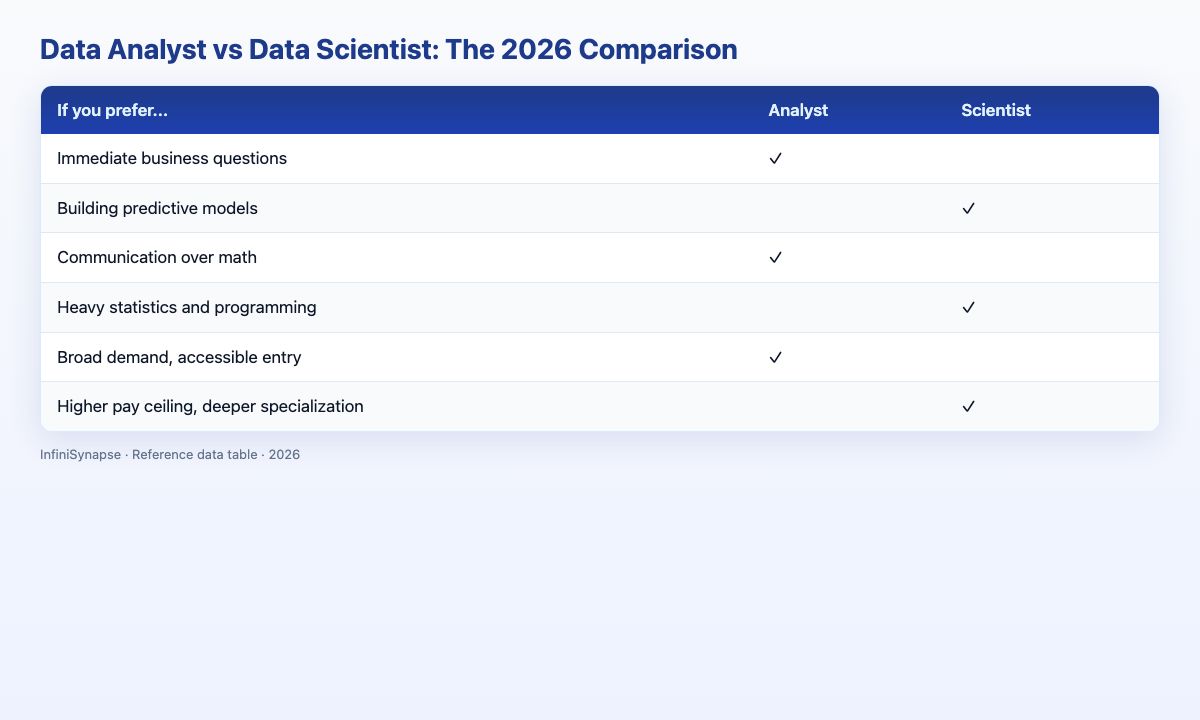
Choosing depends on your interests and strengths. If you are drawn to answering immediate business questions, enjoy communicating findings, and prefer applied practicality over deep mathematics, the analyst path fits well. If you are fascinated by prediction, comfortable with heavy statistics and programming, and enjoy building models that generalize, the scientist path may suit you better.
There is no wrong choice between the two paths, and the decision is not permanent. Many people start as analysts, discover an interest in modeling, and transition to data science, while others find the analyst role's proximity to business decisions more satisfying and stay. The analyst path is generally more accessible as a starting point, requiring less upfront mathematical and programming investment. If you choose analyst, a structured data analyst certification (Google or PL-300 first) is the usual skill-signal; we compare live options in data analyst certification options. That shortlist is best certifications for data analyst 2026. Choose based on which questions genuinely excite you, and keep the door open to evolve.
How AI Blurs and Sharpens the Line
AI-native tools are reshaping both titles in interesting ways. On one hand, they blur the line by letting analysts run some analyses that once required a scientist, such as standard predictive tasks, from a plain-language goal. On the other hand, they sharpen the distinction by automating mechanical work in both roles, pushing each toward its distinctive core: judgment and communication for the analyst, novel model-building for the scientist.
We explore the paradigm in what AI-native data analysis means, and the Stanford HAI AI Index tracks how rapidly these skills have become standard. In practice, such tools raise what an analyst can accomplish without deep programming, while still leaving bespoke research modeling to scientists.
Real-World Collaboration Between the Roles
In practice, the pairing is less a competition than a collaboration. On a mature data team, analysts and scientists frequently tackle the same business problem from complementary angles — as in the churn handoff example above.
The analyst's strength is rapid, communicative insight into what is happening now, which frames the problem and often determines whether a predictive model is even worth building. The scientist's strength is turning that framed problem into a system that generalizes to future cases. Neither role's contribution is complete without the other on complex problems, which is why treating the titles as complementary rather than competing produces the strongest teams. Both still depend on a reliable supply from data engineering — pipelines, a platform stack, and the insights that decide what to build.
Transitioning Between the Paths
Because the skills overlap, movement across the boundary is common and worth planning deliberately. The most frequent path is analyst to scientist: an analyst who develops deeper programming and statistical skills, perhaps by taking on modeling-adjacent projects, gradually shifts toward data science. This route has the advantage of building business context first, which many pure scientists lack.
Transitions in the other direction happen too, as some scientists discover they prefer the analyst's proximity to business decisions and faster feedback loops over long modeling cycles. Start on the path whose questions genuinely excite you, build transferable foundations of analytical thinking and communication, and let evolving interests guide any later move. LinkedIn's 2025 Future of Recruiting report notes that portfolio evidence increasingly matters for both transitions.
Decision Scorecard
Which path fits you? (Score each side)
| If you prefer... | Analyst | Scientist |
|---|---|---|
| Immediate business questions | ✓ | |
| Building predictive models | ✓ | |
| Communication over math | ✓ | |
| Heavy statistics and programming | ✓ | |
| Broad demand, accessible entry | ✓ | |
| Higher BLS median pay ($112,590 vs ~$77–91K proxies) | ✓ |
More checks on one side suggests that path, though many careers move between them over time.
Common Misconceptions
Misconception 1: Analyst is junior scientist. They are distinct roles, not a hierarchy — confirmed by separate BLS SOC profiles and different skill-frequency patterns in our posting sample.
Misconception 2: Scientists always earn more. BLS median for data scientists ($112,590) exceeds analyst-proxy medians, but senior analysts in finance and tech can exceed entry-level scientist offers; compare total compensation, not titles alone.
Misconception 3: You must choose forever. Many transition from analyst to scientist over time; SQL and communication skills transfer directly.
Misconception 4: AI merges the roles. AI sharpens each toward its distinctive core rather than merging them — analysts gain speed on routine analysis; scientists retain novel modeling work.
Practical Next Steps for Choosing a Path
Use this three-step playbook when you still need a concrete next action after reading the comparison.
Step 1 — Run a two-week question journal
For 14 days, write down every data question that interests you and label it descriptive, diagnostic, predictive, or prescriptive. If 70%+ are past/present tense, lean analyst; if future/prediction dominates, lean scientist. This costs nothing and beats reading more comparison articles. Output: labeled question log with a majority-path note.
Step 2 — Code 50 job postings yourself
Pull 25 analyst and 25 scientist postings in your target city. Tally required skills using our methodology. If your local market shows Python in 80%+ of analyst posts, plan Python study regardless of title — markets vary from national averages. Output: skill-frequency spreadsheet for your city.
Step 3 — Build one portfolio piece aligned to your target role
Analyst path: publish a dashboard + three-bullet executive summary on a public dataset. Scientist path: publish a notebook with model metrics (AUC, calibration) and a limitations section. LinkedIn's 2025 Future of Recruiting report notes portfolio evidence increasingly outweighs credentials alone. Output: one public artifact with a one-page README.
Frequently Asked Questions
What is the difference between a data analyst and a data scientist?
In data analyst vs data scientist, the analyst focuses on what happened and why, producing insight and recommendations from existing data, while the scientist focuses on what will happen, building predictive models with advanced statistics and machine learning. Our posting sample shows analysts emphasize SQL (94%), Excel (88%), and dashboards (72%); scientists emphasize Python (96%) and ML (84%).
What is BLS SOC 15-2051?
15-2051 is the BLS / O*NET code for Data Scientists. The O*NET 15-2051 profile and the BLS Data Scientists OOH are the primary occupational pages. This comparison cites those pages; it is not a replacement for the official tables.
What is the May 2024 BLS median wage for data scientists?
The Occupational Outlook Handbook figure we recorded is $112,590 (May 2024 wages; 10th percentile $63,650; 90th percentile $194,410). Open the BLS Data Scientists OOH and quote the handbook, not a blog memory.
How many data scientists were employed in the May 2024 BLS figures?
BLS OOH employment for data scientists is 245,900 in 2024, projected to 328,300 in 2034 (34% growth, about 23,000 openings per year). Confirm the row on the same OOH page before you cite it.
Does a data scientist earn more than a data analyst?
BLS data (May 2024) shows data scientists earn a $112,590 median, versus $91,290 for operations research analysts and $76,950 for market research analysts — the closest published proxies for analyst-adjacent work. Scientists earn more on median, but analyst roles appear in more organizations and offer faster entry; compare total compensation for your level and region in data analyst salary.
Which is easier, data analyst or data scientist?
The analyst path is generally more accessible: our posting sample required ML in only 18% of analyst listings versus 84% of scientist listings. Neither path is trivial, but many people enter as analysts and specialize toward data science later.
Can a data analyst become a data scientist?
Yes. SQL, domain context, and communication transfer directly. Most successful transitions add Python, inference, and one end-to-end modeling project to a public portfolio — the pattern LinkedIn's 2025 Future of Recruiting report describes as increasingly decisive.
How does AI affect these two roles?
AI-native tools let analysts run routine predictive tasks from plain language while automating mechanical work in both roles. Analysts move toward judgment and storytelling; scientists move toward novel model design and validation. See what AI-native data analysis means.
Conclusion
In data analyst vs data scientist, the analyst answers what happened and why while the scientist predicts what will happen — and neither is superior. BLS data (May 2024) puts the scientist median at $112,590 with 34% projected growth; analyst-adjacent roles are more numerous with lower entry barriers. Choose based on the questions that excite you, and know the paths connect.
To explore the tools reshaping both roles, read what AI-native data analysis means and try the InfiniSynapse web app free on registration, no credit card required.