Data Analyst Degree = Bachelor's Path, Not a Hard Hire Gate
By William Zhu & the InfiniSynapse Data Team · Published: 2026-07-09 · Last updated: 2026-09-17 · Last verified: 2026-09-17 · About: Editorial standards · About / team · Contact: zhuhl@infinisynapse.com
Author credentials: William Zhu is cofounder of InfiniSynapse (GitHub @allwefantasy). Desk experience: reviewing hiring screens and portfolio evidence with analysts from degree, bootcamp, and self-taught backgrounds; mapping BLS occupational signals to entry-level analytics paths; coaching career changers on SQL + visualization proof packs. This page is not an admissions counselor or accredited career-services report. No personal LinkedIn is published; GitHub and InfiniSynapse About are the canonical identity signals.
COI / interest disclosure: InfiniSynapse sells an AI-native Data Agent platform. Product mentions appear only in the closing practice CTA (vendor-scoped). Degree vs certification guidance and BLS/HBR/SHRM citations stand independently of any InfiniSynapse trial.
Fact-check / verification: BLS does not publish a single “Data Analysts” Occupational Outlook page. Labor numbers below are labeled proxies: Data Scientists and operations research analysts (May 2025 wages; OOH math occupations). Hiring research: LinkedIn Future of Recruiting 2025 · HBR skills-based hiring · SHRM talent acquisition · Stanford HAI AI Index · Wikipedia data analysis · Wikidata: data analysis · Wikipedia bachelor's degree. Corrections: zhuhl@infinisynapse.com · editorial corrections.
Version history: 2026-07-09 initial · 2026-08-07 EEAT (William Zhu Person / About / COI) · 2026-09-17 cluster: definition-first Title/lead, majors table, May 2025 BLS proxies, drop invented Data Analysts OOH URL. Path table years and scorecard thresholds unchanged. Marker:
DESK-DAD-20260917A.
Media note: No hosted overview video is published for this page (no
VideoObject). Use the path-comparison, decision-scorecard, and BLS-quant infographics below as multimedia substitutes.
 Degree, certification, bootcamp, and portfolio paths into analytics — employers hire on demonstrated ability.
Table of Contents
- TL;DR
- What a data analyst degree is
- How We Evaluated Degree Requirements
- What a Degree Actually Teaches
- Do Employers Require a Degree?
- Degree vs Certification vs Bootcamp
- The No-Degree Path That Works
- When a Degree Is Worth It
- Building Skills Alongside Any Path
- AI-Era Skills Beyond the Classroom
- Decision Scorecard
- Practical Next Steps
- FAQ
- Conclusion
TL;DR
Direct answer: A data analyst degree is a bachelor's in statistics, mathematics, economics, computer science, or a dedicated analytics major. You do not strictly need one in 2026: most entry-level teams hire on SQL and a published portfolio. The diploma still helps in government, healthcare, and formal HR screens.
Who this is for: students and career changers deciding whether a bachelor's in analytics (or a related major) is the right spend.
What you'll learn: what the credential is, which majors map to it, what employers list vs what they hire, and when 2–4 years of tuition loses to a bootcamp plus proof.
This guide sits under the data analyst certification hub. Alternatives: data analyst course · data analyst training. Job-search: how to become a data analyst.
What a data analyst degree is
Key Definition: A data analyst degree is an undergraduate credential whose core is quantitative methods—probability, regression, databases, and visualization—usually awarded as a B.S. or B.A. in statistics, mathematics, economics, computer science, or “data analytics / business analytics.” There is no single nationwide major name.
| Typical major on the diploma | What you actually get | Weak if… |
|---|---|---|
| Statistics / mathematics | Theory, inference, experimental design | No SQL or messy-data hours |
| Economics / business analytics | Causal language, KPIs, stakeholder memos | Spreadsheet-only, no warehouse grain |
| Computer science | Python/R, data structures, pipelines | No business question practice |
| Dedicated analytics / data science B.S. | Mixed tooling + stats | Marketing-heavy, thin math |
A loosely labeled “analytics” major can be thinner than a statistics B.S. plus two public projects. Read the course list, not the brochure title. Overview of the work itself: Wikipedia data analysis (Wikidata Q192976).
How We Evaluated Degree Requirements
We assessed whether a data analyst degree is necessary using 2026 hiring practice, not academic tradition alone. Each claim was checked against BLS Data Scientists, LinkedIn's 2025 Future of Recruiting report, HBR skills-based hiring, and SHRM talent acquisition. We also compared curricula to entry-level postings and to the data analyst certification hub.
Programs score on SQL depth, portfolio output, time-to-employment, and whether graduates can analyze without an instructor prompt. An undergraduate analytics program that teaches theory without job-ready tooling scores lower than a shorter certification paired with published projects.
What a Degree Actually Teaches
A data analyst degree provides structured grounding over years: probability, regression, visualization, database concepts, and usually Python or R. Breadth is the advantage. What formal programs do less well is keep job-ready tooling current—SQL depth, modern BI, and AI-native analysis often need a supplement.
What to verify in the curriculum
University curricula often lag industry practice. Graduates frequently need extra SQL, BI, and AI-native hours. Understanding that gap helps you decide whether a degree in data analytics alone prepares you or whether you will train twice.
In practice
A rigorous statistics or computer science track builds thinking that lasts a career. A loosely defined analytics major may offer little beyond a good certification, faster and cheaper. Research curriculum, alumni outcomes, and internship placement—not the label on the diploma.
Do Employers Require a Degree?
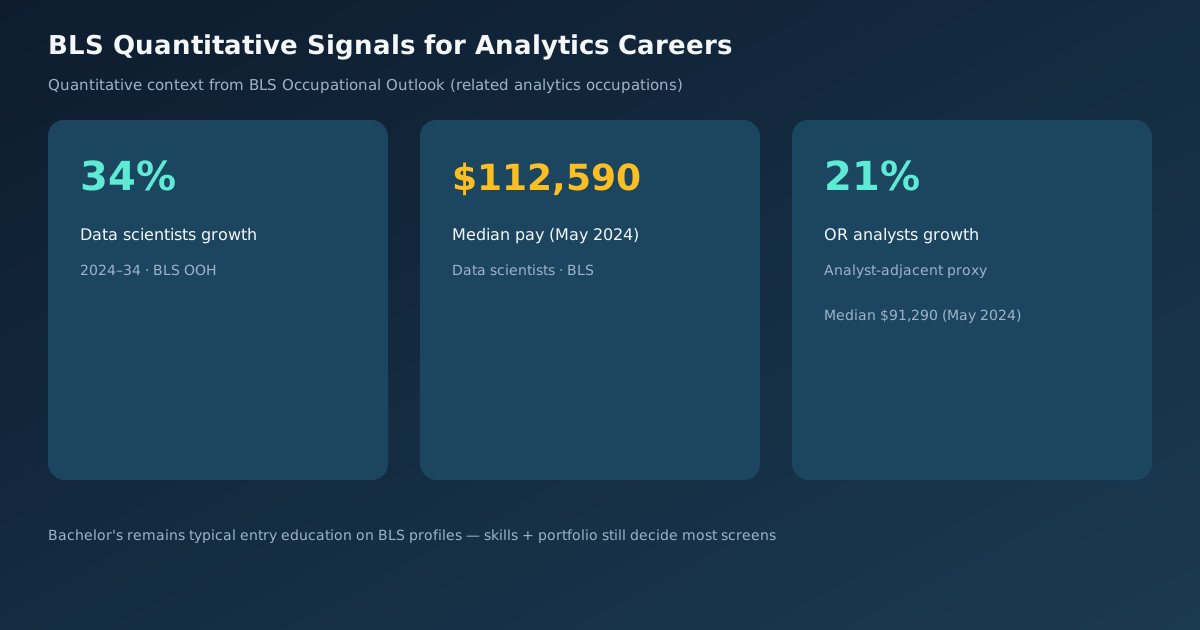 Figure: BLS quantitative context for analytics-adjacent occupations (labeled proxies — not a Data Analysts SOC).
In 2026, most employers list a bachelor's degree as preferred rather than strictly required. BLS treats a bachelor's as typical entry education for adjacent math occupations; postings increasingly add “or equivalent experience.”
Quantitative labor context (proxies, May 2025):
- BLS Data Scientists: median pay about $120,230 (May 2025); bachelor's listed as typical entry education. This is not the first analyst job most readers apply for—use it as the nearest official SOC, not as analyst pay.
- Operations research analysts: median about $88,940 (May 2025); also bachelor's-typical.
- Market research analysts: more numerous, often lower entry barriers—check the live OOH table before you quote a wage.
Hiring managers routinely interview candidates without a formal analytics diploma when the portfolio is strong. Skills-based hiring in Harvard Business Review has weakened the degree as a hard gate at many tech-forward companies. SHRM talent acquisition still sees education filters in regulated HR pipelines.
The honest summary: credentials help but do not guarantee entry; lacking one does not bar entry if you compensate with skills and proof.
| Hiring signal | Typical pattern in 2026 | Source / context |
|---|---|---|
| Entry-level education listed | Bachelor's typical on adjacent BLS OOH pages | Data Scientists (proxy) |
| Posting language | "Degree or equivalent experience" common | Skills-based hiring in tech and mid-market |
| Automated screening | Degree filters still active in government, healthcare, Fortune 500 HR | SHRM |
| Portfolio override | Strong SQL + visualization projects can bypass filters at startups | Desk hiring reviews |
| Referral path | Internal referrals often skip automated education filters | Common recruiting pattern |
Practical example: a mid-career marketing manager who completes a SQL certification, publishes two churn analyses on public retail data, and earns a referral can land an entry-level analyst role at a growth-stage SaaS company without a diploma—even when the posting lists a bachelor's as preferred.
Job-search detail: how to become a data analyst · entry-level data analyst jobs.
Degree vs Certification vs Bootcamp
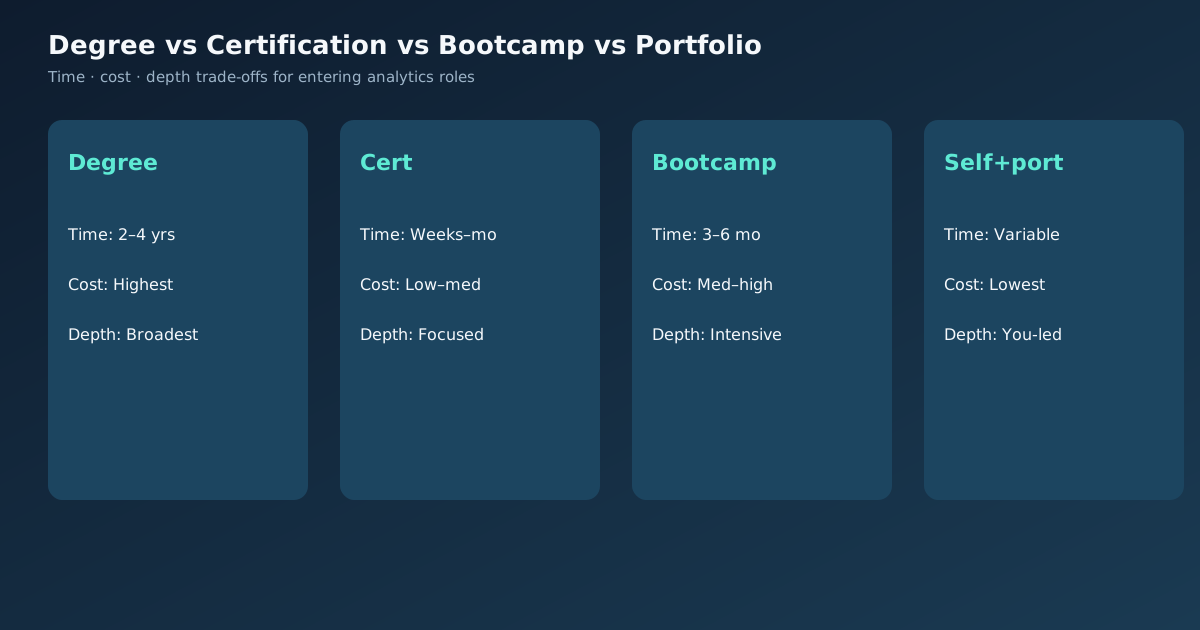 Figure: Time, cost, and depth trade-offs across four entry paths.
A data analyst degree, a certification, and a bootcamp represent three different trade-offs in time, cost, and depth. A multi-year program costs the most but provides the broadest foundation. A certification, covered in the data analyst certification guide, takes weeks to months and focuses on job-relevant skills. A bootcamp compresses training into an intensive program, often with career support, at a middle price point.
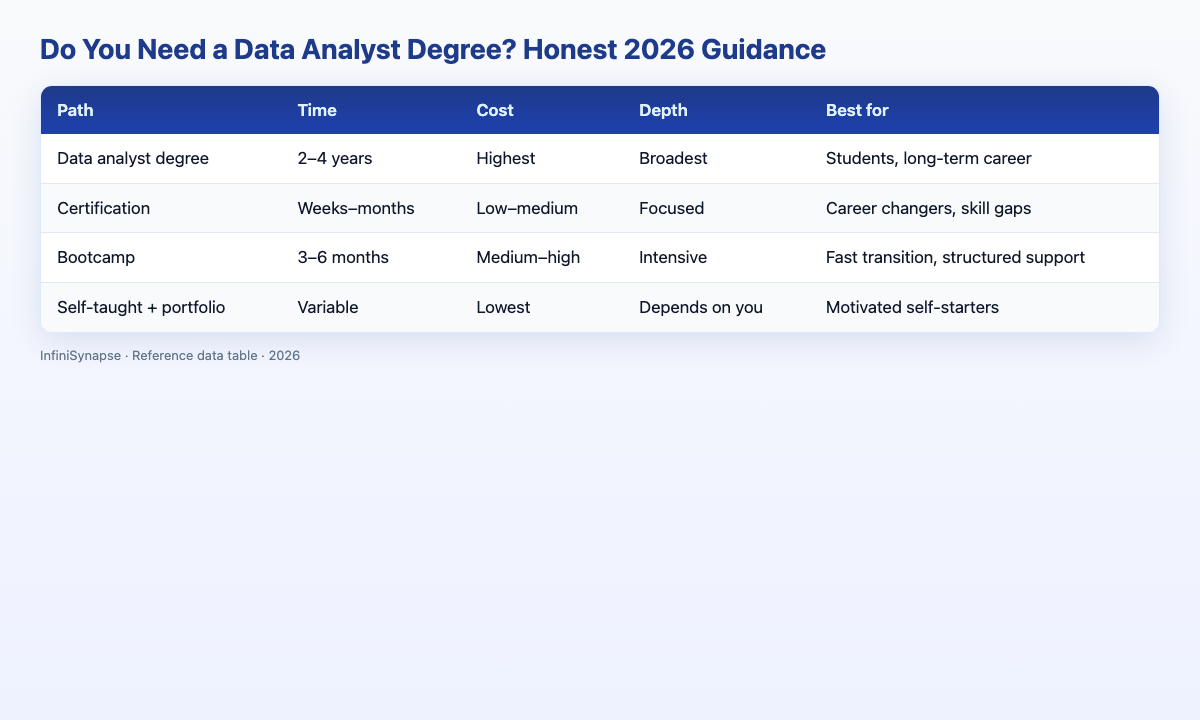
| Path | Time | Cost | Depth | Best for |
|---|---|---|---|---|
| Data analyst degree | 2–4 years | Highest | Broadest | Students, long-term career |
| Certification | Weeks–months | Low–medium | Focused | Career changers, skill gaps |
| Bootcamp | 3–6 months | Medium–high | Intensive | Fast transition, structured support |
| Self-taught + portfolio | Variable | Lowest | Depends on you | Motivated self-starters |
None of these paths is universally superior. A degree suits someone early in their education who wants maximum optionality; a certification or bootcamp suits a career changer who needs efficient skill-building. Many successful analysts combine paths.
The No-Degree Path That Works
Breaking in without a diploma is achievable and increasingly common. The sequence: learn core skills (SQL, spreadsheets, visualization), build a portfolio of two or three real analyses, earn a certification for structure, and run a targeted job search emphasizing demonstrated ability. Each step produces evidence employers can evaluate.
The portfolio is the centerpiece. Employers want to see that you can take a messy dataset, frame a question, clean and query the data, analyze it, and present a clear recommendation. Two or three well-documented projects outweigh a credential listed on a resume with no supporting work.
Target the right employers: startups, mid-size tech companies, and agencies often hire on skills and portfolio. Use data analyst course and data analyst training resources to fill gaps efficiently. Network actively—referrals frequently bypass automated education filters.
When a Degree Is Worth It
A formal program is worth the investment when your situation benefits from its specific advantages. If you are a traditional student with time and affordable access, it provides the deepest foundation and keeps options open—including data science, research, and management tracks that may prefer advanced study later. If you aim for government, healthcare, or academia, academic credentials often remain expected. The move toward augmented workflows, outlined in IBM's augmented analytics overview, frames how teams evaluate modern tooling.
It also makes sense when employer tuition reimbursement or scholarships reduce cost substantially, or when the program includes strong internship placement that converts into offers. Research specific outcomes rather than assuming all programs deliver equal value.
Conversely, a multi-year commitment is harder to justify for experienced career changers who need efficient entry. Spending two to four years when a bootcamp or certification plus portfolio can open the same doors in months is a poor trade for many people. Be honest about timeline, finances, and target roles.
Building Skills Alongside Any Path
Whether you pursue a data analyst degree or an alternative route, active skill-building determines employability. Passive completion of any program produces a credential without ability if you do not practice on real data. The analysts who get hired apply what they learn immediately.
Alongside formal education, practice on public datasets and real business questions. Treat coursework or certification exercises as portfolio pieces: document process, publish findings, annotate reasoning.
Practicing with AI-native analysis tools alongside coursework builds the fluency employers increasingly expect. We explore the paradigm in what AI-native data analysis means, and the Stanford HAI AI Index documents how central these skills have become across knowledge work.
AI-Era Skills Beyond the Classroom
A crucial 2026 consideration is whether the program covers AI-native tools. Many university curricula still focus on traditional statistics and spreadsheets while underemphasizing agents and platforms reshaping daily analyst work. Graduates may enter with solid foundations but without the AI fluency modern teams expect.
Skills employers now want extend beyond most syllabi alone: directing AI-native analysis agents, validating automated outputs, and integrating AI-assisted workflows. Enterprise adoption patterns in Google Cloud's AI overview mirror the shift from pilots to governed analytics.
This does not diminish theoretical grounding—understanding regression, confounding, and misleading charts remains essential. Pair academic foundations with current tooling practice, and plan for ongoing learning regardless of path.
Decision Scorecard
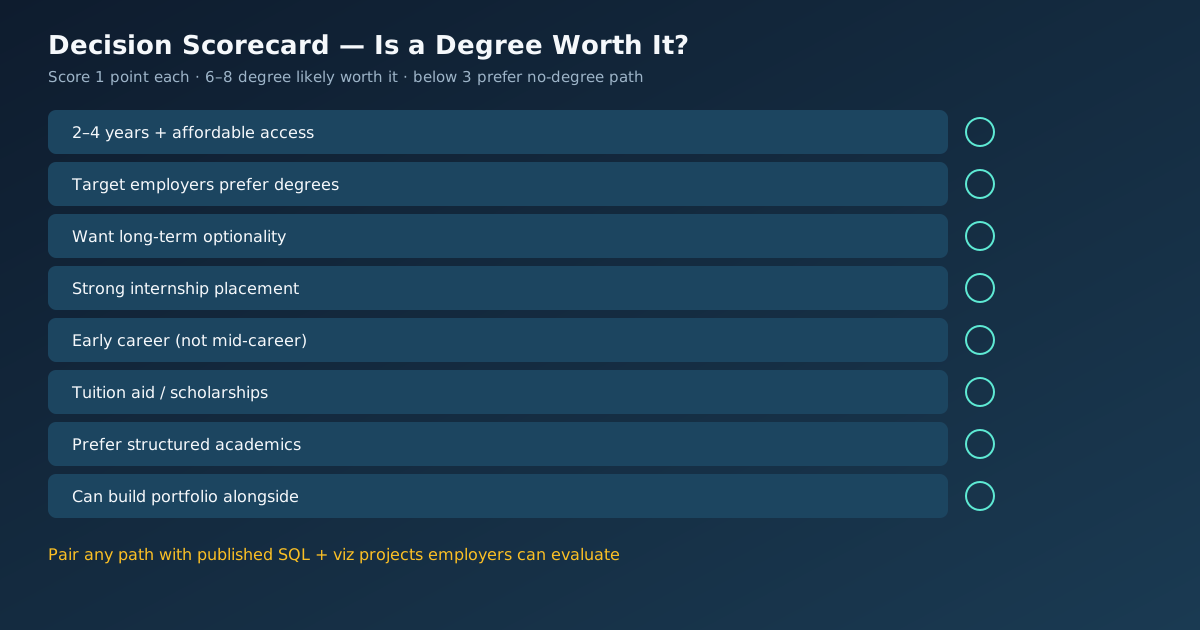 Figure: Score yourself 1 point per check before committing tuition years.
Use this scorecard to decide whether a data analyst degree fits your situation (1 point each):
| Check | Applies to me? |
|---|---|
| I have 2–4 years and affordable access to education | |
| My target employers prefer or require degrees | |
| I want maximum long-term career optionality | |
| The program has strong internship placement | |
| I am early in my career, not a mid-career changer | |
| Tuition reimbursement or scholarships reduce cost | |
| I learn best in structured academic environments | |
| I can supplement the degree with portfolio work |
6–8: a formal program is likely worth pursuing. 3–5: weigh it against certifications and bootcamps. Below 3: the no-degree path may serve you better.
Practical Next Steps
Verify against real job postings
Before committing time or budget, pull five recent job postings in your target market and list the SQL, visualization, and communication skills each repeats. Align your learning plan to those patterns rather than a generic syllabus.
Build one proof pack this month
Ship one public analysis with SQL notebook, chart pack, and a one-page recommendation memo—whether you are in an analytics major or on a self-taught track.
Frequently Asked Questions
What is a data analyst degree?
A bachelor's (or related undergraduate major) whose core is quantitative methods—usually statistics, mathematics, economics, computer science, or a dedicated analytics program. There is no single official major title. See the majors table above.
Do you need a data analyst degree to get hired?
No. Most employers in 2026 hire on demonstrated ability, and a strong portfolio with certifications can substitute in entry-level roles. Adjacent BLS Data Scientists listings treat a bachelor's as typical education, but skills-based hiring means many companies accept equivalent experience. Some large enterprises still prefer degrees—build proof of ability either way.
What degree is best for a data analyst?
Statistics, mathematics, economics, computer science, and dedicated analytics programs are the most common paths. Choose theory depth (statistics, math) versus tooling breadth (computer science) based on your goals. Research curricula and alumni outcomes rather than the major name alone.
Can you be a data analyst without a degree?
Yes. Many working analysts entered through certifications, bootcamps, or self-study paired with a strong portfolio. The no-degree path requires deliberate portfolio-building, targeted skill development, and networking to bypass automated filters—but it is a proven route.
Is a data analyst degree worth it in 2026?
It is worth it when you have time, affordable access, and target roles that value academic credentials. It is harder to justify for career changers who need fast entry, since certifications and bootcamps can open the same doors sooner. Evaluate ROI for your situation, not general prestige.
How does a formal program compare to a certification?
A multi-year program offers greater depth and breadth; a certification offers focused, job-relevant skills in weeks to months at lower cost. Many analysts combine both for the strongest profile.
Conclusion
A data analyst degree is a bachelor's-level analytics path, not a hard hire gate. Employers hire on demonstrated ability—so whether you hold a diploma or arrive through certifications, bootcamps, and a self-built portfolio, the decisive factor is proof that you can turn data into decisions. Choose the path that fits your timeline, budget, and target roles, then invest in real skills and a visible portfolio.
To practice the AI-era skills employers want, read what AI-native data analysis means and try the InfiniSynapse web app free on registration, no credit card required.