Data Analyst Certification: Cert or Portfolio
By the InfiniSynapse Data Team · Last updated: 2026-09-24 · We build an AI-native data analysis platform and work with people entering the field; this guide reflects what certifications are actually worth in 2026.
Table of Contents
- TL;DR
- How We Evaluated These Certifications
- Do Certifications Actually Matter?
- The Major Certifications
- Certifications vs Degrees vs Portfolios
- How to Choose a Certification
- Building Skills Alongside
- The AI Skills Employers Now Want
- Making the Most of Your Certification
- Certification Scorecard
- Cluster Guides in This Pillar
- Practical Next Steps
- Frequently Asked Questions
- Conclusion
TL;DR
Direct answer: A data analyst certification structures learning. It does not guarantee a job. Compare it with a degree and a portfolio you can show.
Who this is for: anyone considering a data analyst certification to enter or advance in analytics.
What you'll learn: whether certifications matter, the major options, how they compare to degrees and portfolios, how to choose, and the AI skills employers now expect.
This hub maps the learning-and-certification pillar; the cluster guides below go deep on courses, degrees, bootcamps, and specific certificates. Every one links back here.
How We Evaluated These Certifications
We selected programs for this guide using criteria that mirror what hiring managers list in 2026 data analyst postings, not brand prestige alone. Each certification was checked against four dimensions: SQL and spreadsheet depth with hands-on practice, visualization and communication work, portfolio-ready capstone output, and whether the curriculum acknowledges AI-assisted analysis workflows. We cross-referenced skill requirements with the Bureau of Labor Statistics occupational profile for data analysts and hiring-trend data from LinkedIn's 2025 Future of Recruiting report, which notes that skills assessments and portfolio evidence increasingly influence hiring alongside formal credentials.
How We Evaluated These: In Practice
Price, format, and completion rates matter too. A data analyst certification you abandon halfway delivers less value than a shorter free program you finish and turn into portfolio work. We favor programs with transparent syllabi, public learner reviews from working analysts, and official exam or curriculum pages you can verify — such as Microsoft Learn certification paths and Coursera professional certificate syllabi. The Stanford HAI AI Index tracks how quickly AI-era skills moved from optional to expected in knowledge work, which shapes how we weight AI coverage in certification recommendations.## Do Certifications Actually Matter?
The honest answer about a certification is that it matters, but less as a credential and more as a structured learning path. A good certification program teaches the skills employers want in an organized way, which is genuinely valuable for someone starting out. The certificate itself signals commitment and a baseline of knowledge, but it does not, on its own, prove you can do the job.
What tempers the value of a data analyst certification is that employers hire on demonstrated ability. A certificate paired with a portfolio of real analyses is powerful; a certificate alone, without evidence you can apply the skills, is far weaker. LinkedIn's 2025 Future of Recruiting report notes that skills assessments and portfolio evidence increasingly influence hiring decisions alongside formal credentials. Understanding this keeps expectations realistic: a certification is a useful step, not a magic key.
The Major Certifications
The data analyst certification market clusters into vendor-neutral programs (broad SQL and visualization foundations) and platform-specific credentials (BI tools, cloud analytics stacks). The table below summarizes the programs employers most often recognize on résumés and job postings in 2026. For a scored data analyst certification comparison — fees, n=50 mention rates, and which exam is still offered — see data analyst certification options. The shortlist title is best certifications for data analyst 2026.
| Program | Issuer | Core skills covered | Typical timeline | Best for |
|---|---|---|---|---|
| Google Data Analytics Professional Certificate | Google / Coursera | Spreadsheets, SQL, R, Tableau, capstone | 3–6 months part-time | Complete beginners seeking a structured entry path |
| IBM Data Analyst Professional Certificate | IBM / Coursera | Excel, SQL, Python, Cognos, dashboards | 4–6 months part-time | Beginners who want Python in the curriculum |
| Microsoft Power BI Data Analyst Associate | Microsoft | Data modeling, DAX, Power BI dashboards | Exam-prep (varies) | Roles centered on Microsoft BI stacks |
| Tableau Desktop Specialist | Salesforce / Tableau | Visualization design, Tableau Desktop | 1–2 months prep | Visualization-heavy analyst positions |
| AWS Certified Data Engineer – Associate | Amazon Web Services | Cloud data pipelines (replaces retired DAS-C01) | 2–3 months prep | Analysts already strong in SQL who target cloud data teams |
No single data analyst certification dominates every market. Technology companies and agencies often weight vendor-neutral programs heavily, while enterprises running Microsoft or AWS stacks may prefer matching platform credentials. What matters more than brand prestige is whether the program teaches applicable skills — SQL depth, visualization judgment, and a capstone you can show in a portfolio — because that is what hiring managers evaluate in interviews. The Bureau of Labor Statistics lists analytical, communication, and technical skills as core competencies for data analyst roles regardless of which certificate you hold.
Certifications vs Degrees vs Portfolios
A data analyst certification is one of three main paths into the field, alongside degrees and self-built portfolios. A degree, covered in data analyst degree, offers depth and broad recognition but costs the most in time and money. A data analyst certification is faster and cheaper, offering focused, job-relevant skills. A portfolio, buildable through any path, provides the demonstrated evidence employers prize.
These paths are not mutually exclusive, and the strongest candidates combine them. A data analyst certification provides structure and a credential, while a portfolio built during or after it provides proof. Relative to a degree, a certification trades breadth and prestige for speed and focus, which suits career changers well.
| Path | Time | Cost | Credential signal | Portfolio evidence |
|---|---|---|---|---|
| Data analyst certification | Weeks–6 months | Low–medium | Structured learning + badge | Capstone projects if you publish them |
| Degree | 2–4 years | Highest | Academic screening signal | Coursework samples |
| Self-taught + portfolio | Variable | Lowest | None unless you certify | Primary hiring evidence |
The key insight is that no single path guarantees a job; each contributes something, and combining a certification with demonstrated ability through a portfolio is more powerful than either alone.
How to Choose a Certification
Choosing a certification starts with your goals and starting point. A complete beginner benefits from a comprehensive program that teaches fundamentals from scratch, while someone with some skills may want a certification that fills specific gaps or adds a specialization. Aligning the data analyst certification with where you are and where you want to go prevents wasted effort.
Evaluate a data analyst certification on what it actually teaches, whether it includes hands-on practice, and how well its skills match current job requirements, rather than on brand alone. Cost, time commitment, and format also matter, since a program you can realistically complete beats an ambitious one you abandon. We compare the online and free options in data analyst certification online and data analyst course free. The best data analyst certification is the one that genuinely builds the skills you lack, that you will complete, and that produces portfolio work you can show employers.
Building Skills Alongside
A data analyst certification delivers the most value when paired with active skill-building. As you work through a program, apply what you learn to real datasets and questions rather than only completing the exercises. This practice turns the knowledge a certification imparts into genuine, demonstrable ability, and it produces the portfolio pieces that make you employable.
The most successful learners treat a certification as a scaffold for building real skills, not an endpoint. They supplement the structured curriculum with their own projects, using guides such as data analyst training and data analysis courses to fill gaps. This combination — a certification for structure plus self-directed practice for demonstrated skill — is far more effective than passively completing a program and hoping the certificate alone opens doors.
Practical example: a career changer who completes the Google Data Analytics Professional Certificate, then publishes two supplemental analyses on public retail datasets (churn by cohort, monthly revenue trends with SQL + charts), can cite both the credential and live portfolio links in applications. Recruiters see the certificate as proof of structured learning and the portfolio as proof of execution — the combination that Harvard Business Review's skills-based hiring research describes as increasingly decisive in hiring decisions.
The AI Skills Employers Now Want
A crucial 2026 consideration for any data analyst certification is whether it covers AI-native tools. As agents automate routine cleaning and querying, employers increasingly value analysts who can direct these tools effectively, so a certification that ignores them teaches an incomplete skill set. The strongest programs now incorporate working with AI-native analysis alongside traditional skills.
Look for curricula that address prompt-to-SQL workflows, output validation, and when to trust automated summaries versus when to drill down manually. The Stanford HAI AI Index documents how quickly AI capabilities moved from research into production roles, and IBM's augmented analytics overview describes how teams blend automated and human judgment. A data analyst certification that covers these themes — or that you supplement with practice on real multi-step analyses — positions you for how modern teams actually operate. We explore the paradigm in what AI-native data analysis means.
Making the Most of Your Certification
Earning a data analyst certification is the beginning of its value, not the end. To make the most of it, treat the credential as a foundation you actively build on. The skills a data analyst certification teaches fade quickly if unused, so apply them immediately to real projects, ideally starting a portfolio while the material is fresh. A data analyst certification followed by months of inactivity delivers far less than one immediately put to work on genuine questions.
Networking amplifies the value of a data analyst certification too. Many programs come with communities of fellow learners and alumni, and engaging with them opens opportunities that the certificate alone does not. Sharing your projects, asking questions, and connecting with others who hold the same data analyst certification turns a solitary credential into a professional network. This social dimension is often underused, yet it is where a data analyst certification frequently translates into actual job leads and referrals.
Finally, keep learning after your data analyst certification. The field evolves, especially as AI-native tools reshape analytical work, so the knowledge a certification captures at one moment needs refreshing over time. Treating a certification as one step in ongoing development, rather than a final achievement, is what keeps your skills current and valuable. The analysts who thrive pair their initial credential with a habit of continuous learning, ensuring the investment keeps paying off long after the certificate is issued.
Certification Scorecard
Evaluate a certification before enrolling (1 point each):
| Check | Pass? |
|---|---|
| It teaches the skills employers want | |
| It includes hands-on practice | |
| It fits my starting level | |
| It covers AI-native tools | |
| The cost and time are realistic for me | |
| I can build a portfolio alongside it | |
| Its skills match current job listings | |
| I will realistically complete it |
6–8: a worthwhile certification. 3–5: weigh it against alternatives. Below 3: consider another path.
Cluster Guides in This Pillar
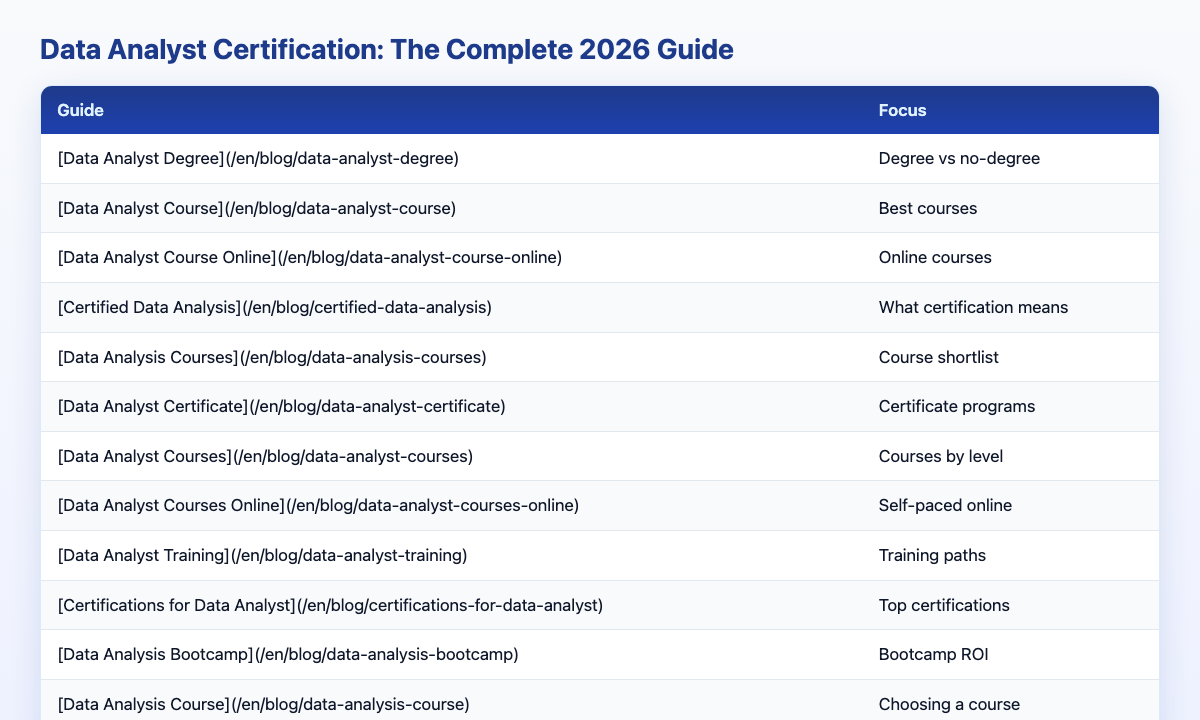
This hub maps the learning-and-certification pillar; the guides below go deep on each option.
| Guide | Focus |
|---|---|
| Data Analyst Degree | Degree vs no-degree |
| Data Analyst Course | Best courses |
| Data Analyst Course Online | Online courses |
| Certified Data Analysis | What certification means |
| Data Analysis Courses | Course shortlist |
| data analyst certificate | Certificate programs. Google issues three different certificates; the comparison is here |
| Data Analyst Courses | Courses by level |
| Data Analyst Courses Online | Self-paced online |
| Data Analyst Training | Training paths |
| Certifications for Data Analyst | Top certifications |
| Data Analysis Bootcamp | Bootcamp ROI |
| Data Analysis Course | Choosing a course |
| Data Analyst Bootcamp | Compare data analyst bootcamp programs |
| Data Analyst Certification Online | Online certs |
| Data Analyst Course Free | Free courses |
| Data Analysis Certificate | Certificate options |
| Data Analysis Certification | Certification list |
Practical Next Steps
Verify against real job postings
Before committing time or budget, pull five recent job postings in your target market and list the SQL, visualization, and communication skills each repeats. Align your learning plan to those patterns rather than a generic syllabus.
Frequently Asked Questions
Is a data analyst certification worth it?
A data analyst certification is worth it as a structured learning path that teaches employer-relevant skills and signals commitment, but it is not a guaranteed job ticket. The Bureau of Labor Statistics projects continued demand for analysts with SQL, communication, and technical skills — credentials help signal baseline competence, but employers still hire on demonstrated ability through portfolios. The best value comes from pairing a certification with real, practiced skill.
Should a certification cover AI tools?
Yes. In 2026, a certification should cover AI-native tools, because employers increasingly value analysts who can direct them as agents automate routine work. The Stanford HAI AI Index documents how quickly agent-assisted analysis matured in production roles. A program that ignores AI teaches an incomplete skill set; supplement with practice on what AI-native data analysis means if your program skips it.
Which data analyst certification is best?
The best choice depends on your goals and starting level. Beginners often start with the Google Data Analytics Professional Certificate or IBM Data Analyst Professional Certificate for broad foundations. BI-focused roles may favor Microsoft Power BI Data Analyst Associate. Evaluate hands-on practice, AI coverage, and whether you will finish — a completed program with portfolio projects beats an ambitious one you abandon.
Do I need a certification to become a data analyst?
No, a certification is not required. It is one of three paths alongside a degree and a self-built portfolio, and none is mandatory. Employers hire on demonstrated ability, so a strong portfolio can substitute for a certificate. Many successful analysts combine a certification with a portfolio for the strongest profile.
How is a certification different from a degree?
A data analyst certification is faster and cheaper than a degree, offering focused, job-relevant skills, while a degree offers greater depth, breadth, and broad recognition at higher cost in time and money. A certification suits career changers seeking efficient entry, while a degree suits those wanting comprehensive academic grounding.
Conclusion
A data analyst certification is a valuable structured path into analytics, best understood as a scaffold for building real skills rather than a guaranteed job ticket. Pair a well-chosen certification with a portfolio and practice, ensure it covers AI-native tools, and you will be well positioned for the modern analytics job market. Above all, remember that the credential opens a door, but it is your demonstrated ability to turn data into decisions that carries you through it and sustains a career well beyond the moment the certificate is earned and framed on the wall.
To build the AI-era skills employers want, read what AI-native data analysis means and try the InfiniSynapse web app free on registration, no credit card required.