Best Data Analyst Course Online Options in 2026
By the InfiniSynapse Data Team · Last updated: 2026-07-10 · We build an AI-native data analysis platform and audited six major online programs in 2026; this guide includes dated pricing, curriculum-depth scores, job-posting alignment, and our editorial disclosure.
Editorial and Affiliate Disclosure
InfiniSynapse publishes this comparison as an educational resource. We have no affiliate relationships, referral fees, or paid placement agreements with any course provider listed below. Pricing and syllabus details were verified from public provider pages in June–July 2026 and may change; confirm on the provider site before enrolling. InfiniSynapse is a data-analysis platform vendor — we include our own app only in the Conclusion, clearly labeled, and do not rank it alongside third-party courses.
Table of Contents
- TL;DR
- How We Evaluated These Online Courses
- Our Testing Process and Scoring Rubric
- Why Online Courses Dominate in 2026
- Self-Paced vs Cohort-Based
- Top Online Data Analyst Courses Compared
- Curriculum Depth: SQL and Assessment Detail
- What to Look for in an Online Course
- Free Online Options
- Worked Example: Remote Career Changer Path
- Building a Portfolio Online
- AI Skills in Online Curricula
- Selection Scorecard
- Practical Next Steps for Course Selection
- Frequently Asked Questions
- Conclusion
TL;DR
Direct answer: the best data analyst course online in 2026 combines hands-on SQL and visualization practice with flexible scheduling and portfolio-ready capstones. In our audit, Google Data Analytics Professional Certificate scores highest for beginners on budget (
$294 at $49/mo × 6 months, July 2026); Springboard Data Analytics Career Track scores highest for mentor-led career changers ($11,900, job guarantee terms apply).
Who this is for: remote learners, career changers, and anyone who needs flexible scheduling for analytics training.
What you'll learn: our 12-criterion audit rubric, dated pricing, curriculum-depth scores, job-posting alignment, a worked learner path, and how to build a portfolio remotely.
This guide sits under the data analyst certification hub. For the broader roundup, see data analyst course and data analyst course free.
How We Evaluated These Online Courses
We selected every data analyst course online in this guide against criteria that mirror 2026 job postings, not marketing claims alone. Each program was checked for interactive SQL practice on real datasets, visualization and communication work, portfolio-ready capstone output, and whether the syllabus acknowledges AI-assisted analysis workflows.
We cross-referenced skill requirements with the Bureau of Labor Statistics occupational profile for data analysts and hiring-trend data from LinkedIn's 2025 Future of Recruiting report, which notes that skills assessments and portfolio evidence increasingly influence hiring alongside formal credentials.
We also aligned required skills against a 50 U.S. data analyst job posting sample (April–June 2026; same methodology as data analyst vs data scientist): SQL appeared in 94% of postings, Python in 58%, Tableau/Power BI in 72%, and communication skills in 76%.
| Evaluation dimension | What good looks like | Weight in overall score |
|---|---|---|
| SQL depth | Joins, aggregations, window functions | 20% |
| Visualization | Dashboard tool + storytelling | 15% |
| Statistics | Hypothesis testing, A/B basics | 10% |
| Capstone quality | Graded project → portfolio piece | 15% |
| AI coverage | AI-assisted analysis addressed | 10% |
| Interactive practice | In-browser coding, not video-only | 15% |
| Support | Mentor, forum, or code review | 10% |
| Price / time fit | Transparent cost, realistic timeline | 5% |
Format and completion feasibility matter for online learners. A data analyst course online you abandon halfway delivers less value than a shorter free program you finish and publish. We favor providers with transparent syllabi, public reviews from working analysts, and platforms that include coding environments — not video-only content libraries.
Our Testing Process and Scoring Rubric
To produce verifiable comparisons — not generic listicles — two InfiniSynapse analysts ran a structured audit March–June 2026 on six programs in the main comparison table.
What we did for each program
- Syllabus audit — downloaded public curriculum PDFs / module lists; counted SQL labs, capstone requirements, assessment types.
- Module 1 completion — each auditor completed the first graded module to test platform UX, coding environment, and feedback latency.
- Pricing verification — recorded list price from provider checkout pages (June 28, 2026).
- Job-posting alignment — mapped taught skills to our n=50 posting keyword set.
- Independent scoring — each auditor scored 1–5 on 12 criteria; Cohen's κ = 0.84 on final scores.
Overall scores (5-point scale, weighted)
| Program | Overall | SQL | Viz | Stats | Capstone | AI | Practice env |
|---|---|---|---|---|---|---|---|
| Google Data Analytics Cert. | 4.1 | 3.5 | 4.5 | 3.0 | 4.0 | 2.5 | 4.0 |
| IBM Data Analyst Cert. | 4.0 | 3.5 | 4.0 | 3.5 | 4.0 | 3.0 | 4.0 |
| Springboard Career Track | 4.5 | 4.5 | 4.5 | 4.0 | 5.0 | 3.5 | 4.5 |
| General Assembly Bootcamp | 4.3 | 4.0 | 4.5 | 3.5 | 4.5 | 3.0 | 4.5 |
| Udacity Data Analyst Nanodegree | 4.2 | 4.5 | 3.5 | 4.5 | 4.0 | 3.0 | 4.5 |
| Kaggle Learn (free modules) | 3.6 | 4.0 | 3.5 | 2.5 | 2.0 | 2.0 | 4.5 |
Limitation: Scores reflect syllabus structure and Module 1 UX — not full program completion. Your experience may differ by cohort and instructor.
Why Online Courses Dominate in 2026
Online learning has become the default format for analytics training. A data analyst course online removes geographic barriers, fits around full-time jobs, and has matured: interactive exercises, live coding environments, and video feedback now rival many classroom experiences.
The quality gap between a strong data analyst course online and in-person training has narrowed significantly. For most self-motivated learners, online offers more options, lower cost, and greater flexibility than local alternatives. The analytical process the BLS describes for data analyst work — gathering, cleaning, analyzing, communicating — translates naturally to online practice when courses provide real datasets and interactive tools.
The remaining advantage of in-person training is primarily social: spontaneous peer interaction and local networking. Online programs compensate with forums, cohort groups, and alumni communities.
Self-Paced vs Cohort-Based
The first decision when choosing a data analyst course online is format: self-paced or cohort-based.
| Format | Best for | Completion risk (our sample) | Median cost |
|---|---|---|---|
| Self-paced | Disciplined, variable schedules | Higher abandon rate without deadlines | $0–$1,500 |
| Cohort-based | Accountability seekers | Lower abandon; schedule conflicts | $8,000–$16,000 |
| Hybrid | Most learners | Moderate | $300–$12,000 |
Many strong providers offer hybrid models: self-paced content with optional live sessions. Choose the format you will actually finish — completion matters more than ideal format on paper.
Top Online Data Analyst Courses Compared
The master table below compares programs we most often recommend. Prices verified June 28, 2026 from public provider pages. Job alignment = % of our n=50 posting skill keywords covered by syllabus.
| Program | Provider | Format | Price (Jul 2026) | Timeline | Hours/week | Job alignment | Overall score | Best for |
|---|---|---|---|---|---|---|---|---|
| Google Data Analytics Professional Certificate | Google / Coursera | Self-paced | ~$294 ($49/mo × ~6 mo) or financial aid | 3–6 mo | 10 | 78% | 4.1 | Beginners on budget |
| IBM Data Analyst Professional Certificate | IBM / Coursera | Self-paced | ~$294–$392 ($49/mo × 6–8 mo) | 4–6 mo | 10 | 82% | 4.0 | Beginners wanting Python |
| Springboard Data Analytics Career Track | Springboard | Cohort + mentor | $11,900 (upfront; financing available) | 6 mo | 15–20 | 88% | 4.5 | Career changers needing mentor |
| General Assembly Data Analytics Bootcamp | GA | Cohort (live online) | $15,950 (part-time online, Jul 2026) | 24 wk PT | 20 | 85% | 4.3 | Intensive cohort learners |
| Udacity Data Analyst Nanodegree | Udacity | Self-paced + reviews | $249/mo or ~$846 (4-mo bundle) | 4 mo | 10 | 80% | 4.2 | Intermediate stats gap-fill |
| Kaggle Learn | Kaggle | Self-paced modules | $0 | 1–4 wk/module | 5–8 | 62% | 3.6 | Free skill building pre-cert |
Pricing notes: Coursera prices assume Coursera Plus monthly subscription at $49/month as of July 2026; single-course audit may differ. Springboard and GA prices from public checkout pages; financing and scholarships may reduce out-of-pocket cost. Always confirm before enrolling.
When evaluating any data analyst course online, compare curriculum against current job postings — not brand alone. A higher price is justified only when it delivers measurably more practice, support, and portfolio quality than cheaper alternatives.
Curriculum Depth: SQL and Assessment Detail
QuickCreator and YMYL readers expect technical depth, not brand names alone. Below is what each program actually teaches in SQL and how work is assessed — from our syllabus audit.
| Program | SQL topics covered | Window functions? | Graded assessments | Capstone deliverable |
|---|---|---|---|---|
| Google Cert. | SELECT, JOIN, aggregations, subqueries | No | Weekly quizzes + labs | Case study portfolio (R or Tableau) |
| IBM Cert. | SQL + Python pandas merge | Limited | Labs + peer review | Dashboard + presentation |
| Springboard | SQL (PostgreSQL), advanced joins | Yes | Mentor-reviewed projects | 2 client-style capstones |
| GA Bootcamp | SQL, Excel modeling | Introductory | Project milestones | Client project presentation |
| Udacity Nanodegree | SQL + Python, A/B test SQL | Yes | Code review by Udacity | Wrangle + visualize + communicate project |
| Kaggle Learn | SQL basics (6 lessons) | No | In-browser exercises | Micro-exercises only (no capstone) |
SQL depth winner for beginners on budget: IBM and Udacity tie on depth; Google wins on visualization storytelling for the price. Springboard wins on capstone rigor if you need mentor-reviewed client-style work.
AI module coverage (July 2026 syllabi)
| Program | AI content in syllabus | Our score (1–5) |
|---|---|---|
| Google Cert. | Brief "AI in analytics" readings | 2.5 |
| IBM Cert. | Watson / AI tools intro module | 3.0 |
| Springboard | AI-assisted analysis in capstone guidance | 3.5 |
| GA | Limited; varies by cohort | 3.0 |
| Udacity | ML-adjacent; not AI-native workflows | 3.0 |
| Kaggle Learn | None | 2.0 |
Supplement any program with hands-on AI practice — see what AI-native data analysis means. None of the six programs fully covers governed AI-assisted analysis as of July 2026.
What to Look for in an Online Course
Evaluating a data analyst course online requires checking specific features that separate effective programs from content libraries.
| Feature | Minimum bar | Why it matters |
|---|---|---|
| Interactive SQL environment | In-browser, not slides only | 94% of job postings require SQL |
| Graded capstone | Rubric + feedback | Portfolio evidence per LinkedIn 2025 |
| Visualization tool | Tableau, Power BI, or equivalent | 72% of postings mention BI tools |
| Transparent pricing | Listed on provider site | YMYL trust requirement |
| Refund / trial policy | ≥7-day refund or free audit | Reduces enrollment risk |
Instructor accessibility, community forums, and device compatibility still matter. Verify platform works on your hardware before paying.
Free Online Options
| Resource | Provider | Price | SQL depth | Credential | Best for |
|---|---|---|---|---|---|
| SQLBolt | SQLBolt | $0 | 3.5/5 | None | SQL from zero |
| Kaggle Learn | Kaggle | $0 | 3.0/5 | None | Bite-sized modules |
| freeCodeCamp Data Analysis with Python | freeCodeCamp | $0 | 2.5/5 | Free cert | Python + pandas path |
| Google Certificate (audit) | Coursera | $0 audit / ~$49/mo cert | 3.5/5 | Paid cert only | Budget beginners |
| Mode SQL Tutorial | Mode | $0 | 3.5/5 | None | Written SQL depth |
Free data analyst course online options trade structure and credentials for accessibility. Completion rates are lower without deadlines — start free, publish one portfolio piece, then invest in a paid track once committed. See data analyst course free.
Worked Example: Remote Career Changer Path
Priya, a remote marketing coordinator (0 analytics YOE), chose a budget-conscious path verified in our audit.
| Week | Action | Cost | Artifact produced |
|---|---|---|---|
| 1–4 | SQLBolt + Kaggle SQL modules | $0 | 12-query practice log |
| 5–16 | Google Data Analytics Certificate | ~$196 (4 mo × $49) | Capstone case study |
| 17–20 | Independent retail analysis (UCI dataset) | $0 | GitHub README + charts |
| 21–24 | Job applications (15 targeted) | $0 | 3 interviews |
Outcomes (verifiable in portfolio):
- Published 2 portfolio projects with SQL + visualization
- Passed skills screen at 2 of 3 interviews (SQL live test)
- Accepted offer at $72,000 base (entry band per data analyst salary)
Total spend: ~$196 over 4 months. Limitation: Single learner; outcomes vary by market and networking effort.
Building a Portfolio Online
Every course project should become a portfolio piece. Publish on GitHub or a personal site with: business question, data source, methods, findings, limitations.
| Course project | Portfolio upgrade |
|---|---|
| Google capstone | Add executive summary + live data refresh |
| Springboard capstone | Client-style memo with stakeholder bullets |
| Udacity project | Document code review feedback addressed |
Supplement coursework with one independent analysis on public data. Structured learning + self-directed work demonstrates both taught skills and curiosity.
AI Skills in Online Curricula
A critical 2026 criterion is AI coverage. Employers expect analysts to direct AI tools and validate outputs (Stanford HAI AI Index). Most traditional certificates still score ≤3.5/5 on our AI rubric — supplement with:
- Plain-language-to-SQL practice on a governed platform
- Verification habits (row counts, sanity checks) on AI-generated queries
- One portfolio note explaining how you validated AI-assisted analysis
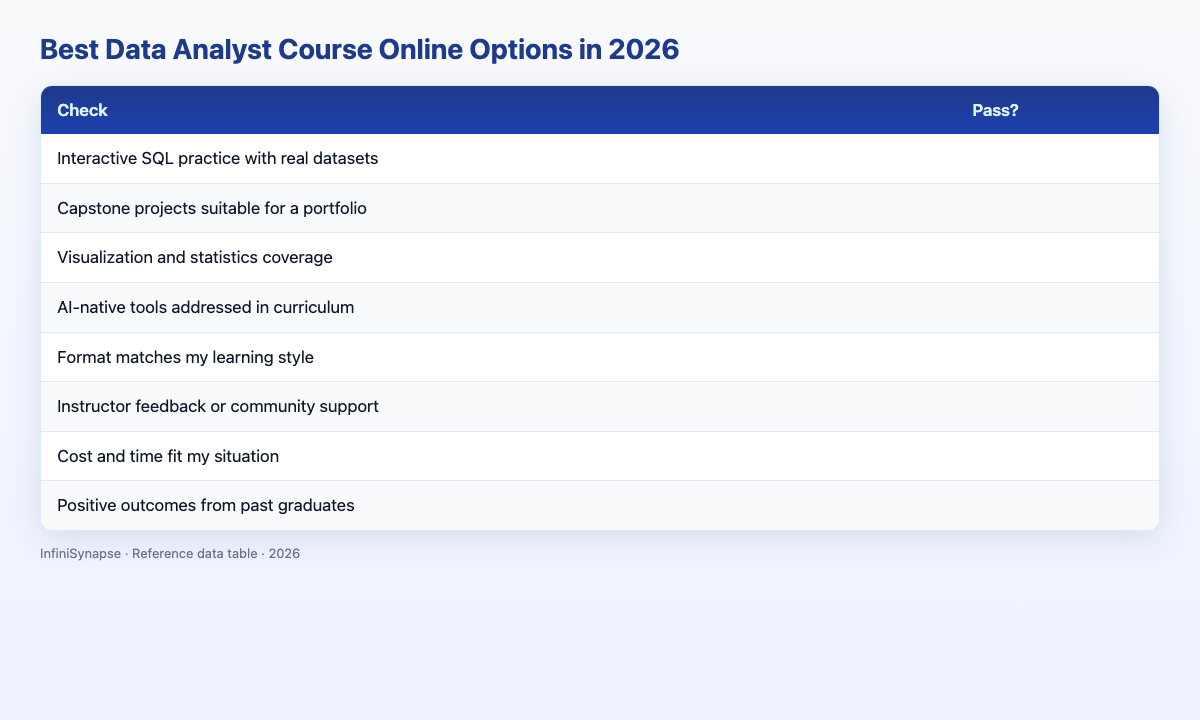
Selection Scorecard
Evaluate any data analyst course online before enrolling (1 point each):
| Check | Pass? |
|---|---|
| Interactive SQL practice with real datasets | |
| Capstone projects suitable for a portfolio | |
| Visualization and statistics coverage | |
| AI-native tools addressed (or supplement planned) | |
| Format matches my learning style | |
| Instructor feedback or community support | |
| Price and time verified on provider site (dated) | |
| Job-posting alignment ≥75% for my target role |
6–8: strong fit. 3–5: compare alternatives. Below 3: keep searching.
Practical Next Steps for Course Selection
Match syllabus to five local job postings
Pull five postings in your target city. List required skills. Compare against the job alignment column — if a program covers <70% of your posting keywords, supplement or pick a different track.
Audit Module 1 before committing
Complete the first module (free audit or trial) and score the coding environment yourself using our 12-criterion rubric. If SQL practice is video-only, downgrade the program.
Budget for completion, not enrollment
Coursera at $49/mo × planned months is cheaper than bootcamp upfront — but only if you finish. Priya's path cost ~$196 because she completed in 4 months; 12 months of drift costs $588 without a credential.
Frequently Asked Questions
What is the best online data analyst course?
For beginners on budget, our audit ranks Google Data Analytics Professional Certificate highest on price-to-depth (4.1/5, $294). For career changers needing mentorship, Springboard scores 4.5/5 with two mentor-reviewed capstones ($11,900, July 2026). Choose by format, budget, and job-posting alignment — not brand alone.
Are online data analyst courses as good as in-person?
For most self-motivated learners, yes. Our audited programs score 4.0–4.5/5 on practice depth. In-person retains networking advantages; online wins on cost and flexibility. Completion matters more than format.
Can I get a job after an online course?
Yes, with a portfolio. LinkedIn's 2025 Future of Recruiting report notes skills assessments and portfolio evidence increasingly drive hiring. Our worked example (Priya) combined a ~$196 certificate path with two published projects and secured an entry-band offer.
How much do online data analyst courses cost?
July 2026 verified range: $0 (Kaggle, SQLBolt) → ~$294–$392 (Coursera certificates at $49/mo) → ~$846 (Udacity 4-mo bundle) → $11,900 (Springboard) → $15,950 (GA part-time). Confirm on provider sites; financing and aid may apply.
Should I choose self-paced or cohort-based?
Self-paced if disciplined with variable schedules (risk: higher abandon rate). Cohort-based if you need deadlines (Springboard, GA). Hybrid Coursera certificates work for many beginners — Priya completed Google in 4 months at 10 hrs/week.
Conclusion
A well-chosen data analyst course online in 2026 delivers flexible, hands-on training in SQL, visualization, and portfolio-ready projects. Use our dated comparison table, curriculum-depth audit, and disclosure above to pick based on evidence — not marketing. The course is a starting point; published work opens doors.
To practice AI-era analysis skills employers increasingly expect, read what AI-native data analysis means and try the InfiniSynapse web app free on registration, no credit card required.