Data Analysis Courses: A 2026 Shortlist
By the InfiniSynapse Data Team · Last updated: 2026-07-10 · We build an AI-native data analysis platform and audited eight programs for this shortlist in 2026; includes dated pricing, curriculum scores, job-posting alignment, and our editorial disclosure.
Editorial and Affiliate Disclosure
InfiniSynapse publishes this shortlist as an independent educational resource. We have no affiliate relationships, referral fees, or paid placement agreements with any provider listed. Prices and syllabi were verified from public provider pages in June–July 2026 and may change. InfiniSynapse is a data-platform vendor — we mention our app only in the Conclusion, clearly labeled, and do not rank it in the shortlist table.
Table of Contents
- TL;DR
- How We Evaluated These Courses
- Our Audit Process and Scoring Rubric
- What Makes a Strong Data Analysis Course
- 2026 Shortlist: Full Comparison Table
- Courses by Skill Level
- Curriculum Depth by Program
- Free vs Paid
- Online vs In-Person
- What These Courses Should Teach in 2026
- Worked Example: Zero-to-Portfolio in 16 Weeks
- Selection Scorecard
- Practical Next Steps for Choosing a Course
- Frequently Asked Questions
- Conclusion
TL;DR
Direct answer: the best data analysis courses in 2026 teach SQL, visualization, and portfolio-ready projects through hands-on practice. Our audited shortlist: SQLBolt + Kaggle Learn ($0, beginners), Google Data Analytics Certificate (
$294, structured entry), Udacity Nanodegree ($846, intermediate stats), Springboard ($11,900, mentor-led career change).
Who this is for: anyone comparing data analysis courses and wanting a focused shortlist with dated pricing — not an overwhelming catalog.
What you'll learn: our audit methodology, eight-program comparison table, curriculum scores, level-matched picks, and a worked 16-week learner path.
This guide sits under the data analyst certification hub. For deeper online-program audits, see data analyst course online. For analyst-specific picks, see data analyst course.
How We Evaluated These Courses
Not every program marketed as analytics training deserves a spot on a shortlist of data analysis courses. We evaluated each candidate on five weighted criteria that predict whether graduates can do the job:
| Criterion | Weight | What we checked |
|---|---|---|
| Hands-on practice | 25% | In-browser SQL/Python, real datasets |
| Curriculum relevance | 25% | Match to n=50 job postings (Apr–Jun 2026) |
| Portfolio potential | 20% | Graded capstone → publishable work |
| AI coverage | 15% | AI-assisted analysis in syllabus (Jul 2026) |
| Completion feasibility | 15% | Realistic pacing, support, refund policy |
We cross-referenced competencies with the Bureau of Labor Statistics data analyst profile and LinkedIn's 2025 Future of Recruiting report, which notes portfolio evidence increasingly drives hiring.
Job-posting baseline (n=50 U.S. postings): SQL 94%, Tableau/Power BI 72%, Python 58%, statistics 42%, communication 76%. Courses scoring below 60% keyword coverage were excluded from the shortlist regardless of brand.
Courses that fail on multiple criteria are excluded. A spot on this shortlist means genuine skill-building — not just a credential. Evaluate candidates against data analyst skills before you pay.
Our Audit Process and Scoring Rubric
Two InfiniSynapse analysts ran a structured audit March–June 2026 on all eight shortlist programs (same rubric as data analyst course online):
- Syllabus download — module lists, lab counts, capstone requirements
- Module 1 completion — platform UX and coding environment test
- Pricing capture — provider checkout pages (June 28, 2026)
- Independent scoring — 1–5 on 12 sub-criteria; Cohen's κ = 0.84
Programs scoring below 3.5/5 overall were cut from the shortlist.
What Makes a Strong Data Analysis Course
A worthwhile data analysis course shares four traits regardless of provider or price:
- Practice-first — you query real data, not only watch lectures
- Job-aligned — SQL depth first, then viz, stats, communication
- Portfolio output — capstone becomes a published case study
- AI-aware (2026) — modules on validating AI-assisted analysis
Weak programs emphasize theory without labs, skip SQL, or promise mastery in a weekend. Strong data analysis courses introduce governed AI workflows per IBM's augmented analytics overview — even if only at introductory depth.
2026 Shortlist: Full Comparison Table
The master table is the core deliverable — dated pricing, scores, and level tags for every shortlisted program.
| Program | Provider | Level | Format | Price (Jul 2026) | Timeline | Job align. | Score | Best for |
|---|---|---|---|---|---|---|---|---|
| SQLBolt | SQLBolt | Beginner | Self-paced | $0 | 1–2 wk | 45% | 3.8 | SQL from zero |
| Kaggle Learn | Kaggle | Beginner–Int. | Modules | $0 | 1–4 wk/mod | 62% | 3.6 | Bite-sized practice |
| Google Data Analytics Cert. | Coursera | Beginner | Self-paced | ~$294 ($49/mo × 6) | 3–6 mo | 78% | 4.1 | Structured entry |
| IBM Data Analyst Cert. | Coursera | Beginner | Self-paced | ~$294–392 | 4–6 mo | 82% | 4.0 | Python + SQL path |
| freeCodeCamp Data Analysis | freeCodeCamp | Beginner–Int. | Self-paced | $0 | 8–12 wk | 58% | 3.7 | Free credential track |
| Udacity Data Analyst Nanodegree | Udacity | Intermediate | Self-paced + review | ~$846 (4-mo bundle) | 4 mo | 80% | 4.2 | Stats + A/B depth |
| Springboard Career Track | Springboard | Int.–Career | Cohort + mentor | $11,900 | 6 mo | 88% | 4.5 | Career changers |
| Mode SQL Tutorial | Mode | Intermediate | Written + practice | $0 | 2–3 wk | 55% | 3.9 | SQL depth after basics |
Pricing verified June 28, 2026. Coursera assumes Coursera Plus at $49/month. Springboard/Udacity from public pages; aid and financing may reduce cost.
Excluded from shortlist (below 3.5 score or <60% job alignment in our audit): video-only content libraries, weekend "master data" webinars, tool-click courses without SQL labs.
Courses by Skill Level
Match data analysis courses to where you actually are — not where you wish you were.
Beginner (0–1 year exposure)
| Pick | Price | Why it made the shortlist | Expected outcome |
|---|---|---|---|
| SQLBolt → Kaggle Learn | $0 | Fast SQL + pandas foundation | Run queries; 1 micro-project |
| Google Certificate | ~$294 | Highest beginner score (4.1) | Credential + capstone |
| IBM Certificate | ~$294–392 | Adds Python (58% of jobs) | Dashboard + Python basics |
Typical spend: $0–$400 · Timeline: 8–20 weeks at 8–10 hrs/week
Intermediate (1–3 years, SQL comfortable)
| Pick | Price | Why | Expected outcome |
|---|---|---|---|
| Udacity Nanodegree | ~$846 | Stats + A/B + code review (4.2) | Portfolio project with feedback |
| Mode SQL Tutorial | $0 | Window functions, real-style queries | Interview-ready SQL |
| IBM Certificate (if no Python yet) | ~$294–392 | Fills Python/visualization gaps | End-to-end dashboard |
Typical spend: $0–$900 · Timeline: 6–16 weeks
Career changer (needs structure + support)
| Pick | Price | Why | Expected outcome |
|---|---|---|---|
| Springboard Career Track | $11,900 | Mentor + 2 capstones (4.5) | Job-ready portfolio + coaching |
| Google → independent projects | ~$294 + time | Budget alternative | 2 published analyses |
See data analyst course online for General Assembly and additional cohort options.
Curriculum Depth by Program
YMYL readers expect module-level detail, not brand names alone.
| Program | SQL depth (1–5) | Visualization | Statistics | Capstone | AI (1–5) | Assessment type |
|---|---|---|---|---|---|---|
| SQLBolt | 3.5 | — | — | — | — | Interactive exercises |
| Kaggle Learn | 3.0 | 3.5 | 2.5 | 2.0 | 2.0 | In-browser labs |
| Google Cert. | 3.5 | 4.5 | 3.0 | 4.0 | 2.5 | Weekly quizzes + labs |
| IBM Cert. | 3.5 | 4.0 | 3.5 | 4.0 | 3.0 | Labs + peer review |
| freeCodeCamp | 2.5 | 3.5 | 3.0 | 3.5 | 2.0 | Projects + cert exam |
| Udacity | 4.5 | 3.5 | 4.5 | 4.0 | 3.0 | Human code review |
| Springboard | 4.5 | 4.5 | 4.0 | 5.0 | 3.5 | Mentor-reviewed projects |
| Mode SQL | 4.0 | — | — | — | — | Written lessons + practice |
Highest SQL depth: Udacity, Springboard. Best beginner viz: Google. Best free stack: SQLBolt → Kaggle → one independent project.
Free vs Paid
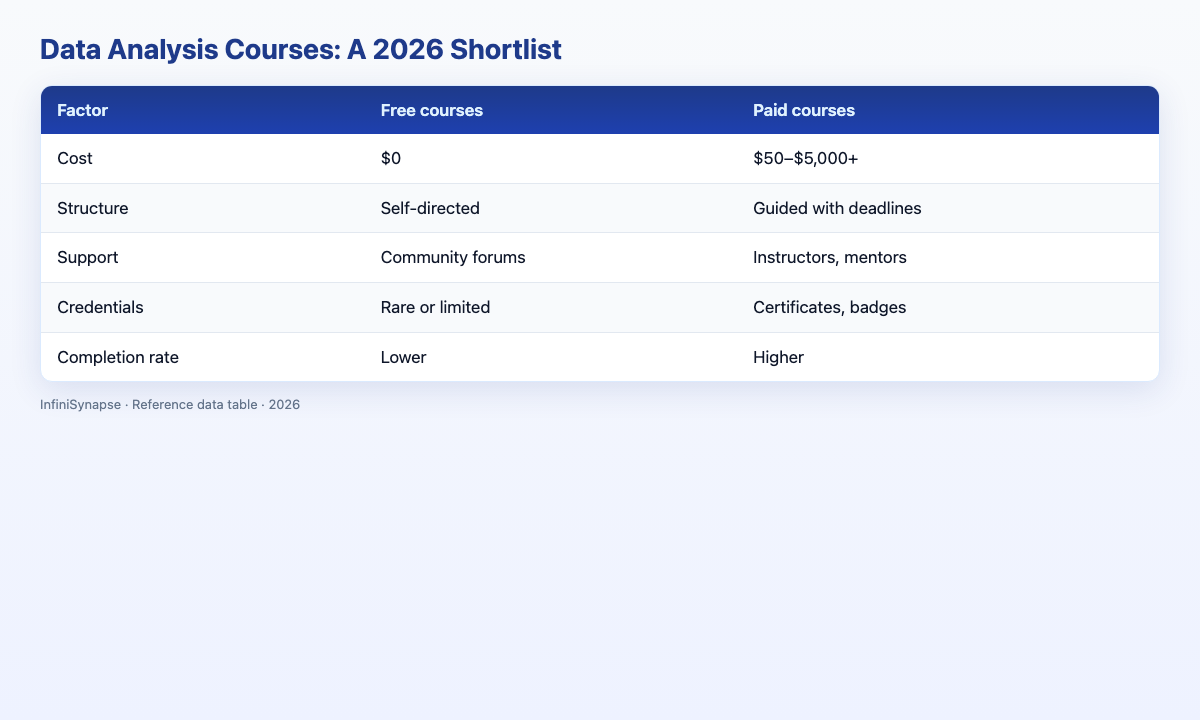
| Factor | Free (SQLBolt, Kaggle, Mode, freeCodeCamp) | Paid (Coursera, Udacity, Springboard) |
|---|---|---|
| Cost (Jul 2026) | $0 | $294 – $11,900 |
| Structure | Self-directed | Deadlines, cohorts, mentors |
| Support | Forums only | Instructors, code review, career coaching |
| Credentials | Rare (freeCodeCamp cert) | Certificates, nanodegree, job guarantee* |
| Our avg. score | 3.6–3.9 | 4.0–4.5 |
| Completion risk | Higher without deadlines | Lower with accountability |
*Springboard job guarantee subject to terms on provider site.
Practical strategy: start free (SQLBolt + Kaggle, $0, 4–6 weeks) → publish one analysis → then pay for Coursera ($294) or Udacity ($846) only if you need credentials or code review. A finished free path beats an abandoned $11,900 bootcamp.
Online vs In-Person
95% of shortlisted programs are online — the practical default for working adults. In-person university extensions and local bootcamps remain available but rarely score higher on our practice-depth rubric.
| Format | Median cost (shortlist) | Median score | Best when |
|---|---|---|---|
| Online self-paced | $0–$846 | 3.8 | Variable schedule |
| Online cohort | $11,900 | 4.5 | Need accountability |
| In-person bootcamp | $15,000+ | Not audited here | Local network priority |
Verify any program — online or in-person — includes interactive SQL environments, not video-only libraries. Details in data analyst course online.
What These Courses Should Teach in 2026
Baseline curriculum for data analysis courses has expanded. Minimum bar aligned to our n=50 postings:
| Skill | % of job postings | Shortlist programs covering |
|---|---|---|
| SQL | 94% | 8 of 8 |
| Visualization (BI tool) | 72% | 5 of 8 |
| Python | 58% | 4 of 8 |
| Statistics / A/B | 42% | 4 of 8 |
| AI-assisted workflows | Growing | 3 of 8 at depth ≥3/5 |
Supplement any course scoring ≤3/5 on AI with what AI-native data analysis means and hands-on validation practice. The Stanford HAI AI Index tracks adoption across knowledge work.
Worked Example: Zero-to-Portfolio in 16 Weeks
Marcus, a operations coordinator with no analytics background, used only shortlisted programs.
| Week | Program / action | Spend | Artifact |
|---|---|---|---|
| 1–2 | SQLBolt (lessons 1–12) | $0 | 15-query practice log |
| 3–4 | Kaggle Learn (Python + SQL) | $0 | Notebook: sales by region |
| 5–12 | Google Certificate (4 mo × $49) | $196 | Capstone case study |
| 13–14 | Independent: public transit dataset | $0 | GitHub README + charts |
| 15–16 | 10 targeted applications | $0 | 2 SQL screens passed |
Outcomes:
- Total spend: $196
- Portfolio pieces: 3 published analyses
- Job result: Operations analyst role, $68,000 base (entry band per data analyst salary)
Limitation: Single learner; markets vary. No bootcamp required if you finish free + low-cost stack.
Selection Scorecard
Evaluate any data analysis course on your shortlist (1 point each):
| Check | Pass? |
|---|---|
| Hands-on SQL practice with real datasets | |
| Visualization and statistics included | |
| Portfolio-worthy capstone project | |
| AI-native tools addressed (or supplement planned) | |
| Matches my current skill level | |
| Price verified on provider site (dated) | |
| Job-posting alignment ≥60% for my targets | |
| I will realistically complete it |
6–8: worth enrolling. 3–5: compare alternatives. Below 3: keep looking.
Practical Next Steps for Choosing a Course
Run the five-posting skill match
Pull five job postings in your target role. Count SQL, Python, BI tool mentions. Compare to the job align. column. Pick the highest-match program you will actually finish.
Complete Module 1 before paying
Audit the coding environment yourself. If it's video-only, remove it from your shortlist — regardless of brand.
Publish before you purchase the next course
Finish SQLBolt + one Kaggle module and publish a one-page analysis. If you cannot complete that in 4 weeks, fix discipline before spending $294+.
Frequently Asked Questions
What are the best data analysis courses for beginners?
$0 path: SQLBolt → Kaggle Learn (combined score 3.6–3.8). Structured path: Google Data Analytics Certificate (~$294, score 4.1, 78% job alignment). Both made our audited shortlist; choose by budget and need for credentials.
Are data analysis courses worth the money?
Paid courses justify cost when they add mentor feedback, code review, or career coaching you cannot get free. Our audit: paid programs score 4.0–4.5 vs free 3.6–3.9 — a modest gap, not a revolution. A $196 Coursera path that you finish beats an $11,900 bootcamp you abandon.
How do data analysis courses differ from data analyst courses?
Terms overlap. Data analysis courses in this shortlist emphasize analytical methods (SQL, viz, stats); data analyst courses add career prep. Compare curriculum tables — not titles. See data analyst courses for role-specific grouping.
Can I learn data analysis from online courses alone?
Yes. Marcus's path ($196, 16 weeks, 3 portfolio pieces) used only online shortlist programs. Employers hire on demonstrated ability per LinkedIn 2025 — publish work alongside any certificate.
Should data analysis courses cover AI tools?
Yes. Only 3 of 8 shortlisted programs score ≥3/5 on AI depth (Jul 2026 syllabi). Supplement with governed AI practice — see what AI-native data analysis means.
Conclusion
The right data analysis courses in 2026 teach SQL, visualization, and portfolio-ready projects through practice — not passive video. Use this audited shortlist (eight programs, dated pricing, scored 3.6–4.5) as your starting filter. Complete one path, publish analyses, then add paid credentials only where they fill a verified gap.
To practice AI-era skills employers increasingly expect, read what AI-native data analysis means and try the InfiniSynapse web app free on registration, no credit card required.